
June 4, 2026
The Sleeping Giant: Why Venezuela's Most Contested Gold Asset Is Finally Moving
For decades, frontier mining jurisdictions have tested the limits of institutional patience. Capital enters on the promise of extraordinary geology, then waits years, sometimes generations, while political cycles, regulatory overhaul, and sovereign risk grind progress to a halt. Venezuela represents perhaps the most extreme version of this story in the Western Hemisphere — a country whose subsoil contains one of the most diverse and abundant mineral endowments on the planet, yet whose policy environment made commercial development effectively impossible for nearly twenty years. That dynamic is now shifting in ways that are drawing serious operators back to assets dormant since the Chávez era.
The Richard Warke Venezuela gold project, structured through his Augusta Capital Corp. entity, is the most significant signal yet that high-conviction capital is prepared to move on Venezuelan resources.
When big ASX news breaks, our subscribers know first
Venezuela's Mineral Endowment: Bigger Than Most Investors Realise
Venezuela's resource narrative is typically dominated by oil, but the country's mineral portfolio extends far beyond hydrocarbons. Its subsoil contains a remarkably diverse range of both conventional and critical materials, spanning precious metals, base metals, and technology-critical minerals.
| Mineral Category | Key Resources |
|---|---|
| Precious Metals | Gold, Silver |
| Base Metals | Copper, Aluminium (Bauxite) |
| Critical Minerals | Coltan (Tantalum and Niobium), Cobalt |
| Industrial Minerals | Coal, Diamonds |
Of particular strategic relevance is coltan, a metallic ore refined to extract tantalum and niobium. These materials are essential inputs for mobile phone manufacturing, battery technology, and aerospace-grade components — all sectors where Western supply chains remain heavily exposed to Chinese-controlled production. Furthermore, coltan is not a widely discussed commodity in mainstream investment circles, which means Venezuela's position as a significant holder of this ore has been systematically underappreciated.
The broader context matters here. As of mid-May 2026, gold futures are trading above $4,713 per ounce, reflecting a macro environment defined by geopolitical uncertainty, currency debasement concerns, and accelerating central bank accumulation. In that pricing environment, the gold price outlook for large undeveloped deposits in jurisdictions undergoing regulatory reform becomes extraordinarily compelling from a resource optionality standpoint, even before a single development dollar has been committed.
The Guiana Shield: Geology That Commands Attention
Siembra Minera sits within Bolívar State in southeastern Venezuela, a region underlain by the Guiana Shield — one of the most ancient and mineralised geological formations in the entire Western Hemisphere. Cratons of this type, characterised by their geological stability over billions of years and resistance to tectonic reworking, frequently host large, structurally controlled gold deposits where mineralisation has been concentrated over deep time into exceptionally high-tonnage systems.
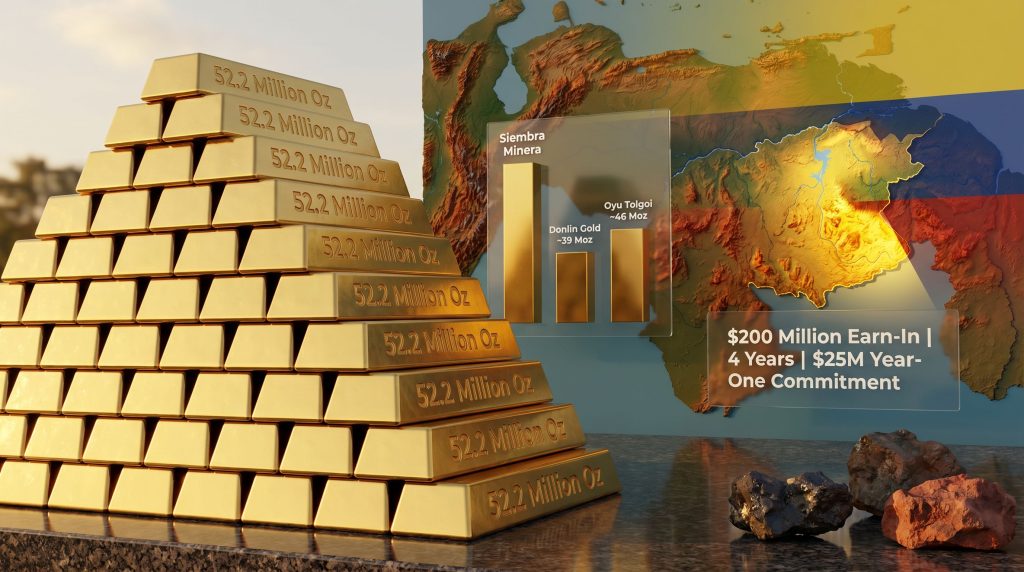
This geological context is not incidental. It is the reason why the Siembra Minera resource estimate stands at 52.2 million bullion ounces of gold, a figure that places it within a very small peer group of globally significant undeveloped gold deposits.
Investors should note that resource estimates of this magnitude require independent technical verification under recognised reporting standards such as NI 43-101 or JORC. The economic value of any resource is contingent on recovery rates, processing costs, capital intensity, and metallurgical characteristics that remain undefined until feasibility-stage engineering is completed.
What Is the Siembra Minera Project?
Scale, History, and Why It Has Been Stranded
The Siembra Minera project's development timeline is a direct reflection of Venezuela's political history. Gold Reserve Ltd., a Washington-based junior mining company, originally held a majority position in the asset. In 2008, Hugo Chávez's government nationalised the project, reducing Gold Reserve's interest to a 45% minority stake while transferring operational control to state entities. The nationalisation eliminated the management depth and capital access required to advance the asset through meaningful development stages.
What followed was nearly two decades of effective stagnation, produced by a compounding set of structural barriers:
- 2008 nationalisation stripped foreign operators of majority control and development authority
- US-led sanctions from 2019 onward created legal and financial barriers for any foreign entity seeking to transact with Venezuelan state entities
- Venezuela's economic collapse eliminated the state's capacity to self-fund development, leaving the asset stranded without an alternative capital source
- Mandatory state ownership laws actively deterred institutional capital from engaging with joint venture structures that offered no path to majority control
The April 2026 mining law reform enacted by acting President Delcy Rodríguez's administration directly dismantles point four. By removing mandatory state ownership requirements, the new legislative framework creates a commercially rational pathway for foreign operators to pursue majority stakes for the first time since the Chávez-era nationalisation framework was installed.
Putting 52.2 Million Ounces in Context
The resource scale demands comparison. To understand what 52.2 million ounces represents in practical terms, consider that the world's largest actively producing gold mines typically yield between one and four million ounces annually. At a hypothetical production rate of two million ounces per year, Siembra Minera's resource base alone could theoretically sustain more than 25 years of output at a tier-one scale.
| Project | Estimated Resource (Moz Gold) | Status |
|---|---|---|
| Siembra Minera, Venezuela | 52.2 | Development-stage, stalled |
| Donlin Gold, Alaska | ~39 | Pre-development |
| Pascua-Lama, Chile/Argentina | ~18 | Suspended |
| Sukhoi Log, Russia | ~67 | Development-stage |
| Oyu Tolgoi, Mongolia | ~46 (gold equivalent) | Producing |
At current spot prices above $4,713 per ounce, the theoretical gross in-ground value of Siembra Minera's resource exceeds $245 billion. That figure carries extensive caveats regarding recoverable ounces, capital costs, and operating margins, but it illustrates why this asset has retained strategic relevance despite nearly two decades of political paralysis.
Richard Warke and Augusta Capital: Understanding the Operator Behind the Deal
A Track Record Built on Complex Assets
The Richard Warke Venezuela gold project cannot be evaluated without understanding the operator directing it. Warke is a Vancouver-based mining entrepreneur whose investment model centres on identifying large-scale assets in resource-rich but operationally complex jurisdictions, advancing them through development-readiness, and executing value-crystallising transactions.
His most recent and prominent achievement is the co-founding of Equinox Gold Corp., which in May 2026 announced an agreement to acquire Orla Mining Ltd. in a transaction valued at approximately $5.1 billion, representing one of the largest gold sector consolidation deals of the year. Consequently, this single transaction provides meaningful context for the calibre of capital relationships and strategic execution capability Warke brings to any new project.
Warke's documented geographic portfolio includes:
- Colombia, with gold-focused development
- Ecuador, spanning copper-gold systems
- Peru, covering gold-silver assets
- The United States and Mexico through Equinox Gold's multi-commodity production base
Venezuela represents a meaningful jurisdictional extension of this portfolio, and the decision to commit capital there signals high conviction in both the asset's quality and the durability of the regulatory reform trajectory.
Beyond mining, Warke holds part ownership stakes across several high-profile sporting assets including the PGA Tour, the Boston Celtics, and Fenway Sports Group — the entity that owns the Boston Red Sox and Liverpool FC. This breadth of investment activity signals the capital network and institutional relationships Warke can mobilise when structuring complex transactions.
Augusta Capital Corp.: Purpose-Built for This Type of Opportunity
Augusta Capital Corp. is the Vancouver-headquartered private vehicle through which the Siembra Minera earn-in agreement has been structured. It operates as a development-stage capital platform specifically designed to take early-stage positions in large-scale resource assets, particularly those in jurisdictions where governance complexity or historical political disruption has created valuation dislocations.
The involvement of an operator with Augusta Capital's profile signals something the asset has historically lacked: institutional-quality management depth combined with the capital access necessary to advance a project of this scale from a stalled position through pre-feasibility and feasibility milestones.
How the Earn-In Agreement Is Structured
Breaking Down the Financial Mechanics
The agreement between Gold Reserve Ltd. and Augusta Capital is structured as a phased earn-in — a widely used mechanism in the mining industry that enables an incoming partner to acquire an ownership interest through staged capital deployment rather than an upfront acquisition payment. This approach is particularly well-suited to situations where jurisdictional uncertainty makes a fixed-price acquisition commercially inappropriate.
| Parameter | Detail |
|---|---|
| Maximum Earn-In Investment | Up to $200 million |
| Ownership Target (Augusta Capital) | 50% of Gold Reserve's stake |
| Investment Timeframe | 4 years |
| Minimum Year-One Commitment | At least $25 million |
| Negotiation Framework | Joint discussions with Venezuelan authorities |
The Ownership Structure: A Critical Distinction
A structural nuance that is frequently misunderstood in early reporting on this deal requires explicit clarification. Augusta Capital is not acquiring a 50% position in the Siembra Minera project itself. It is acquiring 50% of Gold Reserve's existing 45% interest in the project. This means Augusta Capital's project-level exposure, once the full earn-in is exercised, represents approximately 22.5% of total Siembra Minera.
However, this calculation is subject to a transformative variable introduced by the April 2026 legislative reform. If Gold Reserve successfully leverages the removal of mandatory state ownership requirements to reclaim majority control of Siembra Minera, the underlying value of Augusta Capital's 50% stake in Gold Reserve's position increases substantially. The earn-in structure is therefore partly a bet on the reform's practical enforceability and on the outcome of joint negotiations with Venezuelan authorities.
Why an Earn-In Is the Right Instrument Here
Several characteristics of the Siembra Minera opportunity make the earn-in structure particularly rational:
- Phased risk exposure limits capital commitment if the political environment deteriorates before year two or three milestones are reached
- Regulatory optionality allows both parties to adjust their negotiating positions as Venezuela's legal framework continues to evolve post-reform
- Negotiation leverage is enhanced by joint capital commitment, strengthening both parties' standing in discussions with Venezuelan officials
- Development momentum is created by the $25 million year-one minimum, which forces near-term action and creates observable progress benchmarks
The deal terms were disclosed through a memo obtained by Bloomberg News, which means the information reflects internal deal documentation rather than a formal public announcement. Investors should factor this provenance into their assessment of term completeness. In addition, completing a definitive feasibility study will be a critical milestone before any large-scale capital deployment can be responsibly committed.
Venezuela's 2026 Mining Law: What Actually Changed
The Structural Shift That Makes This Deal Possible
The mining legislation enacted under acting President Delcy Rodríguez's administration in April 2026 is the single most important enabling condition for the Richard Warke Venezuela gold project deal. Its central provision — the elimination of mandatory state ownership requirements — represents a direct reversal of the nationalisation architecture installed under Chávez beginning in 2008.
Before the Reform:
- State entities held mandatory majority ownership in all mining joint ventures
- Foreign operators were structurally capped at minority positions regardless of capital contribution
- Operational control and profit repatriation mechanisms were constrained by co-ownership requirements
- Foreign majority ownership was legally unavailable, eliminating institutional capital interest
After the Reform:
- Foreign operators can pursue and hold majority ownership in Venezuelan mining projects
- Gold Reserve gains a legal pathway to pursue recapture of its pre-nationalisation position
- Joint venture frameworks can be negotiated on commercially rational, bilaterally agreed terms
- The structural deterrent to large-scale foreign capital deployment has been removed
The Geopolitical Layer: US-Venezuela Mineral Interests
The timing of Venezuela's regulatory reform intersects with a distinct strategic priority: the Trump administration's active effort to reduce US dependence on Chinese-controlled critical mineral supply chains. The administration has already moved to take direct stakes in mineral companies and explore production support mechanisms as part of this decoupling effort following disruptions to material flows during the 2025 trade confrontation with Beijing.
Venezuela's coltan, copper, bauxite, and gold reserves carry meaningful relevance within this framework. The broader critical minerals demand surge further amplifies this strategic calculus, particularly for coltan's role as a source of tantalum and niobium for mobile phone manufacturing, battery systems, and jet engine components — a category where Western supply chain exposure to Chinese processing capacity remains strategically vulnerable.
This geopolitical alignment creates a policy environment favourable to Venezuelan mineral development, but investors should not interpret this as project-specific government support, funding commitments, or guaranteed regulatory facilitation. The commercial pathway for Siembra Minera depends on bilateral negotiations between Gold Reserve, Augusta Capital, and Venezuelan authorities, the outcome of which remains uncertain.
The next major ASX story will hit our subscribers first
Key Risks That Cannot Be Ignored
A Multi-Layered Risk Framework
Any serious evaluation of the Richard Warke Venezuela gold project must engage with a risk profile that extends considerably beyond the geological or operational challenges typical of large-scale mining development.
Political and Sovereign Risk
- Venezuela's governance trajectory remains structurally uncertain despite the April 2026 reform
- Policy reversals under future administrations represent a non-trivial probability
- The Rodríguez administration's political durability and constitutional authority over mining law reform have not been independently tested
Sanctions and Legal Risk
- The full US sanctions architecture governing Venezuela has not been formally dismantled
- Legal complexity around capital flows, contract enforceability, and international dispute resolution remains elevated
- Residual sanctions constraints could affect the practical ability to deploy the $200 million earn-in budget
Operational and Infrastructure Risk
- Bolívar State's infrastructure, including power supply, road networks, and water access, has deteriorated materially during Venezuela's extended economic contraction
- Environmental permitting, community engagement, and logistics rehabilitation will require substantial pre-development capital investment
- The $200 million earn-in budget may prove insufficient to reach feasibility-readiness given the scale of infrastructure deficit
Capital Markets and Counterparty Risk
- Gold Reserve Ltd. is characterised as a small junior mining company, meaning its balance sheet capacity to support parallel development activities alongside the earn-in relationship is inherently limited
- Augusta Capital's private structure limits public market transparency on capital deployment pace and milestone achievement
- Resource estimates lack publicly available NI 43-101 or JORC classification detail, making independent verification of the 52.2 million ounce figure difficult for external analysts
Latin America's Broader Mining Investment Wave
The Siembra Minera deal reflects a wider pattern of accelerating foreign capital deployment into Latin American resource assets as Western governments and institutional investors seek supply chain resilience. This regional trend provides useful context for assessing Venezuela's position within the competitive landscape for mining capital.
Argentina approved two mining projects via its RIGI investment incentive framework in May 2026, representing a combined value of $2.1 billion and projecting over 8,000 new direct and indirect jobs. Ecuador and Colombia continue attracting copper and gold development capital. Furthermore, the evolving geopolitical mining landscape is drawing Brazil's critical mineral sector into increasing institutional attention as Western governments prioritise supply chain security.
Venezuela, if the current reform trajectory holds, occupies the highest-risk position within this regional investment wave, but potentially also the highest-reward entry point. The combination of exceptional geology, multi-decade underdevelopment, and a legal framework now permitting majority foreign ownership creates an asymmetric opportunity structure that operators like Warke are specifically positioned to evaluate and execute on.
The $5.1 billion Equinox-Orla transaction demonstrates the scale of value that disciplined mining development operators can crystallise in the current gold price environment. Applying that same value-creation model to an asset of Siembra Minera's scale, under a materially improved regulatory framework, is the core thesis behind the Augusta Capital earn-in agreement. Moreover, the broader wave of gold M&A activity across global markets reinforces how aggressively well-capitalised operators are moving to secure large-scale undeveloped assets before the window narrows.
Whether the thesis proves executable depends on factors that no amount of geological or financial analysis can fully resolve: the political durability of Venezuela's reform agenda, the practical enforceability of the new mining law, and the outcome of negotiations that have not yet formally begun.
This article is for informational purposes only and does not constitute financial or investment advice. Mining resource estimates, project valuations, and geopolitical assessments involve material uncertainty. Readers should conduct independent due diligence before making any investment decisions. Gold prices cited reflect May 14, 2026 futures data sourced from Mining.com market data.
Want to Stay Ahead of the Next Major Mineral Discovery?
Discovery Alert's proprietary Discovery IQ model delivers real-time alerts on significant ASX mineral discoveries — cutting through complex geological and market data to surface actionable investment opportunities the moment they're announced. Explore historic examples of major discoveries and the returns they generated, then start your 14-day free trial to position yourself ahead of the broader market.