June 8, 2026
The global mining sector stands at a transformative juncture where traditional commodity cycles intersect with revolutionary technological advancement. Australia's resource-dependent economy now faces unprecedented opportunities as Rio Tinto and BHP Australia earnings rebound positions both companies to capitalise on evolving demand patterns. Furthermore, the convergence of electrification trends, autonomous operations, and shifting geopolitical supply chains has fundamentally altered the competitive landscape for mining operations worldwide.
This transformation extends beyond simple commodity price movements. Modern mining companies must balance operational excellence with strategic positioning across multiple mega-trends, from data center copper intensity to battery mineral supply chains. The companies that emerge as leaders in this environment will be those that demonstrate both operational leverage to current commodity cycles and strategic exposure to structural demand shifts reshaping global industrial markets.
Rio Tinto and BHP Position for Market Leadership
Australia's two largest mining conglomerates enter 2026 with compelling operational momentum across their core commodity portfolios. Both companies have positioned themselves at the intersection of traditional industrial demand and emerging technology-driven consumption patterns. Consequently, their focus on iron ore trends & China demand provides strategic exposure to electrification trends supporting sustained price appreciation.
The earnings environment for Australian miners reflects several converging factors that distinguish this reporting period from previous cycles. Rio Tinto and BHP Australia earnings rebound reflects valuation normalisation opportunities, where elevated stock prices can now be supported by corresponding earnings growth. This represents a fundamental shift from speculative commodity positioning toward earnings-driven value creation.
Currency dynamics provide additional tailwinds for Australian-domiciled operations. The Australian dollar's appreciation against major trading currencies enhances revenue conversion for companies that report in USD but maintain significant cost structures in AUD. This currency leverage amplifies the operational benefits of rising commodity prices, creating compounding effects on reported earnings growth.
Bloomberg Intelligence analysis indicates that both mining giants benefit from commodity price strength that enables valuations to align with broader equity market performance. The analysts specifically noted how commodity price support allows mining companies to close valuation gaps with other sectors. However, this suggests previous underperformance reflected temporary commodity weakness rather than structural operational challenges.
When big ASX news breaks, our subscribers know first
Strategic Positioning Drives Operational Excellence
The current mining cycle differs significantly from previous commodity booms due to technological advancement in operations and strategic capital allocation discipline. Modern mining companies have implemented autonomous systems, advanced process optimisation, and supply chain resilience improvements. In addition, mining innovation trends provide sustainable cost advantages beyond traditional economies of scale.
Advanced Automation Impact:
• Reduced labour costs through autonomous vehicle fleets
• Improved safety metrics reducing production interruptions
• Enhanced equipment utilisation rates
• Consistent operation during adverse weather conditions
Process Optimisation Benefits:
• Higher recovery rates from ore processing
• Energy efficiency improvements
• Reduced consumables usage per unit of output
• Predictive maintenance reducing unplanned downtime
Capital allocation strategies have shifted toward high-return projects rather than volume-based growth targets. This disciplined approach reflects lessons learned from previous commodity cycles where companies pursued production growth at the expense of returns. Consequently, this led to industry-wide margin compression during downturns.
Supply chain resilience improvements have reduced operational disruption risks that historically created earnings volatility. Companies have diversified supplier networks, implemented inventory optimisation systems, and developed alternative logistics pathways. These improvements maintain production continuity during external challenges.
BHP's Copper-Centric Growth Strategy Captures Electrification Demand
BHP's strategic positioning centres on copper exposure that provides operational leverage to multiple secular growth trends. The company's asset portfolio includes world-class copper operations positioned to benefit from electrification infrastructure development. Furthermore, data center expansion and renewable energy system deployment create additional demand opportunities.
BHP Financial Trajectory Analysis:
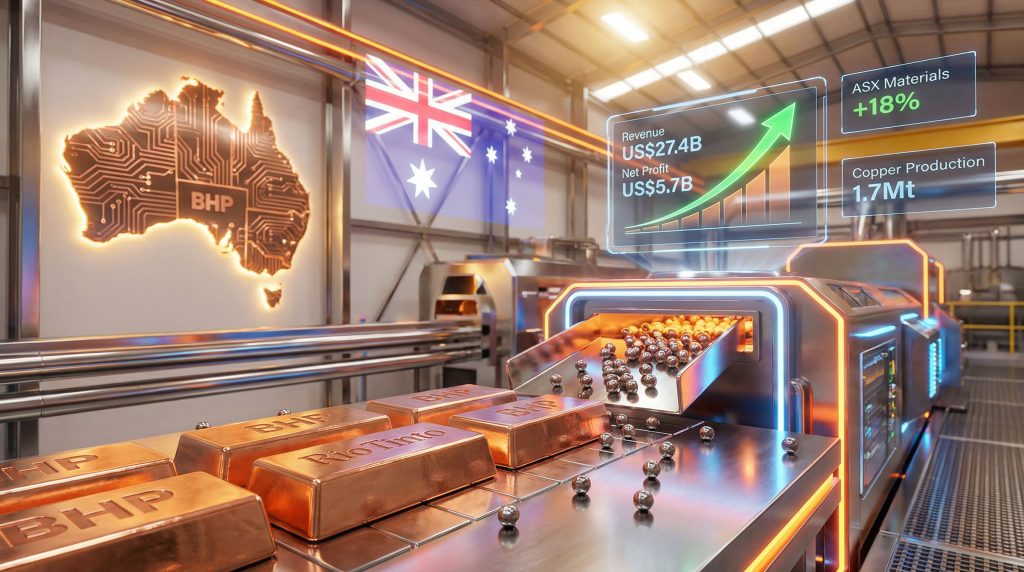
| Metric | HY FY25 Actual | HY FY26 Forecast | YoY Change |
|---|---|---|---|
| Revenue | US$25.2B | US$27.4B | +8.8% |
| Net Profit | US$4.4B | US$5.7B | +29.4% |
| Copper Production | 1.6Mt | 1.7Mt | +6.3% |
The financial projections demonstrate significant earnings leverage to commodity price improvements and operational efficiency gains. Net profit growth of 29.4% substantially exceeds revenue growth of 8.8%. This indicates margin expansion from both higher commodity prices and cost management initiatives.
Copper production growth of 6.3% reflects capacity expansion projects and operational optimisation rather than new mine development. This organic growth approach provides sustainable production increases without the capital intensity and development risks associated with greenfield projects.
Escondida Expansion Mechanics
BHP's Escondida operation represents the world's largest copper mine by production volume. Recent expansion projects focus on debottlenecking existing processing infrastructure rather than developing new mining areas. For instance, this reduces capital requirements while increasing throughput capacity.
The expansion strategy emphasises processing circuit optimisation, concentrator capacity increases, and tailings management improvements. These operational enhancements provide sustainable competitive advantages by reducing all-in sustaining costs while increasing production capacity.
Olympic Dam Modernisation Programme
Olympic Dam represents BHP's most complex operation, producing copper, uranium, gold, and silver from underground operations. Recent modernisation initiatives focus on processing efficiency improvements that enhance recovery rates while reducing unit operating costs.
The modernisation programme includes advanced flotation technology, improved grinding circuits, and enhanced metallurgical processes. These technical improvements increase copper recovery rates from existing ore sources, providing margin enhancement opportunities independent of commodity price movements.
Future-Facing Commodity Portfolio
BHP's strategic shift toward battery metals and critical minerals reflects management's recognition of structural demand changes. The company has reduced thermal coal exposure while increasing copper and nickel capacity. Consequently, this positions the portfolio for long-term secular growth rather than cyclical commodity exposure.
Rio Tinto's Strategic Pivot Beyond Iron Ore Concentration
Rio Tinto faces unique strategic challenges following the terminated acquisition discussions with Glencore. The failed transaction would have created the world's largest mining company but places increased pressure on management to demonstrate organic growth capabilities. However, this particularly applies to commodities beyond iron ore where the company maintains dominant market positions.
The company's iron ore operations in the Pilbara region provide substantial cash generation capabilities but offer limited growth potential. Infrastructure constraints and market concentration risks present challenges, whilst China remains the dominant consumer of Australian iron ore. This creates geopolitical exposure that concerns long-term strategic planning.
Wilsons Advisory analysis emphasises that growth opportunities outside iron ore represent the most significant value creation potential for Rio Tinto. Particularly in copper and lithium where supply-demand fundamentals support premium valuations compared to traditional bulk commodities.
Operational Excellence in Pilbara Iron Ore:
• Autonomous truck fleets reducing labour costs
• Predictive maintenance systems improving equipment availability
• Advanced blending optimisation maximising ore quality
• Rail and port automation enhancing logistics efficiency
The Pilbara operations demonstrate industry-leading cost performance through comprehensive automation implementation. Autonomous mining trucks, predictive maintenance systems, and optimised blending processes have reduced all-in sustaining costs. Furthermore, these improvements maintain production quality standards.
Copper Development Pipeline
Rio Tinto's copper portfolio includes development projects that could provide significant production growth over the next decade. The company's copper strategy focuses on large-scale, long-life assets that provide sustainable competitive advantages. These advantages come through geological quality and operational scale.
Recent copper project developments emphasise processing technology advancement and environmental performance improvements. These meet increasingly stringent regulatory requirements whilst maintaining economic returns.
Lithium Supply Chain Integration Opportunities
The global lithium supply chain presents vertical integration opportunities for Rio Tinto. This particularly applies to chemical conversion processes that add value beyond raw material extraction. Battery manufacturers increasingly prefer long-term supply relationships with integrated producers who can provide consistent quality and delivery reliability.
Moreover, lithium industry innovations create additional value-creation opportunities through technological advancement and processing capabilities.
"The strategic focus on growth outside iron ore reflects market recognition that diversification away from Chinese demand dependency represents Rio Tinto's most compelling value creation opportunity in current commodity markets."
Market Dynamics Creating Valuation Normalisation
Australian mining stocks have demonstrated significant outperformance relative to broader equity markets. Sector gains reflect both commodity price strength and operational leverage improvements. The materials sector's performance indicates investor confidence in sustainable earnings growth rather than speculative commodity positioning.
Key Performance Drivers:
• Copper pricing strength from industrial electrification demand
• Iron ore price stabilisation supported by Chinese infrastructure spending
• Operational efficiency gains offsetting inflationary cost pressures
• Currency tailwinds enhancing USD revenue conversion
The combination of these factors creates a supportive environment for mining company earnings growth. This extends beyond simple commodity price movements, as companies demonstrating operational excellence and strategic positioning benefit from multiple expansion as well as earnings growth.
Commodity Price Fundamentals:
| Commodity | Current Price | Key Drivers |
|---|---|---|
| Copper | $5.77/lb | Electrification, data centres |
| Iron Ore | Market dependent | Chinese infrastructure |
| Gold | $4,995/oz | Monetary policy, geopolitics |
| Palladium | $1,754/oz | Automotive, industrial demand |
Copper markets demonstrate particular strength driven by structural demand growth from electrical infrastructure development. Data centre expansion creates additional copper intensity as artificial intelligence and cloud computing require enhanced electrical systems. These installations have higher copper content per unit.
Iron ore pricing reflects Chinese economic policy support for infrastructure development. This provides baseline demand despite residential property market challenges, whilst government infrastructure spending programmes support steel demand that maintains iron ore consumption levels.
Investment Implications and Risk Assessment
Current mining sector valuations reflect optimistic earnings expectations. This suggests that operational results must meet or exceed already elevated forecasts to justify continued price appreciation. However, investors should evaluate both upside potential and downside risk scenarios when assessing position sizing and portfolio allocation.
Furthermore, commodity pricing impact on operational performance requires careful analysis of margin sustainability across different price scenarios.
Critical Performance Metrics:
- All-in sustaining costs relative to commodity price levels
- Free cash flow generation supporting dividend sustainability
- Return on invested capital demonstrating management effectiveness
- Production guidance indicating operational capability
Risk Factors:
• Chinese economic slowdown impacting commodity demand
• Geopolitical tensions affecting trade relationships
• Environmental regulations increasing compliance costs
• Currency volatility impacting revenue conversion
Geopolitical considerations increasingly influence mining sector investment decisions. Supply chain security and trade relationship stability affect long-term strategic planning, whilst companies with geographically diversified operations and customer bases demonstrate greater resilience to political disruption.
Environmental, social, and governance (ESG) factors increasingly impact mining company valuations. Institutional investors integrate sustainability criteria into investment decisions, whilst companies demonstrating leadership in environmental performance and community engagement access capital at lower costs. In addition, these companies attract long-term institutional investment.
Portfolio Allocation Considerations:
• Cyclical exposure management balancing growth potential against volatility
• Commodity diversification across multiple resource categories
• Geographic distribution reducing concentration risk
• ESG integration supporting sustainable investment themes
The mining sector provides portfolio diversification benefits through commodity exposure that often moves independently of traditional equity market factors. However, sector concentration risk requires careful position sizing and risk management.
The next major ASX story will hit our subscribers first
Future-Facing Strategic Positioning
Both BHP and Rio Tinto demonstrate strategic positioning for long-term commodity demand trends that extend beyond current economic cycles. The emphasis on copper, lithium, and other battery minerals reflects management recognition of structural demand changes. These changes are driven by energy transition and technological advancement.
Electrification trends support sustained copper demand growth across multiple applications. From electric vehicle charging infrastructure to renewable energy systems, data-driven mining operations enhance operational efficiency whilst meeting growing demand. Data centre expansion creates additional copper intensity requirements as artificial intelligence and cloud computing demand enhanced electrical systems.
Battery mineral supply chains present opportunities for vertical integration and value-added processing. These provide sustainable competitive advantages, whilst mining companies with chemical processing capabilities access higher-margin market segments and develop long-term customer relationships.
Long-term Demand Drivers:
• Electric vehicle adoption requiring copper wiring and battery materials
• Renewable energy systems needing copper transmission components
• Data centre expansion demanding enhanced electrical infrastructure
• Grid modernisation projects requiring extensive copper installation
The transition toward sustainable energy systems creates sustained demand for specific minerals that may persist for decades. Rather than following traditional commodity cycles, companies positioned in these markets benefit from secular growth trends.
What Does This Mean for Investors?
Rio Tinto and BHP Australia earnings rebound represents more than cyclical commodity price recovery. Both companies have implemented strategic positioning that provides exposure to structural demand growth from electrification and energy transition trends.
Mining companies with strong operational capabilities and strategic asset positioning should benefit from continued demand growth in technology-driven commodity markets. Furthermore, they maintain exposure to traditional industrial demand that provides earnings stability during transition periods.
Rio Tinto and BHP Australia earnings rebound therefore reflects both operational excellence and strategic positioning for long-term commodity demand trends. This combination provides compelling investment opportunities for investors seeking exposure to structural economic transformation through established operational platforms.
Disclaimer: This analysis is for informational purposes only and does not constitute investment advice. Commodity markets involve significant risks, and past performance does not guarantee future results. Investors should conduct their own due diligence and consider their risk tolerance before making investment decisions.
Want to Capitalise on Australia's Mining Revival?
Discovery Alert's proprietary Discovery IQ model delivers real-time alerts on significant ASX mineral discoveries, turning complex mining data into actionable investment insights that help investors identify opportunities ahead of the broader market. Begin your 14-day free trial today and understand why historic discoveries can generate substantial returns by exploring successful mining investment outcomes.