July 23, 2026
The Hidden Decarbonisation Problem That Renewable Energy Cannot Easily Solve
Hard-to-abate industrial sectors share a common characteristic that separates them from the rest of the energy economy: their core processes depend not on electricity, but on sustained, high-temperature heat. This technical reality makes decarbonisation a fundamentally different challenge than switching a power grid to wind and solar. For the aluminium industry, this distinction sits at the heart of why Rio Tinto biochar for cleaner aluminum is generating serious attention among industrial strategists, climate investors, and materials scientists alike.
The aluminium value chain is responsible for roughly 2% of total global greenhouse gas emissions, according to the International Aluminium Institute (IAI). That may sound modest in isolation, but when measured against the scale of global industrial output, it represents a significant and persistent emissions source. More specifically, approximately 90% of those emissions are concentrated at just two production stages: alumina refining and aluminium smelting. Each stage produces emissions through entirely different mechanisms, which means each demands its own decarbonisation pathway.
When big ASX news breaks, our subscribers know first
Why Alumina Refining Is the Harder Half of the Emissions Equation
Most public discussion around aluminium decarbonisation focuses on smelting, partly because electrolysis-based smelting is electricity-intensive and therefore visible as a grid decarbonisation opportunity. What receives far less attention is alumina refining, the upstream stage where raw bauxite ore is chemically converted into alumina powder before it ever reaches a smelting pot.
The Steam Problem at the Core of the Bayer Process
Alumina refining relies on the Bayer process, a century-old chemical technique that uses pressurised, caustic sodium hydroxide solution to dissolve aluminium-bearing minerals from bauxite. The digestion stage of this process requires large volumes of high-pressure steam, and generating that steam consistently at the temperatures and pressures required is the central emissions challenge.
According to Rio Tinto's own Climate Action Plan, approximately 75% of process heat emissions at its Gladstone refineries originate from steam generation during the digestion stage. The remaining 25% comes from the calcination stage, where aluminium hydroxide is thermally converted into alumina at temperatures exceeding 1,000 degrees Celsius. Both stages currently depend on fossil fuels, with coal and natural gas remaining the dominant energy sources at most global alumina operations.
The critical technical constraint is temperature. Current commercial electrification technologies cannot reliably and cost-effectively deliver the sustained high-temperature process heat that alumina refining requires at industrial scale. This is precisely why the International Energy Agency (IEA) has identified modern bioenergy as a bridging technology for hard-to-abate sectors, noting that it currently supplies approximately 55% of global renewable energy output, making it the single largest renewable energy source in the world today. Furthermore, renewable mining solutions are increasingly being evaluated across the industry as operators seek infrastructure-compatible alternatives to fossil fuels.
Modern bioenergy's role in industrial decarbonisation is frequently underestimated in public discourse. While solar and wind attract the majority of clean energy investment headlines, biomass-derived fuels are quietly powering the most technically challenging emissions reductions across steel, cement, chemicals, and refining.
How Pyrolysis Transforms Bana Grass into a Coal Substitute
The Mechanics of Bio Pellet Production
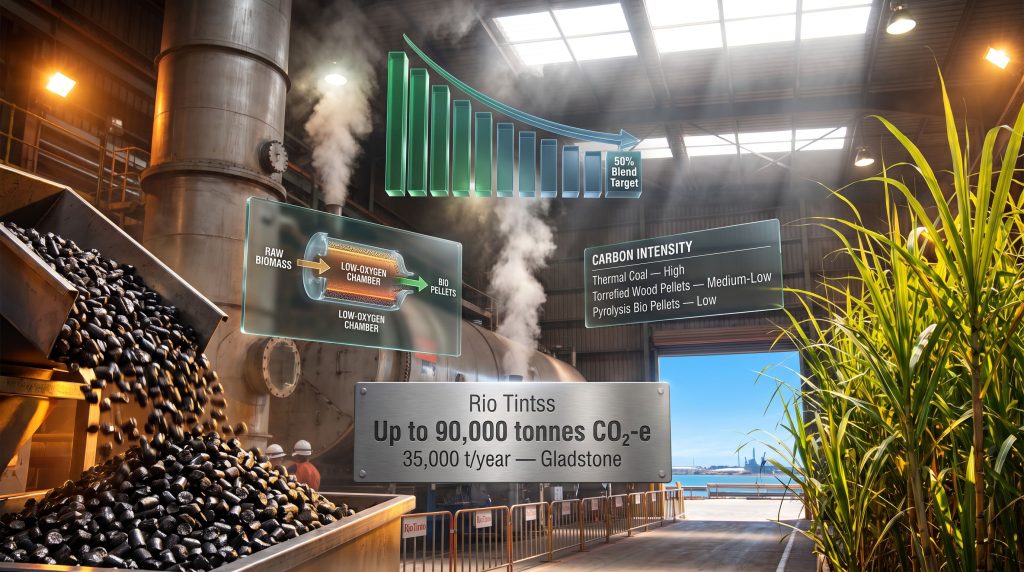
Superchar Limited (SCL), an Australian bioenergy company, produces bio pellets through a thermochemical process called pyrolysis, which involves heating organic material in a low-oxygen or oxygen-free environment. Unlike conventional combustion, pyrolysis does not fully oxidise the feedstock. Instead, it drives off volatile compounds while leaving behind a carbon-dense solid with a significantly lower moisture content and higher energy density than raw biomass.
The feedstock SCL uses is bana grass, a fast-growing perennial species that can be harvested multiple times per year and cultivated on marginal land with minimal competition against food crops. This feedstock selection carries meaningful advantages from a lifecycle emissions perspective, since land-use change emissions — which often undermine the climate case for biomass — are substantially reduced when non-food perennial grasses are grown on otherwise unproductive land.
The pelletised format of the final product is not incidental. It is engineered specifically to match the physical and combustion characteristics that industrial boilers require. Coal-fired boiler systems are designed around specific fuel density, particle size, and moisture profiles. A fuel that cannot meet those parameters cannot be simply dropped into existing infrastructure without equipment modifications. The pellet format enables drop-in compatibility, which is the defining commercial advantage of this approach.
How Bio Pellets Compare to Other Fuel Types
| Fuel Type | Carbon Intensity | Boiler Compatibility | Infrastructure Change Required |
|---|---|---|---|
| Thermal Coal | High | Full | None |
| Raw Biomass | Variable | Partial | Moderate |
| Torrefied Wood Pellets | Medium-Low | High | Minimal |
| Pyrolysis Bio Pellets | Low | High | Minimal to None |
A critical but often overlooked distinction: SCL's production process requires no chemical additives or binders to produce its pellets. This matters for industrial operators because additive-free fuels reduce the risk of introducing contaminants into boiler systems, simplify fuel quality management, and potentially reduce regulatory complexity around emissions monitoring. In addition, the bio-pellet deal with Super-Char represents a commercially significant step toward reducing Scope 1 emissions at Gladstone without requiring wholesale infrastructure replacement.
Rio Tinto's Gladstone Operations and the Five-Year Supply Agreement
The Scale of the Gladstone Industrial Cluster
Gladstone in central Queensland is one of Australia's most significant heavy industrial hubs. Rio Tinto operates two major alumina refineries there: Yarwun and Queensland Alumina Limited (QAL), which ranks among the largest alumina refineries in the world by annual output. The Boyne aluminium smelter, also located nearby, completes an integrated aluminium production chain. Combined, these operations support a workforce of more than 3,000 people and represent a substantial share of Rio Tinto's total Scope 1 emissions exposure.
Rio Tinto's own Climate Action Plan explicitly identifies the Gladstone refineries as the company's single largest source of process heat emissions. This designation makes Gladstone the logical and necessary focal point for any serious effort to achieve the company's 2030 and 2050 climate targets. The Rio Tinto Gladstone repowering programme further underlines the scale of investment being directed at transforming this industrial cluster.
Agreement Structure and Projected Emissions Impact
The five-year bio pellet supply agreement with Superchar Limited includes the following key parameters:
- First deliveries targeted for 2028, contingent on the successful completion of operational trials and a formal feasibility assessment
- SCL plans to construct a dedicated production facility near Gladstone at an estimated capital cost of A$30 million
- Initial annual production capacity is set at 35,000 tonnes of bio pellets
- At full contract capacity, the programme is projected to reduce Rio Tinto's reported Scope 1 emissions by up to 90,000 tonnes of CO₂ equivalent per year, measured under Australia's National Greenhouse and Energy Reporting (NGER) framework
- Trial blending ratios under the expanded agreement will range from 5% to 50% coal substitution
Earlier trial phases conducted in 2024 and 2025 demonstrated that bio pellets could replace up to 30% of coal in refinery boilers without requiring significant equipment modifications. The expanded agreement tests whether that ceiling can be pushed higher, with four performance metrics under evaluation: fuel combustion performance, measurable emissions reductions, operating cost implications, and long-term supply chain reliability.
Rio Tinto's Operations Managing Director, Armando Torres, confirmed that the trials conducted to date have provided meaningful operational data, and that the agreement represents a deliberate next step in understanding how bio pellets can be scaled for practical use across the Gladstone refinery complex.
Rio Tinto's Multi-Technology Decarbonisation Architecture
Targets, Capital, and Technology Stack
The bio pellet programme does not exist in isolation. It is one component of a broader decarbonisation architecture that Rio Tinto has been constructing since 2018. The company's headline targets include a 50% reduction in combined Scope 1 and Scope 2 emissions by 2030, measured against a 2018 baseline, and net-zero emissions across all operations by 2050. To support these targets, Rio Tinto has committed approximately US$7.5 billion in decarbonisation capital between 2022 and 2030.
| Decarbonisation Lever | Application Area | Development Stage |
|---|---|---|
| Bio pellet fuel blending | Alumina refinery boilers (Gladstone) | Trial to commercial scale |
| Renewable electricity procurement | Smelting and general operations | Active (30-year agreements in place) |
| Battery storage systems | Grid stability and peak load management | Active deployment |
| Hydrogen research programmes | Process heat and industrial applications | Research and pilot phase |
| ELYSIS zero-carbon smelting technology | Aluminium smelting (eliminates carbon anodes) | Pilot to commercial scale |
| Energy efficiency upgrades | Cross-portfolio operations | Ongoing |
Why ELYSIS and Biochar Must Both Succeed
A common misconception is that ELYSIS, the zero-carbon smelting technology developed through a joint venture between Rio Tinto and Alcoa, addresses the same emissions source as the bio pellet programme. It does not. ELYSIS targets the smelting stage, replacing conventional carbon anodes with inert electrode materials. Rather than emitting CO₂ as a process byproduct, ELYSIS-equipped smelting cells produce oxygen — a genuinely transformative technology for the downstream half of the aluminium production chain.
The bio pellet programme addresses the upstream refining stage, where the emissions profile is structurally different and requires a fuel-based rather than an electrochemical solution. Both programmes must succeed simultaneously for Rio Tinto to achieve meaningful progress toward its 2030 targets. Solving one stage while leaving the other unaddressed would still leave the Gladstone complex as a major emissions liability. Consequently, the industrial decarbonisation technologies being trialled across Rio Tinto's portfolio reflect a deliberate multi-front strategy rather than a single-solution bet.
The Commercial Imperative: Why Low-Carbon Aluminium Is Becoming Non-Negotiable
Demand Growth Meets Emissions Pressure
The International Aluminium Institute forecasts approximately 40% growth in global aluminium demand by 2030, driven by electric vehicle manufacturing, utility-scale solar and wind infrastructure, power grid expansion, and lightweight construction applications. The IEA classifies aluminium as a critical material for clean energy technology deployment, creating a structural paradox: the energy transition requires more aluminium, yet aluminium production itself must decarbonise at pace.
This paradox is shaping purchasing decisions across the automotive and renewable energy sectors. Downstream manufacturers increasingly require verified low-carbon aluminium with documented emissions intensity per tonne, turning production decarbonisation from a voluntary commitment into a commercial prerequisite. The mining decarbonisation benefits extend beyond regulatory compliance, however, encompassing supply chain resilience and long-term cost competitiveness.
Carbon Border Mechanisms and Trade Flow Implications
The European Union's Carbon Border Adjustment Mechanism (CBAM) is beginning to alter the economics of aluminium trade flows into regulated markets. Under CBAM, importers of high-carbon aluminium face increasing cost penalties that reflect the embedded emissions intensity of production. This regulatory architecture effectively prices in emissions performance as a commercial variable, rewarding producers who can document lower Scope 1 emissions per tonne and disadvantaging those who cannot.
| Producer Region | Primary Decarbonisation Approach | Competitive Position |
|---|---|---|
| Canada (Rio Tinto AP60) | Hydroelectric smelting + ELYSIS technology | Strong: low-carbon electricity and zero-carbon smelting R&D |
| Australia (Gladstone) | Bio pellet refining + renewable electricity | Developing: domestic biomass supply and existing infrastructure |
| Middle East | Gas-fired with emerging CCS potential | Moderate: low energy costs, slower transition |
| Europe | Grid decarbonisation + CBAM compliance | Driven by regulatory pressure |
| China | Coal-dominant with selective renewables | Scale advantage, higher emissions intensity |
Furthermore, the emergence of the low-carbon alumina venture between Alcoa and its partners illustrates that Rio Tinto is not alone in pursuing structural emissions reductions across the aluminium value chain.
The next major ASX story will hit our subscribers first
Key Risks That Could Constrain the Biochar Strategy
Supply Chain Scalability
The commercial viability of bio pellet substitution at industrial scale depends heavily on whether bana grass cultivation can be expanded at the pace required. Key unknowns include:
- Land availability and suitability for large-scale perennial grass cultivation in Queensland
- Water requirements and seasonal variability for bana grass yields
- Logistics infrastructure needed to move bio pellets from the planned Gladstone production facility to refinery boiler feed systems at the required volumes
- Whether a single 35,000-tonne annual facility represents a genuinely scalable model or a constrained first step
Technical Uncertainties at Higher Blend Ratios
The initial trials achieved up to 30% substitution without major equipment modifications. Whether higher ratios — particularly toward the 50% upper bound of the expanded trial programme — introduce combustion consistency challenges, equipment wear, or unplanned maintenance requirements is a technical question that remains open. Different boiler designs and operating temperature profiles may respond differently to higher bio pellet fractions, and this variability cannot be fully anticipated from lower-ratio trials alone.
Emissions Accounting and Lifecycle Considerations
The 90,000 tonne CO₂-e reduction figure is measured under Australia's NGER framework, which classifies biogenic carbon from biomass combustion according to specific accounting rules. It is important to understand that this figure reflects Scope 1 reported emissions at the facility level and does not necessarily represent the full lifecycle emissions benefit. A rigorous lifecycle analysis (LCA) that accounts for feedstock cultivation, processing, transport, and combustion is essential to validate the genuine climate benefit of bio pellet substitution beyond the NGER accounting boundary.
Investors and industrial operators evaluating biochar strategies should distinguish carefully between reported Scope 1 reductions under national frameworks and full lifecycle emissions performance. The two figures can diverge meaningfully depending on feedstock sourcing and supply chain emissions intensity.
Key Statistics at a Glance
| Metric | Value |
|---|---|
| Global aluminium sector share of GHG emissions | ~2% |
| Share of aluminium emissions from refining + smelting | ~90% |
| Proportion of Gladstone refinery emissions from steam digestion | ~75% |
| Maximum bio pellet blend in initial trials | 30% |
| Expanded trial blend range under new agreement | 5% to 50% |
| Initial annual bio pellet supply volume | 35,000 tonnes/year |
| Planned SCL facility investment | A$30 million |
| Projected annual Scope 1 reduction at full capacity | Up to 90,000 tonnes CO₂-e |
| Rio Tinto 2030 emissions reduction target | 50% vs. 2018 baseline |
| Rio Tinto decarbonisation capital (2022 to 2030) | ~US$7.5 billion |
| Global aluminium demand growth forecast by 2030 | ~40% |
| Modern bioenergy share of global renewable energy | ~55% |
Frequently Asked Questions: Rio Tinto Biochar and Cleaner Aluminum
What is biochar, and how does it differ from ordinary charcoal?
Biochar is produced through pyrolysis, meaning the thermal decomposition of organic material in a low-oxygen environment. Unlike conventional charcoal, biochar used in industrial applications is engineered to precise specifications for carbon content, moisture level, particle size, and combustion behaviour, making it suitable for deployment in demanding industrial boiler systems.
Why are bio pellets being chosen over hydrogen or full electrification for alumina refining?
Both hydrogen and full electrification remain commercially and technically immature for the sustained high-temperature steam generation that alumina refining requires at scale. Bio pellets offer a near-term, infrastructure-compatible alternative that can be deployed incrementally through blending, without requiring the redesign or replacement of existing plant equipment.
What is the difference between alumina refining and aluminium smelting from an emissions perspective?
Alumina refining converts raw bauxite ore into alumina using high-temperature steam and chemical processing. Aluminium smelting then converts alumina into metallic aluminium through electrolysis. Both stages are emissions-intensive but through different mechanisms, which is why they require separate and complementary decarbonisation technologies.
When will measurable emissions reductions begin at Gladstone?
First deliveries from Superchar Limited are currently targeted for 2028, following the completion of expanded operational trials and a formal feasibility study. Quantifiable Scope 1 emissions reductions under the NGER framework are therefore expected from the 2028 reporting period onward.
Could this approach be adopted by other alumina producers globally?
In principle, any alumina refinery operating coal-fired boilers with access to a reliable and cost-competitive biomass feedstock supply could apply a comparable blending strategy. Commercial viability would depend on local biomass economics, applicable carbon accounting frameworks, boiler engineering compatibility, and the capital requirements of any necessary infrastructure adjustments.
Why This Agreement Matters Beyond Gladstone
The significance of Rio Tinto biochar for cleaner aluminum extends well beyond its immediate projected emissions reduction. At a broader level, it represents the construction of a replicable commercial template for bio pellet deployment in hard-to-abate industrial settings. If the Gladstone trials demonstrate that a 40% to 50% blend ratio is technically stable, commercially viable, and verifiable under national carbon accounting rules, the implications for other alumina producers across Australia, Southeast Asia, and the Middle East could be substantial.
The conditions under which this approach scales from a flagship trial to a mainstream industrial practice are well-defined: sustained feedstock supply at competitive cost, regulatory clarity around biogenic carbon accounting in NGER and equivalent frameworks, demonstrated boiler performance across multiple site types, and the establishment of domestic supply chains that reduce exposure to imported fossil fuel price volatility.
Australia's Safeguard Mechanism, which requires large industrial emitters to reduce their emissions intensity over time, creates an ongoing financial incentive for operators to lower their reported Scope 1 baseline. Bio pellet blending, if it performs as anticipated, would directly reduce the emissions baseline against which Safeguard obligations are measured, potentially generating additional value through reduced carbon credit purchase requirements.
The Rio Tinto and Superchar agreement is not presented as a complete solution to industrial decarbonisation. It is better understood as a pragmatic, infrastructure-compatible transitional step that allows hard-to-abate sectors to begin reducing emissions at meaningful scale while longer-term breakthrough technologies — including green hydrogen for process heat and next-generation electrification — continue their path toward commercial readiness.
The aluminium industry faces a unique historical moment. Demand for the metal is expanding precisely because the world needs more of it to build the clean energy infrastructure required to reduce emissions from other sectors. Meeting that demand while simultaneously reducing the emissions intensity of production is the defining industrial challenge of the next decade. Rio Tinto biochar for cleaner aluminum represents a measured, technically grounded response to that challenge — one that other producers, investors, and policymakers will be watching closely as the Gladstone trials progress toward their 2028 operational milestone.
Want to Track the Next Wave of ASX Mineral Discoveries Fuelling the Clean Energy Transition?
Discovery Alert's proprietary Discovery IQ model delivers real-time alerts the moment significant ASX mineral discoveries are announced, transforming complex data across more than 30 commodities into clear, actionable insights for investors at every level. Explore Discovery Alert's dedicated discoveries page to understand how historic discoveries have generated substantial returns, and begin your 14-day free trial today to position yourself ahead of the market.