July 23, 2026
The Industrial Intelligence Shift Rewriting Mining's Operating Playbook
For most of the twentieth century, mineral processing plants operated on a fundamentally reactive logic. Equipment ran until it failed, ore grades were assessed through periodic laboratory sampling, and field workers spent their shifts physically inspecting infrastructure in environments that carried genuine safety risks. Productivity ceilings were largely accepted as structural constraints tied to ore variability, equipment age, and human bandwidth. That operating philosophy is now being systematically dismantled.
The emergence of industrial AI as a process control architecture, rather than a supplementary analytical tool, represents one of the most consequential shifts in extractive industry history. Nowhere is this transition more tangible than at the Vale AI model plant in Itabira, Brazil, where the company has deployed what it describes as a model plant for the future of iron ore processing. The results challenge long-held assumptions about what is achievable within existing physical infrastructure.
When big ASX news breaks, our subscribers know first
What Is the Vale AI Model Plant in Itabira and Why Does It Represent a New Operating Standard?
Itabira is not a neutral choice of location. Situated approximately 100 kilometres from Belo Horizonte in the state of Minas Gerais, the city carries deep significance within Vale's institutional history as the place where the company was founded more than eight decades ago. Selecting it as the site of the company's first high-technology model plant carries both symbolic weight and strategic logic.
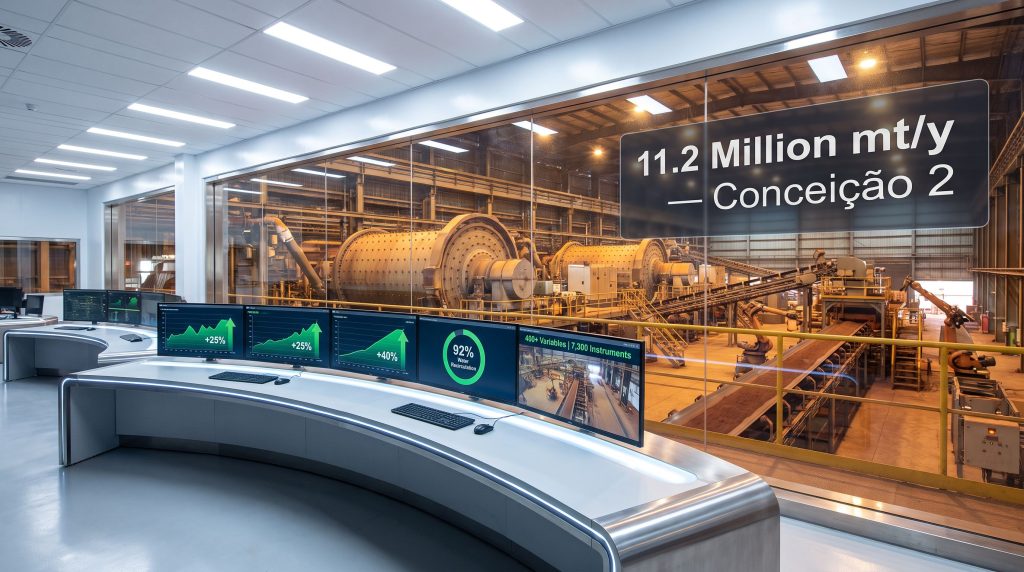
The Conceição 2 facility is an iron ore processing plant that underwent an 18-month transformation under Vale's Model Plant Program. Rather than constructing a greenfield operation, the company retrofitted an existing plant with 51 distinct technological solutions aimed at eliminating operational bottlenecks, expanding automation, and reducing worker exposure to hazardous conditions. The result is a facility now capable of processing 11.2 million metric tons per year (mt/y), up from 9 million mt/y recorded in 2024, without a single new tonne of physical construction capacity.
This distinction matters. The throughput gain was achieved entirely through digital integration and process optimisation, not capital-intensive expansion. For investors and operators evaluating the economics of mining modernisation, that ratio of output growth to capital deployed is the central value proposition.
Vale's operations vice president described the program as representing a fundamentally new way of operating mining assets, one grounded in advanced technology application that redefines efficiency, sustainability, and competitive positioning simultaneously. The Conceição 2 plant is explicitly designated as a benchmark for expanding this model across Vale's broader portfolio of operations.
How Does the AI System Actually Function Inside the Plant?
Understanding the technical architecture at Conceição 2 requires moving beyond the high-level language of "digitalisation" and examining what the system actually does at the process level.
The AI layer operates as a continuous supervisory control system that monitors and dynamically adjusts production parameters in real time based on incoming data from across the plant. It does not simply flag anomalies for human review. It actively corrects processing routes based on live ore characteristics, reducing the lag between detection and response from hours to seconds.
The physical infrastructure supporting this capability is substantial. Furthermore, AI-powered mining efficiency approaches like this demonstrate how deeply automation has penetrated operational decision-making:
- More than 100 monitoring cameras installed across the plant complex provide continuous visual coverage of operations
- Approximately 7,300 automated instruments, including advanced measurement devices and sensors, feed live data into the AI control layer
- Over 400 process variables are monitored and managed simultaneously across all stages of the ore processing workflow
- Online ore grade analysis technology enables immediate processing route corrections as material moves through the system
A particularly important capability is the online ore grade analysis function. In conventional processing, ore grade assessment typically relies on periodic laboratory samples, meaning the plant operates on lagged information. At Conceição 2, grade data feeds directly into the AI system in real time, allowing instant adjustments to the mineral processing route. This reduces iron loss into tailings and improves the overall utilisation of material that enters the plant.
Comparison: Traditional Iron Ore Processing vs. AI-Integrated Processing at Conceição 2
| Operational Dimension | Conventional Processing | AI-Integrated Model (Conceição 2) |
|---|---|---|
| Process variable oversight | Manual sampling intervals | 400+ variables monitored in real time |
| Instrumentation scope | Limited sensor coverage | ~7,300 automated instruments |
| Failure anticipation | Reactive maintenance | Predictive failure modelling |
| Ore grade correction | Periodic lab analysis | Instant online adjustment |
| Human field exposure | High frequency | Significantly reduced |
| Water recirculation rate | Industry average ~70-75% | 92% recirculation achieved |
Vale's technical vice president Rafael Bittar has indicated that the facility has reached a level of digital maturity at which every critical operational decision is underpinned by expert systems, rather than expert systems serving as an occasional reference point for human decision-makers. This distinction between AI as infrastructure versus AI as advisory tool is subtle but operationally profound.
What Measurable Results Has the Vale AI Model Plant in Itabira Delivered?
The performance data from Conceição 2 is among the most compelling in recent mining industry literature. Within less than two years of the pilot program's commencement, the facility generated improvements across productivity, product quality, resource efficiency, and environmental performance simultaneously. Data-driven mining operations of this kind are increasingly setting the benchmark for what modern extraction can achieve.
Performance Snapshot: Conceição 2 AI Model Plant
- Productivity uplift: +25%
- Direct reduction pellet feed share: +40%
- Iron content lost in waste streams: -26% (2026 baseline)
- Water recirculated within the system: 92%
- Annual processing capacity reached: 11.2 million mt/y (up from 9 million mt/y in 2024)
The 40% increase in direct reduction (DR) pellet feed output warrants particular attention because it connects plant-level performance to one of the most significant structural trends in global steel production. DR pellet feed is a premium iron ore product specifically engineered for use in direct reduction ironmaking processes, which use natural gas or hydrogen as a reductant instead of coking coal. This pathway produces steel with substantially lower carbon emissions than blast furnace routes and is central to the decarbonisation strategies of major steelmakers across Europe, the Middle East, and increasingly Asia.
By increasing its DR pellet feed share by 40%, Conceição 2 is not simply improving margins on existing product. It is repositioning itself within a product category that commands pricing premiums and aligns with long-term demand growth driven by the green steel transition. For context, DR-grade iron ore pellets typically require iron content above 67%, tight silica and alumina specifications, and low phosphorus levels — all of which demand precision control of exactly the kind the AI system enables. Notably, green steel pricing dynamics are increasingly rewarding producers capable of consistently delivering to these specifications.
The 26% reduction in iron content within tailings is similarly significant from both a financial and environmental perspective. Tailings represent the residual material after valuable mineral extraction. Every percentage point of iron that exits in the waste stream rather than the product stream is revenue lost and ore destroyed. Reducing tailings iron content through better process control therefore generates direct financial returns while simultaneously reducing the environmental footprint of waste disposal.
The 92% water recirculation rate places Conceição 2 well above typical industry benchmarks. In conventional iron ore processing, water consumption and management represent both an operational cost and an environmental liability, particularly in water-stressed regions. Achieving near-complete recirculation reduces freshwater draw, lowers operating costs, and substantially diminishes the risk profile associated with tailings dam storage.
How Remote Operation and Robotics Are Transforming Worker Safety
One of the less commercially visible but equally important dimensions of the Conceição 2 transformation is its impact on occupational safety. Mining remains among the most hazardous industrial sectors globally, with risks spanning mechanical equipment, chemical exposure, structural instability, and process-related accidents.
The model plant approach directly reduces these exposures through several mechanisms:
- Remote operation solutions, including robotic arms and remotely controlled electrical and mechanical equipment such as motors and valves, allow tasks previously requiring physical presence in hazardous zones to be conducted from control rooms
- Real-time imaging from over 100 cameras means that when field access is genuinely required, workers can review live site conditions and plan activities with precision before entering any area
- Predictive failure modelling built into the AI system anticipates equipment degradation before failures occur, reducing unplanned shutdowns and the chaotic, higher-risk conditions associated with emergency maintenance
- Continuous process monitoring eliminates the need for routine physical checks that previously required workers to move through active industrial environments
The combination of these factors means the frequency of human presence in high-exposure areas has decreased substantially, with field visits becoming condition-based and pre-planned rather than constant and reactive.
ABB's Role as Technology Integrator in the Model Plant Ecosystem
Vale's decision to structure the Conceição 2 deployment around a partner ecosystem rather than a single-vendor technology stack reflects a sophisticated understanding of industrial digitalisation risk. Large-scale AI integration in processing plants rarely fails because of the AI itself. It fails because systems from different vendors cannot communicate, data formats are incompatible, or new technology layers conflict with existing infrastructure.
ABB occupies the role of technology integrator within the Conceição 2 ecosystem, responsible for ensuring interoperability between systems and suppliers rather than simply providing proprietary automation hardware. This distinction is critical. As technology integrator, ABB's mandate is to make the entire system function as a coherent whole, regardless of which individual components or vendors are involved.
The ABB mining director for South America has characterised the initiative as demonstrating extraordinary vision in its combination of advanced technology with safety and operational excellence, describing it as positioning Vale at the forefront of global mining practice. Vale's AI-driven model plant provides further detail on the technical architecture underpinning this integration.
A key strategic rationale for the partner ecosystem approach is capital efficiency. Rather than replacing existing infrastructure with a new single-vendor stack, the program optimises investments already embedded in the plant. This reduces the capital requirement for transformation and accelerates the timeline to measurable returns, a model that may prove more replicable across Vale's broader asset base than a wholesale replacement strategy would be.
The next major ASX story will hit our subscribers first
Workforce Transformation: Training 122 People for a Data-First Mining Environment
Technology deployment without workforce transformation produces underperforming systems. Vale's recognition of this principle is evident in the scale of human capability development embedded within the Model Plant Program.
All 122 operators, instrument technicians, and leaders at the Conceição 2 plant completed structured training under the new operating model, accumulating more than 2,800 hours of training in aggregate. The curriculum was not limited to equipment-specific instruction. It encompassed data analysis, real-time decision support tool operation, and the broader conceptual shift from physical process management to integrated digital operations.
Skills Framework: Pre-Digital vs. AI-Ready Mining Operator
| Capability Area | Pre-Digital Operator Profile | AI-Ready Operator Profile |
|---|---|---|
| Primary work environment | Physical plant floor | Integrated control room |
| Decision support tools | Experience and manual checks | Real-time data dashboards |
| Training methodology | On-the-job observation | VR simulation and digital systems training |
| Data interpretation | Limited | Core daily requirement |
| Field access frequency | Constant | Condition-based and planned |
Training methods include immersive simulator programs and virtual reality environments that replicate actual plant operating conditions. This approach allows workers to develop proficiency with complex systems and practise emergency response scenarios without exposure to real operational risk.
The experiential shift among frontline workers is tangible. A 17-year Vale veteran at the Conceição 2 plant has described moving from a working life defined by constant physical presence in the field, performing manual checks and interventions, to one in which remote monitoring via mobile devices handles routine oversight. Field attendance has become exception-based rather than the default mode of operation.
This transition demands a fundamentally different skill profile. Workers who previously relied on sensory observation and physical familiarity with equipment now need to interpret data streams, recognise anomalies in dashboard visualisations, and make decisions informed by system outputs rather than direct physical inspection.
Scalability, Replication, and What the Itabira Blueprint Means for the Broader Industry
Vale has explicitly positioned Conceição 2 as a benchmark for expansion across its operational portfolio. The critical question for the industry is not whether the model worked at a single plant, but under what conditions it can be replicated elsewhere.
Several technical prerequisites appear necessary for successful deployment:
- Adequate existing instrumentation density, or willingness to invest in sensor networks as a prerequisite
- Stable and high-quality data infrastructure to support real-time processing of 400-plus variable streams
- Process chemistry and ore characteristics that are sufficiently consistent for AI training data to be representative
- A workforce development program running in parallel with technology deployment, not following it
For competitors and peer iron ore producers, the Conceição 2 results create tangible competitive pressure. A 25% productivity increase achieved without greenfield capital expenditure effectively lowers the cost per tonne of production and improves ore utilisation rates simultaneously. Operations that continue on conventional processing models face a widening efficiency gap as AI-integrated peers compound their advantages through continuous system learning and refinement. This pressure is further amplified by shifts in the China steel iron ore market, where demand-side volatility is pushing exporters toward product differentiation and cost discipline.
Sustainability Alignment: Water, Waste, and the Green Steel Supply Chain
The environmental performance of the Vale AI model plant in Itabira reinforces a broader argument about the relationship between operational efficiency and sustainability outcomes. In iron ore processing, these objectives are frequently aligned rather than in tension.
The 92% water recirculation rate dramatically reduces freshwater consumption and lowers the volume of water requiring treatment or storage in tailings facilities. This matters significantly in Brazil's Minas Gerais state, where the legacy of tailings dam failures has placed intense regulatory and community scrutiny on water management practices at mining operations.
The reduction of iron content in tailings by 26% simultaneously improves revenue capture and reduces the volume of iron-bearing material requiring disposal. Better mineral recovery is both a financial efficiency metric and an environmental one, since it reduces the total mass of waste generated per tonne of product.
The expansion of DR pellet feed production connects the plant directly to the green steel transition. Processes such as hydrogen iron ore reduction are increasingly reliant on premium feedstocks of precisely the kind Conceição 2 is now producing at greater volumes. As steelmakers shift toward hydrogen-based direct reduction to meet emissions reduction commitments, demand for DR-grade iron ore products is projected to grow substantially over the coming decades. Facilities capable of consistently producing high-specification DR pellet feed at competitive cost are positioning themselves within what may become the highest-value segment of the iron ore market.
Frequently Asked Questions: Vale's AI Model Plant in Itabira
What is Vale's AI model plant in Itabira?
It is the Conceição 2 processing facility, transformed over 18 months through the integration of 51 technological solutions including AI process control, advanced instrumentation, remote operation systems, and digital workforce training programs. It serves as a blueprint for Vale's future operating model across its portfolio.
How much did productivity improve at the Conceição 2 plant?
Productivity increased by 25% within the pilot window, with annual processing capacity rising from 9 million mt/y in 2024 to 11.2 million mt/y following the transformation.
What is direct reduction pellet feed and why is it strategically important?
DR pellet feed is a high-grade iron ore product used in direct reduction ironmaking, a lower-emissions alternative to blast furnace steelmaking. Output of this product at Conceição 2 increased by 40% following AI integration, connecting the plant to growing demand from green steel producers.
How many variables does Vale's AI system monitor in real time?
The system monitors and manages more than 400 process variables across all stages of ore processing, supported by approximately 7,300 automated instruments and over 100 monitoring cameras.
What is the annual processing capacity of the Conceição 2 plant?
Following the AI integration, the plant reached a capacity of 11.2 million metric tons per year.
How does Vale's AI system improve worker safety?
By enabling remote operation of equipment including robotic arms and automated valves and motors, reducing routine physical field presence, supporting predictive maintenance that prevents unplanned shutdowns, and providing real-time imaging for pre-planned field access.
Is Vale planning to expand the AI model plant concept to other operations?
Yes. Vale has stated that Conceição 2 will serve as a benchmark for expanding the model plant program across other operational units within its portfolio. The partnership with ABB as technology integrator is structured to support this rollout. Global Mining Review's coverage provides additional context on the industry significance of this expansion strategy.
What role does ABB play in the Vale Model Plant Program?
ABB serves as the technology integrator for the program, responsible for ensuring interoperability between different systems and suppliers rather than providing a closed single-vendor solution. This approach prioritises scalability and capital efficiency.
What Vale's Itabira Plant Signals for the Future of Mining
The most significant implication of the Conceição 2 results is not the specific performance figures, impressive as they are. It is the evidence that AI in mineral processing has crossed a threshold from experimental application to operational infrastructure.
When a facility reaches the point where every critical operational decision is supported by expert systems, the nature of mining management changes. Process engineers, operators, and plant leaders are no longer primarily responsible for detecting and responding to operational conditions. They become responsible for interpreting AI-generated intelligence, validating system recommendations, and optimising the parameters within which the AI operates. This is a fundamentally different professional role.
For the broader iron ore sector, the competitive implications are likely to accelerate. Producers operating without equivalent digital infrastructure face compounding disadvantages in cost per tonne, product quality consistency, resource recovery rates, and ESG performance metrics that increasingly influence financing costs and customer procurement decisions.
The Vale AI model plant in Itabira is not a case study in what technology can achieve under ideal conditions. It is a demonstration of what the new baseline for competitive iron ore processing looks like.
This article is intended for informational purposes only and does not constitute financial or investment advice. Forward-looking statements regarding operational performance, expansion plans, and market developments involve inherent uncertainty and should not be relied upon as guarantees of future outcomes.
Want to Spot the Next Major ASX Mineral Discovery Before the Broader Market Does?
Discovery Alert's proprietary Discovery IQ model delivers real-time alerts on significant ASX mineral discoveries, transforming complex mineral data into actionable insights for both short-term traders and long-term investors — explore historic discoveries and their returns to understand what early positioning can mean, then begin your 14-day free trial at Discovery Alert to gain your market-leading edge.