July 23, 2026
The Hardest Decarbonisation Problem in Mining Has a New Testing Ground
Open-pit iron ore mining sits at the extreme end of industrial energy consumption. The vehicles that move ore from pit face to crusher are not merely large — they are among the most energy-intensive machines operating anywhere on earth. A single ultra-class haul truck can consume upwards of 130 litres of diesel per hour under full load conditions, and a typical Pilbara iron ore operation runs dozens of these machines continuously across 24-hour shift cycles. When you multiply that fuel burn across an entire fleet, across an entire year, the resulting emissions figure is not an operational footnote — it is the dominant variable in a major miner's Scope 1 carbon inventory.
This is precisely why the Jimblebar battery-electric truck trials phase 2 represents something more significant than a technology demonstration. It is an attempt to solve what many mining engineers regard as the most technically complex decarbonisation challenge in the extractives sector: replacing diesel haul trucks with zero-emission alternatives without sacrificing the relentless productivity that makes large-scale iron ore mining commercially viable.
When big ASX news breaks, our subscribers know first
Why Haul Trucks Are the Emissions Battleground for Iron Ore Majors
Processing plants, offices, and auxiliary equipment all contribute to a mine's carbon footprint, but none of them come close to matching the emissions intensity of the haulage fleet. Industry analysis consistently identifies haul trucks as responsible for between 40% and 50% of total diesel consumption at large open-pit operations, with some Pilbara operations skewing even higher given the extreme haul distances and loaded gradients involved.
For BHP and Rio Tinto — two companies whose Pilbara iron ore divisions represent some of the highest-volume mining operations anywhere on the planet — this creates a pointed strategic problem. Credible net-zero commitments require tangible progress on haul truck emissions, not theoretical roadmaps. Investors, regulators, and institutional shareholders are increasingly sophisticated at distinguishing between genuine operational progress and headline-level sustainability positioning. The broader iron ore market outlook makes this operational credibility even more commercially significant.
Haul trucks account for a disproportionate share of total mine-site fuel consumption in large open-pit operations. Electrifying this fleet segment is widely regarded as the highest-impact and highest-complexity decarbonisation challenge in the mining industry.
The commercial pressure is compounding. Carbon pricing mechanisms, evolving disclosure requirements, and the financing preferences of large institutional investors are all pushing ASX-listed miners toward operational proof points rather than aspirational targets. A working battery-electric haul truck in a Pilbara iron ore operation is worth considerably more strategically than a policy commitment made from a boardroom.
What Is the Jimblebar Trial and Who Is Behind It?
The Three-Party Structure and Why It Was Chosen
The trial at BHP's Jimblebar iron ore mine in Western Australia's Pilbara region brings together three organisations with distinct but complementary interests: BHP as the mine operator and host, Rio Tinto as a co-participant and data beneficiary, and Caterpillar as the original equipment manufacturer and technology developer. Each party carries different incentives into the program, and that diversity is deliberate.
Rather than running parallel single-company pilots — an approach that would fragment the dataset and duplicate infrastructure costs — the tri-party model concentrates resources and operational exposure in one location. The result is a richer body of real-world performance data than any single organisation could generate independently, generated faster, and under the specific environmental conditions that matter most: the Pilbara's relentless heat, long haul distances, and continuous operating cycles.
Jimblebar itself is not an arbitrary choice of site. It ranks among BHP's largest iron ore operations and presents the kind of operational intensity that stress-tests equipment in ways that controlled trials simply cannot replicate. If a battery-electric truck can perform reliably at Jimblebar, the argument for deployment across less demanding environments becomes considerably stronger.
Understanding the Cat 793 XE Early Learner
The vehicle at the centre of the trial is the Caterpillar 793 XE Early Learner — a purpose-built battery-electric variant of Caterpillar's 793 haul truck platform. The "Early Learner" designation is technically significant and worth unpacking, because it signals something important about the trial's design intent.
This is not a truck built to match the commercial performance specifications of its diesel counterpart from day one. It is a data-collection platform engineered to operate under real mining conditions while generating the operational intelligence needed to inform the next generation of production-ready battery-electric trucks. The distinction matters enormously when interpreting trial results.
| Feature | Cat 793 XE Early Learner | Cat 793 Diesel Equivalent |
|---|---|---|
| Powertrain | Battery-electric | Diesel-mechanical |
| Trial Status | Phase 1 complete / Phase 2 active | Commercially deployed |
| Charging Method (Phase 2) | Dynamic in-motion charging | Not applicable |
| Design Purpose | Data generation and validation | Commercial ore haulage |
| Operating Environment | Pilbara iron ore — Jimblebar | Standard open-pit mining |
The payload class of the 793 platform places it firmly in the ultra-class haul truck segment, making it directly relevant to the scale requirements of major Pilbara operations. A successful electrification of this payload class would cover the majority of ore-moving requirements at large iron ore mines.
What Phase 1 of the Jimblebar Trial Actually Established
Operational Data from the First Three Months
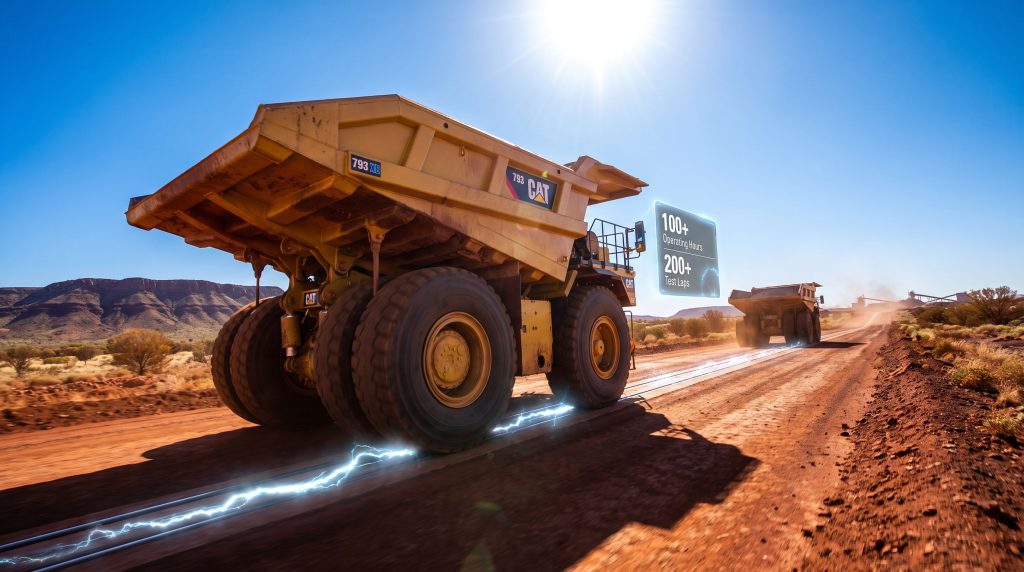
Phase 1 of the Jimblebar battery-electric truck trial accumulated more than 100 operating hours and completed over 200 test laps across a three-month period using two Cat 793 XE Early Learner trucks. The dataset generated from this phase was sufficient to validate baseline assumptions across three core pillars:
- Safety performance under active Pilbara mining conditions, including interactions with other fleet equipment and personnel
- Technology reliability across the full operating temperature range experienced at Jimblebar, where ambient conditions regularly exceed 40°C
- Maintenance requirements including servicing intervals, battery thermal management behaviour, and component wear patterns under loaded haul conditions
What Validated Key Assumptions Actually Means
The language of assumption validation is precise and deliberately conservative. It does not mean the trucks performed at commercial benchmark levels. It means that the engineering premises underpinning the trial design held up under operational scrutiny. That is the correct metric for an Early Learner program, and it is genuinely meaningful progress.
One dimension of Phase 1 that deserves more attention than it typically receives is the thermal management data. Battery chemistry is temperature-sensitive in both directions — performance degrades at high ambient temperatures, and thermal runaway risk increases under sustained high-load charging and discharging cycles. The Pilbara delivers both challenges simultaneously. The fact that Phase 1 completed its full program without reported thermal incidents is a substantive data point, not a trivial one.
Maintenance learnings from Phase 1 also fed directly into the Phase 2 design. Furthermore, understanding how servicing intervals, tyre wear patterns under battery-driven torque delivery, and the specific failure modes of electric drivetrain components behave under Pilbara conditions requires actual operational exposure — and Phase 1 provided it.
Phase 2 and the Dynamic Charging Challenge
Why Stationary Charging Alone Cannot Solve the Productivity Problem
The move into Jimblebar battery-electric truck trials phase 2 introduces the most technically ambitious element of the entire program: dynamic in-motion charging via an energy transfer system that delivers electrical power to trucks while they are actively hauling ore. Understanding why this capability matters requires a brief explanation of open-pit haulage economics.
In a large open-pit operation, haul truck productivity is measured by tonne-kilometres per hour. Any time a truck is stationary, it is generating zero productive output while still consuming capital, labour, and infrastructure. Diesel trucks refuel in minutes and return to the haul cycle almost immediately. A battery-electric truck that requires extended stationary charging periods creates a fundamental productivity gap versus its diesel equivalent — a gap that would materially undermine the business case for fleet electrification regardless of fuel cost savings. Indeed, the iron haulage operations sector has consistently demonstrated how sensitive productivity metrics are to any interruption in haulage cycle times.
Dynamic in-motion charging represents a fundamentally different engineering challenge compared to depot-based or stationary opportunity charging. It requires simultaneous coordination of power delivery, vehicle speed, road geometry, and safety interlocks — all under the thermal and dust conditions of a Pilbara iron ore operation.
Dynamic charging addresses this constraint by embedding energy transfer capability into segments of the haul road itself. Trucks receive electrical power continuously as they traverse electrified road sections, maintaining battery state-of-charge without interrupting the haul cycle. In principle, this closes the productivity gap with diesel. In practice, it introduces a set of engineering challenges that Phase 2 is specifically designed to quantify and resolve.
What Phase 2 Is Evaluating
The Phase 2 evaluation framework covers five interconnected dimensions:
- Technical readiness: Whether the energy transfer system maintains consistent power delivery across variable haul road surface conditions, including dust, gradient changes, and loaded versus unloaded truck configurations
- Infrastructure scalability: The physical and electrical infrastructure requirements for extending dynamic charging across a full haul network, including power delivery architecture and integration with mine management systems
- Safety under dynamic conditions: How the charging system behaves when trucks are fully loaded, moving at operational speed, and operating in close proximity to other equipment
- Maintenance and interface durability: How the mechanical and electrical components of the charging interface withstand continuous operational stress under Pilbara conditions
- Commercial feasibility: Total cost of ownership modelling that incorporates dynamic charging infrastructure capital expenditure alongside ongoing operational costs
Why the Pilbara Is the Right Place to Test This Technology
Extreme Conditions as a Validation Multiplier
The Pilbara's operating environment is frequently described as among the most demanding on earth, and that characterisation is not hyperbole. Ambient temperatures regularly exceed 45 degrees Celsius during summer months. Haul distances are long, gradients are significant, and operations run continuously across three shifts with no seasonal downtime. Dust concentrations are extreme, and the electrical and mechanical systems onboard mining equipment must perform reliably through all of it.
These conditions stress-test battery chemistry, power electronics, and charging interfaces in ways that more temperate trial environments simply cannot replicate. A battery-electric truck that validates performance metrics at Jimblebar carries a degree of global deployment confidence that results from a milder climate trial cannot match. This is the core strategic logic behind selecting the Pilbara as the proving ground, and it reinforces Australia's iron ore leadership as a natural testing environment for next-generation mining technologies.
How Jimblebar Compares to Other Global Trial Environments
| Trial Location | Operator | Conditions | Trial Status |
|---|---|---|---|
| Jimblebar, WA (Pilbara) | BHP / Rio Tinto / Caterpillar | Extreme heat, iron ore haulage | Phase 2 active |
| Boliden Aitik, Sweden | Boliden / Epiroc | Sub-arctic, copper mining | Operational trials |
| Codelco operations, Chile | Codelco / OEM partners | High altitude, copper mining | Feasibility stage |
| Komatsu 930E-5 BE (multiple) | Various operators | Mixed climates | Ongoing OEM development |
The Jimblebar trial stands out not only for its environmental severity but for the scale of the operation in which it is embedded. Testing in a live, high-production iron ore environment — rather than a scaled-down or purpose-built trial facility — generates data that is directly transferable to commercial deployment decisions.
The next major ASX story will hit our subscribers first
The Strategic Stakes for BHP and Rio Tinto
BHP's Electrification Roadmap
BHP has publicly positioned battery-electric truck technology as a foundational component of its operational decarbonisation strategy. The company's stated approach is staged: accumulate operational trial data, resolve charging infrastructure requirements, then make capital allocation decisions for wider fleet electrification across the Pilbara iron ore portfolio. BHP's president for Australia has indicated that the trial is advancing the understanding needed to scale across operations, covering charging infrastructure, energy management, and integration with safe and productive operating systems.
The sequencing here is deliberate. Committing capital to fleet-scale electrification before the infrastructure questions are resolved would expose the company to stranded asset risk if dynamic charging technology requires significant further refinement. The trial model allows BHP to generate the data needed for a defensible capital allocation decision without prematurely locking in a particular technical pathway. The mining decarbonisation benefits that flow from getting this sequencing right are substantial for both operators and the broader industry.
Rio Tinto's Rationale for Co-Participation
Rio Tinto's decision to participate in a trial hosted at a competitor's operation is strategically interesting. The data-sharing model means Rio Tinto gains access to real-world Pilbara performance data from a live haul operation without bearing the full cost and operational complexity of running an independent trial. Rio Tinto Iron Ore has noted that the Pilbara's scale and intensity make it the ideal environment to understand what broader deployment would require, reinforcing that the company views Jimblebar trial data as directly applicable to its own fleet planning.
This cooperative approach within a competitive industry reflects a broader pattern in mining decarbonisation: the technology development costs are high enough, and the industry-wide pressure to demonstrate progress is uniform enough, that shared trial programs offer a rational path forward for all participants.
What Fleet-Scale Electrification Would Mean for Pilbara Economics
The implications of successful electrification at Jimblebar extend well beyond emissions accounting. Diesel fuel represents one of the largest operating cost line items for Pilbara iron ore producers. Electrification — particularly when powered by renewable energy sources — would materially alter the operating cost structure of haulage, though the capital expenditure required for dynamic charging infrastructure, grid connection, and renewable energy supply would need to be weighed carefully in any total cost of ownership analysis.
There is also a compelling intersection with autonomous haulage technology. Both BHP and Rio Tinto already operate autonomous haul truck fleets at Pilbara operations, and the mining automation trends shaping this space suggest the convergence of driverless and zero-emission capabilities is accelerating. The possibility of fleets that are simultaneously driverless and zero-emission represents a compounding productivity and cost advantage that is shaping long-term fleet strategy discussions at both companies.
Caterpillar's Evolving Role in the Electric Mining Transition
From Equipment Seller to Integrated Solutions Partner
Caterpillar's participation in the Jimblebar trial reflects a strategic repositioning that is reshaping how mining OEMs compete. The traditional model — design a machine, sell it, support it through a dealer network — is giving way to a more integrated approach in which the OEM participates directly in customer operational trials, co-develops deployment solutions, and extracts product development intelligence from real-world performance data.
The "Early Learner" product philosophy is the clearest expression of this shift. Caterpillar is building trucks explicitly designed to generate the data needed for confident customer deployment, rather than attempting to bring a commercially polished product to market without the field validation to back it up. Caterpillar's leadership has indicated that progress from the trial is accelerating the development of solutions that customers can implement with confidence — a framing that positions the trial as product development infrastructure, not simply a marketing exercise.
Competitive Dynamics in the Battery-Electric Haul Truck Segment
Caterpillar is not operating in isolation. Komatsu, Liebherr, and Epiroc are all pursuing battery-electric haul truck programs with varying degrees of maturity. The BHP and Rio Tinto battery-electric haul truck trial gives Caterpillar access to the kind of high-severity, real-world operational data that is extraordinarily difficult to replicate in controlled testing environments, providing a potential product development advantage that competitors without comparable trial partnerships will struggle to match.
The lessons learned at Jimblebar — both from Phase 1 and the dynamic charging work underway in Phase 2 — will feed directly into engineering specifications for future production variants of the Cat 793 XE. The timeline from Early Learner to commercially deployable battery-electric haul truck remains dependent on Phase 2 outcomes, but the trial is compressing that development curve in ways that isolated R&D programs cannot.
Scenario Analysis: What Phase 2 Could Mean for the Industry
The outcomes of the Jimblebar battery-electric truck trials phase 2 will not be binary. Three plausible scenarios frame the range of possible conclusions:
Scenario A: Full Validation
Dynamic charging performs as designed across variable haul road conditions, safety interlocks function reliably under operational stress, and the total cost of ownership modelling supports a fleet-scale business case. BHP and Rio Tinto advance toward staged fleet electrification commitments, with wider deployment programs potentially beginning before 2030.
Scenario B: Partial Validation
The core technology functions but requires significant refinement in areas such as charging interface durability, power delivery consistency on steep gradients, or integration with existing mine management systems. The commercial deployment timeline extends by three to five years while second-generation hardware is developed and retested.
Scenario C: Fundamental Constraints Identified
Phase 2 surfaces limitations in dynamic charging that are not resolvable within acceptable cost or engineering parameters under Pilbara conditions. Investment redirects toward alternative zero-emission pathways — hydrogen fuel cell powertrains, hybrid diesel-electric configurations, or stationary fast-charging systems paired with redesigned haul cycle management. The Pilbara electric haul truck programme has, however, been designed with sufficient engineering rigour to minimise the likelihood of this outcome.
Disclaimer: The scenario projections above are analytical frameworks based on publicly available information and general industry knowledge. They do not constitute financial advice or represent the stated positions of BHP, Rio Tinto, or Caterpillar.
Key Takeaways: What the Phase 2 Trial Signals
- Phase 1 delivered genuine proof of concept — more than 100 operating hours and over 200 test laps validated safety, technology, and maintenance assumptions under real Pilbara conditions
- Phase 2 is the commercial viability test — dynamic in-motion charging is the technology bridge between demonstration and deployment at scale
- The tri-party model compresses the learning curve — shared operational data between BHP, Rio Tinto, and Caterpillar accelerates development timelines that would take far longer in isolated programs
- The Pilbara's severity is a validation multiplier — success under these conditions provides global deployment confidence that milder-climate trials cannot replicate
- Fleet electrification timelines remain infrastructure-dependent — the pace of scale-up will be determined as much by charging system maturity and grid capacity as by truck technology itself
- The intersection with autonomous haulage is underappreciated — the prospect of fleets that are simultaneously driverless and zero-emission adds a compounding dimension to the long-term economics of Pilbara iron ore production
Frequently Asked Questions: Jimblebar Battery-Electric Truck Trial Phase 2
What is the Jimblebar battery-electric truck trial?
A collaborative program between BHP, Rio Tinto, and Caterpillar testing two Cat 793 XE Early Learner battery-electric haul trucks at BHP's Jimblebar iron ore mine in Western Australia's Pilbara region, with the objective of generating real-world operational data to inform potential large-scale fleet electrification.
What did Phase 1 establish?
Phase 1 logged more than 100 operating hours and over 200 test laps across three months, confirming baseline performance across safety, technology reliability, and maintenance protocols under Pilbara conditions.
What is Phase 2 testing?
Phase 2 introduces dynamic in-motion charging through an energy transfer system, evaluating whether trucks can receive electrical power while actively hauling — a capability considered essential for matching the productivity economics of diesel fleets.
Why does dynamic charging matter?
Stationary charging creates productivity penalties by removing trucks from the active haul cycle. Dynamic charging allows continuous operation while maintaining battery state-of-charge, which is the key to making battery-electric haulage commercially competitive at scale.
What is the Cat 793 XE Early Learner?
A purpose-built battery-electric variant of Caterpillar's 793 ultra-class haul truck platform, designed specifically to generate operational and technical data under real-world mining conditions rather than to meet full commercial performance specifications from the outset.
When might battery-electric haul trucks be deployed at scale in the Pilbara?
Wider fleet deployment decisions are contingent on Phase 2 outcomes and the resolution of charging infrastructure requirements. No confirmed commercial deployment timeline has been publicly announced by BHP or Rio Tinto beyond the trial program currently underway.
Want to Track the Next Wave of ASX Mining Innovation Before the Market Does?
Discovery Alert's proprietary Discovery IQ model scans ASX announcements in real time, instantly identifying significant mineral discoveries and actionable investment opportunities — from the companies developing the next generation of Pilbara iron ore technology to the explorers making transformative finds. Explore historic discoveries and their market returns on Discovery Alert's dedicated discoveries page, and begin your 14-day free trial today to position yourself ahead of the broader market.