August 20, 2026
The Hidden Productivity Crisis Draining Value From Open-Pit Mining Operations
Every tonne of ore moved through an open-pit mine represents a chain of decisions, machine interactions, and data events that traditional fleet management systems were never designed to fully capture. MaxMine AI-powered tools for mine operator productivity have emerged as a direct response to this structural gap. In most operations, significant value is quietly lost not through catastrophic failures, but through the accumulated weight of small inefficiencies: a haul truck idling for an extra four minutes per cycle, a load misclassified in a manual reporting system, a shift supervisor making decisions based on data that is already an hour old.
These are not edge cases. Across the global open-pit mining industry, the structural gap between data collection and meaningful operational response is one of the most persistent and underappreciated sources of margin erosion. As commodity price cycles tighten, the question of how to extract more productivity from existing fleets — without adding capital expenditure — has moved firmly into the executive agenda.
When big ASX news breaks, our subscribers know first
Why Conventional Fleet Management Systems Are Reaching Their Limits
Traditional fleet management systems were built around a relatively simple premise: track where machines are, log what they move, and report results at shift end. For an era when data collection itself was the primary challenge, this was sufficient. In today's environment, where sensor-rich machines generate continuous streams of operational data, the bottleneck has shifted entirely.
The problem is no longer data scarcity. It is data quality, classification accuracy, and the speed at which meaningful signals can be extracted and acted upon. Manual data entry introduces classification errors that compound over time, distorting production records and making it nearly impossible to identify genuine performance trends versus reporting artefacts.
Furthermore, subjective performance reviews conducted after the fact by supervisors working from incomplete information fail to capture the real dynamics of intra-shift performance variation. Consider the compounding effect of several common inefficiencies operating simultaneously across a large fleet:
- Idle time accumulation across a fleet of 30 haul trucks, each averaging just 8 minutes of unproductive idle per cycle, can represent hundreds of lost productive hours per month
- Haul road deterioration, when undetected and unaddressed, increases rolling resistance, raising fuel consumption per tonne moved and accelerating tyre wear
- Load inconsistency, whether systematic under-loading or occasional over-loading, affects both productivity metrics and long-term equipment health
- Misclassified production cycles create reporting errors that hide the true scale of these problems from management
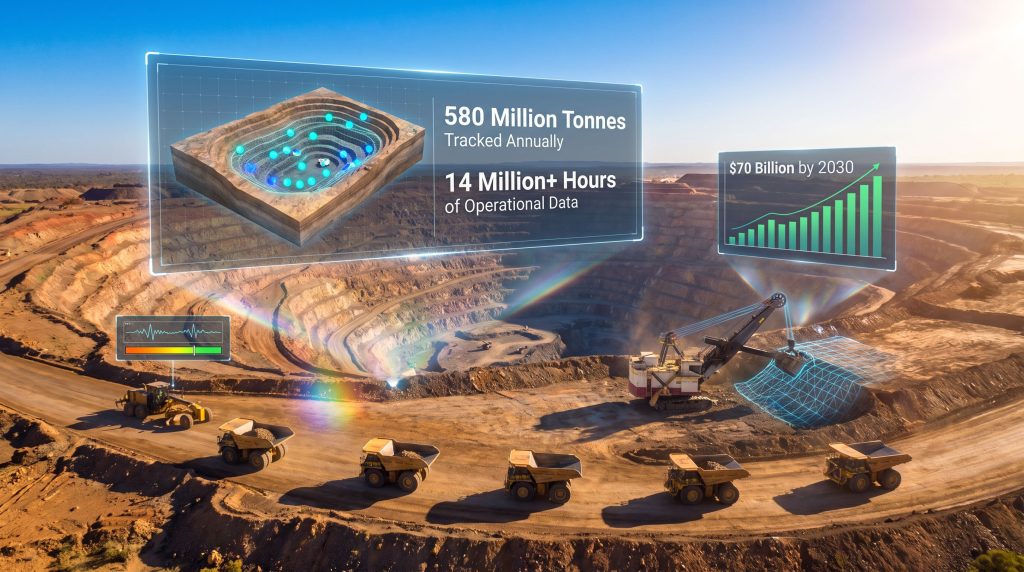
The mining fleet management sector is projected to surpass $70 billion by 2030, reflecting the scale of investment the industry recognises is required to address these systemic challenges. Mining companies are simultaneously navigating productivity mandates, fuel reduction targets, and increasingly stringent ESG reporting requirements. Addressing all three with a single integrated platform is the value proposition reshaping how the industry thinks about operational technology.
Broader shifts toward data-driven mining operations are accelerating the pressure on conventional systems to evolve or become obsolete.
What MaxMine's AI Platform Actually Does Differently
A Foundation Built on Operational Scale
MaxMine has spent over a decade building a comprehensive AI-powered mining productivity platform specifically designed for open-pit and open-cut environments. The platform's depth comes from the scale of operational data it has accumulated: more than 580 million tonnes tracked annually, over 14 million hours of operational data analysed, and a history of more than 230 incident investigations conducted across its client base.
This data foundation matters for a reason frequently underappreciated in discussions of AI-powered mining efficiency. Machine learning systems improve in direct proportion to the quality and volume of operational data they are trained on. A platform that has processed 14 million hours of real-world mining machine behaviour has calibrated its models against a scale of operational diversity that newer entrants cannot easily replicate.
Platform Architecture at a Glance
The platform architecture spans five distinct functional layers:
| Platform Layer | Product Name | Primary Function |
|---|---|---|
| AI Analytics Engine | MaxCube | Data cleansing, event classification, and machine learning processing |
| Short Interval Control | MaxMine Pulse | Real-time production tracking and intra-shift decision support |
| Operational Analytics | MaxMine Impact | Safety, productivity, and sustainability improvement programmes |
| Reporting and Dashboards | MaxHub | Analysis layer for supervisors and management teams |
| Infrastructure Monitoring | MaxMine Roads | Haul-road condition monitoring and grader effectiveness tracking |
One of the more technically significant capabilities within this architecture is the platform's production-grade machine learning classification system. Deployed across Australian mining customers for over six months, this system automatically identifies and categorises load and dump events without manual input. The practical consequence is a measurable improvement in production tracking accuracy and a substantial reduction in the data reconciliation workload that typically consumes significant supervisor time at shift boundaries.
The L5 Navigation Partnership: Precision Positioning as a Competitive Differentiator
MaxMine's recently announced collaboration with L5 Navigation, a Swedish machine control technology developer, represents a meaningful technical expansion of the platform's capabilities. The integration centres on GNSS (Global Navigation Satellite System) receivers capable of delivering centimetre-level equipment positioning accuracy.
This level of positional precision is qualitatively different from the standard GPS tracking found in conventional fleet management systems. Standard GPS typically delivers accuracy within a few metres, which is adequate for broad fleet visibility but insufficient for detailed dig-face management or precise equipment positioning relative to mine design surfaces.
Technical Note: Centimetre-level GNSS positioning, combined with 3D geological modelling of mine surfaces and block models, allows operators to confirm exact equipment location relative to planned excavation geometry. This capability has direct implications for ore loss and dilution control, two of the most financially significant and least visible sources of value leakage in open-pit mining.
The Machine Guidance capability enabled by this integration allows operators to visualise maps, surfaces, and block models within a synchronised three-dimensional environment. For drill and blast operations, advancements in AI in drilling and blasting further complement this level of positional accuracy. For excavator operators, it enables better control of dig boundaries. For fleet supervisors, it provides a live operational picture that was previously only available in retrospective shift reports.
These capabilities will be embedded within MaxMine Pulse, the platform's real-time short interval control product, creating a unified interface for live fleet tracking, payload monitoring, and precision positioning.
Five Productivity Levers and the Human Layer Behind Them
What Drives Measurable Results?
Understanding how MaxMine AI-powered tools for mine operator productivity actually generate measurable results requires looking at both the technological mechanisms and the human factors that determine whether technology adoption delivers lasting change. The platform targets five primary productivity levers:
- Idle Time Reduction — Pattern recognition across shift data identifies when and where unproductive machine time is occurring, enabling targeted intervention
- Payload Optimisation — Continuous load tracking identifies systematic under-loading and over-loading, with direct implications for both productivity rates and equipment lifecycle costs
- Cycle Time Analysis — Benchmarking of haul cycles surfaces inefficiencies in routing sequences, queue management, and dump point operations
- Haul Road Condition Monitoring — Sensor-based continuous assessment of road surface quality links infrastructure condition directly to fuel consumption and tyre wear outcomes
- Operator Behaviour Tracking — Individual and crew-level performance measured against standardised benchmarks, enabling targeted coaching rather than generalised feedback
The fifth lever deserves particular attention because it represents the dimension where technology adoption most often fails. Platforms that generate rich performance data but deliver it exclusively to management dashboards frequently encounter operator resistance, because the data becomes a surveillance tool rather than a professional development resource.
MaxMine's approach inverts this dynamic by delivering personalised shift result summaries directly to operators. This design choice transforms performance data from something that happens to operators into something that works for them. Metric-based, objective feedback replaces the inherently subjective supervisor assessment, reducing the adversarial tension that can undermine performance improvement programmes.
Industry Insight: Research across manufacturing and logistics sectors consistently shows that worker-facing performance feedback, when delivered transparently and tied to individual improvement rather than punitive outcomes, generates sustainable productivity gains that management-only dashboards cannot achieve. MaxMine's operator coaching architecture applies this principle directly to mining fleet operations.
The Sustainability Connection: Productivity Data as an ESG Input
One of the less obvious but increasingly important dimensions of MaxMine's platform is its ability to simultaneously serve productivity and sustainability objectives. Reducing idle time and optimising haul cycles does not just improve tonnes per hour metrics — it directly reduces fuel burn per tonne moved, which translates into lower operational emissions.
Improving haul road condition reduces rolling resistance, which further reduces fuel consumption across the entire fleet on a continuous basis. This means the same operational data driving productivity improvement is simultaneously generating the inputs needed for scope 1 emissions reporting.
For mining operators navigating increasingly detailed ESG disclosure requirements, the ability to demonstrate measurable emissions reductions achieved through operational optimisation — rather than capital investment in new equipment — represents a meaningful reporting advantage. Notably, recent industry research on emissions tracking highlights that operational efficiency improvements remain among the most cost-effective pathways to decarbonisation.
The next major ASX story will hit our subscribers first
Who Is Deploying MaxMine and What Does the Client Mix Reveal?
The composition of MaxMine's client roster provides important signals about where the platform sits within the industry's technology adoption curve. Operating across a client base that includes Glencore, Coronado Global Resources, Batchfire Resources, Mineral Resources (MIN), Macmahon, and NRW Civil & Mining confirms deployment at enterprise scale across multiple commodity types and operational structures.
| Client | Type | Commodity Exposure |
|---|---|---|
| Glencore | Global diversified major | Multi-commodity, global |
| Coronado Global Resources | Owner-operator | Metallurgical coal |
| Batchfire Resources | Owner-operator | Thermal coal |
| Mineral Resources (MIN) | ASX Top 200 diversified miner | Lithium, iron ore |
| Macmahon | Contract miner | Multi-commodity, open-pit and underground |
| NRW Civil & Mining | Specialist contractor | Multi-commodity, Australian focus |
The presence of both owner-operators and contract miners within the same client base is particularly significant. These two operational structures have different commercial incentive frameworks. Owner-operators capture the full benefit of productivity improvement through reduced operating cost per tonne, whereas contract miners improve their competitive positioning and margin performance relative to contract benchmarks.
A platform that delivers measurable value across both structures demonstrates genuine versatility rather than niche applicability.
The Broader Trajectory: AI and IoT Converging Toward Integrated Mine Intelligence
The capabilities MaxMine is assembling — combining AI-driven analytics, real-time short interval control, precision GNSS positioning, and operator-facing coaching tools — reflect a broader industry convergence that is fundamentally changing the economics of operational technology investment. Current mining automation trends suggest this convergence will only accelerate over the coming decade.
Historically, mine sites deployed multiple point solutions: a fleet management system from one vendor, a machine health monitoring tool from another, and a separate system for safety incident reporting. The integration overhead and data fragmentation created by this approach limited the analytical value any individual system could deliver.
The emerging model consolidates these functions within integrated platforms that share a common data infrastructure, enabling cross-domain analysis that point solutions cannot support. For instance, correlating operator behaviour data with haul road condition metrics and cycle time performance reveals interaction effects that would be invisible when examining each data stream in isolation.
Emerging capabilities within this category are also beginning to address route optimisation algorithms that dynamically adjust haul paths based on real-time road condition and traffic data, alongside increasingly sophisticated downtime classification systems that distinguish between scheduled maintenance windows, unplanned equipment failures, and operational delays caused by external factors.
As the fleet management market approaches its projected $70 billion valuation by 2030, platforms that successfully integrate AI, precision positioning, IoT data streams, and operator-facing tools into a coherent operational intelligence system are well positioned to capture a disproportionate share of that investment. According to industry analysts tracking mining technology adoption, the competitive advantage will increasingly belong to platforms with the deepest operational data foundations.
Disclaimer: Market size projections and financial forecasts referenced in this article are based on publicly available industry research and should not be construed as investment advice. Forward-looking statements regarding technology capabilities and commercial outcomes involve inherent uncertainty.
Frequently Asked Questions: MaxMine AI Tools for Mine Operator Productivity
What types of mining operations is MaxMine designed for?
MaxMine is primarily built for open-pit and open-cut mining environments and has demonstrated deployment across coal, iron ore, lithium, and contract mining operations. Both owner-operators and contract miners feature in its client base.
How does the machine learning classification system improve production tracking accuracy?
By automatically identifying and categorising load and dump events without manual data entry, the system eliminates the classification errors that typically distort production records. Australian mining customers running the system for over six months have recorded measurable improvements in production tracking accuracy.
What is the operational difference between MaxMine Pulse and MaxMine Impact?
MaxMine Pulse delivers real-time, intra-shift fleet visibility, enabling supervisors to make resource allocation and routing decisions during a shift rather than reviewing performance retrospectively. MaxMine Impact is the broader operational improvement programme layer, delivering structured initiatives across production, safety, road management, and asset health over longer timeframes.
How does the L5 Navigation integration enhance existing platform capabilities?
The addition of centimetre-level GNSS positioning from L5 Navigation moves equipment tracking from broad fleet visibility into precision machine guidance territory. Operators can visualise their exact position relative to mine design surfaces and block models within a synchronised 3D environment, with direct benefits for dig accuracy and asset allocation.
Can productivity optimisation contribute meaningfully to emissions reduction targets?
Operational improvements targeting idle time reduction, haul cycle optimisation, and road condition management directly reduce fuel consumption per tonne moved. This approach delivers scope 1 emissions reductions without requiring capital expenditure on new equipment, making it a viable pathway for operators managing both productivity and ESG performance mandates simultaneously. MaxMine AI-powered tools for mine operator productivity therefore serve dual commercial and sustainability imperatives within a single integrated platform.
Want to Know Which ASX Mining Companies Are Leading the Productivity Revolution?
Discovery Alert's proprietary Discovery IQ model scans ASX announcements in real time, instantly identifying significant mineral discoveries and turning complex data into actionable investment insights — the same way advanced platforms like MaxMine are transforming raw operational data into competitive advantage. Explore how historic discoveries have generated substantial returns on Discovery Alert's dedicated discoveries page, and begin your 14-day free trial to position yourself ahead of the broader market.