July 22, 2026
The Industrial Emissions Problem That Coal Cannot Solve Itself
Heavy industry sits at one of the most uncomfortable intersections in the global energy transition. Unlike passenger vehicles or commercial buildings, large-scale industrial facilities cannot simply swap their energy source overnight. Alumina refineries, steel plants, and smelting operations depend on high-temperature combustion processes where coal has, for decades, been the only economically viable option at scale. Yet as carbon accounting tightens and investor scrutiny intensifies, Rio backs Queensland biochar facility development as one credible answer to near-term industrial decarbonisation.
That question is exactly what the agreement between Rio Tinto and Queensland bioenergy company SuperChar is designed to answer, at least in part. The technical approach being explored, replacing a meaningful fraction of boiler coal with thermally processed biomass, reflects a broader shift in how major resource companies are thinking about near-term emissions reduction without the capital disruption of wholesale process redesign. This connects closely to broader trends in renewable energy in mining across Australia.
When big ASX news breaks, our subscribers know first
Why Alumina Refining Produces Some of Mining's Most Stubborn Emissions
Producing aluminium begins long before the smelter. The first stage, alumina refining, involves the Bayer process, a chemically intensive method of extracting aluminium oxide from bauxite ore using caustic soda at elevated temperatures. The process requires sustained, high-grade heat that is typically generated by burning fossil fuels in large industrial boilers.
This thermal dependency creates a persistent Scope 1 emissions problem. Unlike electricity, which can theoretically be sourced from renewables, the heat demand of the Bayer process is direct, continuous, and difficult to electrify at the scale required by a major refinery. The result is that even as miners invest in renewable-powered smelters, the upstream refining stage continues to generate significant direct emissions.
Queensland's Gladstone region, home to some of Australia's most energy-intensive alumina and aluminium infrastructure, sits at the centre of this challenge. Furthermore, reducing the carbon intensity of refinery boiler fuel without shutting down or re-engineering entire facilities represents one of the more pragmatic near-term levers available to operators. For context, the renewable Gladstone operations at Rio Tinto's existing sites demonstrate the scale of transition already underway.
Breaking Down the Rio Tinto and SuperChar Agreement
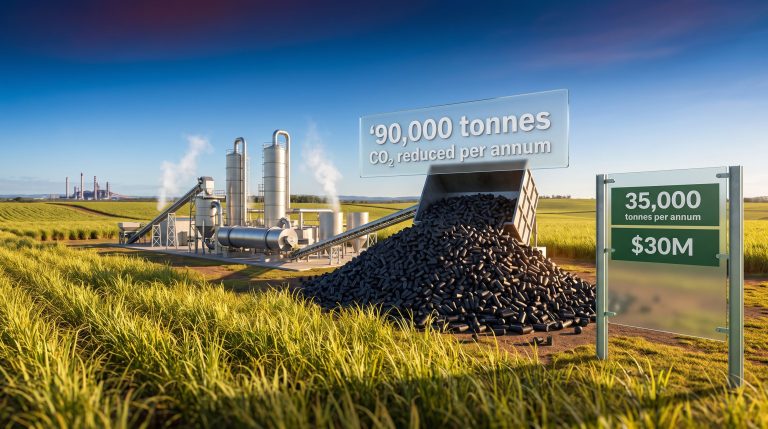
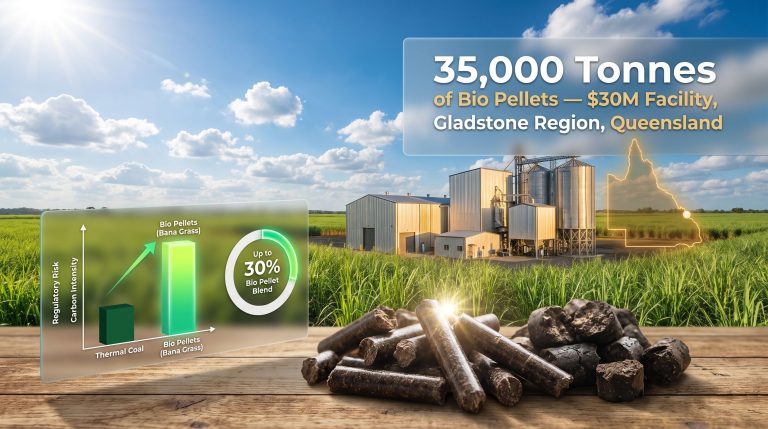
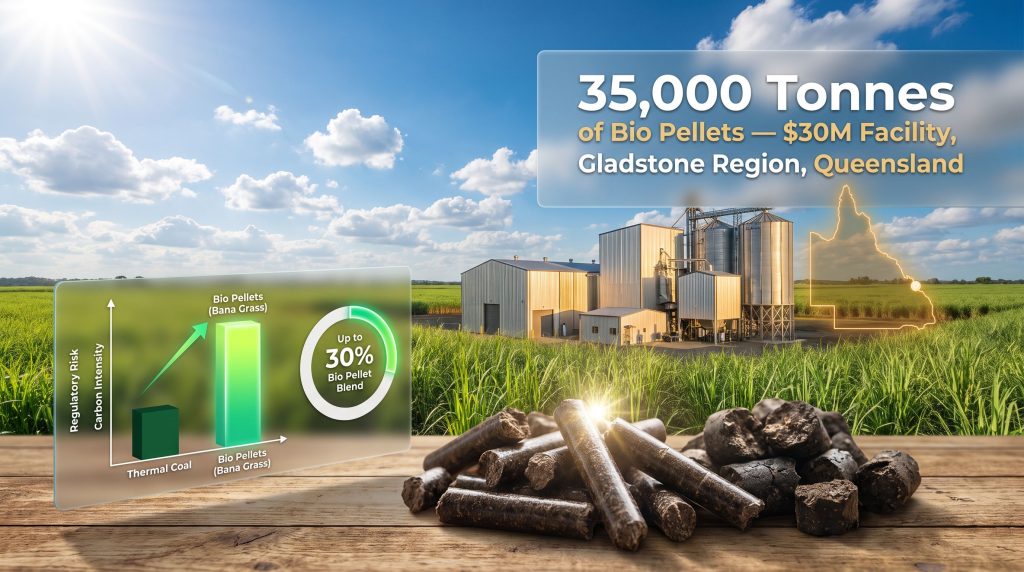
Rio Tinto has entered a preliminary five-year offtake agreement with SuperChar to purchase 35,000 tonnes of bio pellets annually, with delivery targeted by 2028. The arrangement supports SuperChar's proposed $30 million production facility located near Boyne in Queensland's Gladstone region, a site chosen for its proximity to Rio Tinto's existing refinery infrastructure and its access to agricultural biomass feedstock.
| Parameter | Detail |
|---|---|
| Agreement Type | Preliminary five-year offtake contract |
| Volume Committed | 35,000 tonnes of bio pellets per annum |
| Target Delivery Year | 2028 (subject to approvals) |
| Facility Location | Near Boyne, Gladstone Region, Queensland |
| Estimated Facility Capital Cost | $30 million |
| Secondary Product Output | 25,000 tonnes of cooking briquettes per annum |
| Projected Direct Employment | Approximately 25 jobs |
| Primary Feedstock | Bana grass (biomass) |
The agreement is structured as a preliminary offtake arrangement, meaning it provides commercial certainty to underpin SuperChar's development case, but it is contingent on the facility receiving the necessary regulatory approvals and securing its remaining funding. The dual-product model, supplying both industrial bio pellets to Rio Tinto and cooking briquettes to a separate consumer market, adds revenue diversity and improves overall project economics.
Biochar vs. Bio Pellets: Understanding the Terminology
One aspect of this deal that deserves clarification is the distinction between biochar and bio pellets, terms that are often used loosely in industry coverage but represent meaningfully different products.
Biochar in its traditional sense refers to a carbon-rich solid produced by pyrolysis, the high-temperature decomposition of organic material in a low-oxygen environment. It is primarily associated with carbon sequestration applications and soil enhancement rather than energy generation. According to the ABC's coverage, the terminology around these products continues to evolve as the industry matures.
Bio pellets, by contrast, are a fuel product. They are produced by thermally processing biomass, in this case bana grass, to increase energy density and improve combustion properties. The product Rio Tinto is procuring sits within this category, positioning the SuperChar project as a biomass-to-industrial-fuel operation rather than a pure carbon capture exercise.
From Grass to Industrial Fuel: The Technical Conversion Pathway
Bana grass (Pennisetum purpureum hybrid) is a fast-growing perennial crop that has attracted attention as a biomass feedstock due to its high yield per hectare, relatively low water requirements, and suitability for cultivation on marginal agricultural land across central Queensland. Its high cellulose content makes it well-suited to thermal processing pathways.
The conversion from raw biomass to a usable industrial fuel follows a structured process:
- Cultivation and harvesting of bana grass across Queensland's agricultural zones, with multiple cuts possible per growing season.
- Pre-processing and moisture reduction, including mechanical shredding and drying to bring moisture content down to levels compatible with thermal conversion.
- Torrefaction or pelletisation, a thermal treatment stage conducted at moderate temperatures (typically 200 to 320 degrees Celsius) that removes residual moisture and increases energy density.
- Quality grading and specification testing to ensure the finished product meets the combustion performance specifications required for industrial boiler use.
- Delivery and blending at the refinery site, where bio pellets are combined with coal at tested ratios to achieve the desired combustion profile.
Torrefied biomass pellets produced through this pathway can achieve energy densities significantly closer to coal than untreated biomass, a critical factor for industrial boiler compatibility. However, even optimised bio pellets typically carry a lower calorific value per unit mass than high-quality thermal coal, meaning blend ratios must be carefully calibrated.
The 30% Blend Threshold: What the Feasibility Work Revealed
Rio Tinto's internal feasibility assessment, validated through combustion trials conducted in both 2024 and 2025, determined that its Gladstone refinery boilers can operate on fuel blends containing up to 30% bio pellets without requiring fundamental modifications to boiler infrastructure. This threshold is commercially significant because it means the transition can be achieved as an operational adjustment rather than a capital-intensive re-engineering project.
A 30% biomass substitution rate in a major alumina refinery's boiler fleet represents a meaningful and measurable reduction in direct Scope 1 emissions, particularly when applied continuously across a multi-year operating period. At that substitution rate, the effective carbon intensity of boiler combustion is reduced proportionally, assuming the biomass feedstock meets sustainability criteria that allow it to be counted as low-carbon fuel under applicable accounting standards.
The significance of this threshold extends beyond Rio Tinto's own operations. It provides a tested reference point that other industrial operators in Australia and internationally could use when evaluating biomass blending as a decarbonisation strategy for their own boiler assets. Indeed, the mining decarbonisation economics increasingly favour this kind of blended-fuel approach.
Where Bio Pellets Fit Within Rio Tinto's Broader Queensland Decarbonisation Strategy
The SuperChar agreement does not exist in isolation. It forms one component within a layered decarbonisation approach that Rio Tinto is applying across its Queensland aluminium and alumina assets. The Boyne Island aluminium smelter, which is among the most energy-intensive industrial facilities in Queensland, has been the focus of separate renewable electricity investment discussions.
The strategic logic of the bio pellet approach can be understood across three timeframes:
- Near term (to 2028): Bio pellet blending at 30% provides an achievable Scope 1 reduction that can be implemented within the operational lifespan of existing boiler infrastructure, requiring no major capital disruption.
- Medium term (2028 to 2035): As the domestic biomass supply chain matures and production costs potentially decline with scale, the economics of bio pellet substitution may improve, supporting higher blend ratios or expanded application across additional boiler units.
- Long term (post-2035): Full decarbonisation of refinery thermal energy would likely require either green hydrogen combustion or electrification of process heat, both of which remain at earlier stages of commercial development for alumina-scale applications.
This tiered approach reflects a practical reality: the technologies needed for complete decarbonisation are not yet commercially available at the scale required by major refineries. Bio pellet substitution, while not a complete solution, delivers measurable progress without waiting for longer-horizon technologies to mature. Consequently, exploring industrial decarbonisation pathways like this one has become a strategic priority for operators across the sector.
Assessing the Commercial Viability of the SuperChar Facility
Any analysis of the SuperChar project must acknowledge its conditional status. While Rio Tinto's offtake commitment provides important revenue visibility, the $30 million facility requires regulatory approval and the completion of its funding arrangements before construction can proceed. SuperChar's funding position has been described as well advanced, but the project should not be considered fully de-risked until those processes are concluded.
| Factor | Thermal Coal | Bio Pellets (Bana Grass) |
|---|---|---|
| Carbon Intensity | High | Significantly lower |
| Energy Density | High | Moderate (improved post-torrefaction) |
| Domestic Supply Chain | Established and mature | Emerging at commercial scale |
| Price Exposure | Commodity-linked and volatile | Contract-stabilised via offtake model |
| Regulatory Trajectory | Increasing cost burden | Increasingly favourable policy environment |
| Boiler Compatibility | Direct | Validated up to 30% blend at Gladstone |
The addition of a 25,000-tonne per annum cooking briquette output stream is a meaningful structural feature of the business case. This secondary market provides revenue that is not dependent on Rio Tinto's industrial demand and helps absorb fixed operating costs across a broader production base. It also reduces the facility's exposure to any single customer relationship, which is a positive factor from a project financing perspective.
The risks worth tracking closely include:
- Feedstock consistency: Bana grass yields can be affected by seasonal variability and climatic conditions, which introduces supply chain risk if buffer stock management is insufficient.
- Combustion performance variability: Batch-to-batch consistency in torrefied biomass pellets is a known challenge in the industry, and maintaining specification compliance over a five-year supply window will require robust quality management systems.
- Funding completion: The offtake agreement does not guarantee project delivery if the required co-investment or financing cannot be secured within the necessary timeframe.
The next major ASX story will hit our subscribers first
Queensland's Biomass Advantage and the Broader Industry Context
Queensland occupies a structurally advantageous position in Australia's emerging biomass energy supply chain. The state's agricultural land base, warm climate, and existing farming infrastructure create favourable conditions for high-yield biomass crop cultivation. Bana grass in particular is well-suited to Queensland's subtropical growing conditions and can produce multiple harvests annually.
Beyond the SuperChar project, the broader trend of mining sector operators exploring biomass and low-carbon fuel alternatives is accelerating. For instance, the Alcoa decarbonisation strategy includes investigation of biomass co-firing options at its Western Australian refinery operations. There is also growing industry interest in the potential for agricultural residues, including sugarcane bagasse and forestry waste, to serve as industrial boiler fuel supplements across Queensland's resource processing sector.
The mining industry's engagement with biomass as an emissions reduction tool reflects a broader pattern: rather than waiting for a single transformative technology, leading operators are assembling portfolios of incremental solutions that collectively move emissions trajectories in the required direction. Anchor offtake agreements from major industrial customers play a critical enabling role in this dynamic, providing the revenue certainty that allows smaller clean technology developers to access project finance.
Rio Tinto's broader biocarbon joint ventures internationally further illustrate how seriously the company is pursuing biomass-derived fuel solutions across its global operations.
Frequently Asked Questions
What is SuperChar and where will its facility be located?
SuperChar is an Australian bioenergy company focused on producing biomass-derived fuels. The proposed production facility is planned for a site near Boyne in Queensland's Gladstone region, chosen for its proximity to Rio Tinto's alumina refining operations and access to agricultural biomass feedstock in central Queensland.
How much coal could bio pellets realistically replace at Rio Tinto's Gladstone refinery?
Based on combustion trials conducted in 2024 and 2025, Rio Tinto's Gladstone refinery boilers have been validated for fuel blends containing up to 30% bio pellets. At the contracted volume of 35,000 tonnes per annum, this substitution rate would represent a proportional reduction in boiler-related Scope 1 emissions, though the precise tonnage of coal displaced depends on operating conditions and fuel specifications.
When is the facility expected to be operational?
The target delivery date for bio pellets under the offtake agreement is 2028, subject to the facility receiving required regulatory approvals and completing its funding arrangements.
Is Rio Tinto's interest in bio pellets part of a wider decarbonisation commitment?
Yes. Rio backs Queensland biochar facility development as one element within a broader emissions reduction strategy applied across Rio Tinto's Queensland aluminium and alumina operations, which also includes separate renewable energy considerations for its smelting facilities.
What This Agreement Signals for Mining's Green Transition
The structural significance of the Rio Tinto and SuperChar arrangement extends well beyond the specific volumes and timelines involved. It illustrates a model that is likely to become increasingly common across heavy industry: a major operator using its purchasing power to anchor the commercial case for a clean technology supplier, enabling project finance that would otherwise be difficult to secure.
This approach allows large miners to advance their decarbonisation commitments without taking direct equity risk in early-stage technology companies, while simultaneously developing domestic supply chains that may eventually serve multiple industrial customers. For Queensland's industrial emissions profile, a 30% coal substitution at a major alumina refinery, if delivered and sustained over the five-year agreement period, would represent a genuine and measurable reduction rather than a theoretical future commitment.
Whether the SuperChar facility ultimately reaches production will depend on factors beyond Rio Tinto's control. However, the commercial framework established by this agreement, offtake certainty enabling project finance, enabling supply chain development at scale, reflects exactly the kind of structural mechanism that analysts and policymakers have argued is necessary to bridge the gap between clean technology ambition and industrial reality. Furthermore, as Rio backs Queensland biochar facility projects of this kind, it sends a signal to the broader market that biomass-to-fuel conversion can be commercially viable at industrial scale.
Disclaimer: This article is intended for informational purposes only and does not constitute financial advice. Statements regarding project timelines, funding outcomes, and emissions reductions involve forward-looking assumptions that are subject to change. The SuperChar facility remains subject to regulatory and financial approvals. Readers should conduct their own due diligence before making investment decisions.
Want to Uncover the Next Major ASX Resource Discovery Before the Broader Market?
Discovery Alert's proprietary Discovery IQ model scans ASX announcements in real time, delivering instant, actionable alerts on significant mineral discoveries across more than 30 commodities — explore historic discoveries and their returns to understand the opportunity, then begin your 14-day free trial at Discovery Alert to position yourself ahead of the market.