
June 30, 2026
When the Ground Goes Dry: Industrial Extraction and the Silent Erosion of Cultural Landscapes
Across arid and semi-arid regions worldwide, groundwater is disappearing faster than it can be replenished. In the western United States, the Ogallala Aquifer has declined by more than 30 metres in some areas over recent decades. In northern India, satellite data has confirmed dramatic subsurface depletion across agricultural zones. And in the Pilbara region of Western Australia, a quieter but no less consequential story is unfolding — one that sits not just at the intersection of hydrology and industrial extraction, but at the crossroads of cultural survival and corporate accountability.
The Rio Tinto sacred waterhole runs dry narrative is not simply an environmental dispute. It represents a collision between industrial-scale resource extraction, the limitations of existing legal frameworks, and the irreplaceable nature of living cultural heritage. Understanding how this happened, and what it reveals about structural gaps in Australia's groundwater management near Indigenous cultural sites, requires looking beneath the surface — quite literally.
When big ASX news breaks, our subscribers know first
The Hydrology Behind the Headlines: How Aquifer Depletion Works
The Millstream and Bungaroo Systems: Critical Infrastructure Beneath the Surface
Groundwater systems do not operate like reservoirs with visible water levels. They function as complex, porous networks of rock and sediment that accumulate water over decades and centuries through a process called recharge — where rainfall and streamflow percolate downward through permeable geological layers.
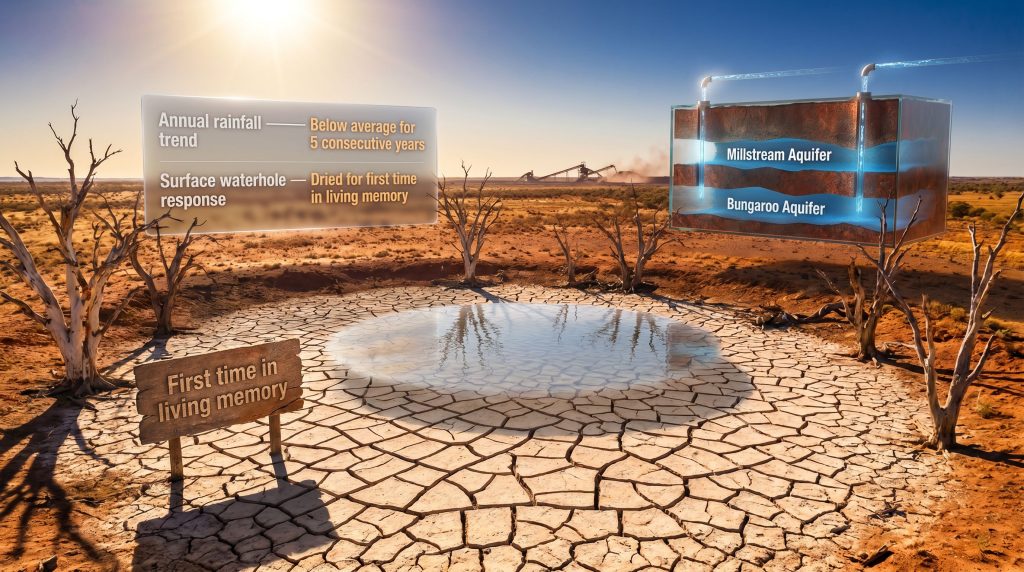
Rio Tinto's Pilbara iron ore operations draw water from the Millstream and Bungaroo aquifer systems, which serve as the primary subsurface water sources feeding surface features, including waterholes, springs, and riparian ecosystems, across a broad geographic area. These systems are recharged seasonally through rainfall and the flow of connected river systems.
The critical vulnerability in such systems is the recharge-extraction balance. When industrial extraction volumes consistently exceed natural recharge rates, the aquifer enters a deficit state. Unlike surface water bodies, this depletion is invisible to the naked eye and develops gradually, often over years, before manifesting as surface impacts such as drying waterholes or dying riparian vegetation.
Why a Cyclone Couldn't Save the Waterhole
One of the most technically significant aspects of this dispute is that the waterhole in question reportedly dried for the first time in living memory despite receiving rainfall input from Cyclone Narelle. To understand why this is alarming, it helps to understand how cyclonic rainfall interacts with deep aquifer systems.
Surface rainfall, even from major weather events, moves primarily as overland flow or is absorbed into shallow soil layers. Deep aquifer recharge from a single rainfall event occurs much more slowly, filtered through metres of geology over weeks, months, or years. If an aquifer has been in deficit for an extended period due to sustained extraction, a single cyclonic event cannot rapidly restore subsurface equilibrium.
This hydrological lag effect is well-documented in over-extracted groundwater systems globally. It means that surface weather patterns cease to be reliable predictors of groundwater health once structural depletion has occurred. The fact that the waterhole failed to respond to what would historically have been a recharging rainfall event strongly suggests the aquifer deficit had crossed a threshold that episodic weather events alone cannot overcome.
"A waterhole that survives millennia of seasonal variation but fails to respond to cyclonic rainfall is not experiencing a dry season. It is experiencing structural depletion, and the distinction matters enormously when attributing cause."
The Compounding Effect: Below-Average Rainfall and Sustained Extraction
Reports indicate that the region has experienced below-average rainfall for approximately five consecutive years leading up to the waterhole's drying. This is significant because aquifer recharge depends not just on isolated events but on cumulative seasonal inputs.
When reduced recharge over a multi-year period is combined with sustained industrial extraction at operational levels, the result is an accelerating deficit. The system loses more water than it gains each year, and the gap compounds.
| Factor | Observed Condition |
|---|---|
| Multi-year rainfall trend | Below average for approximately five years |
| Natural aquifer recharge | Reduced due to lower streamflow inputs |
| Industrial groundwater extraction | Maintained at operational levels |
| Surface waterhole response | Dried for first time in living memory |
| Riparian vegetation impact | River gum mortality confirmed across connected system |
The death of old river gum trees along the connected river system is particularly significant. River gums are deep-rooted phreatophytes, meaning they draw water directly from the water table. Their mortality confirms that the depletion extends well beyond the waterhole itself and into the broader riparian ecosystem, suggesting systemic rather than localised impact.
A Site That Cannot Be Replaced: Cultural Dimensions of the Waterhole
More Than Water: Living Archives of Identity
For the Robe River Kuruma people of the West Pilbara, the waterhole at the centre of this dispute is not an ecological feature that can be assessed purely on volumetric or biodiversity grounds. It is a living cultural site — a location where births occurred across generations, where ceremony was conducted, where knowledge was transmitted from elders to children, and where cultural identity was anchored to landscape.
In many Indigenous Australian knowledge systems, waterholes, springs, and river systems are not passive features of the land. They are active participants in a living cultural framework, connected to ancestral narratives, spiritual responsibility, and ongoing practice. When such a site loses its defining ecological function, it does not simply lose water — it loses its capacity to host the ceremonies and practices that give it meaning.
Furthermore, the broader implications for the WA resources sector are significant, as water extraction concerns increasingly intersect with cultural heritage obligations across the region.
The Concept of Irreversibility in Cultural Heritage
Western legal and environmental frameworks typically assess harm in terms of physical damage and reversibility. A spilled chemical can be cleaned up. A cleared patch of land can be revegetated. However, the cultural harm caused by the permanent drying of a sacred waterhole occupies a fundamentally different category.
If the waterhole does not recover within a culturally meaningful timeframe, the living practices connected to it are disrupted, potentially across generations. Knowledge systems that depend on regular access to the site may fragment. The site's role as a ceremonial and genealogical anchor may be severed.
This is precisely why Robe River Kuruma representative Jason Masters addressed Rio Tinto's board directly at the company's Annual General Meeting in Perth on 6 May 2026, framing the site's significance in deeply personal and intergenerational terms. The demands put to the company went beyond environmental remediation and included a formal commitment to ending water abstraction from the affected waterway and an independent investigation into the damages caused.
The AGM as Accountability Forum: What Happened in Perth
Shareholder Meetings as Cultural Pressure Points
Annual general meetings have traditionally been venues for financial scrutiny. Increasingly, however, they are becoming forums where non-financial risks — including Indigenous cultural heritage, water stewardship, and ESG obligations — are raised directly with corporate boards. The May 2026 Rio Tinto AGM exemplified this shift.
Jason Masters' address to the board placed the sacred waterhole dispute squarely in front of Rio Tinto's leadership and its institutional shareholders simultaneously. This is strategically significant, as it means the issue became part of the formal governance record, creating accountability that extends beyond a press release or a community consultation process.
Rio Tinto's Response and Its Limitations
Rio Tinto Chairman Dominic Barton acknowledged the situation at the AGM, stating the company is working to restore water to the affected system. The company attributed a portion of the depletion to the extended period of below-average rainfall reducing natural aquifer recharge rates.
This framing positions reduced rainfall as a co-contributor to the depletion rather than industrial extraction as the sole cause. From a scientific standpoint, rainfall reduction genuinely is a contributing factor. However, attributing causation to external environmental conditions — while operationally accurate in part — does not address the cumulative effect of sustained extraction during a period of already-reduced recharge.
"When corporate responses emphasise environmental co-factors without committing to extraction reductions, they risk conflating weather patterns with operational choices. The first is outside a company's control; the second is not."
Critically, Rio Tinto did not commit to ceasing groundwater extraction from the affected waterway at the AGM. The Traditional Owners' core demand remains unmet as of the time of reporting.
The Desalination Response: Meaningful Solution or Symptom Management?
What the Desalination Plant Offers
Rio Tinto, in partnership with the Western Australian Government, is constructing a desalination plant valued at approximately A$1.1 million, scheduled for commissioning later in 2026. The facility is designed to supply up to 8 gigalitres of water annually, with the primary purpose of reducing the operation's reliance on freshwater extraction from the Millstream and Bungaroo aquifer systems.
In principle, reducing groundwater dependency through desalinated supply is a constructive step. If operational extraction volumes from the affected aquifer systems are materially reduced following commissioning, it creates the conditions under which natural recharge could begin restoring the deficit — over time.
The Temporal and Cultural Gap
The critical limitation of the desalination response is temporal. Even if extraction from the aquifer systems is reduced once the plant becomes operational, groundwater recovery does not happen on human timescales in the way surface water recovery might. Deep aquifer systems that have experienced sustained multi-year deficits typically require decade-scale recovery periods, and that timeline depends heavily on whether rainfall patterns return to historical averages.
| Dimension | Assessment |
|---|---|
| Annual supply capacity (8 GL/year) | Meaningful volume for reducing groundwater dependency |
| Commissioning timeline (late 2026) | Delayed relative to ongoing cultural site degradation |
| Cost (A$1.1 million) | Modest relative to Rio Tinto's operational scale in the Pilbara |
| Cultural site restoration guarantee | Not provided — aquifer recovery is independent and multi-decadal |
| Traditional Owner co-design | Not publicly confirmed as part of the facility's development process |
Traditional Owners have not indicated that the desalination commitment satisfies their demand for extraction cessation. From a cultural heritage perspective, an infrastructure announcement scheduled for future commissioning does not restore a waterhole that has already dried.
The Juukan Gorge Shadow: Institutional Memory and Structural Risk
What Happened in 2020 and Why It Remains Relevant
In May 2020, Rio Tinto legally destroyed the Juukan Gorge rock shelters in the Pilbara — a site with documented evidence of 46,000 years of continuous human occupation — to facilitate the expansion of iron ore extraction. The destruction was carried out under approvals obtained through Western Australia's then-operative heritage legislation, which critics noted permitted what cultural and ethical frameworks clearly prohibited.
The consequences were severe. Global outrage prompted a Parliamentary inquiry. Rio Tinto's Chief Executive, the Chair, and two senior executives resigned or stepped down in connection with the incident. The company issued formal apologies and committed publicly to strengthening its cultural heritage engagement processes.
The Structural Comparison
The sacred waterhole dispute shares several structural features with Juukan Gorge that make a direct comparison analytically useful, even though the mechanisms of harm differ.
| Dimension | Juukan Gorge (2020) | Sacred Waterhole (2026) |
|---|---|---|
| Nature of harm | Physical destruction | Hydrological depletion |
| Legal standing at time | Legally approved under heritage legislation | Extraction licences in place |
| Cultural significance | 46,000 years of documented occupation | Intergenerational living cultural site |
| Reversibility | Irreversible | Potentially irreversible if aquifer remains depleted |
| Corporate accountability response | Leadership resignations and formal apology | Chairman acknowledgement at AGM |
| Community demands | Apology, compensation, and reform | Extraction cessation and independent investigation |
The key structural parallel is this: in both cases, existing legal approval mechanisms provided operational cover for decisions that caused — or are causing — culturally irreversible harm. The Juukan Gorge destruction was legal. Rio Tinto's groundwater extraction operates under licence. However, legality and cultural adequacy are not synonymous, and the gap between them is precisely where these disputes arise.
Has Post-Juukan Reform Extended to Groundwater?
Following Juukan Gorge, Rio Tinto revised its cultural heritage protocols and increased commitments to Indigenous engagement. The waterhole dispute raises a pointed question: did those reforms extend meaningfully to hydrological management decisions that carry cultural heritage implications?
Physical demolition and groundwater extraction are assessed through entirely different regulatory pathways. Heritage protection legislation governs the former. Water licensing governs the latter. If post-Juukan reforms focused primarily on physical disturbance protocols without integrating cultural landscape connectivity into water management decisions, the structural gap that produced this dispute may never have been closed.
Consequently, the geopolitical and regulatory pressures shaping global mining in 2025 and beyond make such governance gaps increasingly costly for major operators.
The next major ASX story will hit our subscribers first
The Regulatory Gap: Where Water Law and Cultural Heritage Diverge
How Australian Water Licensing Fails Cultural Landscapes
Australian water licensing frameworks are designed primarily around volumetric allocation and beneficial economic use. They assess how much water can be extracted sustainably from a given system and who has the right to extract it. They do not, as currently structured, systematically assess whether extraction from a particular aquifer will degrade the ecological function of a culturally significant surface feature.
Sacred waterholes, springs, and river systems connected to living cultural practice occupy a structural gap between water law and heritage protection legislation. Heritage protection frameworks generally assess harm at the point of physical disturbance, such as excavation or demolition. Gradual hydrological depletion caused by extraction at a distant location rarely triggers heritage impact assessment requirements.
The Aboriginal Cultural Heritage Act 2021 (WA) — which itself underwent significant controversy including industry-led calls for rollback — does not provide comprehensive protection for culturally significant sites from hydrological impacts. The legislation was designed primarily with physical disturbance in mind. In addition, critical minerals policy developments in Australia are increasingly forcing a rethink of how extraction licences interact with cultural heritage obligations.
Comparative Frameworks: What Other Jurisdictions Have Achieved
Several comparable jurisdictions have developed frameworks that more directly address the relationship between water systems and Indigenous cultural rights.
| Jurisdiction | Cultural Water Rights Mechanism |
|---|---|
| New Zealand | Maori water rights recognised through Treaty of Waitangi settlements and the Resource Management Act |
| United States | Tribal reserved water rights established under the Winters Doctrine (1908) |
| Canada | First Nations water rights embedded in modern treaty negotiation frameworks |
| Australia (current) | No equivalent national framework for Indigenous cultural water rights |
Australia's absence from this list is notable. Despite endorsing the UN Declaration on the Rights of Indigenous Peoples (UNDRIP) in 2009 — which explicitly recognises Indigenous peoples' rights to maintain their cultural relationship with lands and waters — domestic implementation in resource extraction contexts remains inconsistent and largely untested.
ESG Dimensions: What Investors Should Be Watching
Water Stewardship as a Material Risk Category
Institutional investors in the global mining sector have increasingly classified water management as a material ESG risk, particularly for operations in arid regions. The reasoning is straightforward: water scarcity creates operational vulnerability through potential licence restrictions, community opposition, and reputational damage.
For the Pilbara, which combines extreme aridity with some of the world's most productive iron ore operations, groundwater dependency is both operationally critical and reputationally exposed. The sacred waterhole dispute introduces a dimension that standard water risk metrics do not adequately capture: cultural heritage connectivity.
Current ESG frameworks, including GRI Water Standards and CDP Water Security disclosures, assess volumetric consumption, watershed stress levels, and water recycling rates. None of these metrics currently require companies to disclose whether their groundwater extraction is affecting the ecological function of culturally significant surface features.
The Post-Juukan ESG Standard
Since 2020, ESG-focused institutional investors have applied a heightened standard of scrutiny to any Rio Tinto incident involving Indigenous cultural heritage in the Pilbara. The company's subsequent commitments to reform created an implicit benchmark against which future incidents would be measured.
The waterhole dispute has already been raised at the shareholder level during the May 2026 AGM, confirming that cultural heritage and water stewardship are now live governance concerns. Understanding the impact on investors of such ongoing controversies is becoming an increasingly important consideration for those with exposure to Rio Tinto's stock.
Emerging Calls for Cultural Water Rights Disclosure
A growing body of thought within sustainable finance and ESG practice is calling for the integration of Indigenous cultural water rights as a standalone risk disclosure category. The argument is that volumetric water metrics alone are insufficient to capture the cultural and reputational dimensions of groundwater management in regions where living Indigenous cultural practice depends on specific hydrological features.
Furthermore, Rio Tinto's global tax and royalty obligations are already under scrutiny — and cultural heritage failures only compound the reputational pressure on the company's social licence to operate.
The Rio Tinto sacred waterhole case may prove to be one of the incidents that accelerates this conversation within ESG standard-setting bodies.
What Genuine Resolution Requires
Beyond Infrastructure: What the Traditional Owners Are Asking For
The Robe River Kuruma Traditional Owners have been clear in their demands. They are not asking for a desalination plant on a future commissioning schedule. They are asking for:
- A binding commitment to end water abstraction from the waterway connected to the sacred site
- An independent investigation into the damages caused by sustained groundwater depletion
- Accountability mechanisms that go beyond voluntary corporate commitments or infrastructure announcements
These demands reflect an understanding that the gap between corporate acknowledgement and structural change is precisely where past failures have occurred. The Juukan Gorge disaster proceeded through multiple stages of internal review, regulatory approval, and community consultation before the destruction was carried out. Process compliance and genuine protection are not the same thing.
Three Pathways Forward
The trajectory of this dispute will likely follow one of three broad scenarios:
-
Voluntary reduction and monitored recovery: Rio Tinto proactively reduces extraction volumes from the affected aquifer systems ahead of the desalination plant's commissioning, establishes independent hydrological monitoring with Traditional Owner oversight, and tracks recovery against agreed cultural benchmarks.
-
Regulatory intervention: The Western Australian Government initiates a review of groundwater extraction licences for the affected area, imposing conditions that require cultural heritage impact assessments for hydrological decisions affecting identified sites. This would establish precedent for integrated water-heritage regulation across the Pilbara.
-
Escalating legal and reputational pressure: Traditional Owners pursue formal legal or heritage protection mechanisms, international ESG investor scrutiny intensifies, and the dispute catalyses broader national policy reform on Indigenous cultural water rights.
"The precedent set by how Rio Tinto and the Western Australian Government respond to this dispute will shape cultural heritage and groundwater management frameworks for Pilbara mining operations for years to come. The institutional memory of Juukan Gorge has not faded, and neither has the expectation of structural, not merely rhetorical, change."
FAQ: Rio Tinto Sacred Waterhole Dispute
Why Has the Rio Tinto Sacred Waterhole Run Dry?
Robe River Kuruma Traditional Owners allege that sustained groundwater extraction from the Millstream and Bungaroo aquifer systems by Rio Tinto has depleted subsurface water levels to the point where the connected sacred waterhole can no longer be maintained. The waterhole reportedly dried for the first time in living memory despite receiving rainfall from Cyclone Narelle, suggesting structural aquifer depletion rather than seasonal variation. ABC News has also reported on broader concerns about water extraction damaging Aboriginal sites across northern WA.
What Is Rio Tinto Doing in Response?
Rio Tinto's Chairman Dominic Barton acknowledged the situation at the May 2026 AGM and stated the company is working to restore water to the system. A desalination plant valued at approximately A$1.1 million, designed to supply up to 8 gigalitres annually, is under construction in partnership with the Western Australian Government and is expected to reduce groundwater dependency when commissioned later in 2026.
How Does This Relate to the Juukan Gorge Disaster?
Both incidents involve harm to culturally significant sites belonging to Aboriginal Traditional Owners in the Pilbara caused by Rio Tinto's operational decisions. Juukan Gorge involved the physical destruction of rock shelters with 46,000 years of documented occupation in 2020. The waterhole dispute involves gradual hydrological depletion of a living cultural site. Both cases, however, highlight the structural gap between legal compliance and cultural protection.
What Are Traditional Owners Demanding?
The Robe River Kuruma people are calling for Rio Tinto to commit to ending water abstraction from the affected waterway, conduct an independent investigation into damages, and provide accountability mechanisms beyond voluntary corporate statements.
Could the Waterhole Recover?
Aquifer recovery is possible if extraction is significantly reduced and rainfall patterns improve. However, groundwater systems in sustained deficit typically operate on decade-scale recovery timelines. A 2026 desalination plant commissioning does not guarantee waterhole restoration within any culturally meaningful timeframe.
Is There a Legal Framework Protecting Sacred Waterholes from Groundwater Depletion?
No comprehensive Australian legal framework currently protects culturally significant hydrological sites from the gradual impacts of groundwater extraction. Water licensing and heritage protection legislation operate largely in parallel, creating a structural regulatory gap that this dispute has exposed.
Want to Stay Ahead of Significant ASX Mineral Discoveries in the Resources Sector?
While the sacred waterhole dispute highlights the complex intersection of extraction, cultural heritage, and corporate accountability, the broader resources sector continues to present compelling opportunities for informed investors — and Discovery Alert's proprietary Discovery IQ model delivers real-time alerts the moment significant ASX mineral discoveries are announced, turning complex data across more than 30 commodities into clear, actionable insights. Explore how historic discoveries have generated substantial market returns and begin your 14-day free trial today to position yourself ahead of the broader market.