
July 1, 2026
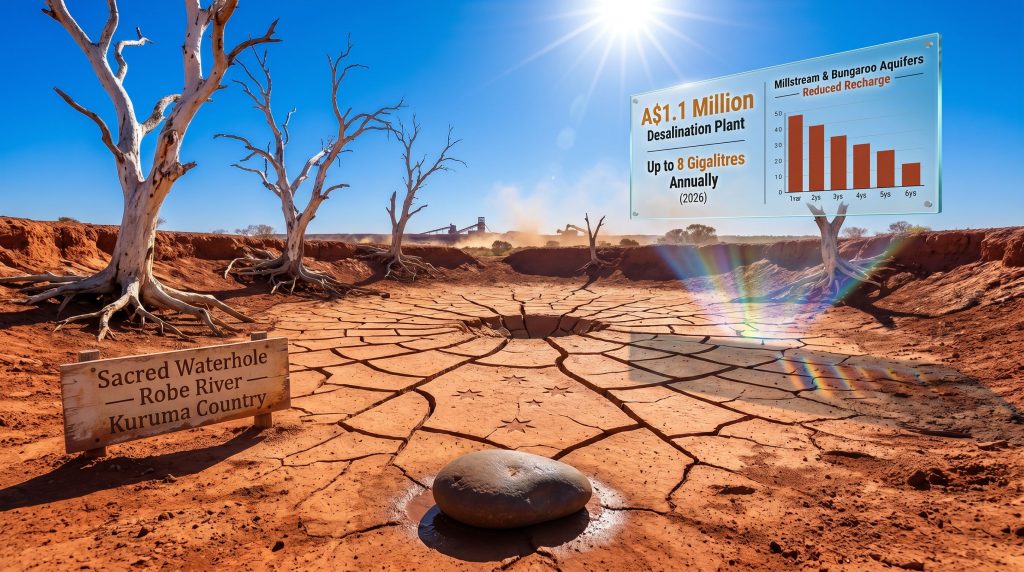
When Ancient Water Systems Meet Industrial Scale: A Reckoning for Mining Governance
Across Australia’s northwest, the relationship between water and culture is not metaphorical. For Aboriginal communities whose ancestors inhabited the Pilbara for tens of thousands of years before European contact, permanent waterholes are not simply geographic features. They are genealogical landmarks, ceremonial sites, and proof of continuity across time. When those waterholes fail, something more than hydrology breaks down.
The failure of a sacred permanent waterhole on Robe River Kuruma Traditional Owner land in Western Australia’s West Pilbara is the kind of event that demands analysis on multiple levels simultaneously: hydrological, cultural, ecological, corporate, and legal. Understanding why Rio Tinto water use dries sacred waterhole conditions to this extent requires looking not just at rainfall deficits or operational water volumes, but at the structural dynamics of how industrial-scale resource extraction interacts with ancient groundwater systems in one of the world’s most water-stressed environments.
When big ASX news breaks, our subscribers know first
The Groundwater Architecture Beneath the Pilbara
Why Permanent Waterholes Are Hydrological Anomalies Worth Protecting
In semi-arid landscapes, the persistence of a permanent waterhole through seasonal drought cycles is a product of complex underground dynamics rather than surface conditions. Permanent features in regions like the West Pilbara are typically maintained by slow, steady discharge from aquifer systems that accumulated water over geological timescales, often thousands of years.
The Millstream and Bungaroo aquifers underpin the West Pilbara Water Supply Scheme, providing both industrial and municipal water to the region. These are not shallow, rapidly rechargeable systems. In semi-arid environments, precipitation-to-groundwater recharge conversion rates are typically very low, as high evapotranspiration rates, low soil permeability, and erratic rainfall patterns all reduce infiltration. What took millennia to accumulate can be drawn down within decades under sustained industrial extraction pressure.
This is the hydrological context that makes the Robe River Kuruma community’s account so significant. Robe River Kuruma representative Jason Masters addressed Rio Tinto’s Annual General Meeting in Perth in April 2025, describing a sacred permanent water pool that persisted through every drought within living Indigenous memory. The waterhole’s failure after Cyclone Narelle delivered substantial rainfall to the region eliminates the simplest climatic explanations. Rainfall events replenish surface water and shallow soil moisture. They do not rapidly restore structurally depleted aquifer systems operating under sustained extraction pressure.
The secondary ecological evidence reinforces the hydrological inference. Mature river gum trees adjacent to nearby water systems have died. River red gums (Eucalyptus camaldulensis) and their close relatives are phreatophytic species, meaning they access water directly from the water table through deep root systems. Their mortality is a reliable indicator of sustained water table decline, not short-term surface drought. Furthermore, water extraction in northern WA has been damaging Aboriginal sites beyond this single incident, suggesting a broader pattern across the region.
The Compounding Physics of Arid Aquifer Depletion
A critical and often underappreciated mechanism in mining water management is the concept of cumulative deficit. When extraction from an aquifer exceeds the natural recharge rate over consecutive years, the deficit does not reset with above-average rainfall seasons. The system must first repay the accumulated shortfall before water levels begin to recover. In arid environments where recharge events are themselves infrequent and climatically variable, this recovery timeline can extend across decades even after extraction ceases entirely.
Rio Tinto acknowledged in March 2025 that the West Pilbara region had experienced below-average annual rainfall and streamflow frequently across the preceding five years. The company’s own statement confirmed that this had reduced groundwater recharge at the Millstream and Bungaroo aquifers. The convergence of two independent stressors, climatically suppressed recharge on one side and sustained industrial extraction on the other, creates conditions that neither factor alone would produce. A five-year period of below-average recharge combined with continuous high-volume extraction is precisely the scenario hydrogeological science would predict as sufficient to cross a threshold from gradual depletion to visible surface failure.
| Aquifer System | Primary Function | Key Stress Factors |
|---|---|---|
| Millstream Aquifer | Core supply for West Pilbara Water Supply Scheme | Reduced streamflow recharge, sustained industrial withdrawal |
| Bungaroo Aquifer | Regional groundwater storage and buffer capacity | Five-year below-average rainfall, continuous pumping demand |
What Rio Tinto’s Operations Actually Look Like in This Region
The Robe River Kuruma Joint Venture: A Complex Stakeholder Relationship
Rio Tinto operates an iron ore joint venture on land belonging to the Robe River Kuruma Traditional Owners in Western Australia’s West Pilbara. This creates a relationship that is simultaneously commercial and custodial, with the same community serving as both the primary objectors to Rio Tinto’s water practices and participants in the commercial arrangement that generates the operational water demand they are objecting to. Considerations around Pilbara iron infrastructure further illustrate how deeply integrated industrial development has become across this landscape.
This dual position is not uncommon in Australian resource agreements with Indigenous communities, and it reflects one of the structural tensions embedded in native title and land use agreement frameworks. Commercial participation does not extinguish cultural rights or obligations, and it does not insulate companies from accountability when operational practices cause damage to culturally significant sites or ecological systems. The Robe River Kuruma community’s decision to raise this issue directly at the AGM rather than through other forums suggests that internal mechanisms had not produced the remediation they sought.
The AGM as a Governance Pressure Point
At the Perth AGM, Rio Tinto Chairman Dominic Barton acknowledged the severity of the situation, stating that the company is making every possible effort to restore water to the system and that this effort is actively underway. Barton also indicated openness to discussing remediation for what he described as potentially irreversible impacts, a notable acknowledgment in a formal corporate governance context.
The fact that Traditional Owners must attend a company shareholder meeting to raise concerns about the depletion of a sacred waterhole on their ancestral land illustrates the power asymmetry embedded in the current regulatory architecture. The AGM forum provides visibility and places concerns on the public record, but it does not constitute a formal remediation mechanism or obligate specific operational changes. Consequently, questions around Rio Tinto governance exposure extend well beyond this single incident.
The acknowledgment of potentially irreversible impacts at a shareholder meeting represents a significant concession, but also highlights the gap between corporate recognition and binding remediation obligations under current frameworks.
The Desalination Investment: Assessing What A$1.1 Billion Actually Buys
Breaking Down the Scale of the Commitment
Rio Tinto and the Western Australian state government are jointly funding an A$1.1 billion desalination plant, equivalent to approximately USD $799,810 at the exchange rate cited in the original Reuters reporting (1.3753 Australian dollars per US dollar). The facility is designed to supply up to 8 gigalitres of water annually once fully operational, with commissioning expected later in 2026.
For context, 8 gigalitres represents 8 billion litres of water per year, or approximately 21.9 million litres per day. Large-scale iron ore operations in the Pilbara are water-intensive across multiple functions including ore processing, dust suppression on haul roads and stockpiles, and operational infrastructure cooling. The precise annual extraction volumes from the Millstream and Bungaroo aquifers are not publicly confirmed in Rio Tinto’s AGM disclosures, which means the adequacy of the desalination plant’s output relative to total operational demand cannot be independently verified from available sources.
What the desalination investment addresses:
- Provides an alternative industrial water supply that operates independently of groundwater recharge cycles
- Reduces the long-term extraction burden on the Millstream and Bungaroo aquifer systems
- Demonstrates a measurable, funded commitment to reducing groundwater dependency
- Creates infrastructure capacity that extends beyond the immediate controversy
What the desalination investment does not resolve:
- The current depleted state of the sacred waterhole, which has not responded to post-cyclone rainfall
- The mortality of mature river gum trees, which cannot be reversed through water substitution
- The accumulated aquifer deficit that has built up over at least five years of below-average recharge and sustained extraction
- The cultural and spiritual harm to Robe River Kuruma Traditional Owners, which exists as an independent category of damage beyond hydrological recovery
The Adequacy Question: Scale vs. Urgency
A critical and largely unaddressed question in Rio Tinto’s public disclosures is the timeline between desalination plant commissioning and meaningful aquifer recovery. Even if the plant begins supplying 8 gigalitres annually from late 2026 and extraction from the natural aquifer systems is substantially reduced, the timeline for the sacred waterhole to recover, if recovery is possible at all, depends on aquifer recharge dynamics that operate on timescales measured in years to decades rather than months.
If a waterhole that persisted through thousands of years of natural climatic variability cannot recover following a significant cyclone rainfall event, the question of whether a desalination supply of 8 gigalitres annually can reverse the underlying aquifer conditions required for its recovery remains genuinely unanswered.
The A$1.1 billion investment figure also warrants contextualisation against Rio Tinto’s operational scale. The company’s iron ore operations in Western Australia generate revenues measured in tens of billions of dollars annually. The desalination plant investment, while potentially meaningful in its operational impact, represents a capital commitment that is modest relative to both the scale of operations and the cultural significance of the harm being addressed.
Juukan Gorge to Waterhole Depletion: Recognising a Pattern
The 2020 Precedent and Its Corporate Consequences
In May 2020, Rio Tinto detonated explosives to expand an iron ore mine in Western Australia, destroying the Juukan Gorge rock shelter, a site of profound and documented archaeological and cultural significance to the Puutu Kunti Kurrama and Pinikura peoples. The site contained evidence of continuous human habitation stretching back approximately 46,000 years, making it one of the most significant archaeological sites in Australia. However, stopping a disaster like Juukan Gorge from happening again remains an open question for the industry.
The destruction triggered sustained investor and public condemnation. A parliamentary inquiry produced damaging findings about Rio Tinto’s cultural heritage decision-making processes. The company’s Chief Executive Officer, Chairman, and other senior executives subsequently departed. Rio Tinto committed to substantial reforms of its Indigenous engagement and cultural heritage assessment frameworks.
| Incident | Year | Nature of Impact | Community Affected | Corporate Response |
|---|---|---|---|---|
| Juukan Gorge Destruction | 2020 | Physical demolition of sacred rock shelter with 46,000-year occupation history | Puutu Kunti Kurrama and Pinikura peoples | CEO, Chair, and senior executives departed; parliamentary inquiry; policy reforms announced |
| West Pilbara Waterhole Depletion | 2025–2026 | Groundwater over-extraction drying sacred permanent waterhole | Robe River Kuruma Traditional Owners | A$1.1 billion desalination plant announced; Chairman acknowledgment of potential irreversible damage |
Structural vs. Procedural Reform: The Governance Question
The West Pilbara waterhole situation emerges approximately five years after Juukan Gorge, and within the period during which Rio Tinto’s reformed Indigenous engagement frameworks were supposed to be operational. This raises a consequential analytical question: whether the reforms implemented following Juukan Gorge addressed the procedural dimensions of Indigenous engagement without adequately constraining the operational decisions that cause cultural and environmental harm.
Procedural reform can improve documentation, consultation, and notification processes without changing the fundamental calculus of water extraction volumes, extraction rates relative to recharge, or operational responses when ecological damage indicators become apparent. If extraction practices continued at rates that were depleting the aquifer through the same period during which cultural heritage reforms were being implemented, it would suggest that the reforms operated in a separate domain from the operational decisions that produced the waterhole failure. In addition, broader debates around natural capital in mining underscore just how far the industry still has to travel on these issues.
Western Australia’s Evolving Legislative Framework
Western Australia’s Aboriginal Cultural Heritage Act 2021 introduced strengthened protections for culturally significant sites, replacing the previous Aboriginal Heritage Act 1972. The newer legislation created more comprehensive duty-of-care obligations for proponents of activities that may impact Aboriginal cultural heritage. However, the intersection of cultural heritage law, native title rights, and water law creates a multi-jurisdictional complexity that Aboriginal communities must navigate simultaneously, often with significantly fewer legal and technical resources than the corporations they are engaging with.
The adequacy of water law specifically, including licensing conditions, extraction volume limits, and compliance monitoring, in protecting culturally significant water features remains a critical question that the West Pilbara situation places under renewed scrutiny. Furthermore, evolving Australian mining policy may yet reshape how these regulatory tensions are resolved in coming years.
Water Stewardship as a Material ESG Risk: What Investors Need to Understand
The Uneven Geography of Rio Tinto’s Water Performance
Rio Tinto’s water stewardship record is not uniform across its global portfolio, and that unevenness is material to ESG assessment. At the Oyu Tolgoi copper-gold operation in Mongolia’s South Gobi region, the company has demonstrated that high-performance water management is operationally achievable in extreme water-scarce environments. The operation achieves greater than 80% water recycling rates and processes ore at approximately 420 litres per tonne, reportedly roughly half the industry average for comparable operations.
The contrast between Oyu Tolgoi’s performance metrics and the West Pilbara situation creates an uncomfortable inference for investors: Rio Tinto’s best-practice water management capabilities exist within the company’s operational portfolio but appear not to have been uniformly applied or prioritised across all operations. This inconsistency is precisely why the mining sustainability transformation conversation has become so urgent across the sector.
The QMM Operation and the Pattern of Accumulated Controversies
Rio Tinto’s QMM mineral sands mine at Fort Dauphin in Madagascar has also attracted water-related controversy, with community reports alleging elevated uranium and lead levels in local water sources, with potential health implications including developmental impacts in children and kidney damage. Rio Tinto has disputed these findings, stating that independent testing shows metal concentrations below detection limits. Religious investment organisations in Britain have reportedly been weighing divestment from Rio Tinto over the QMM situation.
The concurrent existence of multiple water-related controversies across different operations in different jurisdictions creates a compounding ESG narrative. Individual site-level responses, including desalination plants and technical monitoring programs, address specific incidents without resolving the systemic governance question of why water-related harm to communities appears to recur across multiple operations over multiple years.
What Institutional Investors Should Be Monitoring
Water risk has been progressively reclassified by ESG rating agencies and institutional investors from an operational consideration to a material financial risk, particularly for operations situated in water-stressed regions. The Pilbara is classified as a water-scarce environment, which elevates the financial materiality of water management failures in regulatory, reputational, and community relations dimensions simultaneously.
Key indicators investors should track in relation to Rio Tinto’s West Pilbara operations include:
- Annual extraction volumes from the Millstream and Bungaroo aquifers relative to documented natural recharge rates
- Commissioning timeline and operational performance of the A$1.1 billion desalination plant
- Aquifer water level monitoring data, if disclosed through regulatory filings or sustainability reporting
- The status of remediation discussions between Rio Tinto and the Robe River Kuruma Traditional Owners
- Any changes to operational water extraction conditions imposed by Western Australian water regulatory authorities
- Broader institutional investor response, particularly from funds with explicit ESG mandates or religious and ethical investment frameworks
Disclaimer: This article is for informational and analytical purposes only and does not constitute financial advice. All forward-looking statements, projections, and scenario analyses involve material uncertainty. Readers should conduct their own due diligence and consult qualified financial advisers before making investment decisions.
The next major ASX story will hit our subscribers first
Frequently Asked Questions
What caused the sacred waterhole to dry up?
The Robe River Kuruma Traditional Owners attribute the depletion to sustained groundwater over-extraction by Rio Tinto’s iron ore operations in the West Pilbara. Rio Tinto has acknowledged that below-average rainfall and streamflow across the preceding five years reduced recharge capacity at the Millstream and Bungaroo aquifers supplying the regional water system. The convergence of reduced climatic recharge and continued industrial extraction appears to have pushed the aquifer system below the threshold required to sustain the permanent waterhole. Reuters reporting on this issue provides further detail on the community’s account.
Has the waterhole recovered following recent rainfall?
No. Despite significant rainfall delivered by Cyclone Narelle, the waterhole has remained dry. This is a key indicator that the failure reflects structural aquifer depletion rather than a temporary surface-level drought response, as normal rainfall events would be expected to at least partially restore a waterhole that had simply dried due to seasonal conditions. Consequently, Rio Tinto water use dries sacred waterhole conditions in a way that straightforward rainfall cannot reverse.
What is Rio Tinto doing to respond to the situation?
Rio Tinto and the Western Australian state government are jointly funding an A$1.1 billion desalination plant expected to supply up to 8 gigalitres of water annually once operational later in 2026. Rio Tinto Chairman Dominic Barton acknowledged at the AGM that the company is actively working to restore water to the system and expressed openness to discussing remediation for potentially irreversible impacts with the affected Traditional Owner community.
How does this compare to the Juukan Gorge destruction?
The 2020 Juukan Gorge destruction involved the physical demolition of an archaeological site with approximately 46,000 years of documented human occupation and resulted in a parliamentary inquiry and the departure of Rio Tinto’s most senior executives. The West Pilbara waterhole depletion represents a different mechanism of harm, environmental and hydrological rather than direct physical destruction, but similarly affects a site of deep cultural significance on Traditional Owner land where Rio Tinto operates commercially.
What are the long-term ecological consequences?
Beyond the waterhole itself, the death of mature river gum trees along adjacent water systems indicates broader riparian ecosystem degradation. These trees rely on direct access to groundwater through deep root systems, and their mortality signals a water table decline that extends beyond the waterhole’s immediate area. Recovery timelines depend on aquifer recharge rates, the degree to which industrial extraction is reduced, and the effectiveness of the desalination plant in offsetting future groundwater demand.
Is Rio Tinto’s water management record consistent across its operations?
The available evidence suggests significant variation. The Oyu Tolgoi operation in Mongolia’s South Gobi demonstrates industry-leading water recycling performance in an extremely water-scarce environment, while the West Pilbara situation and the contested QMM operation in Madagascar have attracted substantial community and investor concern. The gap between best-practice performance within the company’s own portfolio and the outcomes observed in the West Pilbara raises questions about the consistency of water stewardship standards across operations. Indeed, the pattern of how Rio Tinto water use dries sacred waterhole resources points to a governance challenge that extends well beyond any single site.
Want to Stay Ahead of Significant ASX Mineral Discoveries as They Happen?
Discovery Alert’s proprietary Discovery IQ model delivers real-time alerts on major ASX mineral discoveries, cutting through complex data to surface actionable opportunities for both short-term traders and long-term investors — the same governance and ESG pressures reshaping majors like Rio Tinto are also creating fresh exploration opportunities across the sector. Start your 14-day free trial today, or explore Discovery Alert’s discoveries page to understand how historic mineral discoveries have generated substantial returns for early-positioned investors.