June 30, 2026
When Rally Mathematics Collide With Commodity Reality
Seasoned mining investors understand a principle that often gets lost in the excitement of record-breaking share prices: the larger the preceding rally, the more mechanically vulnerable a stock becomes to even modest reversals in its underlying commodity drivers. This is not a reflection of business quality. It is simply the arithmetic of elevated expectations meeting slightly softer data.
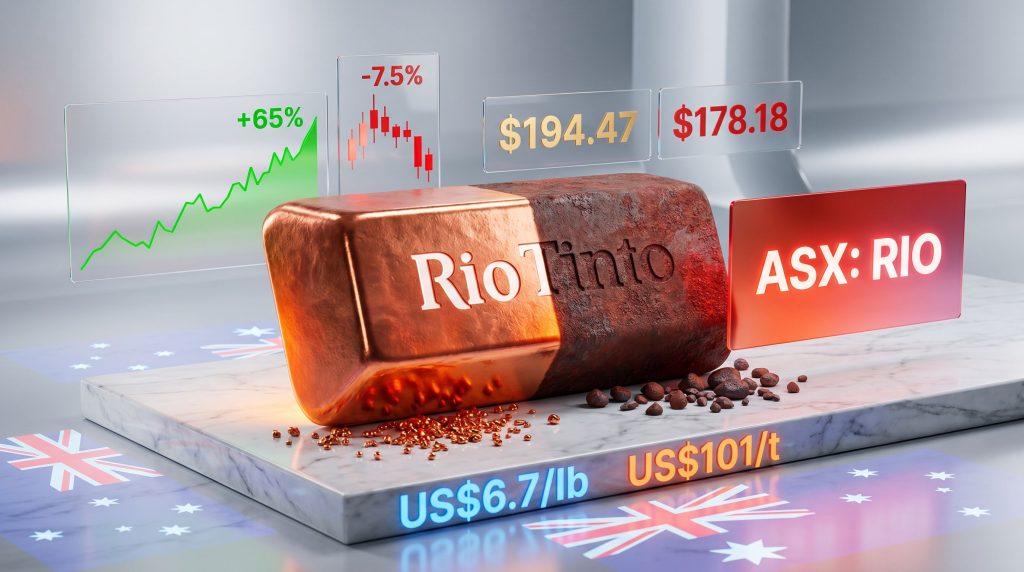
Rio Tinto shares slump buy sell or hold is the question now confronting investors after an extraordinary 12-month run pushed the stock approximately 65% higher and lifted it to an all-time high of $194.47. A combination of cooling commodity prices, rational profit-taking, and renewed geopolitical tension has produced a pullback of roughly 7.5%, with intraday lows touching $178.18 during the correction. The year-to-date gain of approximately 22% remains substantial.
Understanding which scenario is more likely requires looking beneath the share price movement itself and examining the commodity mechanics, production fundamentals, institutional behaviour patterns, and analyst positioning that collectively shape RIO's risk-reward profile at current levels.
When big ASX news breaks, our subscribers know first
The Commodity Cocktail That Powered a 65% Rally
Copper's Record-Breaking Moment and What It Means for RIO's Earnings Architecture
Copper futures reached an all-time high approaching US$6.7 per pound in early June 2026, a level that dramatically re-rated the earnings potential of large diversified miners with meaningful copper exposure. This matters enormously for understanding Rio Tinto's valuation trajectory, because the company's copper division has become an increasingly central component of its investment thesis, particularly as global electrification accelerates structural demand across electric vehicle manufacturing, transmission grid upgrades, and large-scale renewable energy installations.
What is less commonly appreciated by general investors is that copper is not simply a cyclical commodity like iron ore. Its demand profile is increasingly bifurcated between traditional industrial end-uses and a rapidly expanding structural demand base tied to energy transition infrastructure. The International Energy Agency estimates that the energy transition could require copper demand to roughly double by 2040. Furthermore, the ongoing Rio Tinto copper expansion strategy reinforces why this structural overlay gives copper a demand floor that iron ore does not possess.
Rio Tinto's Oyu Tolgoi copper-gold operation in Mongolia has grown into one of the most significant copper assets globally. The underground expansion at Oyu Tolgoi, which reached first production from the underground section in 2023, is projected to make it one of the world's top five copper mines by production volume in the years ahead, providing Rio Tinto with a long-duration copper growth option embedded within its existing asset base.
Unlike pure-play iron ore producers, Rio Tinto's copper exposure functions as a natural hedge within its commodity portfolio. When iron ore softens on China-related demand concerns, copper prices can remain elevated or even strengthen if energy transition spending continues globally. This commodity diversification is a structural differentiator that the market increasingly prices as a premium attribute.
Iron Ore's Multi-Year High in May 2026 and the Pilbara Production Surge
Iron ore prices climbed to multi-year highs in May 2026, creating a second simultaneous tailwind for Rio Tinto's flagship Pilbara operations in Western Australia. The Pilbara region is home to some of the world's highest-grade iron ore deposits, with ore grades that typically exceed 60% iron content across key mining hubs including Tom Price, Paraburdoo, and Brockman.
The operational confirmation arrived in April 2026, when Rio Tinto released its first-quarter FY2026 production results:
| Metric | Q1 FY2026 Result | Context |
|---|---|---|
| Copper equivalent production growth | +9% year-on-year | Broad-based across divisions |
| Pilbara iron ore production growth | +13% year-on-year | Second-best Q1 result since 2018 |
| Strategic direction | Volume expansion confirmed | Management guidance reinforced |
| Operational resilience | Weather and logistics disruptions managed | Headwinds absorbed without material impact |
The 13% jump in Pilbara iron ore production is particularly noteworthy because it was achieved despite acknowledged weather disruptions and reduced shipment windows. However, the broader iron ore demand outlook remains a key variable, suggesting the underlying operational capability of the Pilbara system is stronger than headline production numbers alone might indicate.
Decoding the Pullback: Three Forces Working Simultaneously
Commodity Price Softening: The Primary Mechanical Driver
The most direct explanation for the current weakness in Rio Tinto shares is a coordinated softening across both of its core commodity exposures. According to Trading Economics data, copper futures have retreated from the US$6.7 per pound peak to approximately US$6.3 per pound, representing a decline of roughly 6% from the high. Simultaneously, iron ore has fallen below US$101 per tonne, sitting approximately 9% lower than one month prior.
In isolation, these are not extreme moves. However, a stock that has already appreciated 65% in 12 months carries an elevated valuation relative to normalised commodity assumptions. When the commodity prices underpinning that elevated valuation begin to moderate, the equity correction tends to be amplified relative to the commodity price move itself.
The key thresholds to monitor going forward are:
- Iron ore below US$90 per tonne would represent a serious earnings threat and would likely prompt consensus downgrades
- Iron ore between US$90 and US$105 per tonne represents a zone of manageable softness for a low-cost Pilbara producer
- Copper sustaining above US$6.00 per pound would maintain the energy transition premium in Rio Tinto's valuation
- Copper falling below US$5.50 per pound would signal a genuine demand reassessment and materially alter the bull case
Profit-Taking After an Extended Rally: The Institutional Behaviour Pattern
When a large-cap, well-covered stock delivers 65% returns in 12 months, a predictable institutional response follows. Fund managers who built positions at lower price levels face internal performance mandates that create selling pressure at extended valuations. This is particularly pronounced for funds operating near the end of a financial year reporting cycle.
This dynamic is not fundamentally negative. It simply reflects the structure of institutional capital management rather than any deterioration in Rio Tinto's operational or financial standing. Retail investors who interpret profit-taking-driven weakness as fundamental bad news often make premature exit decisions that undermine their long-term return profiles.
Geopolitical Risk Premium: The Middle East Volatility Channel
A renewed exchange of military strikes between Israel and Iran following the April 2026 ceasefire reintroduced a geopolitical risk premium into global commodity markets. The transmission mechanism operates through several channels simultaneously:
- Shipping cost inflation: Elevated insurance premiums and route diversions through alternative passages increase landed costs for globally integrated miners exporting bulk commodities through exposed sea lanes
- Energy price volatility: Middle East instability typically places upward pressure on oil prices, which directly increases diesel and energy input costs at mine sites and processing facilities
- Risk appetite compression: Institutional investors systematically reduce exposure to cyclical assets during periods of geopolitical uncertainty, compressing valuation multiples regardless of underlying commodity fundamentals
- Currency effects: Safe-haven capital flows into the US dollar during geopolitical flare-ups tend to apply downward pressure on commodity prices, which are denominated in USD
While the immediate military exchange has since ceased, markets are pricing in ongoing uncertainty. This is a classic uncertainty discount, and it tends to persist in commodity equities until geopolitical visibility improves meaningfully.
What Analysts Actually Think About Rio Tinto Shares Right Now
A Fragmented Consensus Tells Its Own Story
The current state of analyst opinion is itself a meaningful data point for investors trying to assess the buy-sell-or-hold question. A deeply split analyst community on a large-cap, heavily covered stock typically signals genuine valuation uncertainty rather than clear directional conviction in either direction. For a broader Rio versus BHP comparison, institutional positioning differs meaningfully between the two miners at present.
| Data Source | Consensus Rating | Analyst Count | Key Implication |
|---|---|---|---|
| Market Index | Mixed Hold/Buy | Multiple analysts | Neutral-to-cautious positioning |
| TradingView | 7 Buy or Strong Buy, 7 Hold, 2 Strong Sell | 16 analysts | No clear directional conviction |
| Investing.com | Neutral | 20 analysts (5 Buy) | Limited bullish conviction at current price |
| MarketBeat | Hold | Not specified | No strong buy or sell signals tracked |
| Stockchase | Leaning Buy with caution | Multiple analysts | Cyclical industry risk explicitly flagged |
| StockInvest.us | Technical Sell | Moving average signals | Short-term downside risk identified |
Price Target Analysis: The Bull Case, Bear Case, and Base Case
- Average analyst price target: approximately $180.23, implying minimal near-term upside and suggesting broad fair value near current trading levels
- Conservative consensus target (Market Index): approximately $172.97, implying roughly 3% potential downside from recent trading levels
- Bull case target (maximum analyst estimate): $211.41, representing approximately 17% upside potential over a 12-month horizon under favourable commodity conditions
The spread between the conservative target of $172.97 and the bull case of $211.41 is substantial, reflecting genuinely wide dispersion in commodity price assumptions across analyst models. This spread simply reflects the reality that small changes in iron ore and copper price assumptions cascade into large changes in net present value estimates due to the operating leverage embedded in large-scale mining operations.
Buy, Sell, or Hold Rio Tinto Shares? A Framework for Each Investor Type
The Hold Case: The Most Defensible Position for Existing Shareholders
For investors who already carry a position in Rio Tinto, the Hold thesis is supported by the following logic:
- The 65% 12-month return has already captured the bulk of the commodity re-rating upside, reducing the incremental opportunity for new capital deployed at current levels
- Average analyst price targets suggest the stock is broadly fairly valued, limiting the margin of safety available to buyers entering now
- Q1 FY2026 production results remain operationally strong, providing no fundamental reason to exit the position
- The dividend income stream, while variable and cyclically sensitive, continues to make the holding cost relatively low for income-oriented investors
- Short-term moving average signals suggest the stock may not have found its near-term floor, meaning patience is likely rewarded more than urgency
The Buy Case: A Long-Duration Thesis for Patient Capital
A constructive buying position is supportable for investors with a longer investment horizon and tolerance for commodity-cycle volatility, provided several conditions are accepted:
- The current pullback is treated as a cyclical correction within a structurally intact commodity supercycle narrative, not as evidence of business deterioration
- Copper's long-term demand trajectory is viewed as a multi-decade structural tailwind rather than a short-term trading opportunity
- Entry is staged across several tranches rather than concentrated in a single transaction, allowing for the possibility of further weakness before stabilisation
- The investor holds conviction in the Oyu Tolgoi underground ramp-up delivering the production volume growth embedded in long-term analyst models
The Sell or Reduce Case: Rational for Specific Portfolio Situations
A decision to reduce or exit Rio Tinto exposure is not consensus-supported but is rational for specific investor circumstances:
- Investors with a short-to-medium investment horizon who cannot tolerate further commodity-driven drawdowns
- Portfolios already overweight the Australian materials sector that need to rebalance for risk management purposes
- Investors whose original thesis rested primarily on the iron ore price cycle, which has partially corrected, and who do not hold independent conviction in the copper growth story
- Technical traders: short-term moving average signals from StockInvest.us indicate the stock may not have established its near-term floor, supporting patience over urgency on new entry
Key Risk Factors That Could Extend the Correction
The Iron Ore Vulnerability: China as the Central Variable
Iron ore remains Rio Tinto's dominant revenue contributor by volume, and the central risk to that revenue stream is Chinese steel demand. The broader China steel and iron ore market dynamics are significant, as China accounts for approximately 70% of global seaborne iron ore demand. The Chinese property sector remains in a multi-year structural adjustment that continues to weigh on near-term steel demand growth.
A sustained decline in iron ore prices below US$90 per tonne would materially compress earnings estimates across the sector and likely trigger downward revisions to analyst price targets. Conversely, stronger-than-expected Chinese infrastructure stimulus or a stabilisation of the property sector would provide meaningful upside support to iron ore prices.
The Oyu Tolgoi Execution Variable
One factor not widely discussed in retail investor commentary is the execution risk associated with the Oyu Tolgoi underground mine ramp-up. Underground block cave mining is technically complex and historically prone to schedule variability. Block cave operations involve inducing a controlled collapse of ore above a series of underground extraction tunnels, and the timing of when ore begins flowing at full design capacity is difficult to predict with precision. Any material delays would directly impact copper production growth forecasts embedded in bullish analyst models.
The Lithium Triangle and Critical Minerals Diversification
A less commonly discussed dimension of Rio Tinto's long-term positioning is its exposure to lithium through its Rincon lithium project in Argentina, located within the Lithium Triangle. Furthermore, the Argentina lithium brine market context is relevant here, as the region contains an estimated 54% of the world's known lithium reserves, primarily in brine deposits in high-altitude salt lakes. Rio Tinto's Rincon asset is a brine-based project, typically carrying lower operating costs per tonne but requiring longer commissioning periods. This emerging exposure adds an additional layer of energy transition optionality to Rio Tinto's portfolio.
The next major ASX story will hit our subscribers first
How Rio Tinto Compares to ASX Mining Peers
| Dimension | Rio Tinto (ASX: RIO) | BHP Group (ASX: BHP) |
|---|---|---|
| Primary commodity exposure | Iron ore + Copper | Iron ore + Copper + Potash |
| Copper growth pipeline | Oyu Tolgoi, Resolution | Olympic Dam, Escondida |
| Critical minerals exposure | Lithium (Rincon brine project) | Potash (Jansen project) |
| 12-month share price performance | Approximately 65% gain | Strong but with different commodity weighting |
| Analyst consensus (approx.) | Hold/Neutral | Mixed |
| Dividend profile | High yield, cyclically variable | High yield, cyclically variable |
| Iron ore grade profile | High grade, Pilbara operations | Mixed grade, Pilbara operations |
Five Leading Indicators to Watch Before Making Any Decision
The following metrics will carry the greatest explanatory power for Rio Tinto's next directional move:
- Monthly iron ore price trajectory: stability above US$100 per tonne versus a sustained decline toward the US$90 range will be the single most important near-term variable for earnings estimates
- Copper futures recovery: a return toward US$6.5 to US$6.7 per pound would signal that energy transition demand is re-asserting itself and would re-rate copper-exposed equities
- Chinese industrial production and manufacturing PMI data: as the dominant demand driver for both commodities, Chinese economic indicators function as the most reliable leading proxy for Rio Tinto's revenue trajectory
- Q2 FY2026 production report: the next operational update will either confirm the momentum established in Q1, particularly for Pilbara iron ore shipment volumes, or flag emerging headwinds
- Middle East geopolitical developments: continued de-escalation would progressively remove the risk premium currently embedded in commodity prices and mining equity valuations
Frequently Asked Questions: Rio Tinto Shares (ASX: RIO)
Why have Rio Tinto shares fallen recently?
The share price has retreated approximately 7.5% from its all-time high of $194.47, driven by softening copper and iron ore prices, profit-taking after a 65% 12-month rally, and renewed geopolitical uncertainty following fresh hostilities in the Middle East.
What is the current analyst consensus on ASX: RIO?
As of June 2026, the consensus leans toward Hold or Neutral across multiple analyst platforms. Average price targets of approximately $180.23 suggest limited near-term upside, while a bull-case scenario projects up to 17% gains over 12 months under favourable commodity conditions. For additional context, Motley Fool's current assessment of Rio Tinto's positioning offers a useful supplementary perspective.
Is Rio Tinto a good dividend stock?
Rio Tinto has historically been among the most significant dividend payers on the ASX, with distributions closely tied to commodity earnings cycles. During periods of elevated iron ore and copper prices, yields have been substantial. However, dividends are variable and not guaranteed.
What is Rio Tinto's biggest commodity risk?
Iron ore remains the dominant revenue driver and primary source of earnings volatility. A sustained decline below US$90 per tonne would materially impact profitability and dividend capacity.
How does Rio Tinto's copper exposure affect its investment case?
Copper provides a structural long-duration growth narrative tied to global electrification. The Oyu Tolgoi underground expansion represents one of the most significant copper growth assets globally and is projected to become a top-five copper mine by production volume.
Should I buy Rio Tinto shares after the recent pullback?
This depends on your investment horizon, risk tolerance, and existing portfolio composition. Consensus data does not strongly support an outright buy at current levels, but investors with a long-term view and comfort with commodity-cycle volatility may find the current price a more considered entry point than the recent all-time high. This is general information only and not personal financial advice.
This article contains general information only and does not constitute personal financial advice. Past performance is not indicative of future results. Commodity price forecasts and analyst price targets are subject to change. Investors should consider their individual circumstances before making investment decisions.
Want To Catch The Next Major ASX Mining Discovery Before The Market Does?
While Rio Tinto's commodity-driven rally illustrates the transformative returns that major mineral discoveries and production surges can deliver, Discovery Alert's proprietary Discovery IQ model scans ASX announcements in real time — instantly identifying significant new discoveries across 30+ commodities and converting complex data into actionable insights for investors at every level. Explore how historic discoveries have generated extraordinary returns on the Discovery Alert discoveries page, and begin your 14-day free trial today to position yourself ahead of the broader market.