
July 24, 2026
When New Mines Meet Reality: The Commissioning Crucible
Every mining project looks compelling on paper. Feasibility studies project smooth throughput curves, metallurgical recoveries hold steady at design parameters, and cash flows materialise on schedule. The real test arrives at commissioning, when geological complexity, mechanical reliability, workforce logistics, and atmospheric physics collide with engineering assumptions. For heap-leach gold operations built at high altitude in arid environments, this collision can be particularly unforgiving.
The Rio2 Fenix Gold production ramp-up sits at precisely this inflection point. After years of development expenditure, permitting processes, and construction milestones, the Fenix Gold operation in Chile's Atacama Region poured its first gold on January 23, 2026, delivering approximately 897 ounces in its inaugural pour following commissioning output of roughly 358 ounces in December 2025. What followed through Q1 2026 was a story that blends genuine operational challenge with surprisingly robust financial performance, making it one of the more instructive case studies in new producer transitions currently unfolding across South America's gold sector.
When big ASX news breaks, our subscribers know first
The Maricunga Belt: Understanding the Geological Foundation
Fenix Gold's geological address is not incidental to its investment case. The Maricunga mineral belt, stretching through Chile's Atacama Region at elevations exceeding 3,500 metres above sea level, represents one of South America's most productive gold corridors. The belt has historically hosted world-class gold and gold-silver deposits, with its oxidised, near-surface mineralisation lending itself to heap-leach processing, a lower capital intensity extraction method well-suited to the geological character of the district.
The Maricunga belt sits within a broader porphyry and epithermal metallogenic province that extends through northern Chile and into Argentina. Oxidised gold deposits in this environment tend to exhibit relatively straightforward leach kinetics, meaning gold dissolves efficiently when irrigated with cyanide solution. However, heap-leach performance at extreme altitude introduces complications that laboratory-scale metallurgical test work does not always fully capture.
Key geological characteristics that define Fenix Gold's resource base include:
- 4.8 million ounces of measured and indicated gold resources, establishing it among the largest undeveloped and now early-production gold inventories in Chile
- 1.8 million ounces in proven and probable reserves, underpinning a mine plan with demonstrated economic viability
- An estimated 1.32 million ounces of life-of-mine production across a 16+ year operational period
- Oxidised mineralisation amenable to heap-leach processing without the capital intensity of milling circuits
The scale of this resource base places Fenix Gold in a different category from many junior gold projects. A 16-year mine life provides the infrastructure amortisation advantages that make unit cost economics increasingly attractive as operations mature. Furthermore, for those tracking the broader Chile copper market outlook, this region's multi-commodity significance becomes even more apparent.
Q1 2026 Production Results: What the Numbers Actually Show
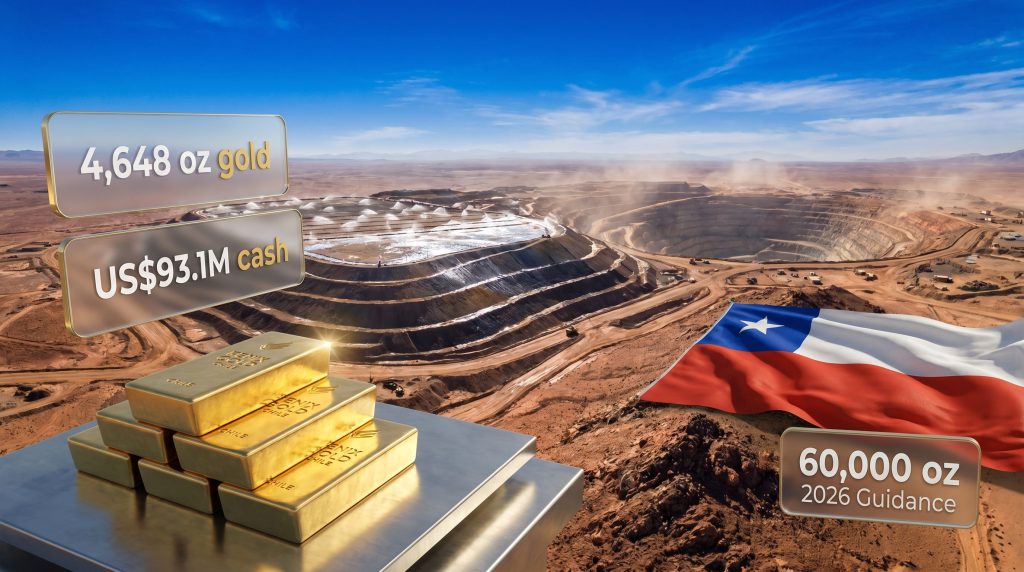
The Rio2 Fenix Gold production ramp-up through Q1 2026 delivered 4,648 ounces of gold from Fenix Gold itself, contributing to a consolidated group output of 7,849 ounces of gold, 49,198 ounces of silver, and more than 6.4 million pounds of copper across Rio2's two-asset portfolio.
| Production Metric | Q1 2026 Result |
|---|---|
| Fenix Gold (gold production) | 4,648 oz |
| Consolidated gold (group total) | 7,849 oz |
| Consolidated silver (group total) | 49,198 oz |
| Consolidated copper (group total) | 6.4+ million lbs |
The copper and additional gold and silver volumes reflect the contribution of Condestable, a producing copper mine in Peru that Rio2 acquired in late January 2026. This acquisition immediately transformed Rio2 from a single-asset development company into a multi-commodity producer, with meaningful implications for cash flow resilience during Fenix Gold's ramp-up period.
Rio2 acknowledged openly that Fenix Gold did not achieve its projected tonnage throughput or ore grades during Q1. This transparency is itself informative. Management characterised the shortfall as startup-phase variability rather than a structural flaw in the operation's design or resource model, and identified the contributing factors before the quarter closed.
Unpacking the Ramp-Up Constraints: A Technical Analysis
The gap between projected and actual performance at Fenix Gold during Q1 2026 stemmed from a cluster of interconnected issues that are, to varying degrees, characteristic of high-altitude heap-leach commissioning. Understanding each constraint provides insight into both the severity of the challenge and the credibility of management's recovery narrative.
| Constraint | Category | Resolution Status |
|---|---|---|
| Blasting permit delays | Regulatory / Administrative | Resolved |
| Contractor labor availability | Workforce | Addressed |
| Elution solution pump failures | Mechanical / Plant | Corrective action implemented |
| Fenix South mining sequencing | Operational | Ongoing optimisation |
| High-altitude operational complexity | Environmental / Structural | Ongoing management |
The Elution Circuit: Why Pump Failures Matter More Than They Appear
Within a heap-leach gold recovery circuit, the elution stage is where gold-loaded activated carbon or pregnant leach solution transitions into the final processing steps that yield refined gold. In a carbon-in-column system, gold-laden carbon is stripped of its gold content using a hot caustic solution, a process critically dependent on consistent solution flow maintained by elution pumps.
Repeated pump failures at this stage do not simply delay processing — they can create a backlog effect where gold-bearing solution accumulates on the leach pad without progressing through the recovery circuit. This defers gold reporting into revenue-generating ounces without any fundamental change to the amount of gold in solution. In practical terms, the gold is there; it is simply waiting for the processing bottleneck to clear.
This distinction matters for investors evaluating whether Q1's production shortfall reflects lost gold or deferred gold. Management's corrective actions targeting pump reliability therefore have direct bearing on whether Q2 2026 production can show a material recovery from the Q1 baseline. Consequently, those following the broader gold price outlook will recognise how pivotal reliable throughput is to realising value at this stage.
High-Altitude Heap Leach: The Physics That Textbooks Understate
Operating a heap-leach facility above 3,500 metres above sea level introduces constraints that are frequently underestimated during project planning. Reduced atmospheric pressure affects pump performance specifications, alters the behaviour of leach solutions in ways that differ from sea-level test conditions, and can influence the rate at which oxygen — critical for cyanide leaching chemistry — remains available in solution.
Workforce dynamics at altitude add another layer of complexity. Contractor labour recruitment for high-altitude Atacama operations faces a narrower talent pool than equivalent projects at lower elevations, contributing to the staffing availability pressures that constrained Q1 throughput. Blast fragmentation, which directly determines the particle size of ore fed to the crusher, can behave differently in the extremely arid and cold conditions of the Maricunga belt compared to test blast programmes conducted at different times of year.
Importantly, Rio2 confirmed that water transport logistics, blast fragmentation results, and metallurgical recovery rates in the heap-leach circuit all performed within expected design parameters during Q1. This is a critical distinction: the issues were operational and logistical rather than geological or metallurgical. The ore is leaching as modelled. The recovery chemistry is behaving as designed.
The Path to 20,000 Tonnes Per Day: Rio2's Throughput Roadmap
Rio2's full-year 2026 guidance of producing more than 60,000 ounces of gold from Fenix Gold requires a substantial acceleration from Q1 levels, with commercial production formally expected in Q4 2026 as throughput scales toward the 20,000 tonnes per day design capacity.
"The project's design capacity of 20,000 tpd represents the threshold at which Fenix Gold's unit economics fully normalise and the operation transitions from a ramp-up asset to a steady-state producer. Every tonne per day of additional throughput in the current gold price environment contributes disproportionately to margin expansion."
The Q2 2026 strategy centres on two primary operational priorities:
- Development of the Fenix Central pit as an additional ore source, providing mining flexibility that reduces grade variability risk inherent in relying on a single mining face at Fenix South
- Contractor mobilisation and equipment deployment to increase the number of active mining faces capable of delivering ore to the primary crusher
Blending ore from multiple mining areas is a standard technique in open-pit operations to smooth grade variability. When a single mining zone, such as Fenix South during Q1, encounters geological variability or sequencing challenges, there is no blending buffer to compensate. Opening Fenix Central in Q2 provides precisely this flexibility.
Key performance indicators that will determine whether the throughput roadmap stays on track through H2 2026 include:
- Progress toward the 20,000 tpd throughput milestone
- Leach pad solution management as irrigated area expands with increased stacking volumes
- Stabilisation of metallurgical recovery rates as the heap matures and solution chemistry reaches steady state
- Strip ratio management balancing waste removal with consistent ore delivery
Financial Strength: A Balance Sheet That Defies Ramp-Up Convention
Perhaps the most counterintuitive aspect of Rio2's Q1 2026 report is the financial trajectory during a period when production fell short of projections. Conventional expectation would suggest a difficult ramp-up quarter should weigh on cash balances. Rio2's Q1 numbers, however, tell a different story entirely.
| Financial Metric | End of Q4 2025 | End of Q1 2026 | Change |
|---|---|---|---|
| Cash and equivalents | US$46.4M | US$93.1M | +US$46.7M (+101%) |
| Operating cash flow | n/a | US$22.8M | Positive quarter |
| Investing activities | n/a | -US$80.3M | Asset development |
| Mining operating income | n/a | US$24.6M | Strong contribution |
| Adjusted net income | n/a | US$12.1M | Profitable quarter |
Cash and equivalents nearly doubled quarter-on-quarter, from US$46.4 million to US$93.1 million, even as Rio2 made a voluntary US$20 million debt prepayment during the same period. Voluntary early debt repayment in the midst of an active ramp-up is a signal that management has high conviction in near-term cash generation, sufficient to reduce leverage ahead of schedule rather than preserve optionality.
The operating cash flow of US$22.8 million was driven by the combined contributions of Fenix Gold's initial production and Condestable's copper output. The US$80.3 million in investing activities reflects the ongoing capital deployment into Fenix Gold's expansion toward full capacity. For further context on how gold and mining equities respond to this type of production milestone, the dynamics here are particularly instructive.
Condestable as a Financial Architecture Decision
The January 2026 acquisition of Condestable copper mine in Peru deserves examination beyond its production contribution. Strategically, the acquisition transformed Rio2's financial exposure profile at a critical moment. A single-asset company navigating a heap-leach ramp-up faces concentrated operational and financial risk: if the ramp-up slows, there is no alternative cash-generating asset to absorb the variance.
By adding Condestable, which contributes copper, gold, and silver production, Rio2 ensured that Q1's Fenix Gold underperformance did not translate directly into a cash flow crisis. Condestable's contribution helped fund both the ongoing Fenix development expenditure and the voluntary debt prepayment, while Fenix Gold itself ramped up. This dual-asset architecture is a more sophisticated capital structure than most junior-to-mid-tier gold developers operate with during their maiden ramp-up.
The dual-commodity exposure also provides distinct demand driver diversification. Gold benefits from monetary safe-haven demand and central bank buying cycles. Copper, in addition, occupies a fundamentally different demand landscape, driven by electrical infrastructure build-out, electric vehicle manufacturing, and grid modernisation programmes globally.
The next major ASX story will hit our subscribers first
Risk and Opportunity: Calibrating the Investment Framework
A balanced assessment of the Rio2 Fenix Gold production ramp-up requires honest engagement with both the downside scenarios and the upside catalysts.
Key risks to monitor through H2 2026:
- Failure to reach 20,000 tpd by year-end would likely push the formal commercial production milestone into 2027, potentially triggering guidance revision and investor sentiment deterioration
- Continued grade variability from Fenix South, if not adequately offset by Fenix Central ore blending, could compress realised ounces below the 60,000 oz annual guidance
- Recurrence of mechanical failures in the elution circuit or primary crusher systems would reintroduce the processing bottleneck dynamic observed in Q1
- Chile's blasting permit process proved a constraining variable in Q1, and any regulatory delays in subsequent permit cycles could disrupt the mining sequence
- The current elevated gold price environment amplifies both the gains from successful ramp-up and the opportunity cost of delayed production
Catalysts that could accelerate the investment case:
- Earlier-than-expected access to higher-grade ore zones within Fenix Central could materially lift H2 2026 production above guidance targets
- The 4.8 Moz measured and indicated resource base suggests exploration upside beyond the current 16-year mine plan, providing potential for future reserve additions that extend mine life further
- Condestable operational integration learnings and sustained copper cash flows provide a financial buffer that most comparable-stage gold developers lack
- A continued favourable gold price environment means every incremental ounce produced above the cost curve generates outsized margin contribution
Furthermore, interpreting gold drill results from ongoing Maricunga exploration programmes will be an important dimension of the longer-term resource story at Fenix Gold.
Fenix Gold's Significance for Chile's Broader Gold Sector
Chile's mining identity is fundamentally shaped by copper. The country supplies roughly 25–27% of global copper production, and its mining investment frameworks, regulatory infrastructure, and institutional knowledge are calibrated primarily around porphyry copper development. Gold, while present across Chile's geological terranes, has historically occupied a secondary position in the country's mining investment narrative.
Fenix Gold's emergence as a producing asset within the Maricunga belt carries significance beyond Rio2's own corporate trajectory. A successful ramp-up at scale would demonstrate that Chile's high-altitude gold districts can support internationally competitive heap-leach operations, potentially re-rating investor interest in the broader Maricunga corridor where additional exploration targets exist.
Conversely, prolonged ramp-up difficulties would reinforce scepticism about the operational complexity premium that high-altitude Atacama gold projects carry relative to comparable deposits at lower elevations. Definitive feasibility studies for future Maricunga projects will inevitably be scrutinised more carefully in light of how the Rio2 Fenix Gold production ramp-up ultimately resolves.
The trajectory through the remainder of 2026 is therefore a data point with implications extending well beyond a single company's quarterly production metrics. It is, in a meaningful sense, an experiment in whether the Maricunga belt's geological endowment can be efficiently converted into consistent operating cash flows at the throughput rates required to justify the capital committed to build it.
Frequently Asked Questions: Rio2 Fenix Gold Production Ramp-Up
What is Rio2's gold production guidance for Fenix Gold in 2026?
Rio2 is targeting more than 60,000 ounces of gold from Fenix Gold during 2026, with commercial production formally expected in Q4 2026 as throughput scales toward the 20,000 tpd design rate.
When did Fenix Gold pour its first gold?
Rio2 completed its first official gold pour on January 23, 2026, following commissioning output of approximately 358 oz in December 2025. The inaugural pour yielded approximately 897 oz.
Why was the Fenix Gold ramp-up slower than expected?
The primary contributing factors included a blasting permit delay, tight contractor labour availability, repeated failures of the elution solution pump, and sequencing challenges as the operation initially focused on the Fenix South mining area. Rio2 confirmed these issues were identified early and corrective actions were implemented before Q1 closed.
How much cash does Rio2 hold after Q1 2026?
Rio2 closed Q1 2026 with US$93.1 million in cash and equivalents, nearly double the US$46.4 million held at year-end 2025, even after voluntarily prepaying US$20 million in debt during the quarter.
What is the total resource base at Fenix Gold?
Fenix Gold holds 4.8 million oz of measured and indicated gold resources, with 1.8 million oz in proven and probable reserves. The life-of-mine plan encompasses an estimated 1.32 million oz of total gold production across a 16+ year mine life.
Where is Fenix Gold located?
Fenix Gold is situated within the Maricunga mineral belt in Chile's Atacama Region, one of South America's most prolific gold-producing geological corridors. For broader context, Mining Weekly's coverage of Rio2's milestone quarter provides additional perspective on how the operation is being received within the wider industry.
Readers seeking additional context on Rio2's Fenix Gold project and Q1 2026 results can explore related coverage published by Reporte Minero, Chile's dedicated mining industry portal, at reporteminero.cl.
Want to Catch the Next Major Mineral Discovery Before the Market Does?
Discovery Alert's proprietary Discovery IQ model delivers real-time alerts on significant ASX mineral discoveries — transforming complex geological data into actionable investment insights, just as compelling ramp-up stories like Fenix Gold illustrate how pivotal early positioning can be. Start your 14-day free trial today and explore historic discoveries that have generated extraordinary returns to understand what early identification of a major find can mean for your portfolio.