June 4, 2026
The Investment Risk Hidden Inside Peru's Most Fragmented Election in a Generation
Few dynamics in commodity markets unsettle capital allocation decisions quite like political ambiguity in a resource-dominant economy. When the rules governing extraction, taxation, and contract security become uncertain, the risk premium embedded in project valuations expands rapidly, and patient capital tends to migrate toward more predictable jurisdictions. Peru finds itself at precisely this inflection point heading into its June 7, 2026 presidential runoff, and the stakes extend well beyond Lima.
When big ASX news breaks, our subscribers know first
Why the Roberto Sanchez Peru Presidential Runoff Matters to Global Copper Markets
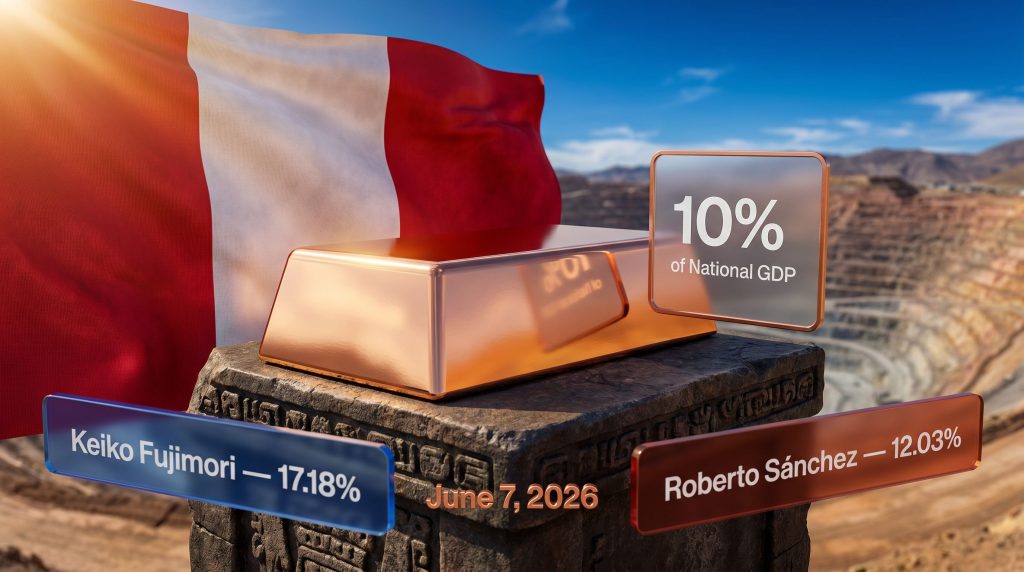
Peru's centrality to global mineral supply chains is difficult to overstate. The country ranks among the world's top two copper-producing nations, with the mining sector contributing approximately 10% of national GDP and accounting for the majority of the country's total export revenues. Beyond copper, Peru is a material supplier of gold, silver, and zinc to international markets, making it a genuinely multi-commodity risk factor for institutional investors with exposure to base and precious metals.
The structural importance of this election becomes clearer when viewed through the lens of supply chain fragility. Copper's role in electrification infrastructure, from grid transmission to electric vehicle manufacturing, has materially elevated the cost of supply disruptions. Furthermore, any sustained uncertainty around Peruvian resource governance policies does not stay contained within national borders. It registers across global futures markets and into the capital expenditure planning cycles of major mining companies operating in the Andes.
The first-round results confirmed what many observers anticipated: a deeply fragmented electorate. Keiko Fujimori led the field with 17.18% of votes, while Roberto Sánchez advanced to the runoff with 12.03%, edging out far-right candidate Rafael López Aliaga by a margin of approximately 21,000 votes. Together, the two runoff candidates captured only around 29% of first-round votes combined, an unusually low figure that reflects widespread public dissatisfaction with the available options.
The low combined first-round vote share is not simply a political curiosity. It signals that whoever wins on June 7 will begin governing with a thin mandate and a fragmented base, creating a structurally fragile governing environment regardless of which policy platform reaches the presidency.
| Candidate | First-Round Vote Share | Runoff Status |
|---|---|---|
| Keiko Fujimori | 17.18% | Confirmed |
| Roberto Sánchez | 12.03% | Confirmed |
| Rafael López Aliaga | ~11.7% (est.) | Eliminated |
Who Is Roberto Sánchez? Understanding the Candidate Beyond the Political Label
Political Background and Career Trajectory
Roberto Sánchez is a 57-year-old left-wing congressman who previously served as Minister of Foreign Trade under ousted former President Pedro Castillo. He is campaigning under the Together for Peru party banner and has built his political identity around the concerns of rural, Andean, and Indigenous communities that he argues have been systematically excluded from the benefits of Peru's resource wealth. According to reporting on the candidates, his policy positions have evolved considerably as the runoff approaches.
His personal biography is central to his political appeal. Raised in an Indigenous family with roots in southern Peru, Sánchez has spoken openly about his modest upbringing and his early aspirations to enter the priesthood, crediting church-based social work as the entry point into his public life. This narrative has proven resonant with the Quechua, Aymara, and Amazonian constituencies that form the geographic core of his electoral support.
The Coalition He Is Trying to Build
Sánchez's first-round base was concentrated in precisely the communities most sceptical of the existing economic model. His challenge heading into the June 7 runoff is arithmetically straightforward but politically complex:
- Rural and Andean voters are already broadly aligned with his worldview
- Urban centrist voters, particularly in Lima and other major cities, are deeply wary of economic disruption
- Business-aligned moderates who rejected both Fujimori and the far-right remain the decisive swing bloc
Winning the runoff almost certainly requires Sánchez to attract voters who did not support him in the first round and who are specifically concerned about the implications of his original economic policy platform for investment stability.
What Sánchez's Original Policy Platform Actually Proposed
Constitutional Reform as the Structural Foundation
The centrepiece of Sánchez's original platform is replacing Peru's 1993 constitution, introduced during the presidency of Alberto Fujimori, his runoff opponent's father. Sánchez advocates for a new framework that would establish a plurinational state, a model that formally recognises Peru's distinct Indigenous nations as constituent political communities within the national structure.
This proposal has a regional precedent. Bolivia adopted a plurinational constitutional framework in 2009, while Chile attempted a similar overhaul in 2022 only to see the proposal rejected at referendum. The Chilean experience is instructive: even in a country with more developed institutional infrastructure, radical constitutional reform proved politically unsustainable when taken to a direct public vote.
Resource Governance Proposals That Alarmed Capital Markets
Sánchez's original platform included a cluster of resource governance measures that generated significant investor concern. In addition, these proposals intersected directly with the broader copper supply crunch already tightening global markets:
- A review of existing mining contracts, potentially reopening fiscal terms negotiated under previous governments
- The introduction of windfall profit taxes on mining companies during periods of elevated commodity prices
- A new wealth tax targeting high-net-worth individuals and large capital holdings
- Greater state oversight of natural resource extraction, repositioning government as a more active participant in the economics of mining
His framing for these proposals rested on a direct challenge to Peru's existing development model. He has argued publicly that three decades of sustained mining activity have failed to deliver material improvements in living standards for communities closest to extraction sites, a claim that carries political weight in Andean regions where resource wealth and persistent poverty coexist visibly.
The Centrist Pivot: Calculating the Cost of Moderation
Signals of an Ideological Recalibration
As the June 7 vote approaches, Sánchez has noticeably softened his economic messaging. His public statements have shifted from structural transformation toward pragmatic constraint, acknowledging that global headwinds, including fuel price increases linked to the ongoing Iran conflict, are limiting the policy space available to any incoming government.
His own language reflects this recalibration. He has stated publicly that insisting on policies that are not viable is not a sensible course of action, a formulation that represents a meaningful departure from the ideological confidence of his first-round campaign. Whether this represents a genuine strategic reassessment or a temporary electoral concession is the central question analysts are attempting to answer.
The Pedro Francke Appointment: What It Signals and What It Does Not
The most concrete expression of Sánchez's centrist pivot came in May 2026, when he appointed Pedro Francke as a senior economic advisor. Francke, a former economy minister under Castillo, occupies an unusual political position: he is credibly associated with the Peruvian left while maintaining a reputation for macroeconomic pragmatism that makes him legible to investors.
Francke moved quickly to provide market reassurance, committing publicly to the following positions:
- Protecting central bank independence from political interference
- Honouring existing mining contracts without reopening fiscal terms
- Promoting private investment as a driver of economic development
- Ruling out nationalisation of mining or other industrial assets in explicit terms
During a televised debate, Francke stated directly that there would be no nationalisations, that contracts would be respected, and that macroeconomic stability would be maintained. These commitments represent a significant departure from the policy direction implied by Sánchez's original platform.
The Francke appointment is best understood as a credibility bridge. It does not resolve the underlying questions about Sánchez's governing instincts, but it introduces a named, market-recognisable figure who has placed his own professional reputation behind specific economic commitments.
Political risk analyst Nicholas Watson of Teneo has noted that Sánchez's past associations, including links to nationalist figure Antauro Humala, who was imprisoned for leading a rebellion against the Peruvian government in 2001, create credibility challenges that a single advisor appointment cannot fully neutralise. The tension is structural: moderating the economic message risks alienating the rural left-wing base that made Sánchez's runoff qualification possible.
How the Castillo Connection Shapes the Investment Calculus
The Endorsement and Its Implications
Former President Pedro Castillo, ousted in December 2022 after attempting to dissolve Congress and subsequently imprisoned on charges of rebellion and conspiracy against the state, has formally endorsed Sánchez for the presidency. Sánchez served as a cabinet minister within the Castillo government and has pledged to seek Castillo's release from prison if elected, while simultaneously stating he would not restore executive power to him.
This distinction matters less to investors than it might to constitutional lawyers. The Castillo-era presidency was defined by persistent uncertainty over mining royalties, threatened nationalisation measures that never fully materialised, and an environment in which the rules of resource governance felt unstable. The Castillo endorsement of Sánchez does not confirm policy continuity, but it reinforces the perception of ideological proximity.
Why This Matters More Than the Economic Rhetoric
For investors evaluating Peruvian mining exposure, the question is not simply what Sánchez says during the campaign. It is whether the institutional anchors around a Sánchez presidency — Francke's advisory role, the right-wing congressional majority, the central bank's independence — would prove durable under governing pressure.
Castillo's own presidency demonstrated that ideological commitments expressed in opposition can translate into genuine policy attempts once in office, even when those attempts are blocked legislatively. The Castillo period produced substantial investment hesitation not because nationalisation actually occurred, but because the perceived probability of disruptive policy action remained persistently elevated throughout the administration. Consequently, the copper price drivers most sensitive to Peruvian output are already embedding a political risk discount.
The next major ASX story will hit our subscribers first
Legal and Governance Risks That Could Reshape the Race
The Financial Crime Allegations
Sánchez faces active legal proceedings in which a prosecutor has accused him of falsifying financial statements and misrepresenting campaign funding information. His legal team contests the allegations. A judicial decision on whether the case proceeds to formal trial was scheduled for June 4, 2026, three days before the runoff vote, creating a compressed timeline in which legal developments could directly intersect with electoral dynamics.
The outcome of that judicial review carries asymmetric risk for the campaign. A decision to advance the case to trial would not immediately remove Sánchez from the ballot, but it would inject a new dimension of governance risk into the electorate's calculus at the worst possible moment for his campaign.
The Congressional Constraint
Even setting aside the legal dimension, a Sánchez presidency would face a structural political obstacle that significantly limits the implementation of his original platform. Right-wing parties hold a majority in Peru's Congress, meaning that constitutional reform, windfall tax legislation, and major resource governance changes would require either coalition-building with ideological opponents or a prolonged executive-legislative standoff.
Peru's recent political history offers cautionary precedents. The country has cycled through multiple presidencies in less than a decade, with impeachments, resignations, and institutional crises creating precisely the kind of governance instability that deters long-term capital commitment. A Sánchez presidency facing a hostile legislature could reproduce elements of this pattern, generating uncertainty even without implementing any of his original policy proposals.
Fujimori vs. Sánchez: A Framework for Mining Sector Decision-Making
Side-by-Side Policy Comparison
| Policy Dimension | Keiko Fujimori | Roberto Sánchez |
|---|---|---|
| Mining contract security | High, status quo orientation | Moderate, review proposed, now softened |
| Nationalisation risk | Very low | Low per Francke commitments |
| Windfall and wealth taxes | Opposed | Proposed, currently under review |
| Constitutional reform | Opposed | Core platform commitment |
| Private investment stance | Pro-investment | Conditional support |
| Central bank independence | Preserved | Committed per Francke |
| Community benefit-sharing | Market-led mechanisms | State-directed redistribution |
The Investor Calculus: Two Different Types of Risk
Fujimori represents the more familiar risk profile: policy continuity for the mining sector with lower regulatory uncertainty. Her challenge is not ideological but personal. Prior corruption convictions and the political legacy of her father's administration create governance credibility concerns that are structural rather than policy-based.
Sánchez represents a different category of risk: policy ambiguity. His moderated campaign tone and the Francke appointment are genuinely encouraging signals, but they cannot fully bridge the gap between electoral messaging and the governing instincts shaped by years of Castillo-era politics. The durability of the centrist pivot under the pressures of actual governance remains entirely untested.
Both candidates enter the runoff carrying public legitimacy deficits that would constrain any governing mandate. The fragmented first-round result is a structural feature of this election, not a temporary condition that the runoff will resolve. Understanding this mining geopolitical risk is essential context for any resource sector stakeholder currently evaluating Andean exposure.
Peru's Political Cycle and Its Historical Effect on Commodity Markets
The Revolving Door Problem
Peru's political instability is not a new phenomenon. The country has experienced a pattern of shortened presidential terms, impeachment attempts, and institutional crises that create a fundamentally unstable investment environment for long-duration assets like mines. Mining projects operate on development timelines measured in decades; they require predictable fiscal frameworks, stable permitting environments, and consistent community consultation processes to attract the capital needed to advance from exploration to production.
Each political crisis in Lima disrupts one or more of these requirements. Environmental permitting decisions get delayed when ministries lack stable leadership. Community consultation processes stall when government interlocutors change. Investment committees at major mining companies defer capital allocation decisions when the regulatory environment is in flux.
Copper's Strategic Context Amplifies the Stakes
The global copper market is operating under fundamentally different supply-demand dynamics than it was a decade ago. The energy transition has materially increased demand projections for copper across electrification applications, from grid infrastructure to electric vehicle manufacturing. This structural demand growth is occurring against a backdrop of constrained new supply, with major copper deposits becoming harder to find, lower in grade, and more complex to permit.
In this context, the Peru political risk premium carries more weight than it did in previous election cycles. Copper was trading at approximately $5.64 per pound as of early June 2026, reflecting both the tightening supply-demand balance and the geopolitical uncertainties already embedded in the market. Any material disruption to Peruvian production or investment timelines, even through policy uncertainty rather than physical interruption, represents a non-trivial contribution to an already strained global supply picture. Furthermore, the commodity price exposure for companies operating in Peru will remain elevated well beyond election day.
Frequently Asked Questions: Roberto Sanchez Peru Presidential Runoff
When is the Peru presidential runoff?
The runoff election between Roberto Sánchez and Keiko Fujimori is scheduled for June 7, 2026. Peruvian authorities have confirmed both candidates' eligibility to contest the second round.
What percentage of votes did Roberto Sánchez receive in the first round?
Sánchez received 12.03% of first-round votes, advancing to the runoff by a margin of approximately 21,000 votes over eliminated candidate Rafael López Aliaga.
What are Roberto Sánchez's policies on mining?
His original platform proposed reviewing mining contracts, imposing windfall taxes, and expanding state oversight of natural resources. In the campaign's final phase, these positions have been substantially moderated, with economic advisor Pedro Francke publicly committing to respect existing contracts and protect private investment. Copper project partnerships already in progress in Peru are watching these developments closely.
Would a Sánchez presidency mean nationalisation of Peruvian mines?
Pedro Francke has explicitly ruled out nationalisation in public debate settings, making this a stated commitment of the campaign. Analysts note, however, that the gap between campaign commitments and governing behaviour, particularly given Sánchez's political associations, introduces residual uncertainty that the market continues to price.
What legal issues does Sánchez face?
Sánchez faces allegations of falsifying financial statements and campaign funding disclosures. A judge was scheduled to rule on June 4, 2026, on whether the case advances to trial.
Why does Peru's election matter for global copper supply?
Peru is one of the world's largest copper producers, with mining representing approximately 10% of GDP. Political uncertainty around resource governance directly affects investment decisions, project development timelines, and ultimately the availability of copper supply to global markets at a time when demand is structurally increasing.
Key Takeaways for Resource Sector Stakeholders
The Roberto Sanchez Peru presidential runoff presents a layered risk profile that resists simple characterisation. The most important conclusions for resource sector investors are:
- The centrist pivot is an electoral strategy calibrated for the runoff context, not necessarily a permanent ideological repositioning that will survive the pressures of governing
- The Francke appointment is a credible market signal, but its influence depends entirely on whether it translates from campaign promise to governing reality
- A right-wing congressional majority functions as a structural constraint on radical policy implementation, limiting but not eliminating governance risk
- The Castillo endorsement and association remains the single most consequential investor concern attached to a potential Sánchez presidency, precisely because the Castillo era demonstrated that ideological intent can generate investment disruption even without policy success
- Both candidates carry governance credibility deficits that will define the post-election operating environment regardless of who wins
- Peru's political risk premium in copper and gold markets is likely to remain elevated not just through June 7, but through the early months of whichever administration takes office
This article is intended for informational purposes only and does not constitute financial or investment advice. Forecasts, political projections, and market assessments involve inherent uncertainty. Readers should conduct independent analysis before making investment decisions based on the political or regulatory environment in any jurisdiction.
Want to Stay Ahead of Significant Mineral Discoveries Amid Political Uncertainty?
When resource-rich jurisdictions like Peru create elevated risk premiums across copper and precious metals markets, identifying actionable opportunities elsewhere becomes critical — Discovery Alert's proprietary Discovery IQ model delivers real-time alerts on significant ASX mineral discoveries, instantly translating complex mineral data into clear, actionable insights for investors at every level. Explore how historic discoveries have generated substantial returns or visit the Discovery Alert home page to begin your 14-day free trial and position yourself ahead of the broader market.