June 24, 2026
The Quiet Consumable That Keeps Underground Mines Alive
Every tonne of metallurgical coal extracted from an underground mine depends on something most investors never think about: the bolts driven into the rock above miners' heads, and the resin capsules that lock them in place. Rock bolts and resin capsules are the unglamorous backbone of underground mining safety. Without a reliable supply, production halts. Without domestic manufacturing, that supply hangs on the fragility of international logistics chains that, as recent years have demonstrated, can fracture without warning.
It is within this context that the Sandvik Alpha Metallurgical Resources joint venture in West Virginia deserves closer examination, not simply as a manufacturing announcement, but as a signal of how two sophisticated industrial players are rethinking the architecture of supply chain security in North American underground mining.
When big ASX news breaks, our subscribers know first
Why Ground Support Products Are More Strategic Than They Appear
Rock bolts and resin capsules occupy an unusual position in the mining equipment ecosystem. They are consumables, meaning they are used once and replaced continuously throughout a mine's operating life. Unlike a longwall shearer or a continuous miner, they do not appear in capital expenditure budgets as headline items. Yet their absence, or delayed delivery, can be catastrophic.
In underground coal and hard rock mining, ground support systems are engineered to manage roof and rib stability. Rock bolts, typically steel or fibreglass rods installed perpendicular or at angles to exposed rock surfaces, anchor unstable strata to more competent material above. Resin capsules, two-component polyester or epoxy systems housed in a cylindrical casing, are injected into the drill hole to chemically bond the bolt to the surrounding rock. Together, they form the primary passive safety system in most underground operations.
The reliability of this system depends entirely on product consistency, correct specification for the local geomechanical environment, and uninterrupted supply. A mine that runs out of rock bolts does not continue operating.
What makes supply chain disruption particularly damaging for these products is their relatively low unit cost but extremely high operational criticality. A $10 rock bolt that fails to arrive can halt a production face generating tens of thousands of dollars per shift.
The Reshoring Logic Behind the Sandvik and Alpha Metallurgical Resources Joint Venture
The structural vulnerabilities in global supply chain risks became starkly visible in the early 2020s, when extended lead times, port congestion, and shipping cost volatility disrupted industrial supply chains across multiple sectors. For mining consumables sourced from offshore manufacturers, these disruptions translated directly into operational risk at the mine face.
Sandvik's decision to re-enter the US ground support manufacturing market, after a period of relying on imported product, reflects a broader recalibration that several global mining equipment original equipment manufacturers (OEMs) are undertaking. The core economic logic is not simply about cost, but about the full-spectrum value of proximity:
- Lead time compression: Domestic manufacturing dramatically reduces the weeks-to-months lead times associated with overseas supply, particularly for specialised product variants
- Customisation capability: Physical proximity to customers enables faster product specification adjustments, trial runs for new ground conditions, and faster resolution of quality issues
- Relationship depth: A local manufacturing and sales presence enables more integrated technical support and long-term commercial relationships
- Margin resilience: Eliminating international freight costs and customs exposure reduces variable cost exposure, even if fixed capital investment is higher
This calculus is particularly powerful when paired with an anchor customer arrangement. By structuring Alpha Metallurgical Resources as both a 49% co-owner and the anchor buyer through a long-term exclusive supply agreement, Sandvik has effectively underwritten the demand side of the investment thesis before the first bolt rolls off the production line.
Deal Architecture: What the 51/49 Structure Actually Means
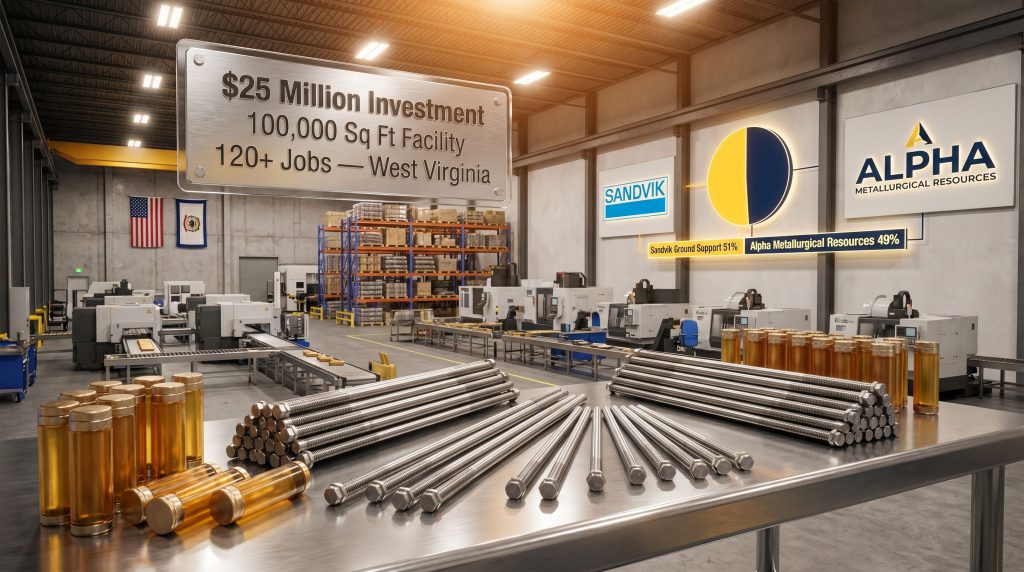
The ownership split in the Sandvik Alpha Metallurgical Resources joint venture is deliberate in what it signals. Sandvik Ground Support retains a 51% controlling stake, preserving operational authority over manufacturing standards, product development, and third-party commercial strategy. Alpha Metallurgical Resources holds 49%, a meaningful equity position that aligns its incentives directly with the venture's financial performance while securing preferential supply access.
| Parameter | Detail |
|---|---|
| Sandvik Ground Support Stake | 51% (controlling) |
| Alpha Metallurgical Resources Stake | 49% |
| Total Capital Investment | $25 million |
| Facility Footprint | 100,000 square feet |
| Location | West Virginia, USA |
| Initial Products | Rock bolts, resin capsules |
| Projected Job Creation | At least 120 positions |
| Sales Channels | Alpha (exclusive supply agreement) + third-party customers |
The inclusion of third-party sales rights is a critical structural feature that is easy to overlook. The facility is not simply an internal supply chain solution for Alpha. It is a commercial platform designed to compete for ground support business across the broader US mining market. This transforms the investment's revenue ceiling from Alpha's internal consumption alone to the entire addressable North American underground mining consumables market.
From a financial risk perspective, the anchor customer model de-risks the investment considerably. Alpha's long-term exclusive supply agreement provides the baseline demand certainty that justifies committing $25 million in greenfield manufacturing capital. Third-party sales represent the upside layer, with any incremental volume above Alpha's contracted requirements flowing directly to joint venture profitability.
Central Appalachia as a Manufacturing Location: Geomechanical and Commercial Alignment
The selection of West Virginia is not incidental. Alpha's core mining portfolio is concentrated in Central Appalachia, a region characterised by underground coal seams that have been continuously mined for over a century. The geomechanical challenges of Appalachian coal mining, including variable roof strata, geological faulting, and high horizontal stress environments, create specific ground support product requirements.
Mining deeper seams or navigating complex geological structures in Central Appalachia demands ground support systems tuned to local conditions. A manufacturer located within the region has inherent advantages:
- Direct exposure to the specific rock mechanics challenges of Appalachian underground mines
- Faster feedback loops between product performance data at the mine face and manufacturing adjustments
- Reduced transit time for urgent or specialised product requirements
- Lower transport costs relative to West Coast or international supply sources
Beyond the geotechnical rationale, West Virginia offers a workforce with generational mining and manufacturing expertise. The region's industrial heritage means skilled trades, understanding of underground mining safety standards, and familiarity with mining consumables are embedded in the local labour market in ways that are difficult to replicate in greenfield industrial locations without that institutional knowledge. Furthermore, according to the West Virginia Governor's office, the state has actively positioned itself to attract precisely this type of advanced manufacturing investment within its energy and mining supply chain sectors.
Competitive Implications for the US Ground Support Market
The entry of a Sandvik-branded domestic manufacturing facility into the US ground support market creates meaningful competitive pressure on suppliers who continue to rely on imported product supply. The competitive dynamics shift across several dimensions.
Lead time differentiation: A domestically manufactured rock bolt delivered within days competes directly against an imported equivalent requiring weeks. For mine operators managing production schedules and safety compliance deadlines, lead time is not a secondary consideration.
Technical proximity advantage: Sandvik's ability to deploy technical support personnel, conduct site trials, and respond to specification changes quickly becomes a significant differentiation tool, particularly for mines with complex geomechanical environments requiring non-standard ground support solutions.
Pricing dynamics: The introduction of a major, well-capitalised domestic manufacturer with an established brand and technical credibility may compress margins for smaller independent importers who have historically competed on price but lack technical support capability.
| Competitive Dimension | Domestic JV (Sandvik/Alpha) | Imported Supply |
|---|---|---|
| Lead Time | Days to weeks | Weeks to months |
| Supply Chain Risk | Low, nearshore production | Higher, geopolitical and logistics exposure |
| Customisation Speed | High, proximity to customers | Low, standardised production cycles |
| Technical Support | Local, integrated | Remote, limited |
| Job Creation | Direct regional employment | Minimal domestic impact |
| Fixed Capital | Higher | Lower |
| Variable Logistics Cost | Lower | Higher |
The next major ASX story will hit our subscribers first
Partial Vertical Integration: A Subtle but Significant Strategic Shift
One of the more analytically interesting dimensions of this arrangement is what it represents for Alpha's business model. Alpha Metallurgical Resources is, at its core, a metallurgical coal producer. Its primary activity is extracting coal for global steel producers. By becoming a co-owner of the facility that manufactures the ground support products consumed in its own mines, Alpha has taken a partial step toward vertical integration within its own supply chain.
This is a meaningful conceptual shift. Rather than simply purchasing rock bolts and resin capsules from external suppliers at market rates, Alpha now participates in the economics of that manufacturing activity. The 49% equity stake means that a portion of every dollar spent on ground support products by Alpha's mining operations flows back to a business in which Alpha holds a substantial ownership interest.
The investment is therefore not purely a cost-control mechanism. It is a partial transformation of a cost line into a profit-participation arrangement, which changes how Alpha's management should think about the long-term return on the $25 million commitment.
This model, where a resource producer co-owns the supply chain infrastructure serving its own operations, reduces exposure to supplier pricing power and creates a financial hedge against input cost inflation in ground support consumables. Consequently, the mining sector transformation unfolding across North America is creating more of these hybrid ownership arrangements as producers seek greater control over critical input costs.
West Virginia and the Regional Economic Dimension
The projected creation of at least 120 jobs at the new facility represents tangible direct employment in a region where mining has historically anchored the economic base. West Virginia's manufacturing sector has experienced structural change over decades, and the arrival of a joint venture combining a global industrial brand with a leading regional coal producer carries both employment and signalling value for the broader investment climate.
Governor-level endorsement of the initiative reflects the state's active posture toward attracting manufacturing investment in its energy and mining supply chain sectors. However, while this reflects alignment between private investment strategy and state industrial priorities, the project's viability rests on its commercial logic rather than policy support alone. As reported by Coal Age, the deal represents one of the more significant ground support manufacturing commitments in the US market in recent years.
The workforce availability argument for West Virginia is grounded in a reality that purely economic analysis sometimes underweights: mining and manufacturing trades knowledge is not easily transferred. Communities with multi-generational mining heritage carry embedded understanding of underground operations, safety culture, and equipment standards that reduces training time and accelerates operational ramp for new manufacturing facilities.
What This Signals for the Broader Mining Equipment Sector
The Sandvik Alpha Metallurgical Resources joint venture in West Virginia should be read as part of a wider realignment in how global mining equipment manufacturers are approaching North American market participation. Several structural forces are converging to make domestic manufacturing economics increasingly attractive, reflecting the broader mining industry evolution currently reshaping how OEMs and producers structure their commercial relationships.
- Supply chain resilience has become a boardroom priority following pandemic-era disruptions, elevating capital investment in nearshore production from a nice-to-have to a strategic imperative
- Customer preference for domestic supply is intensifying in sectors where supply reliability directly affects safety-critical operations
- Long-term supply agreements as investment enablers are becoming the structural mechanism that makes greenfield manufacturing economics viable without relying solely on speculative demand projections
- Joint venture structures with anchor customers reduce demand-side risk while allowing the equipment manufacturer to retain operational and product development control
Furthermore, the future of mining operations will increasingly depend on these integrated supply arrangements, as producers seek to insulate themselves from the input cost volatility and logistical fragility that have characterised the past several years. For investors and industry analysts tracking the US mining equipment sector, this venture illustrates a template that other OEMs may replicate: identify a high-volume consumable with domestic supply gaps, partner with a major end-user as anchor customer and equity co-investor, and use that demand certainty to fund greenfield manufacturing capacity with a third-party commercial upside layer.
The marketing risk management implications of this structure are also worth noting, as the joint venture effectively locks in a major customer relationship while simultaneously positioning the venture as an independent commercial supplier to the broader market. The unglamorous nature of rock bolts and resin capsules should not obscure the strategic sophistication of the structure built around them.
Frequently Asked Questions
What is the Sandvik and Alpha Metallurgical Resources joint venture?
It is a $25 million manufacturing partnership structured as a formal joint venture, with Sandvik Ground Support holding a 51% controlling interest and Alpha Metallurgical Resources holding 49%. The venture will operate a 100,000 square foot production facility in West Virginia manufacturing rock bolts and resin capsules for the US underground mining market, supported by a long-term exclusive supply agreement with Alpha and a third-party sales channel.
What products will the West Virginia facility produce?
Initial production will concentrate on rock bolt systems and resin capsule products, two of the highest-volume consumables in underground coal and hard rock mining. The facility design accommodates future product line expansion as North American market demand evolves.
Why did Sandvik choose a joint venture structure rather than a wholly owned facility?
Partnering with Alpha provides Sandvik with an anchor customer arrangement that de-risks the demand side of the capital investment. Alpha's long-term exclusive supply agreement establishes baseline demand certainty, while Alpha's 49% equity stake aligns its financial incentives with the venture's success.
Does the facility only supply Alpha Metallurgical Resources?
No. While Alpha is the anchor customer through a long-term exclusive supply agreement, the joint venture is explicitly structured to pursue third-party sales to other US mining customers, creating a broader commercial revenue platform beyond Alpha's internal consumption requirements.
How many jobs will the facility create?
The joint venture projects the creation of at least 120 positions at the new West Virginia facility.
Why is West Virginia the chosen location?
Alpha's mining operations are concentrated in Central Appalachia, making West Virginia a natural geographic anchor that minimises logistics costs, shortens delivery times to Alpha's mines, and positions the facility within a broader Appalachian underground mining corridor with deep workforce expertise in mining trades and manufacturing.
This article is based on publicly available information and is intended for informational and educational purposes only. It does not constitute financial advice, investment recommendation, or endorsement of any company or security. Readers should conduct their own due diligence before making investment decisions. Forward-looking projections, including job creation figures and market opportunity assessments, are subject to change based on operational outcomes and market conditions.
Want To Stay Ahead of Strategic Shifts Reshaping the Mining Sector?
Discovery Alert's proprietary Discovery IQ model scans ASX announcements in real time, instantly identifying significant mineral discoveries and actionable investment opportunities — from major producers rethinking supply chains to emerging explorers with transformative potential. Explore historic discoveries and the returns they generated, then begin your 14-day free trial at Discovery Alert to position yourself ahead of the broader market.