
June 12, 2026
The Evolution of Rock Mass Management in Deep Underground Operations
Deep underground mining operations face unprecedented challenges as extraction activities extend into increasingly hostile geological environments. Modern mining industry innovation routinely encounters confining stresses exceeding 100 MPa, brittle rock formations prone to violent failure, and complex stress redistribution patterns that threaten both operational safety and production continuity. These conditions have driven the development of sophisticated geotechnical management strategies, with hydraulic fracturing emerging as a cornerstone technology for proactive risk mitigation.
The transformation of subsurface stress fields through controlled fluid injection represents a fundamental shift from reactive support systems to predictive rock mass conditioning. Furthermore, this approach addresses the root causes of mining-induced instability rather than merely managing its consequences, offering mining engineers unprecedented control over excavation-induced stress concentrations and associated seismic hazards.
When big ASX news breaks, our subscribers know first
Understanding the Core Mechanics of Mining Hydraulic Fracturing
The application of hydraulic fracturing in mining builds upon fundamental principles established through decades of geomechanical research. Unlike petroleum industry applications focused on production enhancement, mining hydraulic fracturing serves primarily as a geotechnical risk management tool designed to address the unique challenges of excavation in high-stress, brittle rock environments.
The process involves introducing pressurised fluid into sealed borehole intervals to initiate controlled fractures that propagate perpendicular to the minimum principal stress direction. Consequently, this mechanism enables systematic manipulation of in-situ stress fields, transforming potentially hazardous concentrated stress zones into more manageable distributed failure patterns.
Key operational distinctions in mining applications include:
• Primary objective of stress redistribution rather than resource extraction
• Focus on controlled damage accumulation to prevent brittle failure
• Integration with comprehensive monitoring systems for real-time validation
• Systematic application patterns designed for excavation-specific geometry
The fundamental difference lies in the strategic intent: while petroleum applications maximise permeability for production enhancement, mining applications optimise stress distribution for safety and operational continuity.
Historical Development and Modern Implementation
The theoretical framework for hydraulic fracturing traces back to Hubbert and Willis' foundational work in 1957, which established the mechanical principles of fluid-driven fracture propagation. However, mining applications diverged significantly from petroleum industry practices, developing unique protocols suited to hard-rock environments and excavation-specific objectives.
Modern mining hydraulic fracturing incorporates advanced fluid-injection protocols combined with extensive sensor arrays, enabling precise monitoring of fracture geometry and stress redistribution. In addition, research on hydraulic fracturing in mining has transformed hydraulic fracturing from an experimental technique into a reliable geotechnical management tool.
Addressing Critical Challenges in High-Stress Mining Environments
Deep underground mining operations encounter stress conditions that can reach 200-300% of regional stress fields around excavation boundaries. These extreme conditions create environments favourable to rock bursts, brittle failures, and uncontrolled seismic activity that threaten operational safety and production targets.
Primary applications of hydraulic fracturing address five interconnected challenges:
• High in-situ stress management through systematic stress redistribution
• Brittle rock mass behaviour modification to promote gradual failure modes
• Seismic hazard mitigation via controlled energy release patterns
• Excavation stability enhancement around critical infrastructure
• Permeability optimisation for fluid management applications
Stress Redistribution Mechanisms
The effectiveness of hydraulic fracturing in stress management depends on creating new fracture surfaces that alter principal stress orientations around critical excavations. This process converts concentrated stress fields into distributed patterns that reduce peak stress magnitudes while promoting time-dependent stress relaxation.
In competent rock masses with natural fracture spacing exceeding 5-10 metres, hydraulic fracturing systematically reduces fracture spacing to 1-3 metres in preconditioned zones. This controlled fracturing creates interconnected networks that facilitate stress transfer and prevent concentration buildup.
Critical performance metrics include:
| Parameter | Untreated Rock | HF Preconditioned |
|---|---|---|
| Stress Concentration Factor | 2.5-4.0× | 1.5-2.5× |
| Fracture Spacing | 5-10 metres | 1-3 metres |
| Failure Mode | Brittle/Sudden | Gradual/Controlled |
| Seismic Response | Large, infrequent events | Small, distributed events |
The Science Behind Controlled Rock Mass Preconditioning
Rock mass preconditioning through hydraulic fracturing represents a paradigm shift in mining geotechnics, moving from passive support systems to active stress field manipulation. The technique creates systematic fracture networks that fundamentally alter rock mass behaviour, promoting predictable failure patterns while reducing overall seismic hazard.
Fracture Propagation Control Mechanisms
Controlled fracture propagation in hard-rock environments requires precise understanding of local stress conditions and natural joint systems. Fractures initiated through hydraulic pressure propagate perpendicular to the minimum principal stress, creating new failure surfaces that intersect existing geological discontinuities.
The relationship between fracture density and rock mass behaviour follows predictable patterns: increased fracture density reduces overall rock mass stiffness, promotes stress relaxation, and enables time-dependent deformation rather than sudden brittle failure. For instance, this transformation is quantified through reduced Young's modulus values and altered strength parameters.
Systematic Network Development
Effective preconditioning programmes employ systematic approaches:
-
Geological characterisation to identify natural fracture patterns and stress orientations
-
Treatment spacing optimisation based on excavation geometry and stress field modelling
-
Progressive fracture development through multi-stage injection protocols
-
Real-time monitoring integration to validate intended damage accumulation
-
Performance validation through micro-seismic analysis and stress measurement
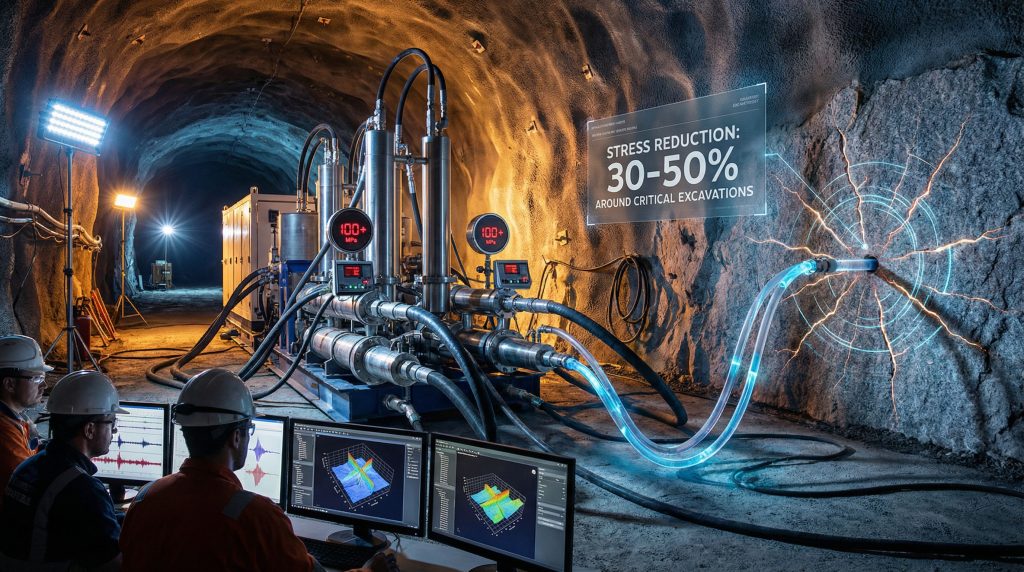
Modern preconditioning programmes can achieve 30-50% reduction in peak stress concentrations around critical excavations when properly designed and implemented according to site-specific geological conditions.
Strategic Applications in Block Caving Operations
Block caving operations present unique challenges where application of hydraulic fracturing in mining becomes particularly critical. Competent rock masses with low natural fracture density often exhibit delayed cave initiation, creating production scheduling constraints and elevated seismic risk.
Cave Initiation Enhancement Strategies
In competent rock masses, natural fracture spacing may exceed 5-10 metres in primary ore zones, creating conditions unfavourable for gravity-driven cave propagation. Hydraulic fracturing addresses this challenge by systematically increasing fracture density above undercut levels, creating connected pathways that facilitate load transfer and progressive failure.
Systematic fracture network development involves:
• Vertical fracture columns created through controlled injection in vertical boreholes
• Lateral connectivity enhancement via overlapping treatment zones
• Network density optimisation balancing cave initiation timing with stable propagation
• Progressive damage accumulation promoting time-dependent failure rather than sudden collapse
Seismic Risk Management in Large-Scale Caving
The transformation from large, high-energy seismic events to multiple smaller-magnitude occurrences represents a critical safety improvement in block caving operations. Without preconditioning, cave initiation in competent rock masses can generate seismic events with magnitudes exceeding M 2.0-3.0, creating operational hazards and potential infrastructure damage.
Systematic hydraulic fracturing preconditioning distributes the same total energy release across multiple smaller events (M 0.5-1.5) occurring over extended periods. This distributed pattern dramatically reduces peak energy release in any single event while maintaining overall cave propagation objectives.
Comparative seismic response patterns:
| Condition | Event Magnitude | Frequency | Total Energy | Peak Risk |
|---|---|---|---|---|
| Untreated | M 2.0-3.0+ | Low | High | Extreme |
| HF Preconditioned | M 0.5-1.5 | High | Similar | Manageable |
Permeability Enhancement for Fluid Management Applications
Beyond stress management applications, hydraulic fracturing serves critical roles in permeability enhancement for gas drainage, water control, and fluid management in mixed-lithology mining environments. The technique creates systematic flow pathways that dramatically improve drainage efficiency and operational safety.
Drainage System Optimisation
In coal mining environments and mixed-lithology operations, hydraulic fracturing can increase permeability by 10-100 times in tight rock formations. This enhancement creates preferential flow pathways that improve gas drainage efficiency, reduce water accumulation risks, and enable proactive fluid management.
Applications include:
• Coal seam gas drainage through enhanced connectivity between natural cleats
• Roof strata weakening to prevent accumulation of dangerous gas concentrations
• Water control systems in operations with significant groundwater inflow
• Enhanced connectivity between natural fracture systems for improved flow rates
Targeted Fluid Migration Control
Selective permeability enhancement enables mining operations to create controlled fluid migration pathways while avoiding uncontrolled fluid migration into active workings. This approach requires precise interval isolation and systematic treatment programmes designed for specific geological units.
The integration with conventional drainage systems amplifies overall system effectiveness, creating redundant pathways that maintain operational continuity even when primary systems experience reduced performance. Moreover, data-driven mining operations increasingly rely on these enhanced systems for predictive maintenance and operational optimisation.
The next major ASX story will hit our subscribers first
Critical Role of Inflatable Packer Technology
The success of application of hydraulic fracturing in mining operations depends fundamentally on reliable borehole isolation systems. Inflatable packers provide the essential hydraulic isolation required to maintain pressure integrity, control fracture geometry, and ensure repeatable results across multiple treatment stages.
Essential Packer System Functions
Modern inflatable packer systems serve three critical functions in mining hydraulic fracturing operations:
Hydraulic isolation prevents fluid bypass and ensures injected energy contributes effectively to fracture initiation and propagation rather than escaping through damaged zones or excavation surfaces.
Pressure integrity maintenance enables stable application of high pressures required in deep, high-stress environments where injection pressures may approach or exceed minimum principal stress magnitudes.
Operational repeatability allows systematic multi-stage treatments with consistent performance across varying borehole conditions and geological environments.
Performance Specifications for Deep Mining Applications
Deep underground mining environments impose severe performance demands on packer systems due to extreme confining stresses, irregular borehole geometries, and limited maintenance access.
Critical performance requirements include:
| Parameter | Specification | Application |
|---|---|---|
| Pressure Rating | Up to 100+ MPa | Deep high-stress environments |
| Sealing Efficiency | 99%+ | Proper borehole sizing conditions |
| Temperature Resistance | Variable | Geothermal environments |
| Conformability | High | Irregular/damaged borehole walls |
| Retrieval Reliability | Consistent | Multiple deployment cycles |
Double-Packer Configuration Operational Principles
Double-packer configurations represent the standard approach for mining hydraulic fracturing applications, providing precise interval control and reliable pressure isolation. These systems incorporate expandable sealing elements that conform to borehole irregularities while maintaining pressure integrity under extreme conditions.
System Design and Deployment Methodology
Double-packer systems consist of two inflatable elements that isolate a central treatment interval, typically 1-3 metres in length depending on application requirements. The expandable sealing elements undergo radial expansion through controlled pressure application, conforming to borehole geometry while creating effective hydraulic barriers.
Deployment sequence involves:
-
System positioning at predetermined depth intervals based on geological targeting
-
Packer inflation to achieve specified sealing pressure against borehole walls
-
Pressure verification to confirm effective isolation before treatment initiation
-
Treatment execution with continuous monitoring of pressure and flow parameters
-
System retrieval for repositioning to subsequent treatment intervals
Integration with Monitoring Systems
Modern packer systems incorporate integrated pressure and flow monitoring capabilities that enable real-time assessment of treatment effectiveness. These monitoring systems provide continuous feedback on fracture propagation, pressure distribution, and system performance throughout treatment sequences.
The integration enables operators to adjust treatment parameters dynamically, optimising fracture geometry and stress redistribution based on real-time response data. Furthermore, AI in mining operations increasingly supports these systems with predictive analytics and automated response protocols.
In-Situ Stress Measurement Applications
Hydraulic fracturing serves as a reliable method for in-situ stress measurement in deep mining environments where conventional stress measurement techniques may prove inadequate. The technique provides critical data for mine planning, support design, and excavation sequencing optimisation.
Fracture Pressure Analysis Methodology
Step-by-step stress measurement procedure:
-
Interval isolation using double-packer configuration at target measurement depth
-
Controlled fluid injection at constant flow rate until fracture initiation occurs
-
Breakdown pressure recording representing peak pressure during initial fracture cycle
-
Multiple cycle execution to validate measurement consistency and reliability
-
Data interpretation to determine principal stress magnitudes and orientations
The breakdown pressure obtained during first-cycle injection provides direct measurement of minimum principal stress magnitude, while subsequent cycles enable validation of fracture reopening pressures and stress field orientation.
Data Quality and Interpretation Considerations
Measurement accuracy depends critically on borehole condition, natural fracture interference, and packer system performance. Proper borehole preparation and systematic pressure cycle analysis ensure reliable stress estimation within acceptable accuracy ranges.
Typical measurement accuracy specifications:
| Stress Component | Accuracy Range | Influencing Factors |
|---|---|---|
| Minimum Principal | ±5-10% | Borehole quality, packer sealing |
| Maximum Principal | ±10-15% | Natural fracture interference |
| Stress Orientation | ±5-15° | Fracture mapping precision |
However, downhole geophysics insights provide complementary data that enhance the accuracy and reliability of stress measurement interpretations.
Safety and Risk Management Framework
Application of hydraulic fracturing in mining requires comprehensive safety protocols addressing high-pressure system hazards, personnel protection requirements, and environmental considerations. These protocols ensure safe operation while maintaining operational effectiveness.
High-Pressure System Safety Requirements
High-pressure hydraulic fracturing systems present inherent safety risks that require systematic management through equipment inspection, personnel training, and emergency response protocols.
Essential safety measures include:
• Pressure system certification ensuring equipment meets specified safety ratings
• Personnel protection zones maintaining safe distances during high-pressure operations
• Emergency shutdown procedures enabling rapid system depressurisation when required
• Equipment inspection schedules preventing failure due to component degradation
• Operator training programmes ensuring competent system operation and hazard recognition
Environmental and Regulatory Compliance
Environmental protection measures focus on fluid containment, groundwater protection, and seismic monitoring to prevent unintended environmental impacts while maintaining regulatory compliance. Mining research on hydraulic fracturing applications emphasises the importance of comprehensive monitoring systems.
Key compliance areas encompass:
• Fluid recovery systems preventing contamination of groundwater resources
• Seismic monitoring networks tracking induced seismicity and response management
• Regulatory reporting requirements documenting operations and environmental performance
• Containment protocols managing fluid migration and surface discharge
Advanced Monitoring and Control Systems
Modern hydraulic fracturing operations integrate sophisticated monitoring systems that provide real-time assessment of fracture propagation, stress redistribution, and system performance. These systems enable optimisation of treatment parameters and validation of intended geotechnical objectives.
Real-Time Data Collection Capabilities
Contemporary monitoring systems combine multiple data streams to create comprehensive pictures of hydraulic fracturing effectiveness and rock mass response.
Integrated monitoring parameters:
| Parameter | Typical Range | Monitoring Purpose |
|---|---|---|
| Injection Pressure | 10-150 MPa | Fracture initiation tracking |
| Flow Rate | 0.1-10 L/min | System performance validation |
| Micro-seismic Events | M -2 to +2 | Fracture propagation mapping |
| Stress Changes | 5-50% variation | Effectiveness verification |
Integration with Mine Planning Systems
The integration of hydraulic fracturing monitoring data with mine planning systems enables optimisation of treatment timing, excavation sequencing, and long-term operational planning. This integration supports predictive modelling and performance assessment over extended operational periods.
Planning integration benefits include:
• Treatment scheduling optimisation aligned with excavation sequences
• Performance data feedback for continuous programme improvement
• Predictive modelling enhancement for future application planning
• Long-term effectiveness assessment supporting operational decision-making
Future Technological Development Trends
The evolution of application of hydraulic fracturing in mining continues through technological advancement in equipment design, monitoring capabilities, and automation systems. These developments address the growing challenges of deeper mining operations and increasingly complex geological environments.
Innovation in Equipment and Systems
Emerging technological trends include:
• Advanced packer designs incorporating smart materials and enhanced conformability
• Automated fracturing systems reducing manual intervention and improving consistency
• Enhanced monitoring integration providing comprehensive real-time assessment
• Digital platform connectivity enabling remote operation and data analysis
Market Growth and Application Expansion
As mining operations extend to greater depths and encounter more challenging geological conditions, hydraulic fracturing applications are experiencing significant growth. Industry projections suggest annual growth rates of 15-20% as operations adapt to deeper, higher-stress environments.
Expanding application areas encompass:
• Deeper mining operations requiring enhanced stress management capabilities
• New geological environments presenting unique geotechnical challenges
• Autonomous system integration supporting unmanned mining operations
• Environmental optimisation reducing ecological impact through improved efficiency
Moreover, underground mines engineering increasingly incorporates hydraulic fracturing as a standard geotechnical tool for managing complex excavation challenges.
Research and Development Priorities
Ongoing research focuses on fracture propagation modelling improvements, environmental impact reduction, and equipment reliability enhancement. These developments support the continued expansion of hydraulic fracturing applications in increasingly demanding mining environments.
Priority development areas include:
• Fracture modelling accuracy improving prediction and control capabilities
• Environmental impact reduction through advanced fluid recovery and monitoring
• Equipment durability enhancement extending operational life and reducing maintenance
• Integration with emerging technologies supporting Industry 4.0 mining initiatives
Current projections indicate that hydraulic fracturing applications in mining will continue expanding as operations progress to greater depths, with technology advancement making applications more cost-effective and environmentally responsible.
The continued evolution of hydraulic fracturing technology represents a critical component of modern mining operations, providing essential tools for managing the complex geotechnical challenges inherent in deep underground extraction. As operations extend into increasingly demanding environments, these technologies will play ever-more crucial roles in maintaining operational safety, production continuity, and environmental stewardship.
Disclaimer: This analysis incorporates technical information and industry projections that reflect current understanding of hydraulic fracturing applications in mining. Actual performance and outcomes depend on site-specific geological conditions, operational parameters, and implementation quality. Readers should consult qualified mining engineers and geotechnical specialists for application-specific guidance.
Ready to Discover the Next Underground Mining Innovation?
As mining operations push deeper into challenging geological environments, Discovery Alert's proprietary Discovery IQ model delivers instant notifications on breakthrough underground mining technologies and geological discoveries across the ASX. Subscribers gain immediate access to actionable investment opportunities in companies developing revolutionary mining techniques, ensuring they're positioned ahead of the broader market when the next major technical advancement emerges.