
August 6, 2026
The Structural Transformation of Energy Investment in the Post-Sanctions Era
Global energy markets are witnessing a fundamental shift in capital allocation patterns as geopolitical pressures reshape traditional investment frameworks. The Russia oil drilling slowdown has emerged as a critical factor influencing petroleum infrastructure development worldwide. Furthermore, this transformation extends beyond cyclical adjustments, representing a structural rebalancing of how energy producers evaluate project economics and strategic priorities in an increasingly fragmented global marketplace.
When big ASX news breaks, our subscribers know first
Understanding the Mechanics Behind Russia's Production Infrastructure Decline
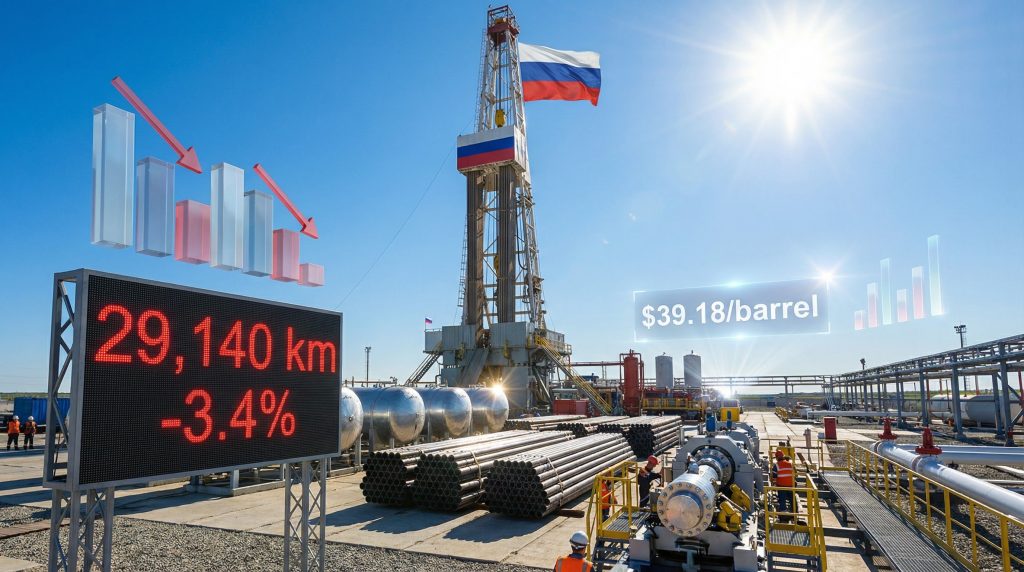
Russia's petroleum sector experienced a measurable contraction in development activities throughout 2025, with drilling operations reaching their lowest intensity since 2022. Industry data reveals that Russian oil producers completed approximately 29,140 kilometres of production wells in 2025, marking a 3.4% decline from the previous year's 30,150 kilometres. The slowdown accelerated dramatically in December 2025, with drilling activity plummeting 16% year-over-year during the final month of the reporting period.
Russia Oil Drilling Performance Metrics
| Drilling Parameter | 2024 Performance | 2025 Performance | Percentage Change |
|---|---|---|---|
| Total Drilling Distance | 30,150 km | 29,140 km | -3.4% |
| December Activity Rate | Baseline | December 2025 | -16% |
| Maintenance Threshold | 26,000-29,000 km | 26,000-29,000 km | No Change |
The temporal pattern of the Russia oil drilling slowdown provides crucial insight into operational decision-making. After achieving record drilling rates during early 2025, activity began declining in June, suggesting deliberate management adjustments rather than external operational disruptions. This phased reduction indicates strategic cost management rather than crisis-driven cutbacks.
The relationship between drilling completion and production commencement follows predictable technical parameters. Wells typically require 3-6 months from completion to first production, creating a lag effect where 2025 drilling reductions will primarily impact output during the second and third quarters of 2026. Consequently, this timeline separation between investment decisions and production consequences creates planning complexity for both operators and market analysts. Additionally, these developments contribute to broader oil price movements that affect global energy markets.
Technical Infrastructure Requirements for Production Maintenance
Russian petroleum operations require specific annual drilling minimums to offset natural field depletion. Industry analysis indicates that Russia needs to drill 26,000 to 29,000 kilometres annually to maintain crude output at approximately 9.2 to 9.4 million barrels per day. Any sustained decline below this threshold will inevitably trigger production reductions across the country's mature field portfolio.
The 2025 drilling total of 29,140 kilometres provided a 3,140-kilometre safety margin above minimum maintenance requirements. However, continuation of the current decline trajectory could breach critical thresholds within 24-36 months. This situation creates long-term production capacity constraints that extend beyond immediate economic cycles.
Field depletion dynamics vary significantly across Russia's diverse petroleum regions:
- Western Siberian fields: 4-7% annual decline rates
- Eastern Siberian assets: 3-5% annual decline rates
- Arctic offshore projects: 6-9% annual decline rates
- Volga-Urals region: 5-8% annual decline rates
Economic Pressure Points Driving Strategic Capital Reallocation
Multiple converging economic factors have fundamentally altered the investment calculus for Russian petroleum companies. Furthermore, this has created a perfect storm of profitability pressures that forced operational adjustments across the sector.
Currency Appreciation Impact on Export Economics
The ruble's 25% appreciation against the US dollar throughout 2025 created significant headwinds for export-dependent oil producers. This currency strength, while beneficial for import cost management, substantially reduced the ruble-denominated value of dollar-based oil revenues. The appreciation occurred while Russia's central bank maintained interest rates near record highs, creating additional financing constraints for capital-intensive drilling projects.
Currency appreciation affects drilling economics through multiple technical mechanisms:
- Revenue compression: Dollar-denominated oil sales generate fewer rubles per barrel
- Cost structure maintenance: Equipment and services retain international pricing benchmarks
- Net present value erosion: Future cash flows become less attractive in domestic currency terms
- Capital allocation shifts: Companies prioritise shorter-payback projects over long-term development
Export Market Discount Expansion
Urals crude, Russia's primary export blend, experienced dramatic pricing deterioration throughout 2025. The tax-purpose price declined to $39.18 per barrel in December 2025, representing a 42% drop from January 2025 levels. More significantly, the discount to Brent crude expanded to approximately $27 per barrel at export points, more than doubling from early 2025 levels. These market dynamics directly correlate with the ongoing oil price rally affecting global energy markets.
This discount expansion reflects structural market dynamics beyond simple price competition:
- Counterparty risk premiums: Buyers demand larger financial incentives for transaction execution
- Logistical complexity costs: Extended supply chains and alternative routing requirements
- Insurance market constraints: Reduced availability and higher premiums for cargo coverage
- Payment mechanism uncertainty: Complications in financial clearing and settlement processes
The widening discount creates a cascading effect on drilling project economics. Consequently, operators must factor substantially lower realised prices into long-term investment decisions. Projects that appeared economically viable at $50-60 per barrel become marginal or unprofitable when realised prices drop to $35-45 per barrel after discounts and transportation costs.
Strategic Response to Profitability Collapse
Industry experts characterise the Russia oil drilling slowdown as a rational response to economic fundamentals rather than operational constraints. Companies have transitioned to defensive financial management, prioritising cash preservation over revenue growth objectives. This strategic pivot reflects several key considerations:
Cash Flow Optimisation Priorities:
- High-return projects: Focus on wells with payback periods under 18 months
- Existing infrastructure leverage: Prioritise fields with established production facilities
- Technology requirement minimisation: Avoid projects requiring advanced international equipment
- Domestic market integration: Emphasise operations with local sales channels
Portfolio Prioritisation Framework:
- Low-cost, high-productivity wells: Target the most economic drilling locations
- Infrastructure-adjacent development: Minimise new facility construction requirements
- Simplified completion techniques: Reduce dependency on complex drilling technologies
- Operational efficiency improvements: Maximise productivity from existing assets
Sanctions Architecture and Long-term Capacity Implications
Western sanctions have created both immediate market access constraints and structural challenges for Russia's petroleum sector development. These restrictions affect production capacity through multiple channels beyond direct financial limitations. Moreover, the tariff impact on investment markets has further complicated the economic landscape.
Technology Access Disruption
Sanctions targeting Russian petroleum companies have restricted access to advanced drilling technologies and expertise traditionally sourced from international service providers. This technological isolation forces operators to rely increasingly on domestic alternatives across critical operational categories:
Restricted Technology Categories:
- Horizontal drilling systems: Advanced directional drilling equipment and software
- Enhanced recovery technologies: Chemical injection and thermal recovery systems
- Reservoir management platforms: Simulation software and data analysis tools
- Completion optimisation: Hydraulic fracturing equipment and specialised fluids
Russian companies have accelerated domestic technology development programmes, but productivity gaps remain significant compared to international standards. Domestic horizontal drilling equipment achieves approximately 70-80% of the efficiency of Western alternatives. Meanwhile, reservoir management capabilities lag by an estimated 2-3 years in analytical sophistication.
Service Sector Ecosystem Effects
The Russia oil drilling slowdown affects the broader oilfield services ecosystem through multiple transmission mechanisms:
Workforce Implications:
- Drilling crew reductions: Estimated 15-20% workforce contraction in 2025
- Technical specialist emigration: Loss of experienced drilling engineers
- Training programme suspensions: Reduced investment in skill development
- Equipment maintenance deferrals: Delayed upgrades for aging drilling infrastructure
Equipment Utilisation Patterns:
- Rig stacking increases: Idle drilling equipment across major regions
- Maintenance cycle extensions: Longer intervals between major overhauls
- Capital investment postponements: Deferred purchases of new drilling technology
- Service company consolidation: Market share concentration amongst remaining providers
Physical Security and Operational Disruption
Beyond economic sanctions, physical attacks on Russian energy infrastructure have contributed to production constraints. Ukrainian military operations targeted oil facilities in the Caspian Sea region during December 2025 and January 2026. These attacks have created direct operational disruptions that compound the effects of reduced drilling activity. According to Bloomberg's analysis, the financial pressures are intensifying as revenue streams deteriorate.
These security challenges force operators to allocate resources toward protective measures rather than productive capacity expansion:
- Enhanced facility protection: Increased security personnel and equipment
- Geographic risk assessment: Evaluation of field exposure to potential attacks
- Emergency response capabilities: Development of rapid repair and restart procedures
- Strategic reserve maintenance: Backup equipment and supply chain redundancy
Production Trajectory Modelling and Future Output Scenarios
The lag between drilling activity and production output creates a forecasting challenge for analysts attempting to model Russia's future petroleum capacity. Multiple factors influence this relationship, from technical completion timelines to field depletion characteristics. In addition, broader trends in the US economy and tariffs create additional uncertainty for global energy markets.
Production Maintenance Economics
Russian petroleum operations require sustained drilling activity to offset natural field decline across the country's mature asset base. Industry analysis establishes clear parameters for production maintenance:
Annual Drilling Requirements:
- Minimum threshold: 26,000 kilometres annually
- Optimal range: 27,000-29,000 kilometres annually
- Current 2025 performance: 29,140 kilometres
- Safety margin: 3,140 kilometres above minimum threshold
The current drilling rate provides moderate protection against production decline. However, continuation of the current reduction trajectory could breach critical thresholds by 2027-2028. Any further decline below 26,000 kilometres annually will trigger measurable production reductions across Russia's petroleum portfolio.
Field Depletion Rate Analysis
Russia's petroleum production comes primarily from mature fields experiencing natural decline rates that vary by geological characteristics and production history:
Regional Depletion Patterns:
| Production Region | Annual Decline Rate | Primary Field Types | Drilling Intensity Required |
|---|---|---|---|
| Western Siberia | 4-7% | Conventional reservoirs | High |
| Eastern Siberia | 3-5% | Mixed conventional/tight | Medium-High |
| Volga-Urals | 5-8% | Mature conventional | Very High |
| Arctic Offshore | 6-9% | Complex reservoirs | Extremely High |
Without sustained drilling programmes, these decline rates accelerate as reservoir pressure depletes and water cut increases. Fields approaching the end of their economic life require increasingly intensive development efforts to maintain output levels. Consequently, this creates a cycle where drilling requirements grow over time to sustain constant production.
Output Impact Timeline Projections
The technical relationship between drilling activity and production output follows predictable patterns based on Russian operational characteristics:
Production Impact Schedule:
- Q2 2026: Initial effects of reduced 2025 drilling become visible
- Q3 2026: Full impact of December 2025 drilling decline manifests
- Q4 2026: Cumulative effect of sustained drilling reduction appears
- 2027: Year-over-year production decline becomes measurable if drilling remains constrained
Current production stands at 9.246 million barrels per day as of January 2026, representing 328,000 barrels per day below Russia's OPEC+ quota allocation. This under-production creates flexibility for managing decline effects. Russia can allow natural reduction without immediately violating international agreements.
Capital Allocation Evolution in Response to Economic Constraints
Russian petroleum companies have fundamentally restructured their investment decision-making processes in response to the convergent economic pressures affecting sector profitability. This transformation represents a shift from growth-oriented capital allocation to defensive financial management.
Investment Priority Restructuring
Companies have abandoned expansion-focused drilling programmes in favour of maintenance-oriented capital deployment:
New Investment Hierarchy:
- Essential maintenance drilling: Wells required to prevent immediate production decline
- High-return, short-payback projects: Wells with payback periods under 12 months
- Infrastructure-adjacent development: Drilling near existing facilities to minimise new construction
- Technology-independent projects: Wells requiring minimal advanced equipment or expertise
Deferred Investment Categories:
- Exploration drilling: New field development postponed indefinitely
- Enhanced recovery projects: Complex technology-dependent operations suspended
- Remote field development: High-cost, low-infrastructure locations deprioritised
- Environmental compliance upgrades: Non-essential facility improvements delayed
Financial Management Transformation
The transition to cash preservation mode affects multiple aspects of operational financial management:
Liquidity Enhancement Measures:
- Accelerated asset monetisation: Sale of non-core properties and equipment
- Working capital optimisation: Reduced inventory levels and extended payment terms
- Capital expenditure deferrals: Postponement of non-critical facility investments
- Debt service prioritisation: Maintenance of credit ratings and banking relationships
Cost Structure Adjustments:
- Personnel cost management: Workforce reductions and salary freezes
- Service contract renegotiation: Pressure on oilfield service providers for price concessions
- Equipment lease modifications: Conversion of purchases to rental arrangements
- Energy efficiency improvements: Reduced operational consumption to lower variable costs
The next major ASX story will hit our subscribers first
Global Energy Market Integration and Strategic Implications
The Russia oil drilling slowdown occurs within a complex international energy landscape where OPEC+ continues managing supply quotas and market share dynamics. Russia's production constraints may influence the alliance's future policy decisions and quota allocation methodology. Furthermore, these developments directly impact global oil futures pricing and market expectations.
OPEC+ Alliance Dynamics
Russia's position within the OPEC+ framework faces potential recalibration as production capacity constraints become more apparent:
Current Russia Position:
- Production level: 9.246 million barrels per day (January 2026)
- OPEC+ quota: 9.574 million barrels per day
- Under-production margin: 328,000 barrels per day
- Compliance status: Exceeding voluntary reduction targets
The sustained under-production creates strategic options for both Russia and the broader alliance:
Russia Strategic Considerations:
- Market share preservation: Maintain production capacity for future quota increases
- Alliance credibility: Demonstrate compliance with voluntary reduction commitments
- Revenue optimisation: Balance output reduction with price improvement effects
- Capacity signalling: Communicate long-term production potential to alliance partners
OPEC+ Policy Implications:
- Quota methodology review: Potential adjustment of member capacity assessments
- Production sharing rebalancing: Opportunity for other members to increase market share
- Price management strategy: Russia's constraints may support higher price targets
- Alliance cohesion maintenance: Managing member expectations around capacity and compliance
International Market Share Dynamics
Russia's production constraints create opportunities for alternative suppliers to capture market share, particularly in traditional Russian export markets:
Beneficiary Producer Categories:
- OPEC+ members with spare capacity: Saudi Arabia, UAE, Kuwait potential winners
- Non-OPEC+ suppliers: US shale, Canadian oil sands, Brazilian offshore potential gainers
- Regional competitors: Central Asian producers may capture pipeline market share
- Alternative crude grades: Similar quality crudes may substitute for Urals in refining systems
Supply Chain Reconfiguration Effects
Reduced Russian drilling activity contributes to broader global supply chain adjustments:
Global Supply Implications:
- Tighter supply fundamentals: Reduced drilling translates to lower future output
- Price support mechanisms: Supply constraints may underpin higher long-term prices
- Investment flow redirection: Capital may shift toward more accessible producing regions
- Energy security considerations: Import-dependent countries may diversify supply sources
Service Sector Reallocation:
- Equipment migration: Drilling rigs and service capacity may redeploy to other markets
- Expertise transfer: Russian-trained personnel may work in alternative jurisdictions
- Technology development: Innovation resources may shift toward non-Russian applications
- Market concentration: Service providers may consolidate operations in accessible markets
Recovery Pathway Analysis and Scenario Planning
Multiple factors could influence the trajectory of Russian drilling activity and production capacity over the coming years. These range from economic stabilisation to technological adaptation and market access expansion. Additionally, analysis from World Oil highlights concerns about the sector's declining health and future output potential.
Economic Stabilisation Scenario
Scenario Parameters:
- Oil price recovery: Brent crude sustainable above $65 per barrel
- Currency stabilisation: Ruble trading range of 85-95 per dollar
- Export discount normalisation: Urals discount to Brent reduced to $10-15 per barrel
- Timeline: 12-18 months for economic conditions to improve
Expected Drilling Recovery:
- Year 1: Drilling activity increases to 32,000-34,000 kilometres
- Year 2: Sustained drilling at 35,000-37,000 kilometres annually
- Production impact: Output growth resumption by late 2027
- Capacity utilisation: Return to 95%+ of optimal drilling rates
Technological Adaptation Scenario
Scenario Parameters:
- Domestic technology maturation: Russian equipment achieves 85-90% of international efficiency
- Service provider network development: Domestic service companies expand capabilities
- Operational efficiency improvements: Process optimisation reduces drilling costs by 15-20%
- Timeline: 24-36 months for full technological transition
Expected Capacity Enhancement:
- Productivity gains: Same drilling footage produces 10-15% more oil
- Cost reduction: Lower drilling costs improve project economics
- Technology independence: Reduced vulnerability to sanction impacts
- Competitive positioning: Domestic service sector becomes regionally competitive
Market Access Expansion Scenario
Scenario Parameters:
- Alternative export routes: New pipeline connections and shipping arrangements
- Customer base diversification: Reduced dependence on traditional buyers
- Sanctions modification: Potential reduction in some restrictive measures
- Timeline: Variable based on geopolitical developments
Expected Market Integration:
- Price realisation improvement: Reduced export discounts through competition
- Revenue stability enhancement: Diversified customer base reduces concentration risk
- Investment attractiveness: Improved market access justifies drilling expansion
- Strategic flexibility: Multiple export options provide operational resilience
Strategic Outlook for Russia's Energy Infrastructure Development
The current Russia oil drilling slowdown represents a rational adaptation to challenging economic conditions rather than a permanent structural limitation. However, sustained periods of reduced investment could create long-term production capacity constraints that persist beyond the immediate economic cycle.
Critical Monitoring Indicators
Operational Metrics:
- Monthly drilling footage data: Tracking of activity levels relative to maintenance thresholds
- Well completion rates: Analysis of drilling-to-production conversion efficiency
- Field decline rate monitoring: Assessment of depletion acceleration in under-drilled areas
- Equipment utilisation tracking: Measurement of drilling rig deployment and efficiency
Economic Indicators:
- Urals crude discount trends: Monitoring of export price realisation improvements
- Ruble exchange rate stability: Currency impact on drilling project economics
- Russian Central Bank policy: Interest rate effects on capital availability
- Energy sector capital allocation: Company investment priority evolution
Strategic Factors:
- OPEC+ quota negotiations: Alliance production policy and capacity assessments
- Sanctions policy evolution: Changes in technology access and financial restrictions
- Technology transfer developments: Progress in domestic capability development
- Export market diversification: Success in developing alternative customer relationships
Long-term Capacity Implications
The intersection of economic pressures, sanctions impacts, and global market dynamics will continue shaping Russian petroleum sector investment decisions throughout 2026 and beyond. The current drilling reduction creates vulnerability to accelerated production decline if maintained for extended periods. However, it also provides financial flexibility to navigate near-term economic constraints.
Russia's theoretical production potential remains substantial, with estimates suggesting capacity for 10.5 to 11 million barrels per day if economic and market access constraints were resolved. Nevertheless, realisation of this potential depends on multiple factor alignment including improved economics, technology access, personnel availability, and international market integration.
The current period represents a strategic inflection point where short-term financial preservation measures may create long-term capacity limitations. The ultimate resolution will depend on how quickly economic fundamentals improve relative to the pace of natural field depletion across Russia's petroleum portfolio.
Disclaimer: This analysis is based on industry data and expert assessments available as of early 2026. Oil and gas industry projections involve significant uncertainty, and actual outcomes may differ materially from scenarios presented. Investment and policy decisions should consider multiple information sources and professional consultation.
Looking to Capitalise on Energy Market Disruptions?
The Russia oil drilling slowdown demonstrates how quickly market dynamics can shift, creating opportunities for savvy investors monitoring petroleum and mining developments. Discovery Alert's proprietary Discovery IQ model instantly identifies significant ASX mineral discoveries, transforming complex market data into actionable insights for both short-term trading opportunities and long-term portfolio positioning. Start your 14-day free trial today and gain the market-leading advantage needed to navigate evolving energy and resource sectors.