July 11, 2026
When Infrastructure Fails to Keep Pace With Geopolitics
Across the global energy landscape, the most catastrophic supply disruptions rarely announce themselves in advance. They emerge at the intersection of long-ignored structural weaknesses and sudden external shocks — the moment when a region's accumulated policy failures become impossible to conceal. Central Asia finds itself at precisely that intersection today, where Russian fuel disruptions in Central Asia have exposed a dependency so deep-rooted that even emergency diplomacy is struggling to paper over the cracks.
The war in Ukraine has introduced a new and consequential variable into this equation: the systematic targeting of Russian refining infrastructure. Unlike battlefield advances that shift slowly over months, drone strikes on oil refineries transmit consequences almost immediately across thousands of kilometres of pipeline, road, and political relationship. Furthermore, geopolitical risks in mining and energy sectors are increasingly converging, amplifying regional vulnerabilities.
When big ASX news breaks, our subscribers know first
The Mechanics of the Supply Chain Collapse
How a Single Facility Can Destabilise an Entire Region
The Omsk refinery, one of Russia's largest oil processing facilities with an annual crude throughput capacity of approximately 22 million tons, was knocked offline by Ukrainian drone strikes. For most observers focused on the Russia-Ukraine conflict, this was a footnote. For Central Asian governments, it triggered an immediate crisis.
Understanding why requires a grasp of how petroleum product supply chains work in landlocked economies. Unlike coastal nations that can pivot to seaborne imports within weeks, landlocked states in Central Asia are physically constrained by the infrastructure corridors that were largely built during the Soviet era and oriented toward Russia. There is no offshore terminal to redirect a tanker to. There is no alternative deep-water port.
What exists is a network of pipelines, roads, and rail lines that, for decades, have flowed predominantly in one direction. The global supply chain disruptions now affecting multiple sectors have made this structural rigidity even more consequential for energy-dependent nations.
The transmission mechanism from refinery strike to regional fuel pump follows a predictable sequence:
- Ukrainian drone strikes reduce output at one or more Russian refining nodes
- Russia redirects domestic allocation priorities, protecting internal supply first
- Export volumes to Central Asian partners are curtailed, either formally or through logistical tightening
- Regional spot markets for gasoline, diesel, and aviation fuel contract sharply, driving price spikes
- Governments initiate emergency procurement and diplomatic outreach across multiple fronts simultaneously
- Rationing and price controls are introduced, creating secondary distortions that further suppress market efficiency
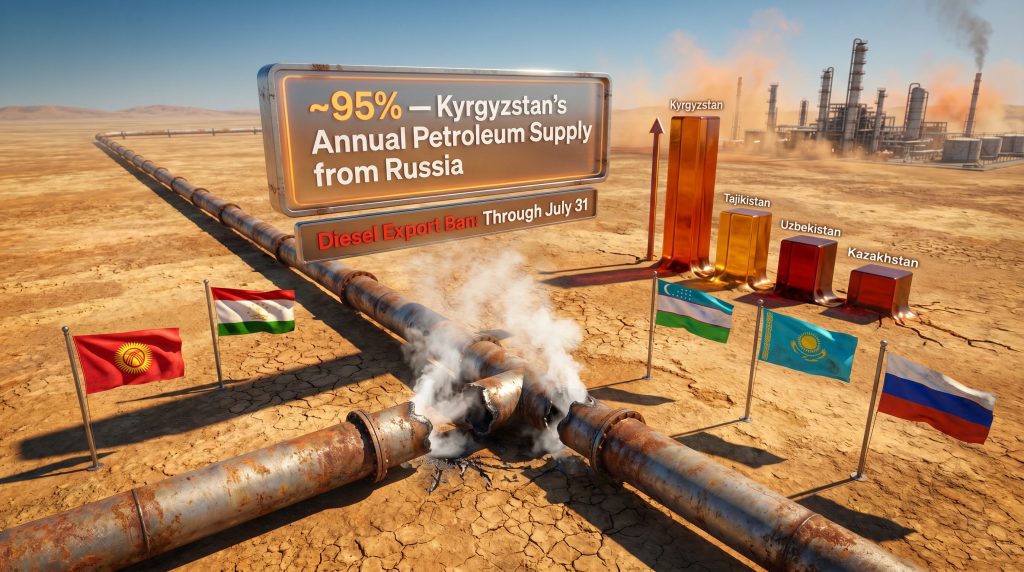
Compounding this, Russia's broader refinery network is now running at output levels estimated to be approximately 20% below domestic demand, with more than 78 of Russia's 83 administrative regions subject to some form of fuel restriction. A diesel export ban was imposed through at least July 31, cutting off a supply artery that Central Asian importers had long treated as reliable. According to reporting on Russia's fuel crisis, the ripple effects across Central Asia are deepening with each passing week.
Country-by-Country Exposure: Who Bears the Greatest Risk?
Central Asia's Fuel Dependency Matrix
| Country | Estimated Russian Fuel Dependency | Primary Fuel Affected | Emergency Response Activated |
|---|---|---|---|
| Kyrgyzstan | ~95% of petroleum product supply | Diesel, gasoline (AI-95) | Yes — preliminary deals with China and Belarus |
| Tajikistan | ~80% of petroleum product supply | Aviation fuel, diesel | Yes — negotiations with Kazakhstan and Turkmenistan |
| Uzbekistan | Significant share of refined imports | Gasoline (AI-92), diesel | Yes — diplomatic outreach, presidential visit to Belarus |
| Kazakhstan | Net producer managing domestic tightness | Diesel | Defensive — tightened border controls, extended export ban |
Kyrgyzstan: The Acute Emergency
Kyrgyzstan's situation is the most immediately precarious. With annual fuel consumption of roughly 2 million tons and approximately 95% of that volume sourced from Russia, the country possesses virtually no alternative supply infrastructure capable of absorbing a major disruption at short notice.
Kyrgyz First Deputy Prime Minister Daniyar Amangeldiev confirmed to Radio Azattyk that preliminary supply agreements had been reached with Beijing and Minsk covering aviation fuel and diesel deliveries. However, the volumes secured under these arrangements are estimated to cover only around 3% of Kyrgyzstan's annual diesel needs — a figure that underscores the enormous gap between diplomatic activity and actual supply adequacy.
State price controls on AI-95 gasoline were lifted as market conditions rendered them commercially unworkable. The government is now actively pursuing backup supply from Belarus, Kazakhstan, Uzbekistan, Turkmenistan, and Azerbaijan, reflecting the scale of the challenge.
Tajikistan: Aviation Fuel as the Pressure Point
Tajikistan's Civil Aviation Agency head Habibullo Nazarzoda confirmed to Radio Ozodi that his agency was in active negotiations with Kazakhstan, Turkmenistan, and other regional partners to secure aviation fuel. The negotiating posture described was exploratory rather than concluded: agencies were mapping available supply before formalising contracts. Parallel price controls on petroleum products were tightened domestically.
Uzbekistan: Record Prices Despite Reserves
Uzbekistan holds an estimated two to three months of strategic fuel reserves, providing a short-term buffer that its smaller neighbours lack. However, domestic AI-92 gasoline prices have reached record highs as import volumes from Russia declined. On July 7, President Shavkat Mirziyoev travelled to Belarus as part of emergency diplomatic efforts to identify alternative supply, following a similar path to Kyrgyzstan's own outreach to Minsk.
Kazakhstan: The Reluctant Pivot Point
Kazakhstan occupies an unusual position in this crisis. As a net hydrocarbon producer, it theoretically has the capacity to assist neighbours. In practice, it is simultaneously managing its own domestic fuel balance under pressure, with approximately 400 illegal cross-border fuel export attempts intercepted by authorities reflecting the scale of black-market demand. A proposal to extend the existing gasoline and diesel export ban through May 2027 is under active consideration.
The Governance Trap Behind the Energy Vulnerability
Why Decades of Policy Choices Created Today's Crisis
Luca Anceschi, Professor of Central Asian Studies at the University of Glasgow, has argued that the political logic of authoritarian governance systematically biases energy policy toward the short term. In systems where leadership legitimacy depends on avoiding immediate threats to political stability rather than on long-cycle infrastructure planning, multi-decade investment commitments are structurally deprioritised.
Energy strategy across the region has historically been oriented toward monetising resource exports rather than building domestic supply security — a distinction that becomes devastatingly consequential the moment an external supplier is disrupted. This pattern mirrors broader US-China trade war impacts on energy dependencies, where political decisions consistently override long-term structural planning.
This analysis is supported by the observable pattern: repeated expert proposals for regional refining cooperation, dating back to the early years of Central Asian independence, have never progressed beyond discussion. The intellectual case for diversification has been clear for decades. The political will has not materialised.
Kyrgyz economist Tolenbek Abdyrov has noted that the current situation reflects a failure that specialists have warned about for years, pointing to the need for diversified import sources, local processing capacity, and the ability to refine crude domestically rather than depending on imported finished products.
The Regional Refining Gap: A Structural Deficit
- Landlocked, non-producing nations like Kyrgyzstan and Tajikistan have no meaningful domestic refining capacity
- Even Uzbekistan, which possesses crude oil and gas reserves, relies heavily on Russian refined products due to limited processing infrastructure
- A coordinated regional model — Kazakhstan and Turkmenistan supplying crude, Uzbekistan refining, and products distributed across the region — has been proposed repeatedly but never implemented
- The infrastructure required for such a system was never built in part because the cheaper option was always available: simply import from Russia
The absence of regional refining cooperation is not a technical failure. It is a governance failure — the accumulated result of choosing the path of least resistance for three decades, until that path was closed by forces entirely outside the region's control.
Assessing the Realistic Alternatives
Which Substitute Suppliers Can Actually Fill the Gap?
| Alternative Supplier | Feasibility | Key Constraints | Coverage Potential |
|---|---|---|---|
| Belarus | Short-term, limited | Logistical distance, limited refining scale | Partial — aviation fuel and diesel |
| China | Medium-term | Transit costs, pricing, political leverage | Partial — diesel and gasoline |
| Kazakhstan | Immediate but restricted | Domestic demand protection, export controls | Moderate — if export ban is eased |
| Turkmenistan | Possible | Infrastructure limitations, bilateral relations | Limited |
| Azerbaijan | Possible | Transit complexity, volume constraints | Limited |
| Iran | Politically sensitive | Sanctions exposure for third parties, diplomatic risk | Uncertain |
A critical insight that regional analysts consistently raise is that simply substituting Russian dependency with a single alternative partner — whether China or Iran — replicates the structural vulnerability rather than resolving it. True resilience requires multi-source procurement combined with domestic infrastructure investment. The emergency deals announced to date cover a small fraction of annual consumption, and the diplomatic effort required to secure even those partial arrangements has already stretched multiple governments simultaneously.
The Economic and Political Consequences of Sustained Disruption
How Fuel Price Shocks Propagate Through Carbon-Intensive Economies
In economies where hydrocarbons underpin virtually every economic activity — agriculture, transport, manufacturing, heating, and food distribution — fuel price increases function as a broadly applied cost burden rather than a sectoral problem. The purchasing power compression is population-wide and rapid. As Anceschi has observed, in highly carbon-intensive economies, energy price spikes translate almost immediately into a generalised increase in the cost of living that makes ordinary people poorer across the board.
Consequently, commodity market volatility compounds these pressures, as interconnected energy and agricultural markets amplify the economic strain on already stretched households. This creates a feedback loop with significant political implications. Authoritarian governance systems derive legitimacy in part from delivering economic stability. When that stability is visibly eroded by fuel shortages and price spikes that governments cannot control, the political calculus shifts.
In political systems where the social contract rests on economic delivery rather than democratic mandate, sustained energy price inflation is not merely an economic problem — it is a direct threat to regime security. The longer disruptions persist without resolution, the more that threat compounds.
Governments face a compressing dilemma: maintaining price controls depletes fiscal reserves and discourages market-based procurement solutions, while removing them accelerates inflation and increases public discontent. Neither path is comfortable, and neither buys much time.
The next major ASX story will hit our subscribers first
What Meaningful Diversification Would Actually Require
A Phased Approach to Regional Energy Resilience
Energy experts and regional analysts have outlined what genuine diversification would need to involve, in phased terms:
- Immediate (0 to 6 months): Secure multi-source emergency supply agreements across at least four to five distinct suppliers; remove price distortions that suppress market-based procurement signals
- Short-term (6 to 24 months): Accelerate investment in domestic refining capacity; establish bilateral reserve-sharing arrangements with Kazakhstan; formalise multi-year supply diversification commitments
- Medium-term (2 to 5 years): Develop regional pipeline and transport infrastructure connecting production nodes to consuming markets; expand hydropower generation in Kyrgyzstan and Tajikistan to reduce hydrocarbon dependency for electricity
- Long-term (5 or more years): Build a coordinated regional energy architecture with shared governance frameworks, emergency reserve protocols, and genuinely diversified supply across commodities and producers
The barriers to this progression are not primarily technical. The infrastructure concepts are well-understood. The financing mechanisms, while challenging, are not unprecedented. The core obstacle is the political coordination required across multiple sovereign governments with competing interests and authoritarian incentive structures that consistently favour short-term stability over long-term resilience.
Is There a Turning Point Ahead?
The Case for Reform and the Risks of Failure
There is an argument that the current crisis — representing the strongest political case for structural energy diversification the region has experienced since independence — marks a genuine inflection point. For the first time, the costs of inaction are not theoretical. They are visible in fuel queues, record retail prices, and emergency presidential travel schedules. The diversification arguments that regional experts have made for decades now carry the immediate weight of lived economic consequence.
Furthermore, Russian fuel disruptions in Central Asia are occurring against a backdrop of shifting crude oil price trends globally, adding additional complexity to any long-term procurement strategy the region might attempt to construct. Whether the current crisis translates into durable reform depends on factors that remain genuinely uncertain:
- Whether the disruption is sustained long enough to overcome political inertia
- Whether any government in the region is willing to lead multi-lateral coordination rather than pursue bilateral emergency fixes
- Whether international financing partners treat regional energy infrastructure as a priority
- Whether the political costs of reform are judged lower than the political costs of continued disruption
Anceschi has noted that if conditions persist, this period could become a genuine inflection point for the political systems governing the region, though whether that inflection runs toward reform or toward instability remains an open question. Indeed, as documented accounts of Central Asia's energy crisis continue to surface, the pressure on regional governments to act decisively is intensifying with each passing month. The scale of the challenge confirms that Russian fuel disruptions in Central Asia represent not merely an energy problem, but a fundamental test of governance resilience across the entire region.
Disclaimer: This article is for informational and educational purposes only and does not constitute investment, legal, or financial advice. Forecasts, projections, and scenario analyses represent analytical perspectives based on available information and should not be relied upon as predictions of future events. Readers seeking investment guidance should consult qualified financial advisers.
Want to Stay Ahead of the Commodity Disruptions Reshaping Global Markets?
When geopolitical shocks expose deep structural vulnerabilities in energy and resource supply chains, the investment implications can be swift and significant — and Discovery Alert's proprietary Discovery IQ model delivers real-time alerts on significant ASX mineral discoveries the moment they hit the market, translating complex commodity dynamics into actionable opportunities. Explore how historic discoveries have generated substantial returns on Discovery Alert's dedicated discoveries page, and begin your 14-day free trial today to position yourself ahead of the next major market move.