August 24, 2026
Indonesia's Grip on the Global Nickel Market Tightens in 2026
Few mechanisms in global commodity markets operate with the precision of a government-controlled extraction quota system. When a single nation accounts for the majority of the world's nickel ore supply and possesses the regulatory architecture to adjust output volumes on an annual basis, the price of nickel ceases to be purely a function of demand. It becomes, in large part, a policy output. That is the reality shaping the Indonesia RKAB revision and nickel price outlook heading into the second half of 2026.
Understanding how Jakarta's regulatory decisions transmit through ore fields, processing plants, and ultimately onto the LME requires a step-by-step examination of the machinery involved, the shocks that amplified it, and the scenarios that will define the next six months.
When big ASX news breaks, our subscribers know first
What Is the RKAB System and Why Does It Function as a Price Lever?
The RKAB, which stands for Rencana Kerja dan Anggaran Biaya, is Indonesia's formal mechanism for approving annual nickel ore extraction budgets at the company level. Every mining entity operating in Indonesia must submit an RKAB application and receive government approval before extracting a single tonne of ore. Historically, these approvals operated on a three-year cycle, providing operators with medium-term supply visibility.
The shift to annual renewal cycles fundamentally altered the government's ability to manage market outcomes. Under the annual system, Jakarta can recalibrate total extraction volumes within a 12-month window rather than waiting three years to course-correct. This structural change effectively transformed the RKAB into a near real-time commodity price management tool.
The supply chain transmission works as follows:
- RKAB quota decisions determine the volume of nickel laterite ore available at the mine gate.
- Ore volumes dictate throughput at downstream processing facilities, including High-Pressure Acid Leach (HPAL) plants and Rotary Kiln Electric Furnace (RKEF) operations.
- Processing output determines the supply of Mixed Hydroxide Precipitate (MHP) and high-grade nickel matte entering global markets.
- MHP feeds into nickel sulfate production, which supplies the electric vehicle battery supply chain.
- All of these flows ultimately influence LME nickel pricing, which serves as the global reference point.
Structural Insight: When the Indonesian government cuts the RKAB quota by 30%, it is not simply reducing ore tonnage. It is compressing the entire downstream nickel supply chain, from processing plants to battery precursor manufacturers, through a single administrative decision.
The 2026 Quota Cut: From Supply Maximisation to Value Capture
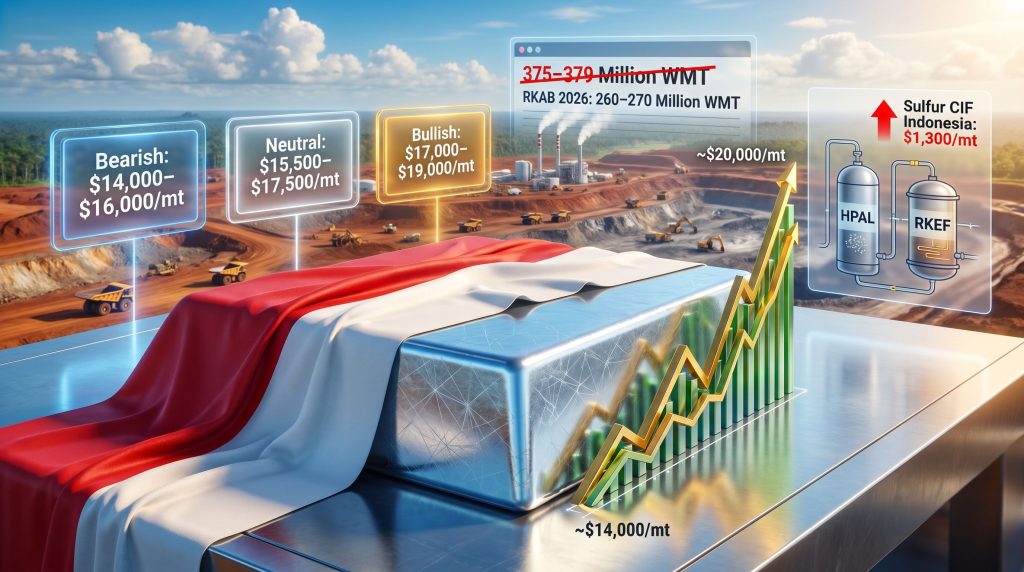
The approved 2026 RKAB quota was set at 260 to 270 million wet metric tonnes (wmt), a reduction of approximately 30 to 34% from the 375 to 379 million wmt approved in 2025. This is not a marginal adjustment. It represents the most significant single-year quota reduction Indonesia has implemented under the annual renewal framework.
The policy logic behind this move extends beyond short-term price support. Indonesia has been progressively repositioning its nickel sector away from raw volume extraction toward value-added processing and downstream integration. The 2020 nickel ore export ban, the subsequent build-out of domestic HPAL and RKEF capacity, and now the aggressive quota reduction in 2026 form a coherent policy sequence. Furthermore, understanding Indonesian nickel industry challenges helps contextualise why this shift is as much structural as it is strategic.
Indonesian authorities have informally targeted a nickel price range of $18,000 to $21,000 per metric tonne as consistent with their long-term economic objectives. At the spot price of $16,587/mt recorded in early July 2026, that target remains unfulfilled, but the quota discipline being applied in 2026 represents a deliberate effort to close the gap.
Three Simultaneous Shocks: How Nickel Rallied 37% in Five Months
The nickel price trajectory from late 2025 through May 2026 was not driven by a single variable. Three distinct shocks converged in sequence, each amplifying the impact of the others.
| Supply Shock | Mechanism | Price Impact |
|---|---|---|
| RKAB quota cut (-30 to 34%) | Reduced ore availability; forced production halts | Primary driver of January to May rally |
| HPM benchmark revision (+100%) | Raised cost floor for all ore-based processing | Amplified cost pressure on HPAL and NPI producers |
| Hormuz sulfur disruption | Sulfur CIF Indonesia rose from below $600 to $1,300/mt | Triggered HPAL cuts; pushed nickel toward $20,000/mt |
| Fed hawkish June pivot | USD strengthening; commodity demand repricing | Contributed to June to July pullback to $16,000 to $17,000/mt |
LME nickel climbed from approximately $14,000/mt in January 2026 to nearly $20,000/mt in May 2026, a rally of roughly 37% from late December 2025 to April 2026. The quota cut created the foundational supply tightness. The HPM revision added a secondary cost layer. The sulfur shock delivered the final upward impulse. For additional context, Goldman Sachs has documented how Indonesia's supply policy directly catalysed this kind of price movement.
The HPM Revision: A Regulatory Pricing Floor That Doubled Overnight
Indonesia's HPM, or Harga Patokan Mineral, functions as a government-mandated benchmark pricing floor applied to all nickel ore transactions within the domestic market. The April 2026 HPM revision raised the correction factor applied to 1.6% grade nickel ore from 17% to 30%, effectively more than doubling the benchmark price applicable to a large portion of the ore traded between miners and processors.
This revision worked in tandem with the quota cut. While the RKAB reduction limited how much ore was available, the HPM revision increased the cost of ore that remained accessible. For HPAL operators already under margin pressure, this dual constraint proved particularly damaging.
The Sulfur Shock: A Geopolitical Variable With Processing Consequences
HPAL processing is chemically intensive. Approximately 10 metric tonnes of sulfur are consumed for every metric tonne of MHP nickel produced, making sulfuric acid one of the most critical variable inputs in the process. Indonesia imports the majority of its sulfur requirements, and the Strait of Hormuz disruptions in early 2026 severely constrained these import flows.
Sulfur prices CIF Indonesia surged from below $600/mt to approximately $1,300/mt at their peak. Huayou Cobalt's Huafei Nickel-Cobalt facility, one of Indonesia's larger HPAL operators, responded by cutting production as the elevated sulfur costs flowed through to MHP output economics. This production curtailment tightened MHP supply precisely when the quota-driven ore shortage was already constricting the upstream end of the chain.
The July RKAB Revision Window: The Single Most Important Variable for H2 2026
Indonesia opened a formal supplementary quota application window from July 1 to 31, 2026, allowing mining companies to apply for additional extraction allocations above the original 260 to 270 million wmt ceiling. The outcome, expected by July 31, represents the pivotal near-term variable for nickel price direction. Consequently, the Indonesia RKAB revision and nickel price outlook for the remainder of the year hinges almost entirely on how Jakarta responds to these applications.
Market intelligence suggesting a potential quota increase to 300 to 350 million wmt was already being partially priced into the June pullback, indicating that traders were forward-pricing the regulatory outcome rather than waiting for the official announcement. This behaviour reflects the market's sophistication in interpreting Indonesian policy signals, even before formal decisions are announced.
A notable real-world consequence of the original quota restriction was the halt in production at WBN after the company exhausted its entire 2026 RKAB allocation well before year-end, illustrating just how binding the quota constraints became in practice. ING's analysis of Indonesia's quota rethink offers further insight into how this policy recalibration has been received by global markets.
Three Scenarios for H2 2026 Nickel Prices
Scenario Summary:
- Bearish ($14,000 to $16,000/mt): Quota rises by at least 30% to 300 to 350 million wmt, sulfur prices decline, and elevated inventories persist.
- Neutral ($15,500 to $17,500/mt): Modest quota increase below 300 million wmt, sustained high sulfur costs, gradual inventory drawdown.
- Bullish ($17,000 to $19,000/mt): Quota held below 300 million wmt with stricter export controls enforced, geopolitical disruptions sustain elevated sulfur costs.
LME nickel at $16,587/mt sits at the midpoint of the neutral scenario range, suggesting the market is assigning the highest probability to a moderate quota increase rather than either extreme. Bernstein's revised 2026 nickel price target of $17,357/mt aligns with the upper boundary of the neutral scenario, while Goldman Sachs' average 2026 forecast of $17,200/mt reflects a similar assessment of first-half tightness. In addition, the nickel price momentum insights from earlier in the cycle reinforce why the structurally elevated cost floor is expected to persist into the second half.
The Cost Curve Has Fundamentally Shifted Upward
One of the least discussed but most consequential dimensions of the 2026 nickel market is the dramatic upward shift in industry-wide production costs. This shift is not a temporary cyclical phenomenon. It reflects structural changes in ore access costs, processing input costs, and ore grade deterioration.
| Cost Metric | 2025 C1 Cash Cost | 2026 C1 Cash Cost | Change |
|---|---|---|---|
| 75th Percentile | $14,650/mt | $17,870/mt | +$3,220/mt (+22%) |
| 90th Percentile | $15,300/mt | $18,650/mt | +$3,350/mt (+22%) |
| LME Spot (July 2026) | – | $16,587/mt | Below 75th percentile |
At a spot price of $16,587/mt, LME nickel sits below the 75th percentile cost threshold. This means a majority of producers in the upper half of the cost curve are operating below their cost of production. This is not a demand-side collapse scenario. It is a regulatory and geopolitical cost-push event that has compressed margins across the industry simultaneously.
RKEF vs. HPAL: Processing Technology Determines Survival
The cost divergence between RKEF and HPAL operations has become one of the defining structural stories of the 2026 nickel market. RKEF-based facilities, which produce high-grade nickel matte, carry no sulfur dependency. When sulfur prices spike, RKEF operators maintain their cost structure while HPAL operators face exponential input cost increases.
The market responded rationally. Indonesian high-grade nickel matte output rose 123% year-over-year to 185,000 metric tonnes of contained nickel in H1 2026, as producers migrated capacity away from sulfur-dependent HPAL operations toward RKEF-based alternatives. This shift represents a technology arbitrage within Indonesia's own processing sector, driven entirely by the sulfur price shock.
Ore Grade Deterioration: The Silent Cost Escalator
A dimension of the cost inflation story that receives insufficient attention is the progressive decline in ore grades across Indonesian laterite deposits. Lower ore grades require greater processing intensity per unit of output, increasing energy consumption, reagent volumes, and ultimately per-tonne production costs. This operates as a compounding cost headwind that exists independently of quota policy or sulfur prices.
Projected 2026 Indonesian mined nickel output of approximately 2.3 million tonnes reflects the combined effect of constrained quotas and grade deterioration. Even if quotas were relaxed, declining grades would continue to apply upward pressure on the cost curve over the medium term. The Indonesian nickel market trends from 2025 already signalled this trajectory, making the 2026 cost escalation less surprising in hindsight.
The next major ASX story will hit our subscribers first
Inventory Levels: The Bearish Counterweight Capping Price Recovery
Supply tightness does not translate directly into higher prices when visible inventories are elevated. Combined LME and SHFE nickel stocks reached approximately 375,000 metric tonnes as of July 2026, representing roughly 9% of 2025 global mine production. Total global visible inventory, including the 274,584 metric tonnes held in LME warehouses (with 16,650 cancelled warrants), reached approximately 497,000 metric tonnes.
Analyst Perspective: The 497,000-tonne global inventory figure is not a straightforward bearish signal in isolation. It also represents an absorption buffer capable of accommodating a moderate quota increase without triggering immediate price collapse. The critical variable is whether demand recovery in stainless steel fabrication or NMC battery production accelerates the drawdown rate faster than incremental supply additions.
The interaction between inventory levels and the RKAB revision outcome will determine the price path under each scenario:
- Bearish scenario: High inventories compound the impact of a 30%+ quota increase, reinforcing the $14,000 to $16,000/mt range.
- Neutral scenario: Gradual inventory drawdown, supported by stainless steel restocking, sustains prices in the $15,500 to $17,500/mt band.
- Bullish scenario: Accelerating inventory depletion, driven by NMC battery demand growth, would be required before prices could sustainably test $17,000 to $19,000/mt.
Finance Minister Regulation No. 32: A New Layer of Export Control
Layered on top of the RKAB quota system and the HPM revision, Indonesia's Finance Minister Regulation No. 32, introduced in July 2026, imposes export licensing requirements on ferronickel products containing at least 4% nickel content. This regulatory addition targets the downstream export channel rather than the upstream mining allocation, creating a multi-layered supply constraint architecture.
The combined effect of tighter RKAB quotas, higher HPM benchmark pricing, and ferronickel export licensing reflects an increasingly sophisticated government strategy to retain value within Indonesia's domestic processing ecosystem. Each regulatory layer reinforces the others, making it progressively harder for global markets to access Indonesian nickel at the volumes and price points previously available. Furthermore, China's investment in Indonesia's nickel processing sector adds another dimension to how this regulatory tightening is likely to play out commercially.
Long-term price projections, based on sustained supply discipline of this kind, suggest the nickel price centre of gravity could shift toward $26,000/mt by 2033 to 2034. This remains a speculative projection contingent on Indonesia maintaining regulatory consistency, but the trajectory of policy decisions in 2026 suggests this is a deliberate long-term ambition. The broader role of Indonesian nickel in the energy transition reinforces why these projections carry particular significance for battery supply chains globally.
Key Reference Data: Indonesia RKAB Revision and Nickel Price Outlook
| Metric | Value |
|---|---|
| 2026 RKAB quota (approved) | 260 to 270 million wmt |
| 2025 RKAB quota | 375 to 379 million wmt |
| Quota reduction | ~30 to 34% |
| LME nickel spot (July 2026) | $16,587/mt |
| LME nickel rally (Dec 2025 to Apr 2026) | ~37% |
| LME nickel peak (May 2026) | ~$20,000/mt |
| C1 cost at 75th percentile (2026) | $17,870/mt |
| C1 cost at 90th percentile (2026) | $18,650/mt |
| Combined LME + SHFE stocks | ~375,000 metric tonnes |
| Global visible inventory | ~497,000 metric tonnes |
| Goldman Sachs 2026 average forecast | $17,200/mt |
| Bernstein 2026 price target | $17,357/mt |
| H1 2026 nickel matte output growth (YoY) | +123% to 185,000 mt contained nickel |
| Sulfur price CIF Indonesia (peak) | $1,300/mt |
| Indonesia's informal price target | $18,000 to $21,000/mt |
| Long-term speculative price projection | ~$26,000/mt by 2033 to 2034 |
Strategic Implications for Market Participants
The Indonesia RKAB revision and nickel price outlook presents differentiated implications depending on where a market participant sits in the value chain.
For producers:
- High-cost HPAL operators face structural margin compression at current spot prices. Viability requires either sulfur price normalisation, a nickel price recovery above $17,870/mt, or meaningful cost reduction initiatives.
- RKEF-based producers with no sulfur exposure are relatively insulated under current conditions and positioned to benefit from any sustained price recovery.
- Ore grade deterioration is a medium-term cost headwind that investment planning must account for independently of quota and sulfur dynamics.
For investors and traders:
- The July 31 RKAB decision is the single most important near-term catalyst. A quota above 300 million wmt points toward the bearish price range; a quota held below 300 million wmt supports neutral to bullish scenarios.
- Monitoring sulfur price trajectories, particularly in relation to Hormuz geopolitics, provides a secondary leading indicator for HPAL production economics and MHP supply flows.
- Stainless steel demand recovery in China and NMC battery adoption rates represent the demand-side variables capable of overriding supply dynamics in the medium term.
For policymakers and supply chain strategists:
- Indonesia's regulatory architecture is demonstrably capable of generating significant price volatility in a globally critical industrial metal. Supply chain resilience strategies that do not account for Indonesian regulatory risk are structurally incomplete.
- The progressive layering of quota controls, benchmark pricing reforms, and export licensing suggests Indonesian nickel supply will become a more actively managed variable, not less, over the coming years.
Disclaimer: This article contains forward-looking statements, price forecasts, and scenario projections that are inherently speculative and subject to change. Figures attributed to third-party analysts including Goldman Sachs and Bernstein reflect their published estimates at the time of writing and do not constitute investment advice. Readers should conduct independent due diligence before making any investment decisions based on the information contained herein.
Want to Track ASX Nickel Discoveries as Indonesia's Supply Policies Reshape the Market?
Discovery Alert's proprietary Discovery IQ model delivers real-time alerts the moment significant ASX mineral discoveries are announced, transforming complex commodity data into clear, actionable insights for both traders and long-term investors. Explore how major mineral discoveries have historically generated substantial returns on Discovery Alert's dedicated discoveries page, and begin your 14-day free trial today to position yourself ahead of the next significant nickel opportunity.