
July 10, 2026
The Silent Export Problem Quietly Undermining the UK's Industrial Future
Every tonne of aluminium ever produced still exists somewhere in the world. Unlike many materials, aluminium is theoretically infinitely recyclable without degradation in quality, which makes its secondary lifecycle one of the most strategically valuable in all of manufacturing. Yet despite this extraordinary property, UK aluminium scrap retention by 2035 has emerged as one of the most pressing industrial policy challenges the country faces, as it ships nearly half of its scrap overseas at the precise moment domestic industry is preparing to need it most.
Understanding why this matters requires stepping back from the trade data and examining what secondary aluminium actually represents in modern industrial supply chains. It is not waste. It is a processed, energy-dense industrial feedstock that requires approximately 95% less energy to produce than primary aluminium refined from bauxite ore. For sectors ranging from electric vehicle manufacturing to aerospace defence, access to high-grade domestic scrap is not merely a cost efficiency question. It is increasingly a question of supply chain sovereignty.
The numbers framing the UK's challenge by 2035 are striking, but the more interesting story lies in what the trajectory reveals about the intersection of trade economics, industrial policy, and circular material flows.
When big ASX news breaks, our subscribers know first
Understanding the Scale of the UK's Aluminium Scrap Gap
The Make UK white paper Strategic Aluminium Scrap places the UK's projected aluminium demand across high-growth sectors at 8 million tonnes by 2035. Depending on the ambition level applied to domestic recycling, between 3.55 million and 6 million tonnes of aluminium scrap will need to be available for domestic processing to meet that demand.
To appreciate how far the UK currently sits from either target, consider the baseline. Approximately 800,000 tonnes of aluminium scrap was recycled in the UK in recent years, representing around 44% of aluminium demand across growth sectors. Before accounting for imports or exports, the potential recycling yield from domestically generated scrap was closer to 1.2 million tonnes, suggesting that significant value was already being lost to outbound trade flows even at that earlier stage.
The core structural tension can be summarised simply:
- The UK generates meaningful scrap volumes, but exports approximately half of what it produces
- Imports compensate for only 27% of the gap created by those outbound flows
- In 2025, the UK exported approximately 624,000 tonnes of aluminium scrap to overseas buyers
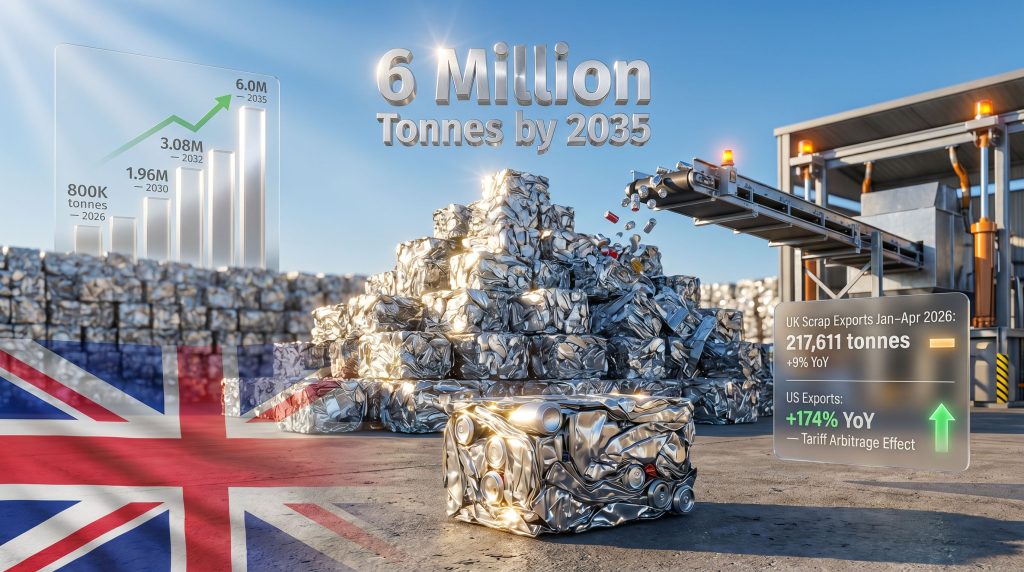
- During January to April 2026, exports climbed a further 9% year-on-year to 217,611 tonnes, compared to 200,374 tonnes in the same period of 2025
This is not simply a recycling rate problem. It is an export leakage problem compounded by insufficient domestic processing infrastructure, creating a feedback loop that rewards overseas buyers while leaving UK industry increasingly exposed.
Two Pathways to 2035: What Each Scenario Actually Demands
The Make UK analysis models two distinct trajectories, and the difference between them is not merely numerical. It reflects two fundamentally different views of how aggressively the UK is willing to restructure its secondary aluminium ecosystem.
| Metric | Option 1 (High Recycling) | Option 2 (Baseline) |
|---|---|---|
| Recycling share of demand by 2035 | 75% | 44% |
| Total scrap required by 2035 | 6.0 million tonnes | 3.55 million tonnes |
| Annual scrap growth rate required | ~25.1% | ~18% |
| Additional retained scrap needed by 2035 | 950,198 tonnes | 440,115 tonnes |
| Retention requirement vs. 2025 export base | 152.3% | 70.5% |
Option 1: The High-Recycling Pathway
Under the high-recycling scenario, the aluminium recycling sector must compound scrap availability at roughly 25.1% annually from the 2026 baseline of 800,000 tonnes, reaching the following milestones:
- 2027: 1.0 million tonnes
- 2030: 1.96 million tonnes
- 2032: 3.08 million tonnes
- 2035: 6.0 million tonnes
Assuming imports hold steady at 18.75% of total procurement, the volume of scrap that must be redirected from export channels into domestic processing grows sharply across the forecast period:
- 2027: 163,112 tonnes of additional retention required
- 2030: 320,449 tonnes
- 2032: 504,114 tonnes
- 2033: 632,802 tonnes, equivalent to 101.4% of the UK's entire 2025 export base
- 2034: 791,780 tonnes
- 2035: 950,198 tonnes, equivalent to 152.3% of the 2025 export base
The 2033 Inflection Point: This is the year at which the mathematics of simple export redirection breaks down entirely. From 2033 onward, even if the UK halted all aluminium scrap exports to overseas buyers, it would still fall short of Option 1 requirements. This forces a qualitatively different policy response, one that must simultaneously expand post-consumer collection, upgrade recovery infrastructure, and activate entirely new domestic procurement channels.
Option 2: The Baseline Pathway
Even without raising recycling's share of demand beyond its current 44% contribution, the UK's growing aluminium market still requires 3.55 million tonnes of scrap for domestic recycling by 2035. The annual growth requirement of approximately 18% is demanding in its own right:
- 2027: 944,048 tonnes
- 2030: 1.55 million tonnes
- 2032: 2.16 million tonnes
- 2035: 3.55 million tonnes
The additional retention required from the export pool grows from 117,039 tonnes in 2027 to 440,115 tonnes by 2035, which equates to 70.5% of the UK's 2025 annual export volume. Unlike Option 1, this stays within the theoretical bounds of what current exports could provide through 2035, but it still demands a fundamental reorientation of domestic scrap trade flows.
Where UK Aluminium Scrap Is Actually Going
The export destination data for January to April 2026 reveals the competitive intensity of international demand for UK-origin scrap material:
| Destination | Volume (tonnes) | Year-on-Year Change |
|---|---|---|
| India | 60,054 | -1% |
| Hong Kong | 34,666 | -4% |
| China | 20,261 | -15% |
| United States | 17,230 | +174% |
| Thailand | 11,546 | +6% |
| Germany | 10,206 | -8% |
| Total (Top 6) | ~154,000 | — |
The top six destinations collectively accounted for approximately 71% of total UK aluminium scrap exports during the four-month period.
The US Tariff Arbitrage Effect
The most striking development in the 2026 trade data is the 174% surge in UK scrap exports to the United States, rising from 6,285 tonnes to 17,230 tonnes year-on-year. This is not driven by any particular affinity between UK producers and American buyers. It is driven by a structural asymmetry in US trade policy.
US aluminium tariffs on primary aluminium imports into the United States now stand at 50%, while aluminium scrap remains tariff-exempt. This creates a powerful economic incentive for American manufacturers to substitute primary aluminium with imported secondary material, and UK scrap traders are responding to that price signal.
Furthermore, this dynamic illustrates a critical and underappreciated risk in the UK scrap retention challenge: the threat is not static. The broader effects of aluminium and steel tariffs imposed by foreign governments, whether in Washington, Brussels, or Beijing, can rapidly intensify UK scrap leakage with no direct connection to UK domestic conditions. The UK's strategic reserve of secondary aluminium is effectively available for auction to the highest global bidder unless domestic policy frameworks intervene.
Which Industries Carry the Highest Exposure
The sectors with the greatest strategic dependence on domestic aluminium scrap access are not uniformly positioned to absorb supply disruptions.
Packaging
The UK consumes more than 16 billion beverage cans annually, with a recycling rate of 81%, placing it among the highest in the world for this category. Novelis has committed a further EUR 70 million to double used beverage can recycling capacity within the UK, signalling confidence in domestic demand growth. The forthcoming Deposit Return Scheme is expected to push recovery rates higher still, improving both volumes and material quality.
Automotive and Electric Vehicles
JLR has introduced aluminium body panels incorporating 85% recycled content, and UK manufacturers are producing specialised components including EV battery casings where alloy purity and traceability are non-negotiable. As EV production scales through the 2030s, demand for high-grade, closed-loop aluminium scrap will intensify considerably. The risk here is subtle: EV battery casing applications require specific alloy grades with tight compositional tolerances, meaning not all scrap is interchangeable. Low-quality or mixed-grade scrap exported today may leave a deficit in exactly the grades that future EV manufacturing requires most.
Defence and Aerospace
Arconic's UK operations incorporate up to 71% scrap in defence-critical aluminium production. This is arguably the sector where export leakage carries the most acute strategic consequence. Defence-grade aluminium alloys are subject to strict compositional and traceability requirements. When strategically important scrap grades leave the UK for Asian or North American buyers, they do not simply represent lost revenue. They represent a tangible erosion of sovereign industrial capability.
Construction
Aluminium's expanding role in low-carbon building systems, structural facades, and sustainable construction creates sustained long-term demand for secondary material as the built environment transitions toward circular procurement standards.
The Smart Retention Toolkit: Policy Options Without Blanket Restrictions
The Make UK white paper is explicit that indiscriminate export bans are not the answer. Such measures risk damaging the UK's trade relationships, particularly the bilateral scrap exchange with European processors that some UK facilities depend on for up to 31% of their input material. In 2024, the UK exported approximately 107,000 tonnes of scrap to Europe while importing 73,000 tonnes, a relationship that underscores the need for mutual access rather than unilateral restriction.
Instead, the paper recommends a precision-targeted approach built around five interconnected mechanisms:
- UK-Market-First Mechanism — Domestic processors receive preferential early access to priority scrap grades before material is made available to overseas buyers
- Improved HS Code Classification — More granular trade codes that identify alloy composition and quality in export documentation, enabling targeted surveillance of strategically valuable material flows
- Enhanced Traceability Systems — End-to-end tracking of high-value alloys from initial collection through to final use, creating accountability at each stage of the supply chain
- Infrastructure Investment — Targeted funding for advanced sorting, de-coating, shredding, and alloy separation technologies that make domestic processing economically competitive with overseas buyers who currently benefit from accepting lower pre-sorting standards
- Stronger Collection Enforcement — Raising compliance standards across the scrap collection sector to reduce informal export channels and improve material yield
The fundamental objective is not to prevent exports altogether, but to ensure that the UK retains access to the grades its own industry needs most, while maintaining the bilateral scrap exchange relationships that add value to domestic processing.
The next major ASX story will hit our subscribers first
What the EU's Policy Direction Signals for UK Strategy
The European Commission has identified aluminium scrap retention as a strategic priority linked directly to industrial decarbonisation and supply chain autonomy. Measures reportedly under consideration include export duties, export licensing requirements for specific grades, mandatory recycled-content targets, and enhanced trade flow surveillance. Consequently, the UK's European supply chain strategy alignment becomes increasingly relevant in this context.
For the UK, the EU's emerging framework has a dual significance. First, it offers a policy template that can be adapted to the UK's own legislative context. Second, and more critically, it creates a risk that the UK becomes a preferred export channel for scrap that EU regulations redirect away from European buyers, unless UK measures are developed in parallel.
| EU Policy Tool | UK Equivalent Opportunity |
|---|---|
| Export licensing | UK-market-first mechanism for strategic alloys |
| Trade flow surveillance | Enhanced HS code tracking and traceability |
| Mandatory recycled content | Sector-specific procurement standards for defence, automotive |
| Infrastructure co-investment | Targeted grants for sorting and pre-processing facilities |
Aligning with EU standards on traceability and quality classification, even without formal regulatory harmonisation, reduces the risk of the UK being exploited as a regulatory arbitrage destination for material that stricter EU rules push out of continental channels.
Three Non-Negotiable Conditions for Closing the Gap
The arithmetic of UK aluminium scrap retention by 2035 points to three conditions that must be met simultaneously, regardless of which pathway is ultimately pursued.
1. Infrastructure investment at scale
Domestic processing economics must become competitive with overseas buyers. This requires capital investment in sorting, de-coating, shredding, and alloy separation technologies. Without this, even well-designed retention policies will leak, as scrap traders respond to price signals rather than policy preferences.
2. Precision policy intervention
Blanket export restrictions carry significant collateral damage risk. Targeted smart retention tools focused on specific strategic alloy grades offer a more viable and commercially sustainable path, particularly given the UK's dependency on EU-origin scrap for a meaningful share of domestic processing input. In addition, the broader question of critical raw materials transition planning must inform how secondary aluminium is classified within national industrial strategy.
3. Ecosystem expansion beyond retention
This is the condition most frequently underestimated. Under Option 1, fully redirecting 100% of current export volumes becomes mathematically insufficient from 2033 onward. The UK must grow its total scrap ecosystem through stronger post-consumer collection, effective Deposit Return Scheme implementation, and the development of new domestic procurement routes capable of attracting material that currently bypasses formal collection channels entirely. Indeed, the aluminium industry leaders most actively investing in circular supply chains globally will increasingly look to markets where retention frameworks are robust and predictable.
The strategic reality is unambiguous: UK aluminium scrap retention by 2035 is a necessary condition for meeting demand targets, but it is not sufficient in isolation. The UK must fundamentally reframe secondary aluminium as a strategic industrial input rather than a commodity export, and build the infrastructure, policy architecture, and market incentives that reflect that shift across every layer of the supply chain.
Disclaimer: This article contains forward-looking projections and scenario modelling drawn from the Make UK white paper Strategic Aluminium Scrap. Such projections involve assumptions about future trade flows, policy developments, and industrial demand that are inherently uncertain. This content is intended for informational purposes only and should not be construed as financial or investment advice. Readers are encouraged to consult primary source material and seek independent professional guidance before making decisions based on forecast data.
Want to Identify the Next Major Resource Discovery Before the Market Does?
Discovery Alert's proprietary Discovery IQ model delivers real-time alerts on significant ASX mineral discoveries, transforming complex resource data into actionable investment insights — explore the historic returns major discoveries have generated and begin a 14-day free trial to position yourself ahead of the broader market.