
July 10, 2026
The Hidden Bottleneck That Shapes Every Aluminum Market Cycle
Most commodity market observers focus on smelter output when tracking aluminum supply. Yet the real constraint sitting upstream of every ingot cast, every rolled sheet, and every automotive component stamped from aluminum is a far less visible process: the conversion of bauxite ore into alumina, the refined white powder that feeds electrolytic reduction cells. When this intermediate step is disrupted, the entire aluminum value chain tightens from the inside out. That structural reality is precisely why the EGA Al Taweelah alumina refinery restart, confirmed in early July 2026, is carrying far more weight for global aluminum markets than a typical facility resumption would suggest.
When big ASX news breaks, our subscribers know first
Why Alumina Is the Linchpin of Aluminum Production
To understand what the Al Taweelah restart means, it helps to understand what alumina actually does in the production chain. Bauxite is first refined through the Bayer Process into alumina, typically at a ratio of roughly four to five tonnes of bauxite per tonne of alumina produced. That alumina is then fed into electrolytic reduction cells, where the Hall-Heroult process uses enormous electrical current to strip oxygen atoms and yield primary aluminum metal. The critical implication is that without a continuous, adequate alumina feed, smelters physically cannot operate at full capacity, regardless of how much electrical power they have access to.
Furthermore, understanding the global context of bauxite production leaders helps illustrate just how concentrated the upstream supply chain truly is, and why any disruption along the refining corridor carries disproportionate weight for the entire market.
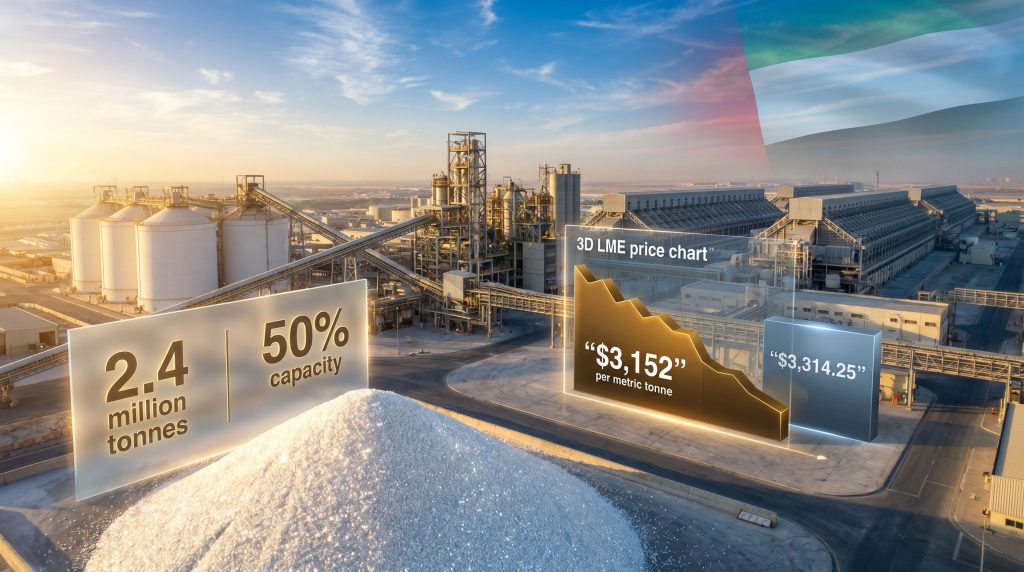
Al Taweelah's position within Emirates Global Aluminium's (EGA) integrated structure makes it particularly significant. The refinery is co-located with the Al Taweelah smelter within the Khalifa Economic Zone Abu Dhabi (KEZAD), a configuration that eliminates the logistical complexity and cost of transporting alumina across ocean freight routes. In 2025, the refinery produced 2.4 million tonnes of alumina, covering approximately 46% of EGA's total alumina requirements. That self-sufficiency ratio is not merely an operational metric; it directly determines EGA's exposure to spot alumina pricing on international markets. When the refinery went offline, that 46% of internal supply had to be sourced externally at prevailing market rates, compressing production economics in ways that the headline output figures alone do not capture.
Consequently, the broader alumina market pressures that were already building across global supply chains made EGA's internal disruption even more commercially painful during the shutdown period.
From Strike to Silence: What the March 2026 KEZAD Attack Changed
The forced shutdown of the Al Taweelah complex did not arise from a market downturn, a maintenance cycle, or a labour dispute. In late March 2026, Iranian missile and drone strikes targeting the Khalifa Economic Zone Abu Dhabi caused physical damage to the facility, triggering an unplanned emergency halt across both the alumina refinery and the adjacent smelter. The Al Taweelah smelter operates 1,262 reduction cells, making it one of the largest single-site primary aluminum operations in the world. The physical damage to this infrastructure created a disruption profile that markets are structurally ill-equipped to price efficiently in the short term.
The distinction between conflict-driven shutdowns and other forms of production curtailment is analytically important and frequently underappreciated.
| Disruption Type | Trigger | Typical Recovery Timeline | Market Impact Profile |
|---|---|---|---|
| Conflict or geopolitical strike | External military event | 6 to 18+ months | Immediate price spike, sustained uncertainty |
| Demand-side curtailment | Weak aluminum pricing | 2 to 6 months | Gradual price support as demand recovers |
| Scheduled maintenance | Planned downtime | Days to weeks | Minimal market disruption |
| Natural disaster | Environmental event | Variable by severity | Regional supply shock, unpredictable |
A market-driven curtailment is, paradoxically, somewhat self-correcting: falling prices encourage curtailment, and as supply tightens, prices rise again, incentivising restarts. A conflict-driven shutdown follows no such internal logic. Recovery is governed by the pace of physical repair, supply chain reconstitution, and geopolitical resolution, none of which respond to price signals in any reliable way. This asymmetry embedded a structural risk premium into aluminum pricing from the moment the strikes occurred.
The EGA Al Taweelah Alumina Refinery Restart: Progress and Timeline
The return to production at Al Taweelah has proceeded faster than initial assessments suggested. First alumina output resumed in early Q3 2026, with the facility targeting a ramp-up to 50% of plant capacity within days of the official restart confirmation. At that threshold, the refinery would theoretically contribute approximately 1.2 million tonnes of alumina on an annualised basis, a material volume relative to global seaborne alumina trade flows. For further context on the scale of this achievement, EGA's official Al Taweelah alumina refinery overview outlines the full operational scope of the facility.
EGA has indicated that the timing of production increases beyond the 50% mark will depend on two interrelated factors:
- Supply chain conditions, particularly the reliability of bauxite inflows
- Optimisation of EGA's broader alumina sourcing strategy, balancing internal refinery output against third-party procurement commitments made during the shutdown period
Full technical production capability at the alumina refinery is targeted for the end of 2026, though actual output volumes will be contingent on how efficiently the upstream bauxite supply chain can be reconfigured. This distinction between technical capability and actual realised output is one that commodity analysts often collapse inappropriately. The former is an engineering milestone; the latter is a commercial and logistical outcome that depends on factors extending well beyond the refinery fence line.
The Upstream Variable: Bauxite Supply and Guinea Alumina Corporation
EGA's upstream position is bolstered by its ownership of the Guinea Alumina Corporation (GAC), a bauxite mining operation in Guinea that represents a potential lever for accelerating the ramp-up trajectory. However, bauxite is a bulk commodity with long shipping lead times from West Africa to the Middle East, meaning that even if GAC volumes are directed toward Al Taweelah, the timeline benefits are measured in months rather than weeks. The pace of recovery beyond 50% capacity will therefore be as much a function of shipping logistics and port handling as of refinery engineering readiness.
Smelter Recovery Operates on a Fundamentally Longer Clock
While the alumina refinery restart has captured headline attention, the smelter restoration trajectory tells a more complex and slower-moving story. As of the most recent available data, only 89 of the 1,262 reduction cells at the Al Taweelah smelter had been restarted. That represents less than 7% of the facility's electrolytics capacity, signalling that hot metal output recovery is still in its earliest stages.
Reduction cells cannot simply be switched back on. After a cold shutdown, electrolytic cells must be preheated, re-lined where necessary, and brought back to operating temperature in a carefully sequenced process that minimises the risk of cell damage. Rushing this sequence can cause permanent cell failure, which would extend the overall recovery timeline significantly. Industry experience with large smelter restarts suggests that full pre-incident production capacity could take up to 12 months to restore.
In addition, it is worth noting how other major producers have approached similar challenges. For instance, the ongoing effort to decarbonise aluminium operations in Gladstone demonstrates how large-scale aluminium infrastructure can be systematically transformed, offering a useful comparative lens on how long-horizon operational planning shapes recovery timelines.
EGA has deliberately decoupled the refinery and smelter restart tracks, which is both operationally logical and commercially revealing. By restoring alumina production ahead of the smelter, EGA preserves the option to sell surplus alumina on the spot market during the interim period, partially offsetting the revenue loss from curtailed hot metal output. This kind of asymmetric restart sequencing is a sophisticated response to the economics of integrated aluminum production and reflects the depth of operational planning that large sovereign-backed industrial operators can deploy in crisis conditions.
How LME Aluminum Prices Are Responding
The restart announcement created an immediate and directionally predictable response in aluminum futures markets. The LME benchmark aluminum contract fell approximately 1.5% to around $3,152 per metric tonne on the day of the confirmation, as markets repriced the supply recovery outlook. For context, aluminum futures had been trading at approximately $3,314.25 per tonne prior to the restart news, reflecting the risk premium accumulated since the March 2026 disruption.
The market logic is straightforward: faster-than-anticipated alumina restoration reduces the probability of prolonged aluminum supply deficits in the Gulf region. As that scarcity narrative weakens, the speculative and hedging positions that had accumulated in aluminum futures begin to unwind, exerting downward pressure on spot and futures prices.
However, as LME Insight's analysis of the restart progress highlights, a return to full production is still expected to take up to six months, which means the market may be pricing in a smoother recovery trajectory than the engineering reality supports.
The key nuance that many market participants risk overlooking is that alumina refinery recovery and smelter output recovery are not synchronised events. Price discovery that conflates these two trajectories may reprice too aggressively in either direction.
The gap between alumina availability and actual hot metal output, with only 89 cells restarted against 1,262 total, means that physically deliverable aluminum supply remains substantially below pre-incident levels even as the alumina constraint begins to ease. Markets that treat the refinery restart as a proxy for full production restoration are likely mispricing residual supply risk in the near term.
The next major ASX story will hit our subscribers first
Sovereign Ownership and the Capital Mobilisation Advantage
EGA is jointly owned by Mubadala Investment Company, Abu Dhabi's sovereign wealth fund, and the Investment Corporation of Dubai, a state-controlled entity. This ownership structure has direct implications for recovery speed and investment continuity that go beyond what any publicly listed aluminum producer could replicate.
Sovereign wealth funds operate with return horizons measured in decades, not quarters. When physical assets are damaged by conflict, the capital mobilisation response from a sovereign owner is not constrained by market sentiment, credit rating pressures, or the need to maintain quarterly earnings guidance. EGA has publicly maintained that its investment plans remain intact despite the Iran conflict, a signal that carries credibility precisely because of who is writing the cheques.
For comparison, a privately held or publicly listed aluminum producer facing the same scale of physical damage would likely face:
- Immediate credit rating scrutiny and potential downgrade risk
- Shareholder pressure to provide insurance recovery timelines
- Difficulty raising repair capital in conflict-adjacent geographies
- Potential asset impairment recognition affecting book value
None of these constraints apply to EGA in the same way, which is a structural advantage that the market's aluminum price models do not always adequately account for.
Gulf Aluminum Infrastructure: Strategic Asset or Geopolitical Concentration Risk?
The KEZAD strikes have surfaced a debate that was already present in supply chain risk discussions but had not crystallised into an acute operational reality: the concentration of significant aluminum smelting capacity within a geopolitical risk zone.
The Middle East accounts for a meaningful share of global primary aluminum output, with EGA alone among the largest producers outside of China. The co-location of refinery and smelter infrastructure within a single economic zone, while commercially efficient, creates a single-point vulnerability that the March 2026 incident exposed with considerable force. Moreover, the aluminium tariff impacts already reshaping global trade flows have further complicated sourcing decisions for downstream buyers caught between pricing pressure and supply security concerns.
Comparative analysis with other major aluminum-producing regions is instructive:
- China distributes production across multiple provinces, with Xinjiang, Yunnan, and Inner Mongolia forming distinct regional clusters that limit single-event exposure
- Canada benefits from geographic remoteness and stable political risk, though energy cost sensitivity creates a different form of vulnerability
- Russia faces trade restriction risks rather than physical infrastructure risk, as demonstrated by the 2022 to 2026 sanctions cycle on Rusal
For downstream aluminum consumers, whether automotive manufacturers, packaging producers, or aerospace fabricators, the Al Taweelah incident is likely to accelerate conversations about sourcing diversification and strategic inventory buffering. The cost of holding additional alumina or aluminum inventory is now being weighed more explicitly against the cost of supply disruption in conflict-adjacent regions.
Three Recovery Scenarios for Al Taweelah Through End-2026
The range of outcomes for the second half of 2026 is wider than consensus pricing currently suggests, given the genuine uncertainty around both refinery ramp pace and smelter cell restarts.
| Scenario | Refinery Capacity by Q4 2026 | Smelter Cell Restarts | LME Price Implication |
|---|---|---|---|
| Accelerated Recovery | 100% ahead of schedule | 400 to 600 cells | Downward pressure on aluminum risk premium |
| Base Case | 80% to 100% technical capability | 200 to 400 cells | Moderate price stabilisation |
| Delayed Recovery | 50% to 70% due to supply chain friction | Under 200 cells | Sustained supply risk premium in futures |
The base case assumes that bauxite supply chain normalisation proceeds without further disruption and that cell restart sequencing at the smelter follows standard engineering protocols. The accelerated scenario would require both upstream logistics to clear faster than expected and smelter engineering teams to execute cell restarts at the upper boundary of what is practically achievable. The delayed scenario would most plausibly arise from a combination of ongoing regional instability affecting logistics corridors and unexpected technical complications in cell rehabilitation.
Frequently Asked Questions: EGA Al Taweelah Alumina Refinery Restart
What caused the Al Taweelah alumina refinery to shut down?
Iranian missile and drone strikes on the Khalifa Economic Zone Abu Dhabi in late March 2026 caused physical damage to the Al Taweelah complex, forcing an emergency production halt across both the alumina refinery and the adjacent smelter.
How quickly is the Al Taweelah refinery ramping back up?
First alumina production resumed in early Q3 2026, ahead of the original recovery schedule, with output targeting 50% of plant capacity within days of the formal restart confirmation.
When will the refinery return to full production?
EGA expects to achieve the technical capability to operate the alumina refinery at full production by the end of 2026. Actual output volumes will depend on bauxite supply chain conditions and how EGA optimises its alumina sourcing strategy during the ramp-up phase.
Is the Al Taweelah smelter also restarting?
Yes, but on a significantly longer timeline. As of the most recently available data, 89 of the 1,262 reduction cells had been restarted. Full pre-incident hot metal output could take up to 12 months to restore.
How has the restart affected LME aluminum prices?
The restart announcement pushed the LME benchmark aluminum contract down approximately 1.5% to around $3,152 per metric tonne, as faster-than-expected supply recovery reduced the scarcity premium embedded in futures pricing.
Who owns Emirates Global Aluminium?
EGA is jointly owned by Mubadala Investment Company, Abu Dhabi's sovereign wealth fund, and the Investment Corporation of Dubai, both state-controlled entities with long-term investment mandates. Furthermore, the broader competitive landscape of the aluminium industry leaders illustrates just how significant EGA's scale and sovereign backing are relative to its global peers.
Key Takeaways: What the Restart Signals for Aluminum Markets in H2 2026
- The EGA Al Taweelah alumina refinery restart is proceeding faster than initial post-incident timelines suggested, with 50% capacity targeted within days of the July 2026 confirmation
- Refinery recovery and smelter restoration are operating on divergent timelines, and conflating the two risks significant mispricing of residual aluminum supply risk
- At 50% capacity, Al Taweelah contributes an estimated 1.2 million tonnes of alumina annually, a volume material enough to influence seaborne alumina trade flows and reduce upward pressure on spot alumina pricing
- Sovereign ownership by Mubadala and ICD provides capital mobilisation and investment continuity advantages that structurally differentiate EGA's recovery trajectory from what a publicly listed peer could achieve
- Full capacity restoration by end-2026 represents a potential catalyst for further LME price normalisation, though the smelter cell restart trajectory will determine whether physical aluminum supply actually catches up with the alumina recovery narrative
- The KEZAD strikes have introduced lasting scrutiny of geographic concentration risk in Gulf aluminum infrastructure, a theme likely to influence downstream procurement strategies and strategic inventory decisions for years beyond the immediate recovery period
This article contains forward-looking statements and scenario projections that involve inherent uncertainty. Production timelines, capacity figures, and price references are based on information available as of early July 2026 and are subject to change as conditions evolve. Nothing in this article constitutes investment advice. Readers should conduct their own due diligence before making any investment or procurement decisions related to aluminum or alumina markets.
Want to Stay Ahead of the Next Major Mineral Discovery on the ASX?
Discovery Alert's proprietary Discovery IQ model delivers real-time alerts on significant ASX mineral discoveries — transforming complex resource data into actionable insights for both short-term traders and long-term investors. Start your 14-day free trial today and explore Discovery Alert's discoveries page to see how historic mineral finds have generated substantial market returns.