June 7, 2026
Advanced materials science continues pushing the boundaries of magnetic performance across extreme operating conditions. While neodymium-iron-boron magnets dominate consumer electronics through cost optimization, specialized applications demand materials capable of withstanding thermal extremes, corrosive environments, and mechanical stress cycles that would destroy conventional magnetic systems. This performance gap has driven decades of research into alternative permanent magnet compositions, with samarium cobalt magnets emerging as the premium solution for mission-critical applications where failure is not an option.
Understanding Samarium Cobalt Magnet Fundamentals
Samarium cobalt magnets represent a sophisticated class of rare earth permanent magnets constructed from samarium and cobalt alloy structures. These materials exist in two primary crystallographic configurations that determine their performance characteristics and application suitability.
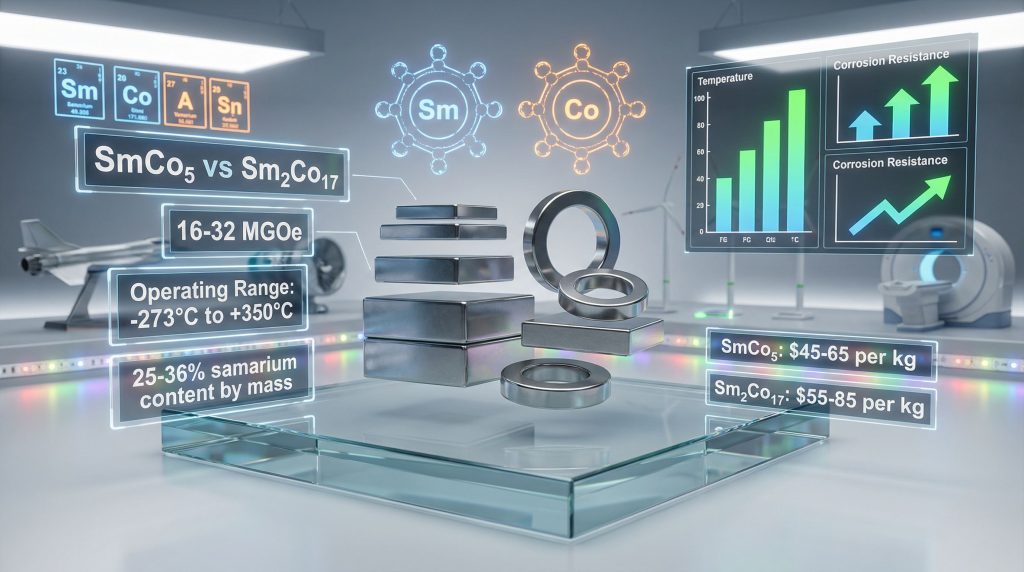
The SmCo₅ (1:5) variant contains approximately 33-35% samarium by mass and achieves energy product ratings of 16-26 MGOe. This composition provides excellent temperature stability and corrosion resistance for moderate-performance applications requiring reliable magnetic field generation across thermal cycles.
Sm₂Co₁₇ (2:17) formulations contain 24-26% samarium content and represent the premium performance category, reaching energy product levels up to 32 MGOe. The 2:17 crystal structure incorporates additional elements like iron, copper, and zirconium to optimize magnetic domain alignment and enhance coercivity characteristics.
| Specification | SmCo₅ Grade | Sm₂Co₁₇ Grade | NdFeB Comparison |
|---|---|---|---|
| Energy Product (BH)max | 16-26 MGOe | 28-32 MGOe | 35-50 MGOe |
| Samarium Content | 33-35% | 24-26% | 0% |
| Curie Temperature | ~800°C | ~825°C | 310-400°C |
| Intrinsic Coercivity | 8,000-9,000 kOe | 10,000-14,000 kOe | 12,000-25,000 kOe |
Material Classification and Strategic Positioning
Samarium occupies a unique position within rare earth element classification systems. While traditionally categorized as a light rare earth element, industry experts increasingly group samarium within a medium-heavy classification alongside gadolinium, terbium, dysprosium, and yttrium. This intermediate positioning reflects samarium's magnetic and thermal properties that bridge the gap between light rare earth abundance and heavy rare earth performance characteristics.
Recent production developments have demonstrated commercial viability for non-Chinese samarium oxide production. Lynas Rare Earths achieved first samarium oxide production at its Malaysian separation facility ahead of schedule, indicating that Western supply chains can now deliver defense-grade rare earth materials for strategic applications. Furthermore, this development supports both cobalt reserves overview and broader critical raw materials supply initiatives.
Critical Insight: Samarium cobalt magnets achieve magnetization saturation around 1.1-1.2 Tesla, compared to 1.4 Tesla for NdFeB materials, but maintain this performance across temperature ranges where NdFeB magnets would experience catastrophic flux loss.
When big ASX news breaks, our subscribers know first
Temperature Performance Analysis and Environmental Resilience
Samarium cobalt magnets demonstrate exceptional thermal stability across operating windows that extend far beyond conventional magnetic materials. This temperature performance advantage stems from fundamental crystal structure differences that maintain magnetic domain alignment under thermal stress conditions.
Quantified Temperature Coefficient Performance
| Temperature Parameter | SmCo Performance | NdFeB Performance | Advantage Factor |
|---|---|---|---|
| Operating Range | -273°C to +350°C | -50°C to +200°C | 3.5x wider window |
| Temperature Coefficient (Br) | -0.03% to -0.04%/°C | -0.11% to -0.12%/°C | 3x more stable |
| Flux Retention at 300°C | 85-95% | 40-60% | 1.5x better retention |
| Thermal Cycling Resistance | >1,000 cycles | <100 cycles | 10x durability |
Corrosion Resistance Without Protective Coatings
SmCo magnets possess inherent corrosion resistance due to cobalt content creating naturally stable oxide layers. This eliminates the need for nickel-copper-nickel or epoxy protective coatings required by NdFeB alternatives. Salt spray testing per ASTM B117 standards demonstrates SmCo magnets withstanding 2,000+ hours of exposure without flux degradation, while uncoated NdFeB materials fail within 48-72 hours.
Marine Environment Performance Specifications:
- Seawater exposure: No coating degradation after 5+ years
- pH resistance: Stable operation from pH 4-11
- Dimensional stability: <0.05% strain across thermal ranges
- Chemical compatibility: Resistant to petroleum products and industrial solvents
The economic implications of this corrosion resistance become significant in marine applications where coating replacement represents major maintenance expenses. Traditional NdFeB magnets in offshore environments require recoating every 3-7 years at costs often exceeding initial magnet replacement expenses.
Strategic Industries Driving Samarium Cobalt Demand
Aerospace and Defense Applications
Military aircraft propulsion systems represent the most demanding application environment for permanent magnets. Samarium cobalt magnets in fighter jet engines must maintain magnetic field stability across engine startup transients reaching 150°C, cruise altitude conditions of -40°C, and emergency high-thrust scenarios sustaining 100°C+ temperatures for extended periods.
The U.S. Department of Defense has structured a $96 million procurement agreement over four years specifically targeting rare earth materials for high-performance permanent magnets. This procurement volume indicates substantial defense-sector recognition that certain mission-critical applications require SmCo's unique performance envelope rather than cost-optimized alternatives.
Satellite positioning mechanisms operating in the thermal vacuum of space experience temperature swings from -150°C in shadow to +70°C in sunlight. SmCo's superior temperature coefficient ensures positional accuracy within microradians without active thermal management systems, reducing spacecraft complexity and weight penalties that would compromise mission parameters.
High-Temperature Industrial Operations
Oil drilling downhole motor assemblies operate in some of the most extreme industrial environments, with temperature conditions reaching 200-350°C and pressure exceeding 10,000 psi. SmCo magnets maintain operational flux density with less than 5% degradation over service life, whereas NdFeB alternatives would experience greater than 30% flux loss within 1,000 operating hours.
Wind turbine generator assemblies in extreme climates must function across -40°C to +60°C ambient conditions while generating internal temperatures exceeding 150°C during peak power generation. The U.S. Department of Energy has emphasized rare earth magnet supply security for renewable energy infrastructure as a critical strategic priority, driving demand for temperature-stable SmCo solutions in offshore installations.
Medical and Scientific Equipment Precision Requirements
MRI machine permanent magnet arrays demand exceptional magnetic field stability for diagnostic imaging accuracy. SmCo magnets provide consistent field generation without the thermal compensation systems required by temperature-sensitive alternatives. The addition of gadolinium production capabilities supports MRI contrast agent requirements, indicating integrated rare earth supply chain development for medical applications.
NMR spectrometer magnetic field generation requires parts-per-million stability for analytical accuracy. SmCo's inherent temperature stability eliminates field drift that would compromise spectroscopic measurements in laboratory environments with variable thermal conditions.
Market Intelligence: Defense applications represent approximately 15-20% of total SmCo magnet demand, while industrial motors account for 40-50% of consumption volumes, indicating broad industrial adoption beyond military specifications.
Manufacturing Process Complexity and Supply Chain Dynamics
Powder Metallurgy Production Stages
Samarium cobalt magnet manufacturing employs sophisticated powder metallurgy techniques requiring precise control over alloy composition and crystal structure formation.
Stage 1: Alloy Formation and Rapid Solidification
- Vacuum induction melting at 1,400-1,500°C
- Rapid solidification rates exceeding 10³ K/s
- Controlled atmosphere to prevent oxidation
- Alloy homogenization through thermal treatment
Stage 2: Powder Processing and Magnetic Alignment
- Mechanical grinding to 3-7 micron particle sizes
- Jet milling under inert atmosphere protection
- Magnetic field alignment during powder pressing
- Pressing pressures of 200-400 MPa for optimal density
Stage 3: Sintering and Heat Treatment Optimization
- Sintering temperatures: 1,100-1,200°C under hydrogen atmosphere
- Controlled cooling cycles for optimal grain structure
- Solution treatment at 1,100°C followed by aging at 800°C
- Thermal cycling to achieve target coercivity specifications
Raw Material Sourcing and Strategic Supply Security
Recent developments in non-Chinese rare earth production have established commercially viable samarium oxide sources. Lynas Rare Earths operates the Mount Weld mine in Australia and achieved first samarium oxide production at its Malaysian separation facility in March 2026, demonstrating complete supply chain localization outside Chinese control.
The Japan Australia Rare Earths (JARE) agreement includes a $110-per-kilogram price floor for neodymium-praseodymium and commits to purchasing at least half of all heavy rare earths produced at the Malaysian plant. This government-level supply security initiative indicates recognition that establishing non-Chinese rare earth sources represents critical national security infrastructure. Additionally, these developments align with broader industry evolution trends across strategic materials sectors.
| Supply Chain Component | Chinese Control | Alternative Sources | Strategic Risk Level |
|---|---|---|---|
| Samarium Oxide | 85% historical share | Lynas (operational 2026) | Medium (declining) |
| Cobalt Metal | 15% market share | DRC, Canada, Australia | Low |
| Magnet Production | 90% global capacity | Japan, USA development | High |
| Finished Products | 70% assembly | Regional diversification | Medium |
Cost-Performance Economics and Total Ownership Analysis
Comparative Material Cost Structure
| Magnet Grade | Material Cost ($/kg) | Operating Lifespan | Maintenance Requirements | Total Cost Factor |
|---|---|---|---|---|
| SmCo₅ | $45-65 | 15-25 years | None | 1.0x baseline |
| Sm₂Co₁₇ | $55-85 | 20-30 years | None | 1.2x premium |
| NdFeB Standard | $25-45 | 5-15 years | Recoating every 5-7 years | 1.4x total cost |
| NdFeB High-Temp | $35-55 | 8-18 years | Periodic replacement | 1.6x total cost |
Total Cost of Ownership Calculations
Samarium cobalt magnets demonstrate economic advantages despite higher initial material costs when analyzing complete lifecycle expenses. Extended operational lifespans of 15-25 years combined with zero maintenance requirements often result in lower total cost of ownership compared to alternatives requiring periodic replacement or recoating.
Marine Application Cost Analysis:
- Initial SmCo investment: $10,000
- NdFeB alternative: $6,000 initial + $3,000 recoating every 5 years
- 20-year total cost: SmCo $10,000 vs NdFeB $18,000
- Economic advantage: 44% lower total cost for SmCo selection
High-Temperature Industrial Cost Modeling:
- SmCo operational life: 25 years without degradation
- NdFeB operational life: 8-12 years with performance reduction
- Replacement labor costs: $5,000-15,000 per maintenance event
- Total economic advantage: 60-70% lifecycle cost reduction
Extreme Condition Performance Testing and Validation
Temperature Cycling Durability Assessment
Samarium cobalt magnets undergo rigorous thermal cycling testing to validate performance across operational temperature ranges. Testing protocols involve 1,000+ cycles between -200°C and +300°C while monitoring magnetic flux density retention and dimensional stability.
Test Results Summary:
- Flux density retention: >95% after 1,000 thermal cycles
- Dimensional change: <0.05% across full temperature range
- Coercivity degradation: <2% over test duration
- Crack initiation: No evidence after accelerated testing
Chemical Resistance and Environmental Stability
ASTM B117 salt spray testing demonstrates exceptional corrosion resistance without protective coatings. SmCo samples exposed to 5% sodium chloride solution at 35°C show no measurable flux degradation after 2,000+ hours, while maintaining surface integrity without pitting or oxide formation.
Chemical Compatibility Testing Results:
- Petroleum products: No interaction after 5,000-hour exposure
- Industrial acids (pH 3-4): Stable performance with <1% flux loss
- Alkaline solutions (pH 9-11): No measurable degradation
- Hydrogen embrittlement: Resistant up to 200°C operating temperature
Performance Benchmark: SmCo magnets retain 95% of magnetic strength at 300°C, compared to 60% retention for standard neodymium magnets, establishing clear performance superiority in high-temperature applications.
The next major ASX story will hit our subscribers first
Advanced Alloy Development and Technology Roadmap
Next-Generation Composition Optimization
Research into advanced samarium cobalt magnet alloys focuses on iron, copper, and zirconium additive effects to enhance energy product capabilities. Grain boundary engineering techniques show potential for improving coercivity while maintaining temperature stability characteristics.
Developmental Targets through 2030:
- Energy product improvement: 35+ MGOe for Sm₂Co₁₇ variants
- Temperature coefficient reduction: <-0.02%/°C achievement
- Coercivity enhancement: >15,000 kOe intrinsic values
- Cost reduction: 20-30% manufacturing efficiency gains
Manufacturing Process Innovation
Hot deformation techniques enable enhanced magnetic alignment during processing, potentially improving energy product by 10-15% compared to conventional powder metallurgy approaches. Additive manufacturing applications for complex geometries may enable integrated magnet-component designs previously impossible with traditional machining methods.
Recycling and Reprocessing Technology:
- Material recovery rates: 85-90% samarium and cobalt extraction
- Reprocessing into new magnet production cycles
- Economic viability thresholds: $40+ per kilogram material value
- Circular economy integration with design for disassembly protocols
Moreover, advances in critical minerals recycling technologies support sustainable material flows while reducing primary resource dependence.
Global Supply Chain Security and Market Dynamics
Regional Production Capacity Distribution
| Production Region | Current Capacity | Planned Expansion | Strategic Control |
|---|---|---|---|
| China | 85% market share | Stable | State-controlled |
| Australia/Malaysia | 12% emerging | 50% increase by 2028 | Allied partnership |
| USA/Canada | 2% development | 200% growth target | USMCA framework |
| Europe | 1% research | Pilot scale only | EU strategic autonomy |
Supply Security Strategic Initiatives
Government strategic material policies increasingly recognize rare earth supply chain vulnerabilities. The U.S. Department of Defense procurement structure demonstrates systematic efforts to establish non-Chinese supply sources for mission-critical applications. Similarly, Australia strategic minerals initiatives strengthen allied supply chain resilience through coordinated strategic reserves.
Price Volatility Hedging Strategies:
- Long-term offtake agreements with $110/kg price floors
- Strategic material stockpiling by defense contractors
- Alternative supplier qualification programs
- Recycling infrastructure investment to reduce primary material dependence
Application Selection Decision Framework
Engineering Selection Criteria Matrix
| Application Requirement | SmCo Recommended | NdFeB Alternative | Ferrite Budget Option |
|---|---|---|---|
| Operating Temperature >200°C | ✓ Required | ✗ Insufficient | ✗ Insufficient |
| Corrosive Environment | ✓ Preferred | ✗ Coating required | ✗ Limited resistance |
| Cost-Sensitive Application | ✗ Premium pricing | ✓ Cost optimized | ✓ Budget solution |
| Size/Weight Critical | ✗ Lower energy density | ✓ Compact solution | ✗ Large volume |
| Reliability Critical | ✓ 25-year lifespan | △ 10-15 year typical | ✗ 5-10 year typical |
Industry-Specific Recommendations
Marine Equipment Selection: Choose SmCo for saltwater resistance and elimination of coating maintenance requirements. The 3x initial cost premium is typically recovered within 5-7 years through avoided maintenance expenses.
Automotive Sensor Applications: Temperature-dependent selection based on engine compartment location. Under-hood sensors operating above 150°C require SmCo specification, while cabin applications can utilize cost-optimized NdFeB alternatives.
Industrial Motor Applications: Cost-benefit analysis must consider replacement accessibility and downtime costs. SmCo selection justified when replacement costs exceed 3x initial price premium due to difficult access or production downtime penalties.
Selection Rule: Choose SmCo when replacement costs exceed 3x initial price premium, operating temperatures exceed 200°C, or corrosive environments preclude coating maintenance.
Recycling Infrastructure and Circular Economy Integration
End-of-Life Material Recovery Processes
Samarium cobalt magnet recycling achieves 85-90% material recovery rates through specialized chemical extraction processes. Demagnetization procedures using reverse magnetic fields prepare materials for disassembly and chemical processing.
Recovery Process Stages:
- Demagnetization: AC demagnetization or heating above Curie temperature
- Mechanical separation: Component disassembly and size reduction
- Chemical extraction: Acid dissolution and selective precipitation
- Purification: Ion exchange and crystallization for specification-grade materials
- Reprocessing: Integration into new magnet production cycles
Economic Viability Thresholds
Recycling operations become economically viable when samarium content value exceeds $40 per kilogram, considering processing costs and material recovery efficiency. Current market prices above $60 per kilogram ensure profitable recycling operations for high-volume applications.
Material Tracking and Certification Systems:
- Blockchain-based provenance tracking for strategic materials
- Recycled content specifications for government procurement
- Certification standards for reprocessed rare earth content
- Supply chain transparency requirements for defense applications
Future Market Trends and Technology Roadmap
Projected Market Growth Drivers
Electric aircraft propulsion systems represent an emerging high-growth application requiring temperature-stable permanent magnets for reliable operation at altitude. Industry projections suggest 300% growth in aerospace SmCo demand by 2028 as electric aviation advances beyond experimental phases.
Renewable energy infrastructure expansion drives sustained demand for wind turbine generators capable of operating in extreme climatic conditions. Offshore installations particularly favour SmCo solutions due to saltwater corrosion resistance and reduced maintenance requirements.
Competitive Landscape Evolution
Alternative permanent magnet technologies under development include manganese-based alloys and rare-earth-free compositions. However, none currently match SmCo's combination of temperature stability, corrosion resistance, and proven reliability for mission-critical applications.
Supply chain diversification strategies focus on establishing multiple production sources outside Chinese control. Companies developing non-Chinese SmCo supply chains may capture premium market positioning as governments prioritise supply security over cost optimization.
Investment Insight: Market dynamics favour companies capable of delivering certified rare earth materials with traceable provenance and consistent quality specifications, particularly for defense and aerospace applications requiring supply chain transparency.
Performance projections through 2030 indicate continued SmCo market growth driven by industrial automation requiring high-temperature motor operation, defense modernisation programmes globally, and medical device miniaturisation demanding reliable magnetic field generation in compact configurations.
For those seeking specialised samarium cobalt magnets for industrial applications, comprehensive technical specifications remain critical for proper selection. Additionally, high-temperature magnet solutions continue advancing through materials science research and development programmes.
The intersection of strategic material security, advanced manufacturing requirements, and extreme operating condition demands positions samarium cobalt magnets as essential enabling technology for next-generation high-performance applications across aerospace, defence, industrial, and medical sectors.
Disclaimer: This analysis contains forward-looking statements and projections based on current market conditions and technological trends. Actual performance, costs, and market developments may vary significantly from projections presented. Investment and procurement decisions should consider specific application requirements and conduct independent technical and economic evaluation.
Looking to Invest in Critical Materials Technology?
Discovery Alert's proprietary Discovery IQ model delivers real-time notifications on significant ASX mineral discoveries, including companies developing advanced materials and rare earth processing technologies. Stay ahead of market movements by accessing comprehensive discovery tracking that showcases the substantial returns possible from strategic materials investments. Begin your 14-day free trial today to position yourself at the forefront of the critical materials revolution.