
August 1, 2026
When Geopolitical Shock Meets Pricing Architecture: Decoding Saudi Arabia's OSP System
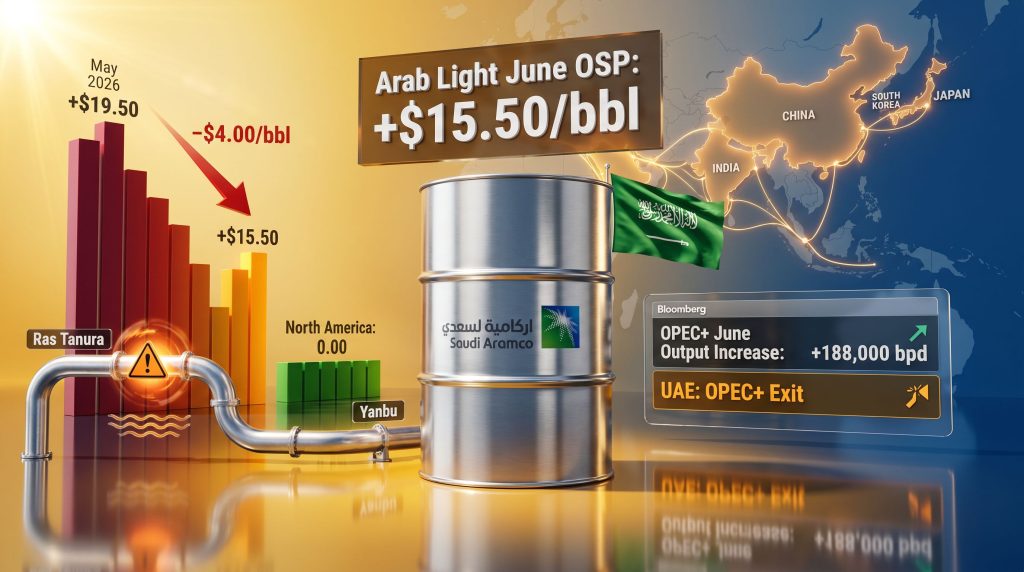
Every barrel of crude oil that leaves a Saudi Aramco terminal arrives at its destination carrying two prices: the underlying benchmark and a carefully calibrated differential known as the Official Selling Price. Understanding how that differential is set, and why it shifts, reveals more about the strategic priorities of the world's dominant oil exporter than any single market data point ever could. In May 2026, that differential for Arab Light crude headed to Asia reached an extraordinary +$19.50 per barrel above the Oman/Dubai average, a level with no modern precedent in peacetime markets.
The June 2026 OSP revision, which saw Saudi Arabia cuts Arab Light June OSP for Asia by $4.00/bbl to $15.50/bbl, is not simply a price cut. It is a structured response to a rapidly evolving geopolitical and commercial landscape. Furthermore, understanding the official selling prices framework helps contextualise just how dramatic this shift truly is.
When big ASX news breaks, our subscribers know first
What an OSP Actually Is and Why Its Architecture Matters
Most casual observers treat the OSP as a simple price announcement. In reality, it functions as a formula-based pricing instrument, not a spot rate. Saudi Aramco publishes these differentials monthly for four distinct destination regions, with each region priced against a different reference benchmark:
- Asia is priced against the Oman/Dubai average, the primary physical sour crude benchmark for Middle East exports eastward
- Northwest Europe is referenced against ICE Brent futures
- The Mediterranean also uses ICE Brent as its base
- North America is priced against the ASCI (Argus Sour Crude Index), which tracks U.S. Gulf Coast sour crude economics
The choice of benchmark for each region is deliberate. The Oman/Dubai average reflects physical Gulf crude market conditions far more directly than Brent, making it acutely sensitive to any disruption affecting regional supply flows. When the Strait of Hormuz faces operational risk, Oman/Dubai can decouple sharply from Brent, amplifying OSP volatility for Asian buyers in ways that European or North American buyers do not experience.
The OSP differential communicates Saudi Arabia's competitive intent in a given market with considerable precision. A uniform cut across all grades signals a macro-level repricing decision. A grade-specific cut suggests a targeted demand adjustment. The June 2026 revision was unmistakably the former.
The Full June 2026 OSP Picture: What the Numbers Reveal
Saudi Arabia Cuts Arab Light June OSP for Asia: Grade-by-Grade Breakdown
The complete scope of Saudi Aramco's June 2026 pricing adjustments across all grades and all regions provides critical context for interpreting the Arab Light move in isolation. According to reporting from Reuters, the adjustments were broadly anticipated but the scale surprised some market participants.
Asia (vs. Oman/Dubai Average)
| Crude Grade | May 2026 OSP | June 2026 OSP | Change |
|---|---|---|---|
| Super Light | +$21.15/bbl | +$17.15/bbl | –$4.00 |
| Extra Light | +$20.00/bbl | +$16.00/bbl | –$4.00 |
| Arab Light | +$19.50/bbl | +$15.50/bbl | –$4.00 |
| Arab Medium | +$17.75/bbl | +$13.75/bbl | –$4.00 |
| Arab Heavy | +$16.40/bbl | +$12.40/bbl | –$4.00 |
Northwest Europe (vs. ICE Brent)
| Crude Grade | May 2026 OSP | June 2026 OSP | Change |
|---|---|---|---|
| Extra Light | +$29.45/bbl | +$27.45/bbl | –$2.00 |
| Arab Light | +$27.85/bbl | +$25.85/bbl | –$2.00 |
| Arab Medium | +$27.05/bbl | +$25.05/bbl | –$2.00 |
| Arab Heavy | +$24.65/bbl | +$22.65/bbl | –$2.00 |
Mediterranean (vs. ICE Brent)
| Crude Grade | May 2026 OSP | June 2026 OSP | Change |
|---|---|---|---|
| Extra Light | +$29.35/bbl | +$27.35/bbl | –$2.00 |
| Arab Light | +$27.65/bbl | +$25.65/bbl | –$2.00 |
| Arab Medium | +$27.05/bbl | +$25.05/bbl | –$2.00 |
| Arab Heavy | +$24.35/bbl | +$22.35/bbl | –$2.00 |
North America (vs. ASCI): No Change
| Crude Grade | May 2026 OSP | June 2026 OSP | Change |
|---|---|---|---|
| Extra Light | +$15.95/bbl | +$15.95/bbl | 0.00 |
| Arab Light | +$14.60/bbl | +$14.60/bbl | 0.00 |
| Arab Medium | +$13.40/bbl | +$13.40/bbl | 0.00 |
| Arab Heavy | +$12.65/bbl | +$12.65/bbl | 0.00 |
The regional differentiation embedded in these numbers deserves particular attention. Asia received a $4.00/bbl reduction, Europe and the Mediterranean received $2.00/bbl reductions, and North America received nothing at all. This graduated structure implies that Saudi Arabia perceives its greatest competitive exposure in the Asian market, moderate competitive pressure in European markets, and near-zero risk of volume loss in North America where domestic supply tightness supports a less elastic buyer base.
Why Symmetry Across Grades Signals a Strategic Posture
A detail that often escapes casual analysis: the fact that every Saudi crude grade to Asia was cut by precisely the same $4.00/bbl is analytically significant. Ordinarily, grade-specific cuts reflect localised demand shifts, such as a preference among Chinese refiners for heavier, more sulphurous grades due to their wider product yield advantage when crude prices are low.
A uniform cut across Super Light, Arab Light, and Arab Heavy alike indicates that this was a portfolio-level pricing decision, not a response to individual grade demand dynamics. Saudi Aramco was repricing its entire Asian crude slate simultaneously, a posture consistent with responding to a broad market shift rather than fine-tuning individual cargo economics.
The Macro Trigger: How the Iran War Reshaped the Pricing Baseline
What Created the Extraordinary May Premium?
To understand why Saudi Arabia cuts Arab Light June OSP for Asia by $4.00/bbl, one must understand the environment that created the May premium it is cutting from. The broader context of oil geopolitics and the U.S.-Israeli military campaign against Iran introduced acute uncertainty into Strait of Hormuz shipping, the critical chokepoint through which approximately 20% of global seaborne oil trade passes.
The operational disruption compressed available spot cargo volumes for Asian buyers, triggering a sharp spike in the Dubai cash premium above futures, which reportedly surged to historically extreme levels in March 2026 before retreating substantially by late April. By the time Saudi Aramco was calculating its June OSP in early May, the Dubai cash premium had retreated to approximately $9.17/bbl, representing a dramatic normalisation from the peak.
Maintaining the May OSP at those levels would have left Saudi crude priced at a significant disadvantage against competing suppliers, including:
- Russian ESPO blend flowing eastward through the Eastern Siberia-Pacific Ocean pipeline
- West African grades with shorter voyage times to Indian refineries
- U.S. crude increasingly present in Asian spot markets
The $4.00 reduction represents a mean-reversion correction, closing the gap between an anomalous war-premium environment and a partially normalised spot market. The resulting oil market disruption has consequently forced every major producer to recalibrate their pricing assumptions for the region.
It is worth emphasising that even after the cut, Arab Light at +$15.50/bbl above Oman/Dubai remains historically elevated relative to pre-conflict norms, when this differential typically traded in a far narrower band. The war has structurally reset the pricing baseline, and the June OSP reflects a moderation within that new regime, not a return to pre-2026 conditions.
The Yanbu Routing Factor: A Hidden Cost in the OSP Calculation
A less-discussed dimension of the June OSP announcement was Saudi Aramco's request that buyers submit June-loading nominations covering both the Ras Tanura terminal inside the Strait of Hormuz and the Yanbu Red Sea port. Saudi Aramco has been actively routing Arab Light exports through Yanbu since the war restricted normal Ras Tanura access, allowing exports to bypass Hormuz entirely.
The freight economics of Yanbu routing differ meaningfully from Ras Tanura for Asian buyers:
- Yanbu lies on the Red Sea's eastern shore, requiring tankers to navigate south through Bab-el-Mandeb before heading east across the Indian Ocean
- This routing adds significant voyage distance compared to the conventional Persian Gulf to Asian port route
- Additional transit time increases the demurrage exposure and freight cost per barrel for Asian refiners
- Dual-terminal nomination requirements add procurement planning complexity, as buyers must coordinate logistics across two very different geographical loading points
Under a scenario where Hormuz restrictions persist through the third quarter of 2026, the effective landed cost of Saudi crude in Asia could remain elevated even after the nominal OSP reduction. Higher freight costs would partially offset the pricing concession at the cargo economics level, a dynamic rarely reflected in headline OSP analysis but material to the actual economics Asian refiners experience.
OPEC+ Output Expansion Complicates Saudi Arabia's Pricing Environment
Three Consecutive Monthly Output Increases
The June OSP announcement coincided with a separate and equally significant development: seven OPEC+ member nations collectively agreeing to raise production targets by 188,000 barrels per day in June 2026, marking the third consecutive monthly output expansion. These OPEC+ output increases compound the pricing challenge Saudi Arabia faces by adding supply to an already softening demand environment.
The interaction between rising output and retreating spot premiums creates a structurally difficult pricing matrix for Riyadh. Saudi Arabia must simultaneously:
- Price competitively enough to ensure its increased output volumes are absorbed by Asian refiners
- Avoid cuts so deep that they signal panic or trigger a broader market expectation of further reductions
- Maintain sufficient revenue per barrel to satisfy the fiscal requirements of Vision 2030 domestic investment programmes
The $4.00 reduction, which fell at the conservative end of the $5–$12/bbl range anticipated by industry surveys ahead of the announcement, suggests Saudi Arabia chose to thread this needle carefully rather than aggressively chase volume at the expense of revenue.
The UAE's OPEC+ Departure: A Structural Fracture
Compounding the production volume dynamics, the United Arab Emirates formally announced its withdrawal from both OPEC and OPEC+ in the week preceding the June OSP announcement, representing one of the most consequential institutional ruptures the alliance has faced. The UAE's exit removes a significant production quota contributor from the coordinated supply management framework.
Subsequent reporting indicated that ADNOC, the UAE's national oil company, was positioning to pursue a shale-style volume-maximisation approach outside the constraints of OPEC quota discipline. If Abu Dhabi expands output aggressively under this post-OPEC strategy, the consequences for Saudi Arabia's pricing architecture are significant:
- The UAE's production capacity of approximately 3.0–3.5 million bpd would enter global markets outside any quota coordination mechanism
- Additional UAE volumes targeting the same Asian buyers would increase competitive pressure on Saudi crude pricing
- The price floor that OPEC+ has historically maintained through collective output discipline would weaken as major contributors defect
- Saudi Arabia's ability to cross-subsidise its Vision 2030 ambitions through elevated oil revenues would face sustained structural headwind
The June OSP cut may therefore represent not only a market-normalisation measure but also an early strategic adjustment to a fundamentally changed supply governance landscape. Saudi Arabia is pricing for a world in which OPEC+ coordination is less reliable than it was a year ago.
Historical Context: How the June OSP Fits Within Long-Term Pricing Patterns
A Structurally Elevated New Baseline
Placing the June 2026 Arab Light OSP for Asia within a longer historical arc reveals how dramatically the conflict has reset the pricing environment. The crude pricing dynamics of recent years provide a useful baseline for comparison:
| Period | Typical Arab Light Asia OSP Range | Primary Driver |
|---|---|---|
| Pre-2020 | –$1.00 to +$3.00/bbl | Balanced supply/demand, low geopolitical premium |
| 2020–2022 | –$2.00 to +$4.00/bbl | COVID collapse and uneven demand recovery |
| 2023–2025 | +$2.00 to +$6.00/bbl | OPEC+ output discipline, rising risk premium |
| May 2026 | +$19.50/bbl | Hormuz disruption war premium (record level) |
| June 2026 | +$15.50/bbl | Partial normalisation post-disruption |
Even after the $4.00 reduction, the June 2026 Arab Light OSP for Asia sits at roughly three to five times the premium range that characterised the pre-disruption era between 2023 and 2025. Asian refiners are consequently operating in a structurally repriced crude procurement environment. Whether premiums continue compressing toward historical norms or stabilise at an elevated post-war baseline depends heavily on how long Hormuz shipping constraints persist and whether Iranian export flows normalise.
The next major ASX story will hit our subscribers first
Broader Energy Security Implications for Asian Crude Importers
Rethinking Supply Chain Resilience
The disruption has accelerated a strategic reassessment already underway among the major Asian crude-importing nations. Energy security planners in China, India, Japan, and South Korea are actively evaluating several structural responses, as noted by analysts at ING:
- Strategic petroleum reserve adequacy: whether current reserve levels provide sufficient buffer against extended supply disruptions
- Supplier diversification: reducing dependence on any single geographic corridor or producer group
- Long-term contract structure: shifting toward agreements that explicitly address alternative routing provisions and force majeure logistics
- Infrastructure investment: developing additional port and storage capacity capable of handling non-Persian Gulf routing requirements
Saudi Arabia's dual-terminal export capability has emerged as a competitive differentiator in this security-conscious environment. However, Yanbu's throughput capacity is finite and cannot fully replace Ras Tanura at scale, meaning the export diversification benefit Saudi Arabia offers has practical limits that sophisticated buyers are already calculating into their procurement models.
Disclaimer: This article contains forward-looking analysis, scenario projections, and market commentary based on publicly available information as of the date of publication. It does not constitute financial advice or investment guidance. Crude oil prices, geopolitical developments, and OPEC+ policy decisions are subject to rapid change, and readers should consult primary market data sources and qualified energy market analysts before making any commercial or investment decisions based on information contained herein.
Frequently Asked Questions: Saudi Arabia Arab Light June OSP for Asia
What does Saudi Arabia's June 2026 Arab Light OSP for Asia mean in practical terms?
Saudi Aramco set the Arab Light OSP for Asian term contract buyers at $15.50 per barrel above the Oman/Dubai benchmark for June 2026 loading cargoes, down from the record May 2026 level of $19.50/bbl. The $4.00/bbl reduction applies uniformly across all five Saudi crude grades exported to Asia, reflecting a partial normalisation of the extraordinary spot market premiums that developed during the U.S.-Israeli military campaign against Iran.
Why was the North American OSP left unchanged while Asia and Europe received cuts?
North American pricing uses the ASCI benchmark, which reflects U.S. Gulf Coast sour crude market conditions rather than Persian Gulf dynamics. North American refiners were effectively insulated from the spot premium spike that Asian buyers experienced because they source from a different physical crude market. Saudi Arabia's decision to hold North American OSPs flat suggests that market is sufficiently price-inelastic, facing adequate domestic supply tightness that volume risk at current pricing levels is minimal.
How does the OPEC+ output increase interact with the OSP reduction?
The 188,000 bpd increase in OPEC+ collective output targets for June, the third consecutive monthly expansion, adds supply to Asian markets simultaneously with the OSP reduction. This combination is designed to ensure Saudi Arabia can place its increased production volumes with Asian refiners while remaining price-competitive against alternative suppliers. However, the interaction also means the market is absorbing both more Saudi volume and a lower price per barrel simultaneously, a dynamic that historically compresses producer revenue unless demand growth offsets both effects.
What is the significance of the Yanbu nomination requirement for Asian buyers?
Saudi Aramco's request for buyers to submit June-loading nominations covering both Ras Tanura and the Red Sea port of Yanbu reflects the operational reality that Hormuz shipping restrictions have made the traditional Ras Tanura export route unreliable. Yanbu routing adds freight cost and transit time for Asian destinations, meaning the effective delivered cost of Saudi crude to Asian refiners may remain elevated even after the nominal OSP reduction, depending on how long Hormuz constraints persist.
What does the UAE's departure from OPEC+ mean for Saudi pricing strategy going forward?
The UAE's exit removes a major production-quota contributor from the alliance's supply management framework and signals that Abu Dhabi intends to pursue independent volume maximisation outside OPEC+ discipline. This weakens the collective price-floor mechanism that Saudi Arabia has relied upon and introduces additional competitive supply pressure into the Asian crude market. Saudi Arabia's OSP strategy will consequently need to adapt to a more fragmented and competitive supply governance environment over the medium term.
Want to Know Which ASX Companies Could Benefit From Shifting Energy Markets?
Discovery Alert's proprietary Discovery IQ model scans ASX announcements in real time, delivering instant alerts on significant mineral discoveries and actionable investment opportunities — from energy commodities to major resource plays — so subscribers can position themselves ahead of the broader market. Explore how historic discoveries have generated substantial returns on Discovery Alert's dedicated discoveries page, and begin your 14-day free trial today to secure your market-leading edge.