
May 21, 2026
Global energy markets face unprecedented disruption as fundamental supply-demand imbalances reshape pricing mechanisms across major oil-producing regions. The convergence of expanding production capacity, evolving consumption patterns, and strategic policy adjustments has created a complex environment where traditional pricing models encounter new challenges. Understanding these dynamics requires examining the intricate relationships between production decisions, market psychology, and long-term energy transition trends that influence crude oil valuations worldwide. Furthermore, saudi arabia crude price adjustments play a pivotal role in establishing global benchmark values for the broader energy sector.
Understanding the Mechanics Behind Saudi Arabia's Official Selling Price Strategy
The Official Selling Price system represents one of the most sophisticated crude oil pricing mechanisms in global energy markets. Unlike volatile spot market quotations, this methodology provides structured pricing for long-term contracts while maintaining flexibility to respond to changing market conditions. Saudi Arabia's approach to saudi arabia crude price adjustments influences approximately 9 million barrels per day of Gulf crude exports, establishing benchmark values for the broader Middle Eastern crude complex.
The Role of OSP Benchmarking in International Energy Markets
Saudi Aramco calculates monthly pricing adjustments against the average of Oman and Dubai crude quotes, creating a spread-based model that reflects regional market dynamics. This methodology incorporates both technical calculations of crude oil value changes and recommendations from customer feedback, establishing a balance between market-driven pricing and relationship management. Additionally, these calculations directly influence saudi exploration licenses and regional energy investment decisions.
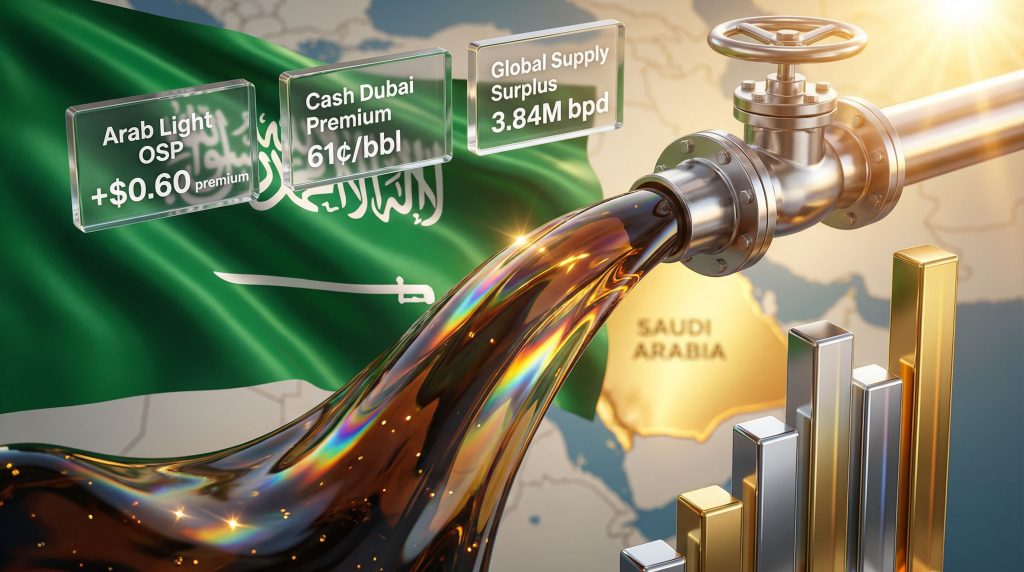
The timing of announcements follows a precise schedule, with OSPs typically released around the fifth of each month. This predictable timeline allows market participants to plan purchasing strategies and hedge positions effectively. The January 2026 Arab Light OSP was set at a +$0.60 premium to Oman/Dubai averages, representing the lowest five-year premium level and signaling significant compression in crude quality differentials.
Monthly calculations reflect changing product yields and market prices, providing a systematic approach that accounts for refinery economics and downstream profitability. When refineries experience margin compression, their crude purchasing behavior influences subsequent OSP adjustments, creating a feedback loop between downstream economics and upstream pricing.
Regional Price Leadership and Market Influence
The cascading effect of Saudi pricing decisions extends throughout the Gulf Cooperation Council region and beyond. Iranian, Kuwaiti, and Iraqi producers typically align their pricing with Saudi adjustments within days of OSP announcements, demonstrating the kingdom's price leadership role in regional markets.
This coordinated pricing approach creates stability for Asian refineries that rely on multiple Gulf crude sources. Rather than managing disparate pricing mechanisms from different suppliers, refineries can anticipate coordinated adjustments that reflect shared regional market conditions.
The influence extends to financial markets, where crude oil derivatives and futures contracts respond to OSP announcements. Trading algorithms incorporate expected OSP changes into pricing models, creating anticipatory market movements before official announcements.
When big ASX news breaks, our subscribers know first
What Economic Forces Drive Saudi Arabia's Recent Price Reduction Trend?
Current market dynamics reflect a fundamental shift in global supply-demand equilibrium. The International Energy Agency projects that global oil supply will exceed demand by 3.84 million barrels per day in 2026, representing one of the largest oversupply conditions in recent history. This projection has profound implications for pricing strategies across all producer nations and contributes to ongoing oil price stagnation in global markets.
Global Supply-Demand Imbalances Reshaping Pricing Strategy
OPEC+ members have released 2.9 million barrels per day of additional production since April 2025, contributing significantly to current oversupply conditions. This increase, combined with continued U.S. shale production growth and other non-OPEC supply additions, has created a market environment where Saudi Arabia must compete aggressively for market share.
| Market Metric | Current Level | Previous Level | Change |
|---|---|---|---|
| Arab Light OSP Premium | +$0.60/bbl | +$2.20/bbl | -$1.60 |
| Cash Dubai Premium (Dec) | 61¢/bbl | 88¢/bbl (Nov) | -27¢ |
| OPEC+ Production Increase | 2.9M bpd | Baseline (Apr 2025) | New capacity |
| Global Supply Surplus 2026 | 3.84M bpd | Balanced market | Oversupply |
The decision by eight OPEC+ member countries to pause Q1 2026 output increases represents recognition that continued production additions would be economically counterproductive. This strategic pivot demonstrates how producer coordination adapts to changing market realities and helps prevent further oil prices ease scenarios.
Cash Dubai premium movements provide insight into spot market conditions affecting OSP calculations. The decline from 88 cents per barrel in November to 61 cents in December reflects weakening demand fundamentals and abundant supply availability in Asian markets. According to Reuters analysis, these trends suggest continued pressure on Middle Eastern crude pricing structures.
Winter Demand Patterns and Asian Market Dynamics
Seasonal consumption trends significantly influence Middle Eastern crude demand during winter months. December through February typically represents a period of reduced refinery utilization in certain Asian jurisdictions, contributing to weakened crude demand and reduced pricing power for Gulf producers.
Asian refinery margins face compression as crude input costs adjust more slowly than refined product prices. This creates secondary pricing pressure as refineries reduce crude purchasing volumes during periods of margin compression, generating cascading demand reduction throughout the supply chain.
Venezuelan supply disruptions have had limited impact on Middle Eastern pricing despite representing significant volume losses. Venezuelan crude accounts for approximately 1% of global supply, with the majority of disrupted barrels previously destined for smaller independent Chinese refiners rather than major consuming hubs.
The current oversupply environment demonstrates how global production coordination requires continuous adjustment to maintain market stability. When supply increases outpace demand growth, even geopolitically motivated disruptions cannot support premium pricing for competing crude sources.
How Do Geopolitical Factors Influence Saudi Pricing Decisions?
Geopolitical considerations in saudi arabia crude price adjustments extend beyond immediate supply disruption risks to encompass longer-term strategic positioning and alliance management. Saudi Arabia's role as the global swing producer requires balancing revenue optimization with market stability objectives and customer relationship preservation. However, emerging trade war impact considerations add complexity to these pricing decisions.
OPEC+ Coordination and Strategic Market Management
The eight-member pause on Q1 2026 output increases represents sophisticated geopolitical coordination among diverse producer nations with varying economic priorities. This consensus-building achievement reflects shared recognition that market oversupply threatens the economic interests of all participating countries.
Member nations include countries with different fiscal breakeven prices, production costs, and strategic objectives. Achieving agreement on production restraint requires diplomatic coordination that extends beyond simple economic calculations to encompass broader geopolitical relationships and regional stability considerations.
The timing of the pause decision, implemented after releasing 2.9 million barrels per day since April 2025, demonstrates how producer coalitions learn from market feedback and adjust strategies accordingly. This adaptive approach maintains group cohesion while responding to changing economic realities.
Regional Disruptions and Market Stability Considerations
Current geopolitical risk premiums appear muted compared to historical levels, reflecting market confidence in spare production capacity and strategic reserve availability. The limited impact of Venezuelan disruptions on Middle Eastern pricing demonstrates how regional supply losses can be contained when global supply conditions remain ample.
Different producer nations employ distinct pricing strategies relative to Saudi benchmarks based on their geopolitical circumstances:
• Iranian crude pricing typically maintains discounts to Saudi equivalents due to sanctions considerations and limited customer base access
• Kuwaiti pricing generally tracks Saudi levels closely as a Gulf peer with similar crude quality characteristics
• Iraqi pricing varies based on federal government control, regional security conditions, and infrastructure constraints
• UAE crude pricing reflects the emirates' diverse export terminal access and customer relationship strategies
Saudi Arabia's approach prioritizes market share preservation over short-term revenue maximization, demonstrating how geopolitical stability objectives can supersede immediate economic optimization. This strategy maintains customer loyalty and market presence during challenging price environments.
What Are the Long-Term Implications of Current Pricing Trends?
Strategic planning for Saudi Arabia's energy sector extends well beyond current market cycles to encompass fundamental shifts in global energy demand and domestic consumption patterns. The kingdom's approach to saudi arabia crude price adjustments reflects longer-term positioning for evolving market conditions rather than purely reactive pricing decisions. Consequently, these adjustments influence potential oil price rally scenarios in future market cycles.
Energy Transition and Demand Outlook
Saudi Arabia's domestic energy transition strategy involves reallocating 270,000 barrels per day from crude oil consumption to natural gas and renewable energy sources. This fuel substitution program serves dual purposes: freeing crude volumes for higher-value export markets while positioning the kingdom as an energy producer capable of meeting evolving global demand patterns.
The projected 1 million barrels per day export capacity increase by 2030 through successful domestic fuel substitution demonstrates confidence in continued global crude demand despite energy transition trends. However, this expansion also requires maintaining price competitiveness to place incremental volumes in increasingly efficiency-focused markets.
Domestic fuel substitution economics reflect opportunity cost optimization. Crude oil used domestically represents foregone export value, while natural gas for power generation and industrial applications provides more cost-effective energy for domestic consumption than importing refined products after exporting crude.
Investment and Infrastructure Considerations
Lower crude prices create complex challenges for downstream refinery economics throughout Asia-Pacific markets. Refineries face margin compression when crude input costs decline faster than refined product prices, potentially reducing throughput volumes and Saudi export demand.
Strategic stockpiling trends among major importing nations respond to price volatility and supply security concerns. When crude prices decline significantly, importing nations may accelerate strategic reserve acquisitions, providing temporary demand support that stabilizes pricing.
Infrastructure investment decisions by both producers and consumers reflect long-term price expectations. Oil Price analysis suggests Saudi Arabia's continued investment in export capacity expansion signals confidence that current price weakness represents cyclical rather than structural market changes.
The kingdom's Vision 2030 economic diversification program aligns with energy transition strategy by reducing oil revenue dependency while developing non-oil economic sectors. Successful execution of the 270,000 barrels per day domestic fuel shift increases crude export earnings while supporting domestic industrial development.
Which Market Indicators Should Traders Monitor for Future Price Movements?
Successful navigation of current market volatility requires monitoring multiple indicators that provide early signals of supply-demand shift timing and magnitude. Understanding these metrics enables more accurate forecasting of saudi arabia crude price adjustments and broader market direction changes.
Technical Benchmarks and Spread Analysis
Dubai-Brent spread dynamics provide crucial insights into Asian market conditions relative to European benchmarks. When Dubai pricing weakens relative to Brent, it typically signals Asian demand deterioration or Middle Eastern supply abundance, both factors that pressure Saudi OSP calculations.
Cash Dubai premium movements offer real-time market sentiment indicators that precede OSP announcements. The recent decline from 88 cents per barrel in November to 61 cents in December provided advance warning of February OSP pressure before official surveys began.
Contango and backwardation patterns in forward curves indicate market expectations for future supply-demand balance. Current market conditions showing contango (near-term prices below forward prices) reflect oversupply expectations and storage economics that influence spot pricing.
Fundamental Supply-Side Metrics
OPEC+ compliance rates and production monitoring provide critical supply-side intelligence. When member nations exceed agreed production quotas, it signals either deliberate market share competition or insufficient coordination effectiveness, both factors that pressure pricing.
U.S. shale production growth trajectories continue influencing global supply balances despite OPEC+ coordination efforts. Weekly U.S. Energy Information Administration data releases provide high-frequency supply indicators that affect market psychology and pricing expectations.
Key indicators to monitor include:
• Weekly U.S. crude production levels and drilling activity reports
• OPEC+ monthly production compliance data and member nation statements
• Asian refinery utilization rates and maintenance schedules
• Strategic petroleum reserve activity across major consuming nations
• Tanker routing and freight rates indicating crude flow patterns
• Refined product crack spreads showing downstream demand strength
Strategic petroleum reserve activities globally provide demand-side indicators that can support or pressure crude pricing. Large-scale reserve purchases during price declines can provide significant temporary demand increases.
How Do Saudi Price Adjustments Compare to Historical Patterns?
Historical analysis reveals distinct patterns that reflect changing global market structures, OPEC+ coordination effectiveness, and Asian market evolution. Understanding these patterns provides context for current pricing decisions and future trend anticipation.
Five-Year Low Analysis and Market Context
The January 2026 Arab Light premium of +$0.60 per barrel represents the lowest level since 2021, indicating unprecedented compression in crude quality differentials. This historical comparison reveals how current market conditions differ from previous cycles in both magnitude and underlying causes.
Previous periods of low premiums typically coincided with global economic recessions or major supply disruptions that reduced overall crude demand. Current conditions reflect oversupply from coordinated production increases rather than demand destruction, creating different market dynamics and recovery patterns.
Seasonal adjustment patterns have evolved over time as Asian refinery capacity has expanded and become more sophisticated. Modern refineries demonstrate greater crude selection flexibility, reducing their willingness to pay historical premiums for specific crude grades when alternatives are available.
Competitive Positioning Against Alternative Crude Grades
Quality differentials between Saudi crude grades and competing supplies have compressed significantly as refinery technology has improved. Advanced refining techniques enable greater yield optimization from lower-quality crude sources, reducing premium pricing power for traditional light sweet grades.
Transportation cost considerations increasingly influence crude selection decisions for Asian buyers. When Saudi crude premiums exceed shipping cost differentials to alternative suppliers, buyers can switch sources more readily than in previous market cycles.
| Historical Period | Arab Light Premium | Market Drivers | Recovery Timeline |
|---|---|---|---|
| 2015-2016 | $0.40-$0.80 | Shale revolution, OPEC+ formation | 18 months |
| 2020 | $0.20-$0.50 | COVID demand destruction | 12 months |
| 2021-2023 | $1.50-$2.50 | Post-COVID recovery, supply constraints | 24 months |
| 2026 Current | $0.60 | OPEC+ oversupply, demand moderation | TBD |
Refinery yield optimization and crude selection criteria have become increasingly sophisticated as digital technology enables more precise economic calculations. Modern refineries can quickly evaluate alternative crude sources based on real-time product pricing and operational efficiency considerations.
The next major ASX story will hit our subscribers first
What Strategic Options Exist for Market Participants?
Current market volatility creates both challenges and opportunities for various participants in crude oil markets. Understanding available strategic options enables more effective risk management and potential profit optimization during periods of significant price adjustments.
Hedging Strategies in Volatile Price Environments
Forward contract positioning provides stability for refineries managing input cost volatility. When crude prices decline rapidly, refineries can lock in favorable input costs through medium-term contracts while maintaining flexibility for spot market opportunities.
Options strategies offer asymmetric risk management for traders and consumers concerned about downside price risk. Purchasing put options provides price floor protection while maintaining upside exposure if market conditions improve unexpectedly.
Currency hedging considerations become increasingly important for international crude transactions as exchange rate volatility can offset crude price movements. Asian refineries purchasing Saudi crude with strengthening local currencies may achieve better economics despite stable dollar-denominated pricing.
Supply Chain Optimization Opportunities
Inventory management strategies during price declines require balancing storage costs against potential future price appreciation. Companies with available storage capacity can benefit from building inventories during price weakness if they anticipate medium-term recovery.
Alternative sourcing arrangements and contract flexibility provide competitive advantages during volatile periods. Refineries with diversified supplier relationships can optimize crude selection based on changing price differentials and delivery terms.
Integration considerations for market participants include:
• Developing flexible supply contracts that allow source switching based on economics
• Investing in storage infrastructure to capitalize on price volatility cycles
• Enhancing refinery flexibility to process various crude grades efficiently
• Building strategic partnerships with multiple suppliers and customers
• Implementing advanced analytics for real-time economic optimization decisions
Long-term planning must incorporate renewable energy considerations as the global energy transition affects crude demand patterns. Companies positioning for success in evolving markets balance traditional crude operations with alternative energy investments.
Frequently Asked Questions About Saudi Crude Pricing
Why Does Saudi Arabia Announce Prices Monthly Rather Than Using Spot Markets?
The Official Selling Price system provides stability benefits that spot market pricing cannot deliver for long-term contract relationships. Monthly pricing allows both buyers and sellers to plan operations and financial management more effectively than daily price volatility would permit.
Administrative and logistical advantages include reduced transaction costs, simplified contract management, and enhanced relationship stability between producers and refineries. These benefits justify the pricing methodology despite potential short-term economic trade-offs during volatile market periods.
Comparison with other global pricing mechanisms reveals that most major crude producers employ some form of monthly or formula pricing rather than pure spot market exposure. This industry-wide preference reflects the operational realities of large-scale crude oil logistics and refinery planning requirements.
How Quickly Do Saudi Price Changes Affect Global Markets?
Price transmission across international benchmarks typically occurs within 24-48 hours of Saudi OSP announcements as traders adjust positions and expectations. Algorithmic trading systems incorporate OSP changes into pricing models automatically, creating immediate market responses.
Regional variations in price adjustment speeds reflect local market structures and trading relationships. Asian markets respond most quickly due to direct crude supply relationships, while European and American markets may show delayed responses based on arbitrage economics and shipping logistics.
Impact on derivative markets and financial instruments extends beyond physical crude markets to affect futures contracts, options pricing, and energy sector equity valuations. This broad market influence demonstrates how saudi arabia crude price adjustments serve as global energy market indicators rather than purely regional pricing mechanisms.
This analysis is based on publicly available market data and industry reports. Future market conditions may differ significantly from current projections. Readers should consult qualified financial advisors before making investment decisions based on commodity market analysis.
Ready to Capitalise on Energy Market Volatility?
Discovery Alert's proprietary Discovery IQ model delivers real-time alerts on significant energy and resource discoveries across the ASX, helping investors identify actionable opportunities as crude price adjustments and energy transitions reshape global markets. Explore why major mineral discoveries can lead to substantial returns by visiting Discovery Alert's dedicated discoveries page, then begin your 30-day free trial to position yourself ahead of evolving energy markets.