August 14, 2026
The Quiet Reordering of Global Resource Diplomacy
When historians examine the mid-2020s, they may identify a defining feature that escaped daily headlines: the systematic repositioning of resource-rich nations as active architects of global supply chain architecture rather than passive commodity exporters. This transition is not driven by a single policy decision or bilateral agreement. It reflects a structural realignment years in the making, one in which geological endowment, geopolitical stability, and industrial ambition converge into something more durable than a trade deal.
Saudi Arabia mining and energy partnerships with US and Japan, formalised in May 2026, represent one of the clearest expressions of this shift. Two distinct bilateral engagements, each operating on different diplomatic registers and targeting different points in the resource value chain, reveal a carefully constructed multi-track strategy that deserves deeper examination than a single news cycle allows.
When big ASX news breaks, our subscribers know first
Saudi Arabia's Mineral Wealth: Scale, Composition, and Strategic Significance
Most international observers still associate Saudi Arabia almost exclusively with petroleum. The mineral reality is considerably more complex. The Kingdom holds an estimated $1.3 trillion in untapped mineral resources, encompassing phosphate, gold, copper, zinc, bauxite, and rare earth metals. This figure, while frequently cited, understates a subtler point: the mineralogical diversity of Saudi Arabia's geology spans multiple commodity classes that are central to entirely different industrial ecosystems.
Phosphate feeds the global fertiliser industry. Copper underpins electrification infrastructure. Rare earth elements are indispensable to permanent magnets used in electric vehicle drivetrains and wind turbine generators. Gold serves both monetary and industrial functions. This is not a single-commodity story. It is a multi-vector mineral proposition spanning agriculture, clean energy, defence manufacturing, and advanced electronics simultaneously.
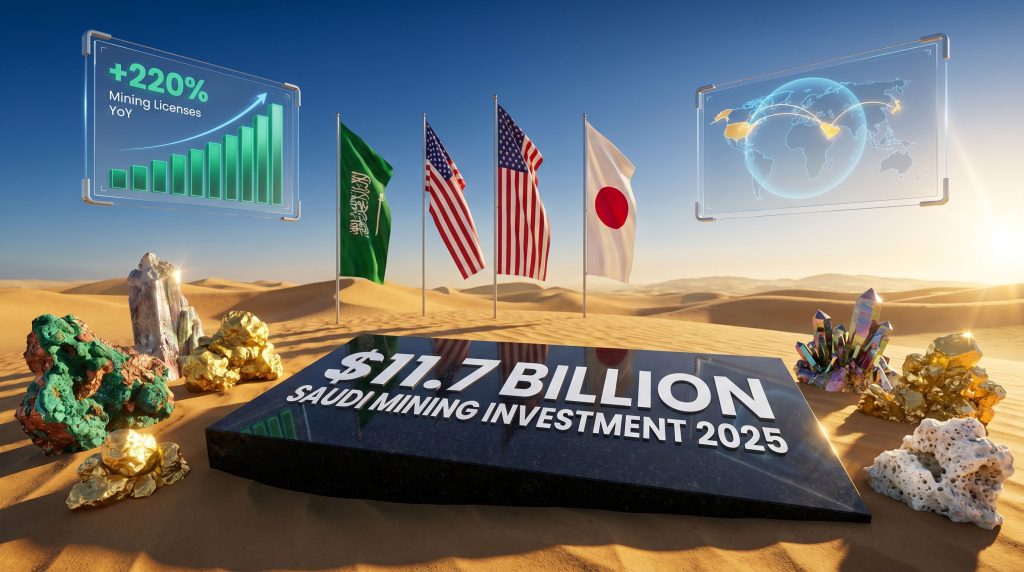
The pace of commercial activation is accelerating sharply. According to Arab News reporting from May 2026, Saudi mining licenses surged 220% year-on-year, with total sector investment reaching $11.7 billion in 2025. These are not incremental gains. They signal a market transitioning from early-stage regulatory preparation to active capital deployment.
| Metric | Value |
|---|---|
| Estimated Untapped Mineral Wealth | ~$1.3 trillion |
| Mining License Growth (Year-on-Year) | +220% |
| Sector Investment in 2025 | $11.7 billion |
| Key Mineral Categories | Phosphate, Gold, Copper, Zinc, Bauxite, Rare Earths |
Vision 2030 and the Third Pillar Objective
Saudi Arabia's Vision 2030 economic transformation agenda targets the mining industry as a third pillar of the national economy, alongside oil and petrochemicals. This framing is strategically significant. It signals that mining is not treated as a supplementary revenue stream but as a foundational industrial sector with its own development architecture, regulatory framework, and international partnership pipeline.
Furthermore, Minister of Industry and Mineral Resources Bandar bin Ibrahim Alkhorayef has consistently articulated this position in international forums, pointing to the Kingdom's mineral resources, investment environment, advanced logistics infrastructure, and regulatory framework as the key enablers for attracting quality foreign capital into the sector, as reported by Arab News in May 2026. The emphasis on regulatory environment is notable: it signals deliberate policy design rather than circumstantial resource advantage. Understanding why mining jurisdiction matters to global capital is, consequently, central to appreciating the Kingdom's strategic positioning.
The US Engagement: Deep Technology Meets Critical Mineral Ambition
The Milken Institute Global Conference 2026 in Washington, D.C. provided the setting for a multilateral meeting between Minister Alkhorayef and senior executives from two US firms: DCVC and Tidal Metals. The engagement, confirmed by Saudi Press Agency (SPA) and reported by Arab News on May 8, 2026, centred on cooperation prospects across mineral exploration, advanced mining technologies, and investment in critical minerals and strategic resources.
Understanding the character of these two firms helps contextualise what this partnership could mean in practice.
-
DCVC operates as a deep technology-focused investment firm with specialisation in science and engineering-driven innovation, including natural resource and industrial supply chain applications. Deep technology investment firms of this type typically back companies developing proprietary methodologies in areas such as computational geology, remote sensing, materials science, and process engineering rather than conventional capital-intensive mining plays.
-
Tidal Metals focuses on deploying modern extraction and processing technologies for minerals used in advanced industries. This positions it within a broader category of next-generation mining technology companies that aim to improve extraction efficiency, reduce environmental footprint, and unlock mineral deposits that would be uneconomical using conventional methods.
The pairing of a deep-tech investment platform with an advanced extraction technology company is not coincidental. It suggests a deliberate effort to introduce the full value chain of modern mining capability, from geological intelligence and capital allocation through to physical extraction and processing, into Saudi Arabia's emerging sector.
The critical minerals discussions cover areas seen as vital to supporting the growth of strategic industries and reinforcing supply chain resilience amid shifting global dynamics, according to Arab News reporting on the Milken Institute engagement.
Why Technology Transfer Matters More Than Capital Alone
A commonly overlooked dimension of bilateral mining partnerships is that capital alone cannot compress development timelines. The more limiting constraint in frontier mineral jurisdictions is typically technical capability: geological survey quality, subsurface data density, ore body characterisation methodology, and processing know-how.
Saudi Arabia's engagement with US deep-tech partners suggests an understanding of this constraint. By attracting firms whose competitive advantage lies in proprietary methodologies rather than balance sheet size, the Kingdom is pursuing a knowledge transfer strategy as much as a capital attraction strategy. Over time, this approach has the potential to accelerate domestic mining capability development in ways that conventional foreign direct investment cannot replicate.
The Japan Partnership: Energy Security Architecture at the Ministerial Level
Running in parallel to the US mining engagement, Saudi Arabia's Minister of Energy Prince Abdulaziz bin Salman held a virtual meeting in May 2026 with Japan's Minister of Economy, Trade and Industry, Akazawa Ryosei. The exchange represented a formal diplomatic engagement at the ministerial level, with Akazawa conveying a written message from Japanese Prime Minister Sanae Takaichi to Crown Prince Mohammed bin Salman affirming Japan's commitment to deepening cooperation in energy and related sectors, as reported by Arab News.
The concrete institutional outcome of this dialogue was the formal establishment of a joint working group, mandated to convene as soon as practicable, review proposals from both sides, and explore further cooperation pathways in energy supply chains, infrastructure, strategic storage, and investment. The Saudi-Japan Vision 2030 alignment underpins much of this cooperative momentum, providing a long-standing framework for deepening bilateral ties.
What distinguishes this outcome is the explicit inclusion of other Asian nations within the working group's mandate. This extension beyond the bilateral relationship is geopolitically significant. It positions the Saudi-Japan framework not as a closed bilateral arrangement but as a potential architecture for broader Asia-Pacific energy cooperation, with Japan serving as the initial anchor partner.
The working group's remit explicitly extends to exploring cooperation with other Asian nations, suggesting the bilateral framework is designed from inception to scale into a regional mechanism.
The Hub-and-Spoke Logic of Saudi Energy Diplomacy
Japan imports a substantial share of its crude oil requirements from Saudi Arabia, making the bilateral energy relationship one of the most consequential in the Asia-Pacific region. The evolution of this relationship beyond crude oil trade into joint infrastructure development, strategic storage, and energy supply chain coordination reflects a maturation of the partnership consistent with both nations' long-term strategic interests.
For Saudi Arabia, Japan represents a trusted interlocutor with deep networks across South Korea, Southeast Asia, and increasingly India. Structuring a formal working group through the Japan channel, with an explicit mandate to extend to other Asian partners, reflects a hub-and-spoke diplomatic logic: use an established, high-trust bilateral relationship as the entry point for broader regional architecture.
For Japan, formalising this partnership at Prime Ministerial correspondence level signals energy security prioritisation at the highest levels of government, consistent with Tokyo's sustained focus on import diversification and supply stability.
Comparing the Two Partnerships: Distinct Agendas, Complementary Architecture
The US and Japan engagements operate on fundamentally different registers, targeting different points in the resource and energy value chain.
| Dimension | Saudi-US Partnership | Saudi-Japan Partnership |
|---|---|---|
| Primary Focus | Critical minerals, exploration, extraction technology | Energy supply chains, infrastructure, strategic storage |
| Engagement Format | Multilateral meeting with private sector executives | Ministerial-level virtual dialogue |
| Institutional Outcome | Cooperation discussions, investment prospects | Formal joint working group established |
| Value Chain Position | Upstream (exploration, extraction, processing) | Downstream (supply chains, storage, market flows) |
| Multilateral Potential | Bilateral framework | Explicitly extends to broader Asian nations |
| Vision 2030 Alignment | Mining sector as third economic pillar | Energy export diversification and sector modernisation |
Viewed together, the two partnerships reflect a coherent dual-track strategy. The upstream track, anchored by US deep-tech engagement, focuses on building the domestic capability and foreign investment pipeline needed to develop Saudi Arabia's mineral base at scale. The downstream track, anchored by the Japan energy partnership, secures long-term market relationships and institutional frameworks for energy export stability.
Neither partnership alone constitutes a complete strategy. Together, however, they form a structurally integrated approach to economic transformation.
Geopolitical Dimensions: Multi-Alignment as Strategic Capital
Perhaps the most analytically underappreciated aspect of these simultaneous engagements is what they reveal about Saudi Arabia's broader geopolitical posture. Engaging US technology firms and Japanese government ministries concurrently, across both mineral and energy domains, reflects a deliberate multi-alignment strategy rather than exclusive bloc membership.
Resource-rich nations that successfully navigate great power competition tend to share a common characteristic: they leverage geological endowment as diplomatic capital, maintaining productive relationships across competing geopolitical spheres without becoming captive to any single one. Saudi Arabia's simultaneous engagement with Washington and Tokyo, across both mining technology and energy supply chain domains, is consistent with this approach.
Several structural factors support this posture:
-
Gulf Cooperation Council membership provides a stable regional framework that reduces bilateral risk for international partners.
-
Existing trade infrastructure with both Eastern and Western markets reduces logistical uncertainty for mineral offtake and energy delivery.
-
Vision 2030's regulatory reforms have progressively reduced bureaucratic friction for foreign investors, improving Saudi Arabia's relative attractiveness as a mineral jurisdiction.
-
Geopolitical stability relative to other major mineral-producing regions in Africa and parts of Latin America provides a comparative risk advantage that institutional investors weight heavily in capital allocation decisions.
The next major ASX story will hit our subscribers first
What These Partnerships Signal for Global Supply Chain Architecture
The broader implication of Saudi Arabia mining and energy partnerships with US and Japan extends beyond bilateral commercial outcomes. They reflect a structural shift in how global critical mineral supply chains are being re-architected in response to concentration risk, geopolitical fragmentation, and the accelerating demand profile of clean energy transition.
Saudi Arabia is positioning itself as what might be described as a third-pole supplier in global critical mineral markets, sitting alongside established producing nations in Australia, parts of Africa, and Latin America. Whether this ambition translates into production volumes commensurate with the $1.3 trillion resource estimate will depend on the pace of technology deployment, capital mobilisation, and infrastructure development in the years ahead.
The Kingdom's stated ambition is to rank among the world's top ten mining nations by 2030. The 220% surge in mining licenses and the $11.7 billion in sector investment recorded in 2025 represent early indicators that this trajectory is gaining momentum. However, emerging market mining risks remain a consideration for investors evaluating frontier jurisdictions, even those with strong institutional frameworks. Whether the deep-tech partnerships being assembled through forums like the Milken Institute can compress the development timeline meaningfully remains one of the sector's most consequential open questions.
Disclaimer: This article contains forward-looking statements and projections regarding Saudi Arabia's mining sector development, bilateral partnership outcomes, and geopolitical positioning. These involve assumptions and uncertainties that may cause actual outcomes to differ materially. Readers should conduct independent research before making investment or strategic decisions based on information contained herein.
Want to Stay Ahead of the Next Major Mineral Discovery?
As global critical mineral supply chains are rapidly restructured and resource diplomacy reshapes investment landscapes, Discovery Alert's proprietary Discovery IQ model delivers real-time alerts on significant ASX mineral discoveries — instantly converting complex geological data into actionable opportunities for investors at every experience level. Explore Discovery Alert's dedicated discoveries page to understand how historic mineral discoveries have generated substantial returns, and begin your 14-day free trial today to position yourself ahead of the market.