July 9, 2026
The Untapped Frontier: Why Saudi Arabia's Geological Terrain Is Reshaping Global Mining Investment
Long before copper became the defining metal of the energy transition and gold reasserted itself as a monetary anchor, the Arabian Shield sat largely unexplored beneath the surface of a nation defined almost entirely by hydrocarbons. Precambrian in age and spanning hundreds of thousands of square kilometres, this ancient geological province shares structural characteristics with some of the most productive mining belts on Earth, yet has received only a fraction of the exploration capital directed toward West Africa, the Pilbara, or the Nevada Basin and Range. That asymmetry is now closing, and rapidly.
Understanding why Saudi Arabia mining exploration investment has accelerated so dramatically requires looking beyond headline policy announcements and into the convergence of geological prospectivity, legislative reform, cost economics, and commodity demand cycles that are simultaneously pulling capital toward the Kingdom.
When big ASX news breaks, our subscribers know first
Saudi Arabia's Mineral Endowment: The Numbers Behind the Narrative
The scale of what remains underexplored in Saudi Arabia is difficult to overstate. The Arabian Shield is a Precambrian geological terrain with strong analogies to prolific mining provinces in West Africa and the Pilbara region of Western Australia, yet systematic modern exploration only began in earnest within the last decade.
The current snapshot of activity reveals a sector in steep acceleration:
- The Kingdom hosts 24 active exploration projects and 17 advanced-stage projects across a range of commodities.
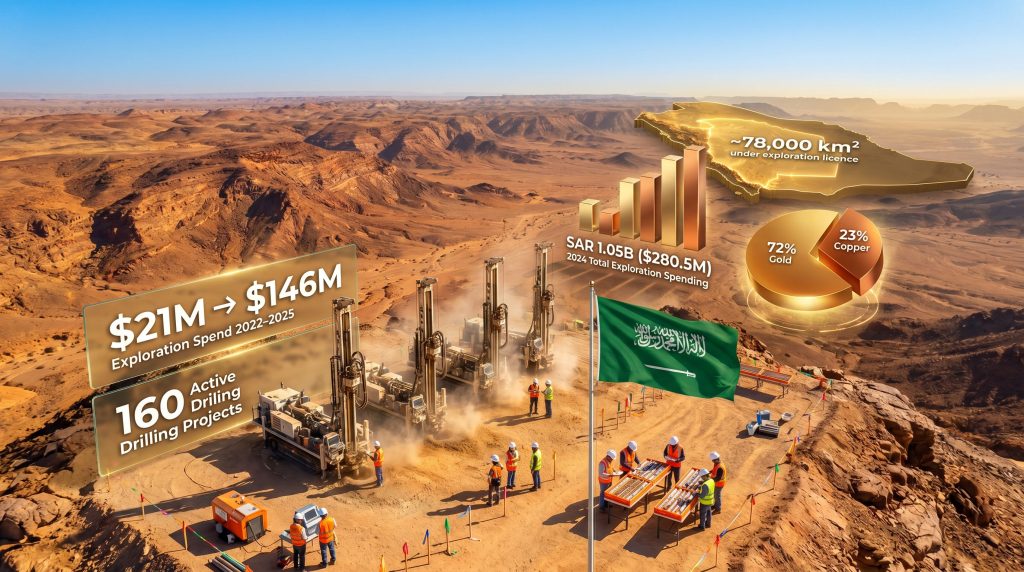
- Approximately 78,000 km² is currently under exploration licence, with a further 13,000 km² scheduled for competitive tender in 2026.
- Copper reserves are estimated to support 15 years of production at current extraction rates, while gold reserves extend across a 40-year production horizon.
- Total exploration spending reached SAR 1.05 billion ($280.5 million) in 2024, doubling year-on-year and signalling a step change in institutional commitment.
- Active drilling projects jumped from 58 in 2023 to 160 in 2024, a near-tripling that reflects both regulatory reform and accelerating foreign interest.
The budget trajectory is equally striking. Minesite-specific exploration spending surged from approximately $21 million in 2022 to a projected $146 million in 2025, representing a 595% increase in just three years — one of the fastest-accelerating exploration build-ups recorded in any jurisdiction globally.
| Metric | 2022 | 2023 | 2024 | 2025 (Projected) |
|---|---|---|---|---|
| Minesite Exploration Budget | ~$21M | – | – | ~$146M |
| Total Exploration Spending | – | – | SAR 1.05B (~$280.5M) | – |
| Active Drilling Projects | – | 58 | 160 | – |
For context, Australia and Canada each allocate over $1 billion annually to exploration activity. Saudi Arabia is closing that gap at an unprecedented pace. Furthermore, Saudi mining exploration licences are now being issued at a rate that would have seemed implausible just five years ago.
The Commodity Logic: Gold, Copper, and Belt-Scale Thinking
Why Gold and Copper Dominate the Exploration Pipeline
The 2025 exploration budget allocation reflects a deliberately targeted commodity strategy: 72% of spend targets gold and 23% targets copper, with the remainder directed toward base metals and industrial minerals.
This weighting is not arbitrary. Gold and copper exploration remains the highest-priority focus for junior explorers, offering clear valuation benchmarks and a deep acquirer market. Copper, meanwhile, occupies a structurally privileged position in the global energy transition narrative. Every electric vehicle requires roughly 2.5 to 4 times more copper than a conventional internal combustion engine. Grid-scale battery storage, offshore wind installations, and solar infrastructure all amplify this demand signal.
Critically, many of the systems being targeted across the Arabian Shield are polymetallic, meaning copper and gold co-occur within the same mineralised zones. This amplifies project economics significantly, as explorers can pursue dual revenue streams from a single drill programme.
The Arabian Shield's Tectonic Setting and Mineralisation Style
The Arabian Shield formed through a series of Neoproterozoic arc accretion events, producing a mosaic of volcanic arc terranes, suture zones, and sedimentary basins. This tectonic architecture is analogous to the structural settings that host major copper-gold porphyry and volcanogenic massive sulphide (VMS) systems in established mining provinces globally.
The significance of 5.5 kilometres of known strike extent in systems like those being explored across the region cannot be understated. In exploration geology, strike extent is a leading indicator of belt-scale potential. Large copper-gold systems typically express themselves across extended strike lengths before the three-dimensional geometry of the ore body becomes apparent through drilling.
The Arabian Shield geochemical survey work being conducted today builds on early exploration conducted by French geologists in the 1960s, who identified copper mineralisation at surface but lacked the analytical precision, drilling technology, and market incentives to advance these targets. Historic drill intercepts from that era, when revisited through modern geophysical frameworks, now serve as powerful technical foundations for systematic resource delineation.
Modern geophysical techniques including gravity surveys, induced polarisation (IP), and high-resolution remote sensing are enabling systematic reinterpretation of historic datasets, creating a powerful convergence of old discovery and new technology.
The exploration methodology being deployed by operators today follows a disciplined progression: rock chip sampling and geochemical surveys establish the geological baseline, gravity and IP programmes define the subsurface architecture, and targeted drill programmes then test the highest-priority anomalies. This approach maximises the probability of discovery while managing capital deployment efficiently.
The Regulatory Architecture: What Changed and Why It Matters
The 2020 Mining Investment Law as a Structural Turning Point
The legislative foundation for Saudi Arabia's modern mining sector was established through the Saudi Mining Investment Law of 2020, which introduced provisions that fundamentally altered the risk calculus for foreign capital. The most consequential change was the permission for 100% foreign ownership of mining operations, removing joint-venture requirements that had previously constrained international participation. Additionally, the tendering pathway now removes the requirement for foreign investors to establish a local company entity as a precondition for participation.
These are not marginal adjustments. In many peer jurisdictions, mandatory local equity participation represents a significant financial and operational burden for junior explorers. Removing that requirement effectively levels the playing field between international juniors and domestic operators. Saudi exploration licences are now accessible to foreign companies under terms that compare favourably with established mining destinations.
The Exploration Enablement Program: Restructuring the Risk-Return Profile
Perhaps the most structurally significant incentive mechanism available to foreign explorers is the Exploration Enablement Program (EEP), a government-administered grant scheme that reimburses qualifying geophysical and geochemical exploration expenditure.
The programme's key parameters:
- Reimbursable grants of up to $2 million per licence
- Coverage of up to 60% of grassroots exploration costs
- Eligibility spans geophysical surveys, geochemical sampling, and related technical work
- A separate $182 million mineral exploration incentive programme was established in 2024, demonstrating sustained government-level commitment to de-risking the sector
A co-funding mechanism that covers up to 75% of qualifying project costs further reduces the capital requirements for smaller exploration companies, enabling them to achieve significantly greater ground coverage per dollar deployed than in comparable jurisdictions.
Operators with active programmes have confirmed the practical effectiveness of these rebate mechanisms. Completing multi-million dollar exploration programmes and receiving reimbursements through the EEP within twelve months represents an unusually efficient capital recovery cycle by global standards. When exploration rebates are layered over already-competitive drilling costs, Saudi Arabia can deliver effective exploration cost structures that rank among the lowest of any active mining jurisdiction worldwide.
Jurisdiction Comparison: Saudi Arabia Against Peer Mining Destinations
| Factor | Saudi Arabia | West Africa | Nevada, USA | Western Australia |
|---|---|---|---|---|
| Foreign Ownership | 100% permitted | Varies by country | 100% permitted | 100% permitted |
| Exploration Cost Index | Among lowest globally | Moderate | High | Moderate-High |
| Government Co-Funding | Up to 75% | Rare | None | Limited |
| Exploration Rebates | Up to $2M per licence | None | None | Some state grants |
| Drilling Rig Availability | High, competitive pricing | Moderate | High | High |
| Geopolitical Risk | Low-Moderate | Moderate-High | Very Low | Very Low |
| Exploration Maturity | Early-stage, high upside | Maturing | Mature | Mature |
What Operating on the Ground Actually Looks Like
The Cost Efficiency Equation in Practice
The practical execution environment in Saudi Arabia offers several structural advantages that translate directly into exploration productivity. Terrain accessibility across much of the Arabian Shield, particularly in regions hosting copper-gold mineralisation, is considerably less demanding than high-altitude South American terranes or remote West African environments.
The presence of major global mining operators in-country has created a mature service ecosystem, with RC and diamond drilling contractors competing at internationally competitive day rates, and in-country laboratory infrastructure delivering fast assay turnaround times.
The velocity this enables is tangible. Executing 5,000 metres of drilling within seven weeks of licence award represents an operational pace that few jurisdictions can match. Major producers operating in the Kingdom, with their larger organisational structures and approval hierarchies, typically cannot achieve comparable speed.
To illustrate the cost efficiency differential concretely, consider a hypothetical $3 million exploration budget:
- Nevada, USA: Approximately 3,000 metres of RC drilling before depletion of budget
- Saudi Arabia (post-EEP rebate): Equivalent effective ground coverage of 10,000 to 15,000 metres, representing a three to five times multiplier on geological sampling density
Greater drilling density directly increases the probability of discovery by providing a denser sampling grid across prospective geological targets. This is not merely a financial efficiency — it is a geological one.
The Knowledge Premium and First-Mover Advantage
Operating effectively in Saudi Arabia requires more than financial capital. There is a meaningful knowledge premium associated with understanding local regulatory nuances, business customs, and operational logistics. Teams with accumulated in-country experience, including those who participated in early tenement applications under prior regulatory regimes, hold a structural advantage in executing programmes efficiently and building relationships with government counterparts.
This institutional knowledge is not easily replicated by new entrants and represents a genuine competitive moat for those who have invested time in understanding the Kingdom's operational environment.
The Investment Landscape: Capital Markets and the Scarcity Dynamic
Limited Listed Exposure Creates Structural Demand
One of the more compelling dynamics in Saudi Arabia mining exploration investment is the structural scarcity of publicly listed vehicles providing direct exposure to the sector. The number of ASX-listed or internationally listed junior explorers with active, drilling-stage programmes in the Kingdom remains extremely limited relative to the geological scale of the opportunity.
This supply-demand imbalance has measurable effects on capital market dynamics. Early-stage capital raises that required significant concessions to attract investor interest only a few years ago can now be executed at market terms, with strong institutional and retail demand, as the Saudi exploration narrative gains broader recognition. The evolution mirrors what occurred in West Africa in the early 2000s, when a small number of pioneering junior explorers gained disproportionate first-mover advantages before the region became a recognised tier-one destination.
The Majors Validate, Juniors Discover Dynamic
The presence of major global mining operators in Saudi Arabia serves a dual function. It validates the geological prospectivity of the Arabian Shield through the commitment of significant capital and technical resources, and it creates a natural acquirer market for junior discoveries. Ma'aden, one of the world's largest gold producers, operates domestically alongside international mining groups with established operational footprints.
This dynamic is well-understood in mature mining provinces: major producers create the service infrastructure and technical ecosystem, while junior explorers generate the new discoveries that feed acquisition pipelines. Saudi Arabia is at an early stage of this cycle, which historically represents the highest-upside entry point for investors willing to accept exploration-stage risk. The critical minerals demand driving this cycle shows no signs of abating, particularly given accelerating energy transition targets globally.
The Saudi Metals Exchange: A Capital Markets Milestone in Progress
The planned Saudi metals exchange, currently in advanced development stages, represents a structural mechanism to integrate the Kingdom's mineral production into global commodity pricing infrastructure. When operational, this exchange would provide price discovery mechanisms, hedging access, and institutional investor participation pathways in Saudi-listed mining assets, further deepening the capital markets ecosystem around the sector.
Risk Factors Investors Must Weigh
Disclaimer: The following section involves forward-looking assessment and inherently uncertain projections. Nothing in this article constitutes financial advice. Investors should conduct their own due diligence and consult licensed financial advisers before making investment decisions.
No emerging jurisdiction investment thesis is without risk. For Saudi Arabia, the key considerations include:
- Market awareness gap: The sector remains underrepresented in mainstream investment research, creating both opportunity and an education burden for early participants.
- Jurisdictional learning curve: Each new mining jurisdiction carries operational and regulatory nuances that require experienced local teams and established networks to navigate efficiently.
- Early-stage exploration risk: The majority of current projects remain at the exploration stage. Resource definition is ongoing and discovery outcomes are inherently uncertain.
- Geopolitical context: While the Kingdom has demonstrated strong institutional commitment to mining sector development, investors should monitor broader regional dynamics and assess their own risk tolerance accordingly.
The next major ASX story will hit our subscribers first
Vision 2030 and the Structural Imperative Behind the Mining Surge
Saudi Arabia's mining expansion does not exist in isolation. It is a deliberate pillar of Vision 2030, the Kingdom's macro-level economic transformation programme designed to reduce structural dependency on hydrocarbon revenues. Mining has been identified as one of the sectors capable of generating diversified export revenue, domestic employment, and industrial downstream activity at scale.
This policy architecture means that the incentive structures described above — the EEP, co-funding mechanisms, and the merit-based tendering system — are expressions of a long-term institutional commitment rather than short-cycle political priorities. The Kingdom is not experimenting with mining as a supplementary revenue stream. It is attempting to build a globally competitive resource sector from the ground up, and it is deploying substantial financial and legislative capital to achieve that objective. According to S&P Global Market Intelligence, mining could become one of the most transformative pillars of the Kingdom's new economy.
Frequently Asked Questions: Saudi Arabia Mining Exploration Investment
Is Saudi Arabia a safe jurisdiction for mining investment?
Political stability, institutional reform through the 2020 Mining Investment Law, and the government's demonstrated financial commitment to exploration incentives are all positive indicators. Experienced local partners and full compliance with in-country regulatory requirements are essential for effective operation.
What minerals are most actively explored in Saudi Arabia?
Gold, representing 72% of the 2025 exploration budget, and copper, at 23%, dominate the pipeline. Additional interest exists in base metals and industrial minerals across the broader Arabian Shield.
How do exploration costs in Saudi Arabia compare globally?
When government rebates covering up to 60% of grassroots costs are combined with co-funding mechanisms covering up to 75% of qualifying project costs, and layered over already-competitive drilling day rates, Saudi Arabia offers effective exploration economics that rank among the lowest of any active jurisdiction globally.
Can foreign companies fully own Saudi mining operations?
Yes. The 2020 Mining Investment Law explicitly permits 100% foreign ownership of mining operations. The tendering pathway for new licence areas also removes the requirement to establish a local company entity prior to participation.
What is the Exploration Enablement Program?
The EEP is a government-administered grant scheme providing reimbursable funding of up to $2 million per licence, covering as much as 60% of grassroots exploration costs for qualifying geophysical and geochemical work.
How does the merit-based tendering system work?
New licence areas are released through a competitive application process evaluated on technical and financial merit. With 13,000 km² of prospective ground scheduled for release in 2026, the pipeline of available ground remains substantial.
The Strategic Outlook: Three Horizons for Saudi Mining Investment
Near-Term Catalysts (12 to 24 Months)
- Assay results from multiple active drilling programmes across the Arabian Shield
- Release of new licence areas under the 2026 tendering schedule
- Commissioning of the Saudi metals exchange
- Continued growth in exploration spending toward parity with mature jurisdictions
Medium-Term Structural Shifts (3 to 7 Years)
- Transition of advanced-stage exploration projects into feasibility studies and development phases
- Emergence of Saudi Arabia as a recognised tier-one destination in global mining investment indices
- Potential for significant acquisition activity as junior discoveries attract interest from established producers seeking resource replenishment
Long-Term Vision: A Global Mining Hub
The analogy most instructive for long-term positioning is the early-stage investment cycle in now-mature jurisdictions. West Africa in the early 2000s and the Pilbara in the 1990s both offered early investors geological upside, cost efficiency, and first-mover advantages that compounded dramatically as capital followed discovery.
Saudi Arabia mining exploration investment at its current moment shares those structural characteristics, with the added dimension of an explicitly supportive policy architecture and a government prepared to co-fund exploration risk. The Kingdom's ambition to become a significant global supplier of both gold and copper — commodities central to monetary systems and the energy transition respectively — is being backed by real capital allocation, not merely policy rhetoric.
Key Takeaways: The Saudi Arabia Mining Investment Thesis at a Glance
- Geological upside: Underexplored Precambrian terrain with demonstrated mineralisation across gold and copper systems, including belt-scale strike extents of 5.5 kilometres or more
- Policy architecture: A comprehensive legislative and incentive framework specifically designed to attract and retain foreign exploration capital, anchored by the 2020 Mining Investment Law
- Cost efficiency: Effective exploration costs among the lowest globally when EEP rebates and co-funding mechanisms are applied to already-competitive drilling rates
- Institutional validation: Presence of major global mining operators confirms geological prospectivity and creates a natural acquisition market for junior discoveries
- Capital markets scarcity: A very limited number of listed vehicles provide direct exposure to active Saudi drilling programmes, creating structural demand for early-mover positions
- Macro alignment: Gold and copper, the Kingdom's primary exploration targets, are both strategically positioned within the most powerful global demand megatrends of the current decade
This article is intended for informational purposes only and does not constitute financial or investment advice. Exploration-stage mining investment involves significant risk, including the possibility of total loss of capital. Past performance of analogous jurisdictions is not indicative of future outcomes. Readers should seek independent financial advice before making any investment decisions.
Want to Track the Next Major ASX Mineral Discovery in Real Time?
Discovery Alert's proprietary Discovery IQ model instantly identifies significant ASX mineral discoveries across gold, copper, and beyond — turning complex geological announcements into actionable investment insights before the broader market reacts. Explore historic discoveries and their remarkable returns, then begin your 14-day free trial at Discovery Alert to position yourself ahead of the next major find.