May 13, 2026
The Saudi Arabia mining infrastructure initiative represents a paradigm shift in how nations can systematically transform their mineral resources into competitive economic assets through coordinated infrastructure development. This groundbreaking approach addresses fundamental operational barriers while creating sustainable frameworks for long-term sector growth. Furthermore, the initiative demonstrates how strategic Saudi exploration licenses can be enhanced through comprehensive infrastructure provision.
Strategic Infrastructure Development Framework
The Saudi Arabia mining infrastructure initiative represents a fundamental shift toward coordinated sector development through government-led infrastructure provision. This comprehensive approach addresses the primary barriers that typically constrain mining investment decisions in developing regions, particularly infrastructure uncertainty and operational risk management.
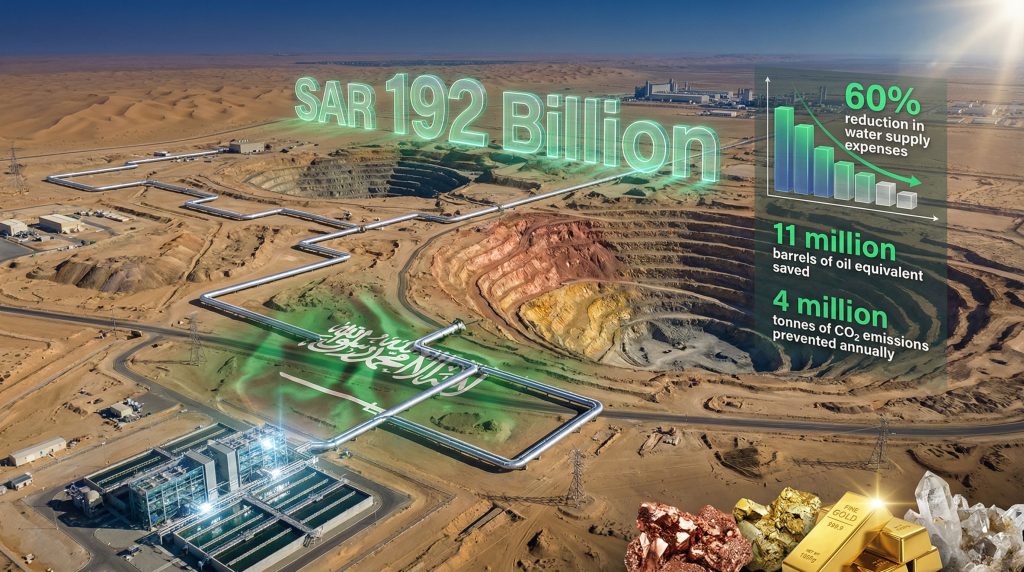
The Jabal Sayid project serves as the flagship demonstration of this infrastructure-led development model. The treated water transmission system delivers 15,000 cubic metres daily through a 75-kilometer pipeline network, supporting up to five potential mining sites across the Al-Mahd governorate region. This engineering solution addresses water scarcity challenges that represent critical operational constraints for mining enterprises in arid environments.
Key Infrastructure Specifications:
- Pipeline capacity: 15,000 m³/day treated water delivery
- Network coverage: 75+ kilometers across multiple sites
- Service area: Al-Mahd governorate, Madinah region
- Operational scope: Up to 5 mining sites supported
- Cost reduction: 60% decrease in water supply expenses
The infrastructure readiness classification system categorizes mining license applications into Categories A, B, and C based on power access, water availability, and transportation connectivity. This tiered approach enables differentiated investment pathways that match infrastructure requirements with project development stages. Consequently, regulatory complexity is reduced whilst accelerating decision timelines.
Environmental benefits emerge as strategic differentiators within this infrastructure framework. The elimination of water tanker transport operations displaces approximately 11 million barrels of oil equivalent while reducing carbon dioxide emissions by 4 million tonnes annually. These environmental performance metrics address international investor requirements for sustainable mining operations. In addition, effective mining waste management becomes increasingly crucial as operations scale.
The partnership structure between the Ministry of Industry and Mineral Resources and the Saudi Authority for Industrial Cities and Technology Zones (MODON) demonstrates integrated planning. This coordination mechanism enables technology transfer, skill development, and supply chain integration opportunities that compound mining sector investment returns.
Resource Valuation and Market Positioning Analysis
The Jabal Sayid mining belt contains mineral resources valued at approximately SAR 192 billion ($51.3 billion), establishing Saudi Arabia's position within the global mining hierarchy through substantial proven reserves. This resource base comprises complementary copper and gold deposits that provide portfolio diversification while serving established commodity markets with transparent pricing mechanisms.
| Resource Category | Estimated Value (SAR Billions) | Global Market Context | Strategic Applications |
|---|---|---|---|
| Copper Deposits | 115-125 | Critical for renewable energy | Solar panels, wind turbines, electric vehicles |
| Gold Reserves | 67-77 | Monetary policy hedge | Investment diversification, central bank reserves |
| Combined Resources | 192 | Positions Kingdom as major player | Export revenue, industrial development |
Copper resources within the Jabal Sayid region align strategically with global renewable energy infrastructure expansion requirements. Solar energy systems, wind turbine manufacturing, and electric vehicle powertrains require substantial copper quantities. This creates secular demand growth that supports long-term investment returns.
Gold deposits provide monetary policy hedging capabilities and investment portfolio diversification benefits. These appeal to central bank reserve management strategies. Furthermore, the combination of copper and gold within the same geographic region creates operational synergies through shared infrastructure utilisation.
Mining Technology Integration
Modern AI-driven mining operations require sophisticated infrastructure foundations to maximise technological benefits. The Saudi Arabia mining infrastructure initiative provides this essential foundation, enabling advanced extraction technologies and autonomous operational systems.
The mining sector investment target of SAR 92 billion by 2030 reflects substantial capital commitment to sector development. Meanwhile, the broader SAR 260 billion GDP contribution target represents tripling of current mining economic impact. This growth trajectory positions Saudi Arabia within the scale range of established mining economies.
Strategic mineral focus areas including phosphates, aluminium, and rare earth elements complement the copper-gold foundation through market diversification. Phosphates serve agricultural applications with secular demand linked to global food production growth. Moreover, aluminium addresses automotive and aerospace manufacturing sectors benefiting from industrial expansion in Asia-Pacific markets.
The proposed mining exchange mechanism enhances transparency for international investors while facilitating financing for exploration projects. However, successful implementation requires understanding key investment strategy components that align with sector-specific requirements.
Environmental Performance and Operational Transformation
Environmental compliance represents a critical competitive differentiator for attracting international mining investment. The Saudi Arabia mining infrastructure initiative integrates environmental performance metrics into foundational infrastructure design rather than treating environmental compliance as post-implementation requirements.
Environmental Impact Reduction Metrics:
Resource Conservation Benefits:
- 11 million barrels of oil equivalent displacement through infrastructure optimisation
- 4 million tonnes annual CO2 emissions reduction from eliminating tanker transport
- Groundwater and surface water conservation through treated water utilisation
- Desert ecosystem preservation through centralised water infrastructure
The treated water delivery system represents innovative water recycling that reduces freshwater demand whilst maintaining operational efficiency. This technical approach addresses sustainability concerns in arid region mining operations where water scarcity creates operational constraints and environmental compliance challenges.
Environmental Technology Integration
Dust control, ecosystem preservation, and temperature extremes present specific environmental compliance requirements for desert mining operations. The infrastructure initiative's environmental framework suggests proactive integration of environmental best practices into engineering design specifications. For instance, data-driven mining operations enable precise environmental monitoring and optimisation.
The water infrastructure project provides community development benefits extending beyond mining operations to surrounding municipalities. Infrastructure improvements enable broader economic development through improved water availability for municipal and agricultural applications, creating positive spillover effects that strengthen social licence considerations.
Technical Infrastructure Integration:
- Treated wastewater substitution for potable water in mineral processing
- Pipeline network design addressing corrosion and temperature extremes
- Maintenance access optimisation for 75-kilometre distribution system
- Water quality standards maintenance throughout transport network
Global Competitiveness and Investment Framework
The Kingdom's mineral development strategy reflects recognition that strategic minerals supporting renewable energy infrastructure represent growth market segments with long-term demand security. This positioning within secular commodity demand trends provides investment return stability that differentiates Saudi mining ventures from cyclical commodity exposure.
International mining competitiveness depends on production costs, extraction efficiency, and transportation advantages relative to established mining regions. Saudi Arabia's infrastructure-first approach creates operational efficiency advantages that compress project development timelines. Consequently, infrastructure-related investment risks are reduced for international mining companies.
Investment Attraction Mechanisms:
| Investment Tool | Target Value | Implementation Timeline | Strategic Focus |
|---|---|---|---|
| Mining Sector Investment | SAR 92 billion | By 2030 | Strategic minerals development |
| Maaden Expansion | $110 billion | Next decade | Integrated operations |
| GDP Contribution Target | SAR 260 billion | 2030 | Sector economic tripling |
| Infrastructure Classification | Categories A-C | Ongoing | Risk-based licensing |
Supply chain vulnerability analysis reveals current global dependencies for critical minerals that create strategic opportunities for new production capacity. Copper supply constraints during renewable energy expansion create market absorption capacity for new Saudi production. Additionally, rare earth element supply concentration creates supply chain diversification demand from technology manufacturers.
The infrastructure development framework enables Saudi mining operations to integrate with global supply chain requirements through production volumes, quality standards, and delivery reliability. Power grid connectivity, water infrastructure reliability, and transportation network efficiency directly influence operational costs and production capacity.
Transportation logistics optimisation requires mineral transport efficiency from extraction sites through processing facilities to export terminals. Current infrastructure capacity assessment and required improvements quantify remaining infrastructure gaps beyond the water infrastructure project completion.
Market integration benefits through the proposed mining exchange address financing facilitation for exploration and development projects. These financial infrastructure components complement physical infrastructure provision through comprehensive sector development support.
Investment Risk Analysis and Market Dynamics
Mining sector investment decisions reflect complex risk assessment frameworks that evaluate geological, operational, regulatory, and infrastructure variables. The Saudi Arabia mining infrastructure initiative directly addresses infrastructure risk factors that typically create investment hesitation among international mining companies considering frontier jurisdiction opportunities.
Capital requirements for mine development typically range from $100 million to $2 billion per project, depending on resource scale, extraction complexity, and infrastructure requirements. The infrastructure provision model reduces these capital requirements whilst accelerating project development timelines through pre-established support systems.
Critical Success Factors:
- Technical expertise development through international partnerships
- Environmental compliance framework implementation
- Community engagement and social licence maintenance
- Market absorption capacity for increased production volumes
- Transportation network integration with global supply chains
Geological risk assessment reveals that the Jabal Sayid region contains proven copper and gold deposits with established resource valuations. This reduces exploration risk compared to greenfield mining ventures. Furthermore, the combination of proven resources with infrastructure provision creates investment risk profiles that attract institutional capital.
Partnership and Collaboration Opportunities
According to Arab News analysis, the Kingdom's mining sector transformation attracts significant international attention from established mining companies and technology providers. Additionally, industry reports from Mining Magazine highlight the strategic importance of this infrastructure-first approach for regional competitiveness.
Regulatory streamlining through the infrastructure readiness classification system creates differentiated pathways for investment decisions. This balanced approach addresses investor requirements for regulatory predictability without compromising sustainability objectives.
The integration of MODON industrial cities with mining infrastructure creates technology transfer opportunities and skill development programmes. These workforce development mechanisms support operational scalability whilst creating employment opportunities in mining regions.
Long-term Market Implications:
The successful implementation of Saudi Arabia's mining infrastructure initiative could establish a replicable model for jurisdiction-level mining competitiveness enhancement. The infrastructure-first approach combined with strategic mineral focus and environmental performance integration provides a framework that other developing mining regions might adapt.
Regional competition dynamics within the Middle East reflect broader economic diversification strategies across Gulf states. The UAE's industrial diversification initiatives and coordination opportunities with neighbouring states create potential for integrated regional mining capabilities. These strengthen collective competitiveness in global commodity markets.
Geopolitical implications of new major mining player emergence include enhanced supply chain resilience for critical minerals. This reduces dependence on traditional mining regions whilst providing Saudi Arabia with strategic influence in commodity market dynamics.
The timeline for full initiative implementation extends through 2030, aligning with the Kingdom's Vision 2030 economic diversification objectives. Success measurement metrics include annual production targets, foreign direct investment attraction benchmarks, and integration success with existing industrial infrastructure networks.
Disclaimer: This analysis is provided for informational purposes only and does not constitute investment advice. Mining sector investments involve substantial risks including commodity price volatility, operational challenges, and regulatory changes. Prospective investors should conduct comprehensive due diligence and consult qualified advisors before making investment decisions.
Ready to Capitalise on the Next Major Mineral Discovery?
Discovery Alert instantly alerts investors to significant ASX mineral discoveries using its proprietary Discovery IQ model, turning complex mineral data into actionable insights just like the strategic opportunities emerging from Saudi Arabia's infrastructure-led mining development. Begin your 30-day free trial today and discover why historic discoveries can generate substantial returns by visiting Discovery Alert's dedicated discoveries page.