July 27, 2026
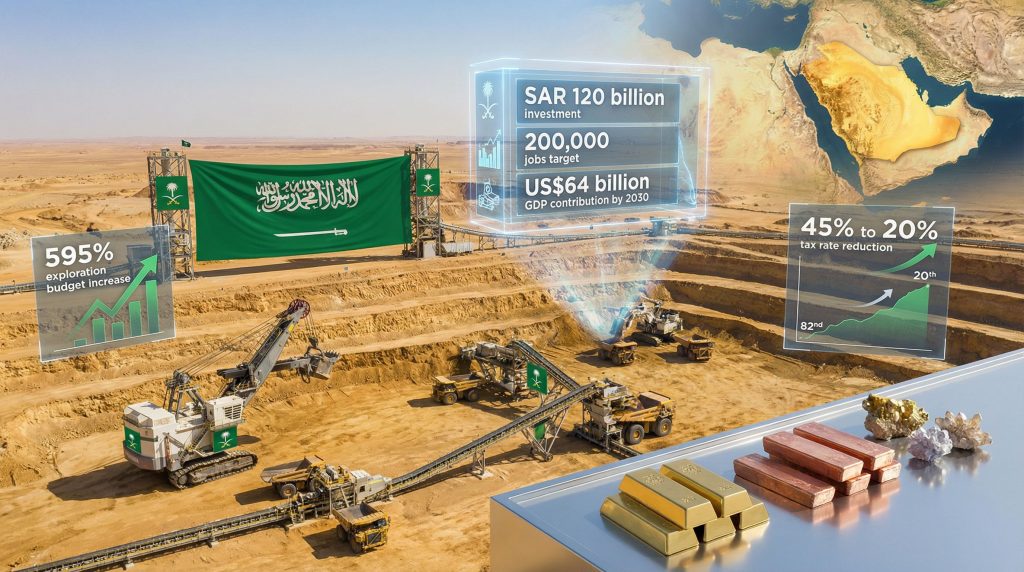
Saudi Arabia mining sector growth has emerged as a cornerstone of the Kingdom's Vision 2030 economic diversification strategy. This transformation reflects a fundamental shift from hydrocarbon dependency toward establishing a robust mineral extraction industry that supports downstream manufacturing across multiple sectors.
The Kingdom's strategic approach leverages extensive geological resources while integrating advanced technologies to create sustainable competitive advantages. Furthermore, comprehensive regulatory reforms have enhanced investment attractiveness, resulting in substantial capital inflows and operational expansion across various mineral commodities.
Strategic Framework for Mining Sector Development
Vision 2030's Mineral Resource Strategy
The comprehensive Saudi Arabia exploration licenses framework has fundamentally transformed the sector's operational landscape. According to Jeffrey Lorsch, Partner at McKinsey & Co., mining sector output has doubled or tripled since 2015, reflecting remarkable investor confidence in the Kingdom's diversification initiatives.
Strategic positioning of mineral extraction within broader industrial development creates multiplier effects across automotive, aerospace, space, and defense industries. This interconnected approach distinguishes current expansion from traditional resource extraction models, as mining operations function as foundational enablers for downstream manufacturing capabilities.
The government's outlook for the mining sector remains particularly robust, with confirmed observations of significant uptick over the past decade. Professional evaluations indicate that regulatory environment improvements and expanding investor confidence have created favourable conditions for sustained growth.
Available opportunities within these interconnected sectors position the Kingdom to achieve annual growth rates exceeding global economic averages. This comparative advantage stems from strategic integration of resource extraction with industrial manufacturing, creating synergistic effects that amplify economic impact beyond traditional commodity-based models.
Global Supply Chain Transformation
Geopolitical tensions have fundamentally altered mineral value chain dynamics, prompting strategic shifts from historical global supply chain dependency toward localised and regionalised development models. The Future Minerals Forum Barometer monitors these transformations and analyses how geopolitical factors impact mineral value chains.
The emphasis on developing local and regional supply chains represents a strategic response to supply chain vulnerabilities exposed through recent geopolitical events. Consequently, this transformation creates opportunities for resource-rich nations to establish themselves as critical nodes in alternative supply networks.
Key supply chain positioning factors include:
- Development of multilateral solutions for sector expansion
- Regional cooperation frameworks for resource security
- Technology transfer mechanisms for processing capabilities
- Strategic partnerships with consuming nations
- Investment in downstream processing infrastructure
The concept of super-regional development ensures that mineral resource development contributes meaningfully to industrial advancement, rather than functioning solely as raw material exporters. In addition, this approach emphasises value-added processing and manufacturing integration within producing regions.
When big ASX news breaks, our subscribers know first
Investment Dynamics and Economic Multipliers
Capital Allocation Mechanisms
Investment patterns within the mining sector demonstrate sophisticated attraction mechanisms designed to leverage both domestic resources and international expertise. The Arab Energy Fund's activities illustrate multilateral capital cooperation models increasingly prevalent in Gulf energy and mining-adjacent sectors.
The Arab Energy Fund, established in 1974 by 10 Arab oil-exporting countries, functions as a multilateral impact financial institution mobilising capital across strategic energy and industrial projects. Recent investment activities include partnerships with global financial institutions like BlackRock, demonstrating integration of regional and international capital sources.
Investment mechanisms encompass:
- Multilateral institutional partnerships
- International joint venture structures
- Strategic minority stake acquisitions
- Regional expertise leveraging
- Institutional network utilisation
According to Khalid Al-Ruwaigh, CEO of The Arab Energy Fund, investment strategies focus on "unique platforms with strong fundamentals and proven track records in critical energy segments". This approach emphasises supporting high-quality businesses positioned to capture regional and international growth opportunities.
Partnership structures designed to bolster long-term growth strategies leverage regional expertise and institutional networks, creating synergistic effects between capital providers and operational entities. These models demonstrate effective mechanisms for channeling investment capital into mining-adjacent sectors whilst maintaining strategic oversight.
Employment Generation and Industrial Integration
Mining sector expansion generates employment through both direct extraction activities and indirect supply chain participation. The strategic linking of mining development to broader industrial segments creates cascading employment effects across multiple industries, supporting the mining industry evolution toward integrated manufacturing ecosystems.
Employment creation mechanisms operate through interconnected industrial development, where mining serves as a foundational enabler for downstream manufacturing. This approach maximises employment impact by establishing integrated industrial ecosystems rather than isolated extraction operations.
Employment generation pathways include:
- Direct mining operations (extraction, processing, refining)
- Supply chain services (transportation, maintenance, logistics)
- Manufacturing support (equipment, specialised services)
- Technical services (environmental compliance, safety management)
- Digital systems operation and data analytics
The emphasis on sector interconnectedness indicates that employment projections require comprehensive analysis of cascading effects across supply chain participants. This integrated approach amplifies total employment impact beyond traditional extraction-focused models while creating demand for advanced technical skills and cross-industry expertise development.
Regulatory Enhancement and Investment Climate
Policy Framework Development
Regulatory improvements have generated measurable sector expansion, with documented output increases of 200-300% since 2015. These performance improvements reflect comprehensive policy reform initiatives designed to enhance international competitiveness and attract sustained investment capital through Vision 2030's mining strategy.
The transformation of regulatory frameworks addresses multiple dimensions of investment attractiveness, including tax policy optimisation, operational licensing procedures, environmental compliance standards, and international partnership facilitation. This comprehensive approach creates favourable conditions for both domestic and international investment participation.
Regulatory enhancement areas encompass:
- Tax policy competitiveness improvements
- Licensing procedure streamlining
- Environmental compliance frameworks
- International partnership facilitation
- Investment protection mechanisms
McKinsey's assessment confirms that regulatory environment improvements have successfully attracted capital and operational expansion over the past decade. The significant uptick in sector performance demonstrates the effectiveness of comprehensive policy reform in creating sustainable investment conditions for long-term strategic planning.
Investment return calculations benefit from improved regulatory predictability and reduced operational uncertainty. These improvements enhance project feasibility assessments and enable strategic planning aligned with comprehensive economic diversification objectives.
International Competitiveness Enhancement
The overall outlook for mining sector development is characterised as very optimistic by international consulting firms. Expectations for continued growth in gold, phosphate, aluminium, and steel production align with Maaden's announcement of additional gold resources, demonstrating concrete expansion of production capacity.
Future prospects for Saudi Arabia mining sector growth align with broader economic expansion targets, with mining functioning as a strategic enabler for achieving growth rates exceeding global averages. However, this positioning reflects successful integration of mining development with comprehensive economic diversification strategies that acknowledge external economic factors.
Competitiveness factors include:
- Production capacity expansion in multiple commodities
- Technology integration for operational efficiency
- Strategic industrial linkage development
- International partnership establishment
- Value-added processing capabilities
The balanced approach to growth forecasts reflects realistic assessment of global economic conditions whilst maintaining robust outlook for domestic expansion. This perspective acknowledges external factors while emphasising strategic advantages created through comprehensive development planning and critical minerals energy security considerations.
Production Capacity and Technological Innovation
Strategic Resource Development
Production capacity expansion focuses on multiple commodity categories, including gold, phosphate, aluminium, and steel, creating diversified revenue streams that reduce dependency on single commodity price fluctuations. This approach enhances economic resilience through portfolio diversification across different mineral markets.
Maaden's announcement of additional gold resources exemplifies systematic capacity expansion strategies that combine resource discovery with production scaling. These developments demonstrate practical implementation of strategic mining development within established operational frameworks whilst maintaining environmental sustainability standards.
Resource development priorities encompass:
- Gold extraction capacity enhancement
- Phosphate production scaling
- Aluminium processing expansion
- Steel manufacturing integration
- Specialised mineral exploration
The integration of mining development with industrial manufacturing creates opportunities for value-added processing within domestic markets. This approach maximises economic value creation from geological endowments whilst capturing additional revenue streams and reducing export dependency on raw materials.
Resource optimisation strategies emphasise sustainable extraction practices that balance production maximisation with long-term resource conservation. This approach ensures sustained production capacity whilst maintaining environmental compliance and operational efficiency through advanced monitoring systems.
Digital Transformation and Automation
Digital transformation initiatives within mining operations focus on automation, AI in mining operations, and data analytics implementation for productivity enhancement. These technological advances improve operational efficiency whilst reducing environmental impact through optimised resource utilisation and predictive maintenance systems.
Technology implementation areas include:
- Automated extraction systems
- AI-powered resource optimisation
- Environmental monitoring capabilities
- Predictive maintenance systems
- Supply chain optimisation tools
Innovation ecosystem development supports mining-adjacent industries through research and development investment, university-industry collaboration, and international best practice adoption. This comprehensive approach creates sustainable competitive advantages through continuous technological advancement and indigenous capability development.
Environmental monitoring and sustainable extraction practices integrate advanced technology with regulatory compliance requirements. These systems provide real-time data for optimised resource management and environmental impact minimisation whilst maintaining production efficiency standards.
Global Market Integration and Trade Development
International Trade Positioning
Export market development focuses on diversification of destination markets and optimisation of trade routes to reduce dependency on traditional trading relationships. This strategy enhances revenue stability through geographic market diversification whilst capturing premium pricing opportunities in specialised markets.
Trade positioning strategies encompass:
- Export destination diversification
- Trade route optimisation
- Bilateral cooperation agreements
- Regional supply chain integration
- Value-added product development
International partnership formation emphasises knowledge transfer and technology sharing arrangements that enhance operational capabilities whilst establishing long-term strategic relationships. These partnerships provide access to advanced technologies and specialised expertise whilst creating mutual benefits for participating nations and supporting global mining investment initiatives.
The development of financial market infrastructure includes metals exchange capabilities and risk management instruments that support market-making functions and investment facilitation. These systems integrate with global commodity trading networks whilst maintaining regional operational control and strategic autonomy.
Economic Diversification Benefits
Mining sector revenue provides diversification benefits compared to traditional hydrocarbon dependency, offering different price volatility patterns and market cycles. This diversification enhances national economic resilience through reduced correlation with oil market fluctuations whilst creating multiple pathways for sustained growth.
Portfolio diversification benefits extend beyond commodity price considerations to include different customer bases, supply chain requirements, and technological dependencies. This comprehensive diversification reduces systemic risks whilst creating strategic flexibility for long-term economic planning.
Revenue stability mechanisms include:
- Commodity portfolio diversification
- Price volatility hedging instruments
- Long-term supply agreements
- Value-added processing integration
- Market timing optimisation
Counter-cyclical investment opportunities emerge during commodity market downturns, enabling strategic capacity building and technology investment when costs are reduced. This approach maximises long-term competitive positioning through strategic timing of capital deployment and infrastructure development.
Environmental Sustainability and ESG Compliance
Sustainable Development Integration
Environmental, social, and governance compliance frameworks align with international investment standards whilst supporting sustainable development objectives. These frameworks ensure operational sustainability whilst maintaining access to international capital markets and strategic partnerships through transparent governance structures.
ESG implementation components encompass:
- Environmental impact assessment systems
- Social responsibility programs
- Community development initiatives
- Governance transparency structures
- Stakeholder engagement mechanisms
Circular economy integration emphasises resource recovery, recycling technology implementation, and by-product utilisation for additional revenue stream creation. This approach maximises resource value whilst minimising environmental impact through comprehensive waste management systems and ecosystem restoration programs.
Environmental restoration and land rehabilitation planning ensure long-term sustainability whilst maintaining community relationships and regulatory compliance. These programs demonstrate commitment to environmental stewardship whilst creating positive social impact through biodiversity conservation and sustainable land use practices.
Research and Innovation Development
Research and development investment priorities focus on sustainable mining technologies, environmental monitoring systems, and resource optimisation methodologies. These investments create competitive advantages through operational efficiency whilst meeting environmental compliance requirements and supporting technology transfer initiatives.
University-industry collaboration facilitates technology advancement and knowledge transfer whilst developing local expertise and research capabilities. This approach builds sustainable competitive advantages through indigenous technological development and human capital enhancement aligned with investing guide 2025 recommendations.
Sustainability integration areas include:
- Clean technology implementation
- Water resource management
- Energy efficiency optimisation
- Carbon footprint reduction
- Biodiversity conservation
Global South partnership development emphasises technology transfer, capacity building, and investment cooperation with emerging mining economies. These relationships create mutual benefits through shared expertise and collaborative development approaches whilst maintaining sovereignty over resource development decisions.
The next major ASX story will hit our subscribers first
Regional Cooperation and Future Outlook
Middle East Integration Framework
Cross-border resource sharing and joint venture development create opportunities for regional economic integration whilst optimising resource utilisation across national boundaries. These arrangements enhance competitiveness through scale economics and shared infrastructure development whilst supporting regional stability.
Regional cooperation frameworks encompass:
- Resource sharing agreements
- Joint venture structures
- Technology exchange programs
- Infrastructure coordination
- Market access facilitation
Knowledge sharing and technical expertise exchange programs facilitate best practice adoption whilst building regional capabilities for sustainable development. This collaborative approach accelerates development timelines whilst reducing individual investment requirements and enhancing collective competitiveness.
Logistics optimisation through regional supply chain development reduces transportation costs whilst improving delivery reliability and market responsiveness. These efficiencies enhance competitiveness in global markets whilst supporting regional economic integration objectives and strategic autonomy.
Strategic Economic Transformation
The transformation from traditional energy dependency toward diversified industrial development represents fundamental economic restructuring that extends beyond simple sector addition. This comprehensive approach creates synergistic effects between established energy capabilities and emerging mining industries whilst maintaining strategic flexibility.
South-South collaboration models support sustainable development through technology transfer and capacity building initiatives that benefit participating nations. These relationships provide alternatives to traditional development models whilst maintaining sovereignty over resource development decisions and strategic planning autonomy.
Future development pathways include:
- Integrated industrial ecosystem development
- Technology-driven efficiency improvements
- International partnership expansion
- Sustainable development implementation
- Regional leadership positioning
The combination of geological endowments, strategic planning, regulatory improvement, and international cooperation creates conditions for sustained economic transformation. This comprehensive approach positions the Kingdom for leadership in sustainable mining development whilst achieving economic diversification objectives that strengthen long-term resilience and prosperity through strategic integration of mining, manufacturing, and technology sectors.
This analysis reflects current market conditions and policy frameworks. Future performance may vary based on global economic conditions, commodity price fluctuations, and geopolitical developments. Investment decisions should consider multiple factors and professional advice.
Looking to Capitalise on Strategic Mineral Development Opportunities?
Discovery Alert's proprietary Discovery IQ model delivers real-time notifications on significant ASX mineral discoveries, helping subscribers identify actionable investment opportunities in the rapidly evolving global mining landscape. Begin your 30-day free trial today to gain a competitive edge in strategic mineral investments that align with international development trends.