June 8, 2026
When Price Becomes the Enemy: How Saudi Arabia Lost Its Grip on China's Crude Market
Every major commodity relationship contains a hidden stress point — a price threshold beyond which even the most strategically embedded supplier becomes uncompetitive. For decades, Saudi Arabia managed to stay well below that threshold in its trade with China, cementing a position as one of the country's most relied-upon crude sources. That equilibrium has now fractured in spectacular fashion.
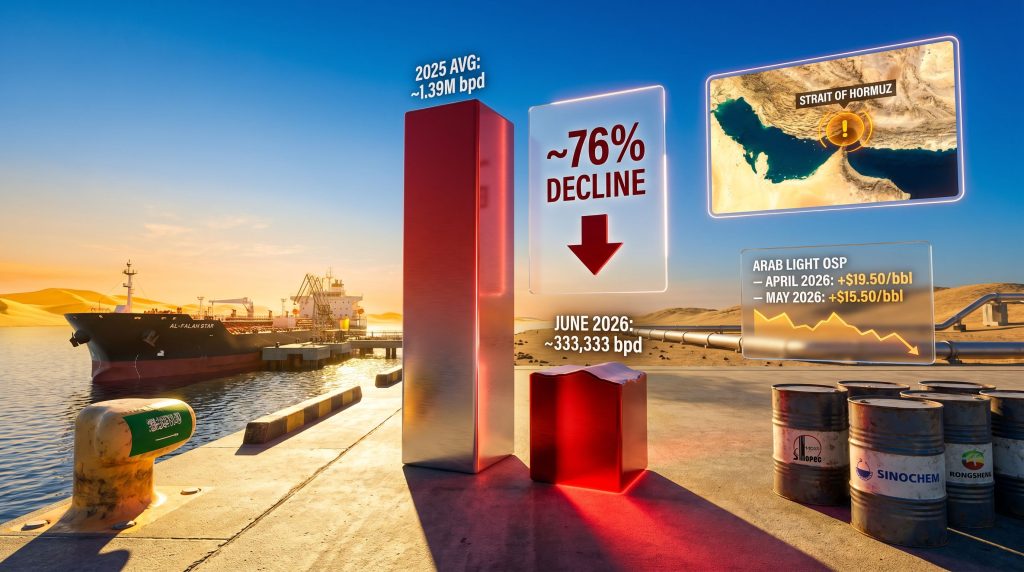
Saudi crude exports to China record low in June is no longer a projection — with shipments forecast at roughly 10 million barrels for the entire month, equivalent to approximately 333,333 barrels per day (bpd), the numbers are stark. Against a 2025 average of 1.39 million bpd, that represents a contraction of around 76% within a matter of months. The data, compiled through Kpler vessel-tracking systems and Reuters trade source networks, points to a breakdown that is simultaneously logistical, financial, and geopolitical in nature.
When big ASX news breaks, our subscribers know first
The Architecture of the Saudi–China Crude Trade
To appreciate the scale of what is unfolding, it helps to understand why the Sino-Saudi crude relationship developed the way it did. China's refineries, particularly the large integrated complexes operated by state-owned majors and newer independent players, were progressively optimised over the 2010s and early 2020s to process medium-sour crude grades. Arab Light, Saudi Arabia's flagship export grade, fits that profile well.
Long-term supply agreements between Saudi Aramco and Chinese counterparts reinforced this structural dependency. Combined with diplomatic alignment between Riyadh and Beijing — underpinned by China's role as Saudi Arabia's largest single export customer — these ties created what appeared to be a highly stable bilateral trade architecture.
The 2025 average of 1.39 million bpd arriving in Chinese ports was the output of that architecture operating under normal conditions. Furthermore, understanding current crude prices helps contextualise just how quickly that architecture could be disrupted when price signals overrode strategic inertia following the outbreak of the U.S.-Iran conflict at the end of February 2026.
Key Trade Metrics at a Glance
| Metric | Value |
|---|---|
| 2025 Average Saudi Crude Exports to China | ~1.39 million bpd |
| June 2026 Projected Export Volume | |
| Year-on-Year Volume Decline | ~76% |
| May 2026 Arab Light OSP Premium (Asia) | +$19.50/barrel (record high) |
| June 2026 Arab Light OSP Premium (Asia) | +$15.50/barrel |
| OSP Month-on-Month Reduction | -$4.00/barrel |
Context: The June 2026 projected volume of approximately 333,333 bpd represents the lowest Saudi crude shipment to China recorded in available Kpler and Reuters trade data. The figure is not a rounding anomaly — it reflects a genuine and severe collapse in bilateral crude flows driven by the intersection of geopolitical disruption and pricing dynamics.
How the Hormuz Disruption Became a Pricing Catastrophe
The Strait of Hormuz is the single most important crude oil transit chokepoint on the planet, carrying an estimated 20% or more of globally traded oil through a narrow passage between the Persian Gulf and the Arabian Sea. When the U.S.-Iran conflict intensified at the end of February 2026, Hormuz transit became largely constrained, fundamentally altering the supply calculus for Middle Eastern crude producers.
Saudi Arabia responded by redirecting its crude export operations through the East-West Pipeline, a strategic inland conduit that moves oil from eastern production fields across the Arabian Peninsula to the Yanbu terminal on the Red Sea coast. However, whilst this rerouting preserved Saudi Arabia's ability to continue exporting, it introduced logistical complexity, extended shipping distances to Asian destinations, and elevated freight costs — all of which fed into delivered crude prices for buyers.
More critically, the regional supply disruption caused by constrained Hormuz flows tightened the availability of Middle Eastern crude grades across the board. With Iraqi, Kuwaiti, and UAE barrels also affected by transit uncertainty, the Oman/Dubai benchmark moved sharply higher. Consequently, Saudi Aramco's Arab Light premium to Asia followed, reaching a record +$19.50 per barrel in May 2026. These geopolitical oil risks have proven far more disruptive than many analysts initially anticipated.
How the OSP Formula Works in Practice
Saudi Arabia's official selling price for Asian customers is not set arbitrarily. The formula structure calculates Arab Light's delivered value relative to the Oman/Dubai average benchmark, with a premium or discount applied to reflect market conditions. In simplified terms:
Arab Light OSP (Asia) = Oman/Dubai Benchmark + Premium Adjustment
When the regional benchmark rises due to supply tightening, and Saudi Arabia simultaneously increases its premium adjustment to capture scarcity value, the cumulative effect on delivered crude costs is amplified. At +$19.50 per barrel in May 2026, Chinese refiners were being asked to pay a premium that, when layered on top of an already elevated benchmark price, compressed refining margins to levels that made crude procurement economically indefensible.
The June OSP reduction to +$15.50 per barrel — a concession of $4.00 per barrel — was acknowledged by trade sources as insufficient to reverse the buying pullback that had already been set in motion. According to reporting from Reuters, major Chinese refiners had already submitted reduced nominations before the adjustment was announced, suggesting that the damage had accumulated faster than Saudi pricing mechanisms could respond.
The Buyer Side: Why Chinese Refiners Walked Away
Understanding the refiner decision-making process requires moving beyond the headline price and into the economics of crude processing. Chinese refineries convert crude oil into refined petroleum products — gasoline, diesel, jet fuel, fuel oil, and petrochemical feedstocks — and their commercial viability depends on the spread between crude input costs and product output values. When crude input costs rise faster than product prices, refining margins compress, and operators face a binary choice: absorb losses or reduce throughput.
In April 2026, Chinese state-owned oil majors lowered their refinery operating rates relative to the prior month, a direct response to constrained Hormuz flows reducing available crude supply and pushing up input costs. By the time June nominations were being filed in early May 2026, the combination of elevated OSPs and reduced refinery utilisation had created conditions in which major buyers collectively determined that Saudi crude at prevailing prices exceeded their margin tolerance.
The three refiners identified as having scaled back June liftings represent the full spectrum of Chinese crude procurement:
- Sinopec — China's largest refiner and a state-owned enterprise with the highest crude throughput volumes in the country
- Sinochem — A state-owned chemical and energy conglomerate with significant refinery assets and international crude trading capabilities
- Rongsheng Petrochemical — One of China's largest private-sector refiners, operator of the massive Zhoushan integrated complex
The simultaneous pullback by both state-directed buyers (Sinopec, Sinochem) and an independent commercial operator (Rongsheng) is analytically significant. State-owned Chinese refiners do not operate purely on commercial logic — they also factor in energy security mandates, government-directed procurement preferences, and strategic inventory objectives. The fact that even these buyers reduced nominations signals that the OSP premium had crossed a threshold where neither commercial nor strategic rationale could justify continued purchasing at prevailing volumes.
Market Psychology Insight: In crude oil markets, nomination reductions by state-aligned buyers tend to have an outsized signalling effect. When a Sinopec or a Sinochem visibly steps back from a supplier, it communicates to the broader market that pricing has moved beyond commercially viable territory — and can accelerate similar responses from other buyers who had been hesitating.
Production Capacity vs. Export Reality: The Aramco Paradox
One of the less-discussed dimensions of this situation is the gap between Saudi Arabia's theoretical production capability and its actual deliverable export volumes. According to reporting via Zawya, Saudi Aramco's chief executive indicated that the company could reach an oil production capacity of 12 million barrels per day within approximately three weeks if required — a statement that underscores the kingdom's ability to scale output rapidly under the right conditions.
Yet this latent capacity has not translated into restored Chinese volumes. The constraint is not production — it is the combination of export route limitations imposed by Hormuz disruption, the pricing consequences of rerouting through Yanbu, and buyer resistance at prevailing OSP levels. Separately, Aramco's first-quarter 2026 profit performance, which reportedly reflected a 25% year-on-year increase that exceeded analyst estimates, illustrates a counterintuitive outcome: elevated prices are generating stronger financial results even as China-bound volumes collapse.
This dynamic reveals an important tension within Saudi Arabia's export strategy. Revenue maximisation through high OSP premiums is delivering short-term financial gains, but it is simultaneously accelerating buyer diversification away from Saudi crude — a trade-off with potentially lasting consequences for market share. Indeed, the trade war oil impact adds another layer of complexity to these already strained supply relationships.
Furthermore, Aramco's chief executive has cautioned publicly that approximately 1 billion barrels of cumulative supply has been lost to global markets since the Hormuz disruption began, a figure that contextualises the scale of the disruption beyond the Saudi-China bilateral relationship. Recovery from supply gaps of that magnitude takes time even after transit routes reopen, because refinery restocking, inventory normalisation, and contract renegotiation all require weeks or months to execute.
Who Captures the Redirected Barrels?
When Saudi crude volumes destined for China are reduced, those barrels do not simply disappear from the market. Saudi Arabia's production continues; the destination changes. Analysts at Energy Aspects noted in a May 2026 research note that the reduction in Saudi volumes to China was expected to benefit other Asian buyers, with additional barrels redirected toward other Northeast Asian customers — notably buyers in Japan, South Korea, and potentially Taiwan.
This reallocation dynamic creates a secondary competitive dimension. As Saudi crude shifts toward non-Chinese Northeast Asian buyers, the relative supply availability of alternative crude grades for Chinese refiners tightens. Chinese buyers pivoting away from Saudi crude will find themselves competing more aggressively for:
- Russian crude at discounted pricing structures, though sanctions compliance constraints limit accessibility for some buyers
- Iraqi Basrah crude, a medium-sour grade partially comparable to Arab Light in refinery configuration terms
- UAE ADNOC grades, which have gained relevance in Asian markets as UAE production has expanded
- West African and Atlantic Basin crudes, which become price-competitive when Middle Eastern premiums are elevated
The pricing competitiveness of these alternatives is directly enhanced by Saudi OSP levels. Every dollar increase in the Arab Light premium effectively subsidises the relative attractiveness of competing crude grades. In this context, OPEC's market influence over pricing decisions carries considerable weight in determining how long these competitive dynamics persist.
Alternative Crude Competitiveness Framework
| Crude Source | Pricing Basis | Relevance to Chinese Buyers |
|---|---|---|
| Russia (ESPO, Urals) | Discounted to Brent/Dubai | High demand; sanctions compliance a variable |
| Iraq (Basrah Heavy/Light) | OSP-linked; typically competitive | Direct substitute for Arab Light in some configurations |
| UAE (Murban, Das) | ADNOC OSP; Abu Dhabi exchange-traded | Growing market share in Asia |
| West Africa (Bonny Light, etc.) | Brent-linked spot market | Competitive when freight costs are absorbed by OSP savings |
The next major ASX story will hit our subscribers first
The Historical Anomaly of June 2026
To place the current situation in context, previous periods of reduced Saudi crude flows to China offer instructive comparisons. The 2020 COVID-19 demand collapse saw Chinese crude imports contract sharply as refinery utilisation fell in response to collapsing fuel demand. That episode was demand-driven — Chinese refiners reduced crude purchasing because their end-product markets evaporated. The recovery, once demand rebounded, was rapid.
The June 2026 situation is structurally different in three ways:
- Supply disruption and price premium: The current episode is driven by a geopolitical supply constraint that simultaneously reduces Saudi export capacity through Hormuz and inflates OSP premiums — a dual mechanism that amplifies buyer resistance
- Cross-buyer consensus: The simultaneous pullback by state-owned and independent refiners suggests a broadly shared commercial assessment rather than isolated purchasing decisions
- Alternative supply availability: Unlike the 2020 episode, alternative crude grades are available and price-competitive, giving Chinese buyers a genuine substitution pathway rather than forcing them to return to Saudi crude as soon as prices normalise
Speculative but analytically grounded: If Saudi OSPs remain materially elevated through the third quarter of 2026, the period of reduced Chinese procurement may be long enough to allow Chinese refiners to develop new supplier relationships, renegotiate term agreements, and restructure crude import portfolios in ways that persist beyond the immediate geopolitical episode. The concern for Saudi Arabia is not just losing spot market volumes — it is the risk that habitual procurement patterns, once broken, do not automatically reconstitute themselves when prices normalise.
Three Scenarios for the Saudi–China Crude Relationship
Scenario 1: Rapid Normalisation
Hormuz transit is partially restored during Q3 2026. Saudi Aramco reduces OSP premiums to levels closer to pre-conflict norms. Chinese refiners resume term liftings at volumes below the 2025 average but above June 2026 lows. The episode is categorised as a cyclical disruption rather than a structural break.
Scenario 2: Prolonged Premium Elevation
OSPs remain elevated through the second half of 2026 as Hormuz remains constrained or as geopolitical risk premiums prove slow to unwind. Chinese buyers deepen alternative supply relationships, and Saudi market share in China contracts persistently. This scenario poses the greatest long-term risk to Saudi Arabia's position in its most important export market.
Scenario 3: Escalation and Tail Risk
Further geopolitical deterioration disrupts East-West Pipeline operations or threatens Yanbu terminal capacity, creating compounded export constraints across all Saudi shipping routes simultaneously. This tail risk scenario would carry significant global oil price implications beyond the Saudi-China relationship. Monitoring broader oil price movements will be essential for understanding how this scenario might unfold.
Frequently Asked Questions
What is the Saudi crude exports to China record low in June 2026?
Approximately 10 million barrels total for the month, equivalent to roughly 333,333 barrels per day — confirmed as a record low based on available Kpler vessel-tracking and Reuters trade source data.
Why did Saudi Arabia's official selling price reach record levels in early 2026?
The U.S.-Iran conflict beginning in late February 2026 severely constrained Strait of Hormuz crude transit. This tightened regional supply across multiple Middle Eastern producers, elevated the Oman/Dubai benchmark price, and prompted Saudi Arabia to raise its Arab Light OSP premium for Asian buyers to a record +$19.50 per barrel in May 2026.
Which Chinese refiners reduced Saudi crude nominations for June 2026?
Trade sources cited by Reuters identified Sinopec, Sinochem, and Rongsheng Petrochemical as among the major buyers that scaled back June liftings.
How is Saudi Arabia compensating for reduced Hormuz exports?
Saudi Aramco has been rerouting crude exports through the East-West Pipeline to the Yanbu port on the Red Sea, which provides an alternative maritime export gateway bypassing the Strait of Hormuz entirely. According to reporting, Aramco has stated that this pipeline has helped mitigate the impact of the broader energy supply shock on its export operations.
Will Saudi crude exports to China recover in the second half of 2026?
Recovery is conditional. It depends on whether Hormuz transit constraints ease, whether Saudi OSPs are adjusted downward sufficiently to restore Chinese refinery margin viability, and whether Chinese buyers have developed alternative supply commitments during the disruption period that reduce their appetite for Saudi crude at any price.
The Deeper Strategic Question for Saudi Arabia
The immediate financial picture for Saudi Arabia remains relatively resilient — elevated crude prices have driven Aramco's Q1 2026 profits sharply higher, demonstrating that price gains can offset volume losses in the short term. However, the strategic calculus over a longer horizon is more complicated.
Saudi Arabia's Vision 2030 economic transformation programme requires sustained hydrocarbon revenues to fund its investment ambitions. That revenue base is most secure when Saudi crude commands both high prices and strong volumes in its largest export market. The current situation delivers the price but is eroding the volume, and the risk is that prolonged absence from Chinese refinery procurement schedules allows structural substitution to take root.
Equally, Chinese refinery investments in Saudi downstream assets and joint venture arrangements create a web of interdependencies that may act as a moderating force against permanent buyer defection. The relationship is not purely transactional — there are embedded capital and contractual ties that create mutual incentives to restore bilateral trade flows once pricing conditions permit.
What is clear from the June 2026 data is that the Saudi crude exports to China record low is not merely a temporary blip in a single month's shipping manifest. It is the visible output of a geopolitical shock, a pricing mechanism under stress, and a market structure that has been tested beyond its normal tolerance parameters — with consequences that will take months, and possibly years, to fully resolve.
Disclaimer: This article contains analysis, projections, and scenario modelling that reflect conditions as of May 2026 based on available trade source data and reported figures. Crude export volumes cited are preliminary estimates derived from vessel-tracking data ahead of official customs releases and are subject to revision. This article does not constitute financial or investment advice. Readers should conduct their own due diligence before making decisions based on commodity market analysis.
Want to Track the Investment Opportunities Emerging From Global Energy Disruptions?
Discovery Alert's proprietary Discovery IQ model delivers real-time alerts on significant ASX mineral discoveries, instantly translating complex market data into actionable insights for investors at every experience level — explore historic discoveries and their exceptional returns to understand what's possible, then begin your 14-day free trial at Discovery Alert to position yourself ahead of the market.