
August 6, 2026
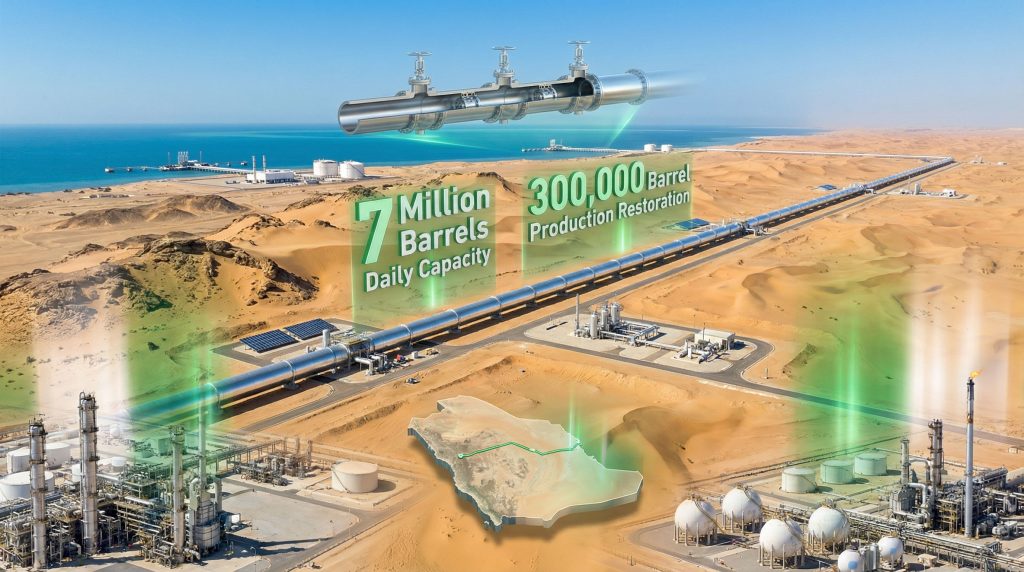
The restoration of the saudi east-west crude pipeline back to full capacity demonstrates the critical importance of energy infrastructure resilience in maintaining global supply chains. Recent attacks on Saudi Arabia's energy facilities have highlighted both vulnerabilities and recovery capabilities within the kingdom's oil export network. Furthermore, the rapid restoration of pipeline operations illustrates sophisticated emergency response protocols that minimise market disruption during geopolitical crises.
Understanding the East-West Crude Transportation Corridor
Saudi Arabia's East-West pipeline functions as a strategic bypass system, transporting crude oil from the kingdom's eastern production fields to Red Sea export terminals at Yanbu port. This 1,200-kilometre infrastructure project has evolved from a secondary export route into the primary pathway for Saudi crude reaching global markets, particularly following the effective blockade of Strait of Hormuz shipping lanes.
The pipeline's technical specifications reflect massive engineering scale, with pumping stations positioned strategically across the kingdom's geography to maintain optimal pressure and flow rates. Recent infrastructure attacks targeted these critical pumping facilities, temporarily reducing capacity by approximately 700,000 barrels per day before restoration efforts returned the system to full operational status.
Geographic Routing and Strategic Importance
The East-West pipeline's routing provides crucial geographic diversification for Saudi crude exports, eliminating dependence on Persian Gulf chokepoints that have become increasingly vulnerable to regional conflict. By terminating at Yanbu on the Red Sea coast, the system enables direct access to Mediterranean and Atlantic markets without requiring transit through the Strait of Hormuz.
This geographic advantage becomes particularly valuable during periods of regional instability, when traditional shipping lanes face disruption from military activities or diplomatic tensions. The Red Sea routing reduces transit times to European refineries by 7-10 days compared to alternative pathways around the Arabian Peninsula.
Integration with Broader Export Infrastructure
The pipeline system integrates with Saudi Arabia's comprehensive crude oil export network, including marine loading terminals, storage facilities, and quality control systems at Yanbu port. This integration enables seamless commodity flows from upstream production facilities to international tanker loading operations.
Storage capacity at Yanbu provides operational flexibility during maintenance periods or temporary production fluctuations at upstream facilities. The port's deep-water terminals accommodate Very Large Crude Carriers (VLCCs), enabling efficient bulk transportation to distant markets.
When big ASX news breaks, our subscribers know first
What Makes the 7 Million Barrel Daily Capacity So Critical?
The 7 million barrel daily capacity of the saudi east-west crude pipeline back to full capacity represents substantial economic and strategic value within global energy markets. To contextualise this volume, worldwide oil consumption approximates 100 million barrels per day, making the pipeline responsible for roughly 7% of global daily demand.
However, recent market dynamics including the oil price rally have intensified focus on supply chain reliability. Moreover, oil price movements trade war concerns have elevated the strategic importance of alternative transportation routes.
Economic Scale and Market Impact
| Metric | Value | Global Context |
|---|---|---|
| Daily Capacity | 7 million barrels | 7% of world consumption |
| Revenue Impact* | $560-700 million/day | At $80-100/barrel pricing |
| Export Significance | Primary Saudi route | Post-Hormuz constraints |
| Recovery Timeline | <1 week estimated | Rapid restoration capability |
*Revenue calculations based on historical pricing ranges; current 2026 market prices require verification from real-time commodity data sources.
The economic implications of capacity disruptions extend beyond immediate revenue losses for Saudi Arabia. According to Reuters, global crude oil markets respond rapidly to supply uncertainty, with commodity futures experiencing volatility that affects:
- Transportation costs across airline, shipping, and logistics sectors
- Manufacturing expenses for petrochemical and plastics industries
- Consumer pricing for gasoline, heating oil, and diesel fuels
- Investment flows into energy infrastructure and alternative supply sources
Alternative Route Dependencies
Traditional crude export pathways through the Strait of Hormuz have faced significant disruption, elevating the strategic importance of alternative transportation infrastructure. The Strait of Hormuz typically handles 17-21 million barrels per day of crude and refined product flows, representing approximately 20% of global petroleum transit.
With Hormuz shipping effectively blocked according to recent reports, the East-West pipeline has become Saudi Arabia's primary crude export mechanism. This dependency creates both operational challenges and strategic vulnerabilities that require careful risk management.
Cost Analysis: Pipeline vs. Tanker Transportation
- Pipeline transport: $0.50-1.50 per barrel (estimated)
- Tanker transport: $1.50-4.00+ per barrel (route-dependent)
- Net savings: 50-75% cost reduction via pipeline routing
- Time advantage: 7-10 day reduction for European deliveries
Cost estimates reflect industry averages; specific Saudi Aramco transportation costs are proprietary and not publicly disclosed.
Why Do Infrastructure Attacks Target Energy Chokepoints?
Energy infrastructure represents high-value targets for strategic disruption due to their outsized economic impact relative to the resources required for successful attacks. A single pumping station or production facility, when successfully targeted, can generate hundreds of millions of dollars in daily revenue losses while requiring relatively modest offensive capabilities.
Geopolitical Risk Assessment Framework
Recent attacks on Saudi energy infrastructure demonstrate sophisticated targeting of critical nodes within the crude oil supply chain. The strikes affected:
- East-West pipeline pumping stations (700,000 b/d capacity loss)
- Manifa offshore field (300,000 b/d production loss)
- Khurais onshore field (300,000 b/d production loss)
- Refinery and port infrastructure (processing and export capabilities)
This coordinated targeting pattern indicates detailed intelligence regarding Saudi Arabia's energy infrastructure vulnerabilities and operational dependencies. The timing of attacks following ceasefire announcements suggests strategic coordination designed to maximise economic disruption during diplomatic negotiations.
Strategic Value of Energy Infrastructure
Energy infrastructure attacks generate multiple layers of economic and political pressure. Additionally, Saudi exploration licenses expansion plans face increased security considerations following these incidents.
Immediate Economic Impact:
- Direct revenue losses for target nation
- Global commodity price volatility
- Supply chain disruptions across dependent industries
- Insurance premium increases for infrastructure protection
Secondary Strategic Effects:
- Diplomatic leverage during peace negotiations
- Demonstration of offensive capabilities to regional adversaries
- Market confidence erosion affecting investment flows
- International attention and potential intervention pressure
Recovery Timeline Analysis
The rapid restoration of the saudi east-west crude pipeline back to full capacity suggests either exceptional emergency response capabilities or pre-positioned backup infrastructure. Several factors potentially contributed to quick recovery:
Engineering Factors:
- Modular pumping station design enabling component replacement
- Redundant pipeline segments allowing bypass routing during repairs
- Pre-positioned spare equipment for critical system components
- Specialised maintenance crews with rapid mobilisation capability
Unknown Technical Details:
- Specific damage assessment methodologies employed
- Quality assurance protocols for emergency repairs
- Pressure testing and validation procedures
- Long-term reliability implications of rapid restoration
How Do Oil Field Production Losses Compound Pipeline Disruptions?
Production losses at individual oil fields create cumulative supply disruptions that extend beyond pipeline capacity constraints. The simultaneous targeting of Manifa and Khurais fields alongside pipeline infrastructure demonstrates strategic coordination designed to maximise overall system disruption.
Furthermore, the OPEC oil production impact becomes more significant when major production facilities face operational challenges.
Manifa Field Recovery Dynamics
Manifa field, located offshore in the Persian Gulf, represents significant production capacity within Saudi Arabia's crude oil portfolio. The 300,000 barrel per day production loss initially sustained at this facility has been restored according to Saudi Ministry statements.
Offshore Field Technical Challenges:
- Platform structural assessment following strike damage
- Subsea infrastructure inspection via Remotely Operated Vehicles (ROVs)
- Wellhead integrity validation and pressure testing protocols
- Power and control system restoration for automated operations
- Export pipeline connectivity to onshore transportation networks
The relatively rapid restoration of Manifa production suggests damage was contained to surface facilities rather than core production infrastructure. Offshore platforms maintain robust structural design standards to withstand harsh marine environments, potentially providing resilience against targeted strikes.
Khurais Field Ongoing Challenges
Khurais field continues experiencing 300,000 barrel per day production capacity losses, with repairs ongoing according to official statements. This extended restoration timeline suggests more complex damage requiring specialised technical intervention.
Large-Scale Onshore Facility Complexity:
- Multi-well production coordination across extensive field area
- Process equipment replacement for separation and stabilisation systems
- Electrical and instrumentation system restoration for field automation
- Pipeline network repairs connecting satellite wells to central facilities
- Quality control and testing before resuming commercial production
Onshore fields typically feature more distributed infrastructure compared to offshore platforms, potentially creating multiple repair requirements across geographically separated facilities. The extended timeline for Khurais restoration may reflect this infrastructure complexity.
Production Ramp-Up Projections
Following infrastructure restoration, oil fields require gradual production ramp-up to ensure operational stability and equipment reliability. Industry standard practices suggest:
- Initial startup at 25-50% capacity for system validation
- Incremental increases over 7-14 days monitoring performance
- Full capacity restoration once all systems demonstrate stable operation
- Enhanced monitoring during initial production periods
Production ramp-up timelines vary based on damage extent and field-specific technical requirements. Saudi Aramco's proprietary restart procedures are not publicly documented.
What Are the Broader Supply Chain Implications?
Global energy supply chain resilience depends on redundancy across production sources, transportation networks, and strategic reserve systems. Disruptions to major supply nodes test these backup mechanisms while revealing vulnerabilities in international energy security frameworks.
Global Energy Security Considerations
The concentration of crude oil production and transportation infrastructure in politically unstable regions creates systemic risks for global energy security. Alternative supply sources and emergency response mechanisms become critical during major disruptions.
Strategic Petroleum Reserve Deployment:
- United States SPR: Approximately 390-420 million barrels capacity
- Release rates: Typically 1-2 million barrels per day over 30-180 day periods
- International coordination: IEA member nations maintain emergency release protocols
- Market stabilisation: Reserve releases aim to offset supply disruptions and price volatility
OPEC+ Backup Capacity:
- Spare production capacity: Estimated 2-4 million barrels per day across member nations
- Activation timeline: 30-90 days for significant capacity increases
- Geographic distribution: Primarily concentrated in Middle Eastern members
- Political coordination: Requires consensus among member nations for activation
Regional Refinery Dependencies
Crude oil supply disruptions create cascading effects across downstream refining and distribution networks. Regional refineries designed for specific crude grades face operational challenges when primary supply sources become unavailable.
Crude Grade Substitution Challenges:
- Refinery optimisation: Processing units configured for specific crude characteristics
- Yield implications: Alternative crudes may produce different product distributions
- Quality specifications: Product quality standards require consistent crude inputs
- Economic impact: Suboptimal crude utilisation reduces refinery profitability
Yanbu Port Throughput Analysis:
- Loading capacity: Multiple berths accommodate VLCC and Suezmax vessels
- Storage infrastructure: Tank farms provide operational flexibility during supply variations
- Quality control: Inspection and testing facilities ensure export crude specifications
- Logistical coordination: Vessel scheduling and cargo allocation systems
Specific throughput rates and storage capacities at Yanbu port require verification from Saudi Aramco operational data, which remains proprietary.
How Do Ceasefire Agreements Affect Energy Infrastructure Protection?
Diplomatic frameworks attempting to establish regional stability face significant challenges when critical infrastructure remains vulnerable to targeted attacks. The timing of recent strikes following ceasefire announcements demonstrates the complex relationship between diplomatic negotiations and strategic infrastructure security.
Consequently, broader geopolitical tensions including the US–China trade war impact on global markets create additional complexities for energy infrastructure security planning.
Diplomatic Framework Analysis
The two-week ceasefire mediated through Pakistani diplomatic channels represents an attempt to establish temporary stability while addressing underlying regional conflicts. However, infrastructure attacks occurring after ceasefire implementation raise questions about enforcement mechanisms and compliance monitoring.
Ceasefire Sustainability Factors:
- Verification mechanisms: Independent monitoring of compliance across conflict zones
- Enforcement capabilities: International response to ceasefire violations
- Economic incentives: Energy infrastructure protection benefits all regional stakeholders
- Political flexibility: Diplomatic space for addressing root causes of conflict
Infrastructure Protection Protocols
Critical energy infrastructure requires specialised protection frameworks that extend beyond traditional military security measures. These systems must address both physical security and cybersecurity vulnerabilities while maintaining operational efficiency.
Multi-Layer Protection Systems:
- Perimeter security: Physical barriers and monitoring systems around facilities
- Air defence: Protection against aerial and missile attacks
- Cybersecurity: Network protection for control systems and data networks
- Personnel security: Background verification and access control for operations staff
- Emergency response: Rapid deployment capabilities for damage assessment and repair
International Monitoring Frameworks:
- Satellite surveillance: Real-time monitoring of infrastructure status and security threats
- Maritime patrol: Naval coordination for offshore platform protection
- Intelligence sharing: Cooperative threat assessment among allied nations
- Diplomatic coordination: International pressure for infrastructure protection norms
Long-term Stability Projections
Sustainable energy infrastructure security requires addressing underlying geopolitical tensions while implementing robust protective measures. Short-term ceasefires provide temporary relief but may not address fundamental security vulnerabilities.
Investment Requirements for Enhanced Security:
- Physical hardening: Upgraded facilities designed to withstand attacks
- Redundancy systems: Backup infrastructure enabling continued operation during disruptions
- Technology development: Advanced monitoring and rapid response capabilities
- International cooperation: Coordinated security frameworks among regional stakeholders
Insurance Market Responses:
- Premium increases: Higher coverage costs reflecting elevated risk assessments
- Coverage limitations: Exclusions for war risks and terrorism-related damages
- Market capacity: Reduced insurer appetite for energy infrastructure exposure
- Risk mitigation requirements: Enhanced security standards for coverage eligibility
The next major ASX story will hit our subscribers first
What Investment Strategies Emerge from Infrastructure Resilience?
Energy infrastructure vulnerabilities create both risks and opportunities for investment strategies focused on supply chain resilience and security technology. Understanding these dynamics enables portfolio construction that addresses geopolitical risk while capitalising on infrastructure development trends.
Portfolio Risk Management
Geopolitical risks affecting critical infrastructure require sophisticated risk management approaches that extend beyond traditional financial analysis. Energy sector investments must account for vulnerability to targeted attacks, supply chain disruptions, and regulatory responses to security threats.
Geographic Risk Distribution:
- Supply source diversification: Reducing concentration in politically unstable regions
- Transportation route alternatives: Investment in multiple pipeline and shipping pathways
- Processing facility distribution: Avoiding over-reliance on single refinery complexes
- Technology sector allocation: Companies developing infrastructure protection solutions
Energy Infrastructure Investment Themes:
- Pipeline construction and maintenance: Companies specialising in rapid deployment and repair
- Offshore production technology: Platforms and systems designed for enhanced security
- Alternative energy development: Reducing dependence on vulnerable fossil fuel infrastructure
- Security technology integration: Monitoring, protection, and response systems
Market Opportunity Assessment
Infrastructure security challenges create market opportunities across multiple sectors, from traditional energy services to emerging technology solutions. Investment strategies can target companies positioned to benefit from increased security spending and infrastructure resilience requirements.
Pipeline Construction and Maintenance Sector:
- Emergency repair capabilities: Specialised equipment and rapid deployment services
- Modular design systems: Infrastructure components enabling quick replacement
- Inspection and monitoring technology: Pipeline integrity assessment and threat detection
- Project management expertise: Coordination of complex infrastructure restoration
Security Technology Development:
- Surveillance systems: Advanced monitoring for critical infrastructure facilities
- Cybersecurity solutions: Protection for industrial control systems and data networks
- Drone and robotics technology: Remote inspection and security patrol capabilities
- Artificial intelligence applications: Threat detection and predictive maintenance systems
Alternative Energy Transition Acceleration:
Infrastructure vulnerabilities may accelerate adoption of distributed energy systems that reduce dependence on centralised, high-value targets. Investment opportunities include:
- Renewable energy development: Wind, solar, and energy storage systems
- Grid modernisation technology: Smart grid systems enabling distributed generation
- Energy efficiency solutions: Technologies reducing overall energy consumption
- Battery and storage systems: Grid-scale storage enabling renewable integration
Investment Disclaimer: Energy infrastructure investments involve significant geopolitical, technical, and regulatory risks. Market conditions can change rapidly during crisis periods, affecting asset valuations and investment returns. Investors should conduct thorough due diligence and consider professional advice when developing energy sector investment strategies.
The restoration of the saudi east-west crude pipeline back to full capacity demonstrates both the vulnerability and resilience of critical energy infrastructure. While rapid recovery capabilities provide some confidence in system robustness, the ease with which strategic infrastructure can be disrupted highlights ongoing security challenges facing global energy markets.
Understanding these dynamics requires careful analysis of technical, economic, and geopolitical factors that influence energy supply chain stability. Investment strategies must balance risk management with opportunities created by infrastructure security requirements and the ongoing transition toward more resilient energy systems.
Al Jazeera reports indicate that the pipeline's restoration reflects sophisticated emergency response protocols that minimise market disruption during geopolitical crises. In addition, the strategic importance of maintaining alternative export routes cannot be understated in today's volatile energy landscape.
Looking for Strategic Exposure to Energy Infrastructure Opportunities?
Discovery Alert's proprietary Discovery IQ model delivers real-time insights on significant ASX mineral and energy discoveries, helping investors identify actionable opportunities in resource companies positioned to benefit from infrastructure resilience trends. With global energy security challenges creating new investment themes across commodities sectors, subscribers receive instant notifications to stay ahead of market-moving discoveries and capitalise on emerging opportunities.