July 17, 2026
The Metal That Western Industry Can't Source — and Why That's About to Change
Across the global critical minerals landscape, a quiet but accelerating shift is underway. Governments, aerospace primes, and clean energy manufacturers are confronting a structural vulnerability that took decades to develop: the concentration of strategically irreplaceable metals inside a single geopolitical jurisdiction. While lithium and rare earths have dominated this conversation, the Sunrise Energy Metals scandium mine in Australia is rapidly ascending the priority list of defence procurement offices and advanced manufacturing supply chains alike.
Scandium sits at an unusual intersection. It is simultaneously one of the most technically valuable elements in modern industrial chemistry and one of the least understood by general investors and policymakers. Its supply chain is extraordinarily thin, its production is almost entirely incidental to other processes, and its pricing is negotiated bilaterally rather than discovered on any exchange.
These characteristics have historically suppressed investment interest. However, they also mean that a single well-positioned mining project can, in theory, redefine the global market entirely. That project exists. It is located in rural New South Wales, Australia. And the case for its transformative potential is more grounded in geological reality than speculative ambition.
When big ASX news breaks, our subscribers know first
Understanding Scandium's Industrial Role Before Understanding the Investment Case
Why This Metal Behaves Unlike Any Other Critical Mineral
Most critical minerals derive their strategic value from volume. Lithium is needed in large quantities for battery cathodes. Cobalt is consumed at scale across the electric vehicle sector. Scandium, furthermore, operates on an entirely different economic logic.
The addition of scandium to aluminium alloys at concentrations as low as 0.1% to 0.5% by weight produces dramatic improvements in tensile strength, weld integrity, heat resistance, and corrosion performance. This means the metal functions as a high-leverage performance modifier rather than a bulk commodity. A kilogram of scandium oxide can upgrade tonnes of aluminium, which explains why even modest increases in supply can unlock entirely new categories of industrial demand.
Current end-use applications span several high-growth sectors:
- Aerospace structural components: Scandium-aluminium alloys reduce aircraft weight while maintaining or exceeding the structural performance of heavier conventional alloys, a critical priority for next-generation commercial and defence aviation.
- Solid oxide fuel cells (SOFCs): Scandium-stabilised zirconia electrolytes offer superior ionic conductivity compared to yttrium-stabilised alternatives, making them the preferred electrolyte material for high-efficiency hydrogen fuel cell systems.
- Semiconductor manufacturing: Aluminium scandium nitride (AlScN) is emerging as a foundational material in next-generation radio frequency and power electronics, particularly for 5G infrastructure and wide-bandgap semiconductor applications.
- Additive manufacturing: Scandium-enhanced aluminium powders enable 3D-printed aerospace components with performance characteristics previously achievable only through traditional machining of high-grade alloys.
What is less commonly understood is that many of these demand pathways have been constrained not by a lack of industrial interest, but by a lack of reliable, large-volume supply. Manufacturers cannot design scandium into commercial-scale production processes if they cannot guarantee supply continuity. This is the fundamental market dynamic that primary mine production is positioned to resolve.
Where Scandium Sits in the Global Critical Minerals Hierarchy
Global scandium production is currently estimated at between 15 and 25 tonnes per year, making it one of the smallest commercially traded metals markets on earth by volume. The overwhelming majority of this supply comes as a by-product of titanium dioxide processing, zirconium refining, and rare earth extraction, predominantly in China, with secondary contributions from Russia and Ukraine, the latter being effectively disrupted by ongoing conflict.
This by-product dependency creates structural instability. Supply volumes are dictated by the economics of the primary metal being processed, not by scandium demand. When titanium or zirconium production adjusts, scandium availability shifts accordingly, regardless of what downstream customers require. For those tracking the critical minerals demand surge, this dynamic represents a fundamental barrier to broader scandium adoption.
The absence of exchange-traded pricing compounds this problem. Without a benchmark price, manufacturers face opacity in cost planning, and investors face opacity in valuation. Scandium's market remains, in effect, a closed bilateral system, which suppresses liquidity and limits institutional capital formation around the sector.
The Syerston Deposit: A Grade Advantage That Changes the Conversation
Why Ore Grade Is the Single Most Important Metric in Mining Economics
Before examining Syerston's specific characteristics, it is worth establishing why ore grade matters so profoundly in mining investment analysis. Grade is the concentration of the target mineral within the host rock, typically expressed in parts per million (ppm) or as a percentage by weight. Higher grade means more recoverable metal per tonne of ore processed, which directly reduces the cost of production, the energy intensity of extraction, and the volume of waste material generated.
In the scandium sector, the grade differential between different deposit types is not marginal. It is extraordinary. The Cummins Range scandium deposit provides a useful point of reference when considering how deposit quality shapes project economics across the broader sector.
| Deposit Type | Scandium Grade | Context |
|---|---|---|
| Syerston, NSW (Sunrise Energy Metals) | 414 ppm average; up to 665 ppm in high-grade zones | Project feasibility data |
| Typical global laterite deposits | 30 to 80 ppm | Geological surveys |
| Chinese by-product recovery streams | 10 to 20 ppm | Industry estimates |
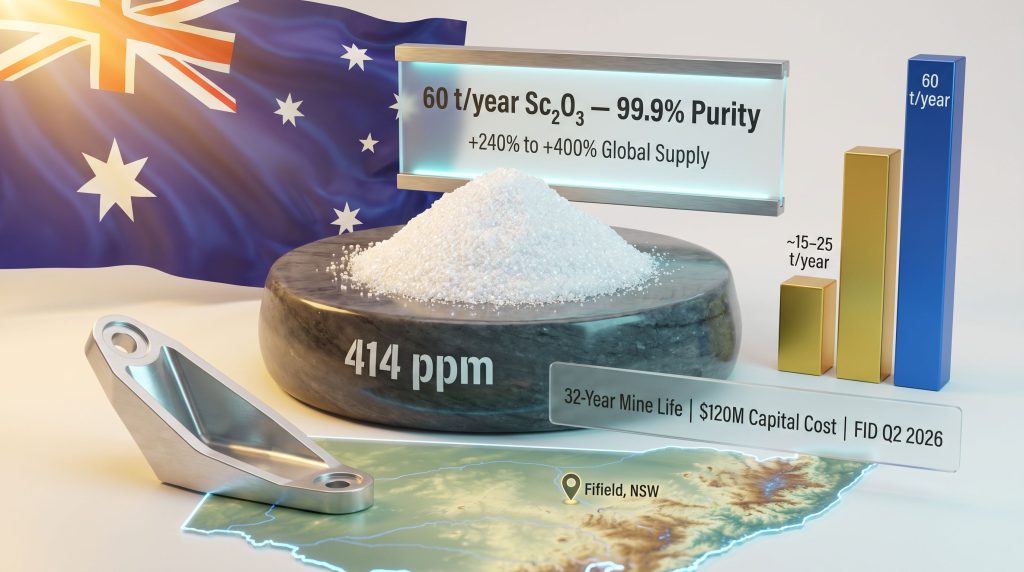
Syerston's ore grades average 414 ppm scandium across the total resource, with high-grade zones reaching up to 665 ppm. By comparison, Chinese industrial by-product streams from which most of the world's scandium is currently recovered contain roughly 10 to 20 ppm of the metal. Syerston's ore is therefore approximately 70 times higher grade than the dominant current supply source.
This is not a marginal advantage. It is a categorical difference in deposit quality that underpins the entire economic and strategic case for the project.
Reserve and Resource Estimates: Reading the Numbers Correctly
Investors encountering mining projects for the first time often conflate resource estimates and reserve estimates, but the distinction carries significant financial weight. A mineral resource is a geological estimate of material that could potentially be economically extracted under reasonable assumptions. A mineral reserve is a subset of that resource that has been confirmed to be economically mineable with a high degree of confidence, accounting for mining dilution, recovery rates, and operational realities.
For the Syerston project, these figures are as follows:
- Total mineral resource: approximately 46 million tonnes at 414 ppm scandium, containing an estimated 19,000 tonnes of scandium metal
- Proven and probable reserves (2025 update): 2.03 million tonnes at 644 ppm, containing approximately 1,311 tonnes of scandium
The fact that the reserve grade of 644 ppm is materially higher than the overall resource average of 414 ppm indicates that the highest-confidence, most economically accessible ore is concentrated in the richest parts of the deposit. This is a geologically positive characteristic, suggesting the mineable core delivers the project's best material first. Furthermore, the definitive feasibility study process for a project of this nature would typically validate these figures under independent technical scrutiny.
Based on current reserve and resource estimates, the project carries a projected mine life of 32 years, which provides an extended revenue horizon rarely achievable in smaller critical mineral projects.
Production Scale and the Global Market Transformation Scenario
What 60 Tonnes Per Year Actually Means in a 15-25 Tonne Market
Sunrise Energy Metals (ASX: SRL | OTCQX: SREMF) has designed the Syerston operation to produce 60 tonnes per year of scandium oxide (Sc₂O₃) at 99.9% purity. To contextualise that figure against current global supply conditions:
| Metric | Current Global Market | Syerston at Full Production |
|---|---|---|
| Annual scandium supply | 15 to 25 tonnes per year | 60 tonnes per year Sc₂O₃ |
| Estimated market share impact | Baseline | 240% to 400% increase in global supply |
| Supply source | Predominantly by-product, China-dominated | Dedicated primary mine, Australia |
| Purity | Variable | 99.9% Sc₂O₃ |
The implication is significant. A single Australian mining operation could more than triple the current global supply of scandium. In almost any other commodity market, adding that volume would be commercially catastrophic. In scandium's case, however, the argument runs in a different direction: constrained supply has historically been the primary reason demand never fully developed across potential end-use sectors.
The foundational thesis behind Syerston is not that it will flood a functioning market with excess supply, but that it will create sufficient volume certainty to allow new markets to emerge and existing ones to scale.
This distinction is critical for evaluating the project's commercial logic. Aerospace manufacturers, fuel cell producers, and semiconductor fabs cannot commit to scandium-integrated designs when global annual supply fits inside a small warehouse. Guaranteed large-volume output, at consistent purity, from a stable jurisdiction, is what transforms scandium from a niche curiosity into an engineered material of industrial consequence.
The Geopolitical Architecture Underpinning Western Demand
China's Structural Control and the Export Restriction Risk
China's dominance over commercially available scandium supply is not simply a matter of geological endowment. It reflects decades of integrated by-product recovery infrastructure built alongside large-scale rare earth and titanium processing operations. This infrastructure advantage has made Chinese scandium effectively the default global supply source, with Western buyers having limited practical alternatives.
Recent years have demonstrated the strategic risk of this dependency. China's use of critical mineral export restrictions as a geopolitical lever, applied across rare earths, gallium, germanium, and graphite, has focused allied government attention sharply on supply chain vulnerabilities. In the context of critical minerals and energy security, scandium has not yet been subject to formal Chinese export controls, but its concentration profile and strategic applications place it firmly within the category of metals that Western policymakers are actively working to secure alternative sources for.
Australia's Positioning as a Trusted Supply Jurisdiction
Syerston is located on Mining Lease ML1770, situated near Fifield in central-west New South Wales, approximately 450 kilometres west of Sydney. Australia's critical minerals regulatory framework for resource extraction, combined with its membership in the Five Eyes intelligence alliance and its existing bilateral critical mineral agreements with the United States, positions the country as a preferred source jurisdiction for strategic materials procurement.
It is important to note that none of this implies the project has received direct government funding or formal strategic project designation from any specific government program. What it does reflect is an alignment between the project's development timeline and the broader policy environment in Western allied nations, where building non-Chinese critical mineral supply chains has become a stated priority across executive, legislative, and defence procurement channels.
Corporate Credibility: Partners, Backing, and Financial Architecture
Institutional Signals That Carry Weight
Sunrise Energy Metals is led by CEO Sam Riggall, who has made the case publicly on platforms including CNBC's Europe Early Edition that a single Australian scandium operation can meaningfully reduce Western dependence on Chinese critical mineral supply. The company operates under the strategic influence of prominent mining entrepreneur Robert Friedland, whose track record across major global resource discoveries provides a degree of institutional credibility uncommon among single-asset development companies.
Two partnerships deserve particular attention from an analytical standpoint:
| Partner | Agreement Type | Scale |
|---|---|---|
| Lockheed Martin | 5-year option agreement | Up to 15 tonnes of scandium oxide |
| U.S. Export-Import Bank | Letter of interest for debt financing | Up to $67 million |
Lockheed Martin is among the world's largest defence and aerospace contractors. A formal option agreement with that organisation for scandium oxide supply represents a materially different signal than a non-binding memorandum of understanding with an unnamed buyer. It indicates that a sophisticated, technically capable procurement organisation has evaluated Syerston's product quality and determined it meets the standards required for defence-grade applications.
The U.S. Export-Import Bank letter of interest for up to $67 million in debt financing similarly reflects institutional-level engagement, though it remains a letter of interest rather than a committed facility, and final approval would be subject to the Bank's standard due diligence and credit assessment processes.
Capital Raises and the Path to Final Investment Decision
Sunrise Energy Metals has completed two significant capital raises in preparation for construction:
- AU$45.6 million raised in November 2024 to fund pre-construction and development activities
- A subsequent AU$32.5 million raise to advance site preparation work
The total capital cost for the Syerston operation is estimated at $120 million, with a life-of-mine operating cost of $534 per kilogram of Sc₂O₃. Site works are anticipated to commence in the second half of 2026, following a Final Investment Decision targeted for Q2 2026, with first production commissioning targeted for H1 2028.
With a 32-year mine life and a $120 million capital cost, the per-year capital amortisation burden is relatively modest compared to major base metal projects of comparable strategic significance. This structural characteristic becomes a meaningful economic advantage if scandium prices appreciate as demand from aerospace, fuel cell, and semiconductor markets scales alongside supply growth.
The next major ASX story will hit our subscribers first
Risk Factors Investors Must Weigh Carefully
Market Liquidity and Price Discovery
The scandium market's most significant structural weakness from an investment perspective is the absence of transparent price discovery. Without exchange-traded pricing, the value of Syerston's output is determined entirely through bilateral negotiation. This creates a scenario where even accurate production forecasts cannot be translated into reliable revenue projections without understanding the contractual pricing terms of specific offtake arrangements.
Adding 240% to 400% more supply to a thin bilateral market carries genuine price compression risk if demand uptake in aluminium alloys, fuel cells, and semiconductors does not accelerate in proportion to supply growth. The project's commercial thesis depends not just on producing scandium, but on the simultaneous expansion of downstream application markets, which involves technology adoption timelines that are inherently difficult to forecast with precision.
Execution, Financing, and Environmental Risk
Key risks in the pre-production phase include:
- The remaining capital requirement must be fully committed before construction commences, with the U.S. Ex-Im Bank facility representing a meaningful but as-yet-unconditional component of the financing stack
- A two-year construction timeline exposes the project to materials cost escalation and contractor availability risk in what remains a structurally tight global mining construction market
- Ongoing compliance with New South Wales state environmental planning frameworks and community engagement requirements near Fifield will require careful management throughout construction and operations
This article contains forward-looking statements and financial projections based on publicly available feasibility data and company disclosures. Readers should conduct independent due diligence and consult a qualified financial adviser before making investment decisions. Mining development projects carry significant execution, financing, and commodity price risks that may differ materially from projected outcomes.
How Syerston Compares to the Broader Development Pipeline
Global Scandium Project Landscape
| Project | Location | Stage | Projected Output | Supply Type |
|---|---|---|---|---|
| Syerston (Sunrise Energy Metals) | NSW, Australia | Pre-construction, FID Q2 2026 | 60 t/year Sc₂O₃ | Primary mine |
| Nyngan (Scandium International) | NSW, Australia | Feasibility stage | ~38 t/year Sc₂O₃ | Primary mine |
| Chinese processing operations | Multiple provinces | Operational | ~15 to 25 t/year combined | By-product |
| Ukrainian and Russian sources | Eastern Europe | Disrupted and variable | Variable | By-product |
Two features of this table deserve emphasis. First, Syerston leads the global development pipeline on every commercially relevant metric: ore grade, resource scale, production target, and construction readiness. Second, both of the world's most advanced primary scandium projects are located in New South Wales, Australia, suggesting the state may be establishing a natural geographic concentration in what could become a genuinely new segment of the global critical minerals supply chain. Industry observers tracking ASX-listed resource developers in this space have noted this clustering as a potentially significant structural development.
A Structural Shift, Not Just a New Mine
The deeper significance of the Syerston project lies in what it represents for market structure rather than simply what it produces. The global scandium market has been locked in a condition of artificial scarcity for decades, not because geological endowment is insufficient, but because no economically viable primary deposit had been developed to the point of actual production.
By-product supply cannot create markets. It can only serve them at the margin. The transition from a by-product-dependent, China-controlled supply dynamic to a primary-mine, Western-aligned model would represent a structural transformation in how aerospace, clean energy, and advanced semiconductor manufacturers plan their material inputs. The Sunrise Energy Metals scandium mine in Australia appears positioned to anchor that transformation, provided the remaining financing, regulatory, and construction milestones are executed on schedule.
Whether Syerston fulfils its potential as a market-defining operation ultimately depends on factors spanning geology, finance, geopolitics, and industrial adoption, each of which carries its own uncertainty. What is not uncertain is that the underlying case for primary scandium supply, at scale, from a trusted Western jurisdiction, has never been more structurally sound.
Want to Catch the Next Major ASX Critical Minerals Discovery the Moment It Hits?
Discovery Alert's proprietary Discovery IQ model scans ASX announcements in real time, instantly identifying high-potential mineral discoveries across scandium, rare earths, and more than 30 other commodities — turning complex data into actionable insights before the broader market reacts. Explore how historic discoveries have generated extraordinary returns on the Discovery Alert discoveries page, and begin your 14-day free trial today to position yourself ahead of the market.