
July 27, 2026
The Structural Void at the Heart of Western Critical Mineral Supply
Imagine designing a high-performance clean energy system, only to discover that one of its most critical functional inputs has no reliable Western supply chain. That is the reality facing solid oxide fuel cell manufacturers today. Scandium oxide, a mineral so geochemically dispersed that economically viable concentrations are vanishingly rare, sits at the centre of an emerging supply crisis that few outside specialist materials science circles have fully appreciated.
Unlike lithium or cobalt, which have attracted billions in exploration capital and deep liquid trading markets, scandium operates in near-total pricing opacity. There is no exchange-traded benchmark. Buyers negotiate directly with a handful of producers, most of whom operate outside allied-nation supply networks. For industrial companies building long-duration capital assets around scandium-dependent technology, this is not an inconvenience. It is a structural vulnerability.
The Australian Mines Flemington scandium PFS, formally commenced in mid-2026, represents one of the most technically credible attempts yet to address this void from within a Tier 1 Western jurisdiction.
When big ASX news breaks, our subscribers know first
Why Scandium Is Unlike Any Other Critical Mineral
The Geochemistry Problem That Defines the Market
Scandium is classified as a rare earth element, but its scarcity is less about crustal abundance and more about how it behaves geochemically. It does not concentrate into ore bodies the way copper, nickel, or even many rare earth elements do. Instead, it substitutes into the crystal lattices of other minerals at trace levels, making it extraordinarily difficult to find in economically extractable concentrations.
Furthermore, this geochemical behaviour has several downstream consequences for the market. Understanding rare earth supply chains helps contextualise just how challenging scandium's position truly is:
- Primary scandium production is dominated by countries operating outside Western supply chain frameworks, with meaningful historic production from Russia, China, and Ukraine
- The absence of a deep spot market means pricing discovery is opaque, with transactions occurring bilaterally and published price data often lagging real market conditions by months
- Downstream manufacturers face a near-impossible task when modelling long-term input costs for scandium-intensive products, suppressing demand-side investment confidence
- The opacity itself becomes a barrier to new project development, since lenders and offtake partners struggle to anchor economic models to verifiable market data
The scandium market is caught in a self-reinforcing constraint: supply opacity discourages demand growth, and thin demand discourages new supply investment. Breaking this cycle requires a project large enough and credible enough to anchor the market.
Solid Oxide Fuel Cells: The Demand Signal That Changes Everything
The application that most fundamentally alters the scandium demand calculus is the solid oxide fuel cell. SOFCs use scandium-stabilised zirconia as their electrolyte material. When scandium is incorporated into zirconia at specific concentrations, it dramatically increases ionic conductivity at lower operating temperatures, improving both efficiency and cell longevity.
Critically, there is no known substitute for scandium in this application that delivers equivalent performance. This non-substitutability gives scandium a different demand profile compared to most industrial minerals, where technological alternatives constrain pricing power. Consequently, the broader critical minerals demand outlook reinforces why scandium's position is so strategically significant.
Bloom Energy, a US-listed SOFC manufacturer, has been scaling its deployment programme significantly. As installed SOFC capacity grows, scandium consumption scales in direct proportion to output. Unlike aluminium-scandium alloy applications, where scandium loadings are measured in fractions of a percent, SOFC demand is a function of installed megawatt capacity, creating a far more predictable and contract-amenable demand structure for upstream producers.
Flemington: A Project Built for the Market That Is Coming
Resource Quality and Geological Characteristics
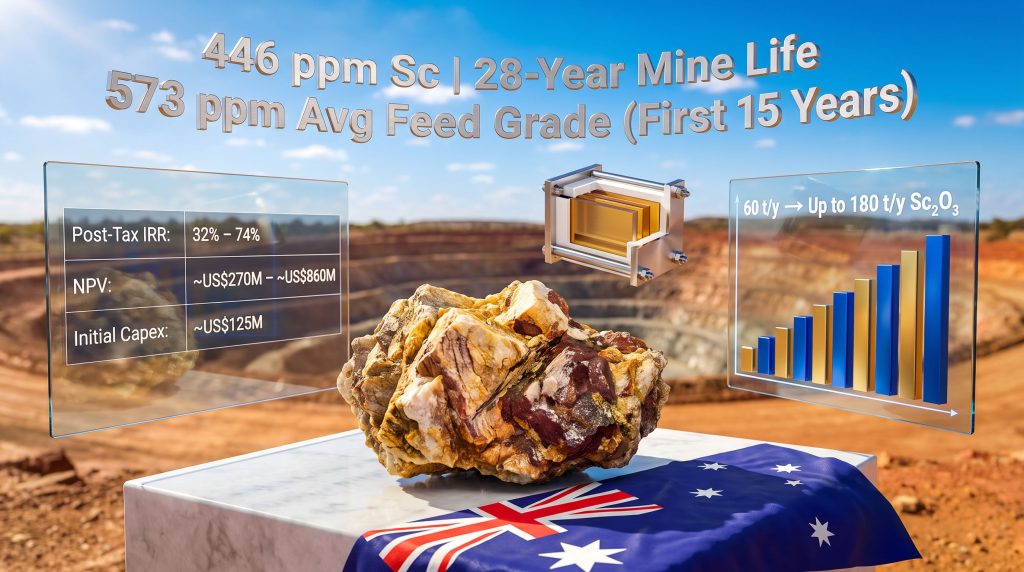
The Flemington scandium project, located in New South Wales, Australia, sits on a mineral resource base of 6.3 million tonnes at 446 ppm scandium at a 300 ppm cut-off grade. What makes this resource genuinely distinctive is not just the headline grade but the internal geometry of the mineralisation.
Near-surface mineralisation geometry at Flemington enables a three shallow open-pit mining configuration. This matters enormously for project economics because open-pit mining eliminates the ventilation, ground support, and materials handling costs associated with underground operations. For a mineral that already commands a premium price, reducing pre-production capital intensity is a significant competitive advantage.
The average feed grade of 573 ppm scandium over the first 15 years of planned operation is particularly notable. To contextualise this: many scandium occurrences globally sit below 200 ppm, where economic extraction at current pricing remains deeply challenging. Flemington's grade profile places it among the highest-quality development-stage scandium assets anywhere in the world.
From Scoping Study to PFS: The Technical De-risking Sequence
Australian Mines completed its updated scoping study in April 2026, establishing the economic foundation for the PFS decision. The scoping study outlined a 60 tonne per annum Sc₂O₃ operation with a 28-year mine life anchored to a 2.09-million-tonne production target.
The progression from scoping study to PFS is not merely administrative. It represents a deliberate engineering de-risking sequence, and understanding mineral deposit tiers helps explain why each stage carries such distinct significance:
- Scoping studies establish conceptual economics using broad assumptions and desktop engineering
- PFS-level work replaces those assumptions with contractor-validated estimates, tested metallurgical parameters, and site-specific infrastructure assessments
- The resulting document meets the minimum technical threshold required for institutional lenders and sophisticated equity investors to engage in project financing discussions
- A completed PFS is also typically required before formal offtake negotiations with large industrial buyers can progress to binding commercial terms
Funding for the PFS workstream was secured through an A$3 million strategic placement led by Tribeca Investment Partners, announced in May 2026. Tribeca's participation carries meaningful implicit validation, as specialist resource funds apply rigorous technical screening before committing capital to development-stage assets.
Dissecting the Scoping Study Economics
Key Financial Metrics Compared
| Economic Parameter | Mine Design Scenario | Market-Aligned Scenario |
|---|---|---|
| Sc₂O₃ Price Assumption | US$1,500/kg | US$3,000/kg |
| Post-Tax NPV | ~US$270 million | ~US$860 million |
| Internal Rate of Return | 32% | 74% |
| Initial Capital Cost | ~US$125 million | ~US$125 million |
| C1 Cash Cost | US$561/kg Sc₂O₃ | US$561/kg Sc₂O₃ |
| Mine Life | 28 years | 28 years |
| Annual Production | 60 t/y Sc₂O₃ | 60 t/y Sc₂O₃ |
The IRR spread between the two scenarios tells an important story. A 32% IRR at conservative pricing already clears most institutional investment hurdle rates. A 74% IRR at market-aligned pricing places Flemington in the upper tier of critical mineral project economics globally. This leverage to price recovery is a structural characteristic of high-grade, low-capital projects in thin markets.
Capital Efficiency and Cost Positioning
An initial capital requirement of approximately US$125 million for a 60 t/y operation is strikingly modest relative to the project's NPV potential in both pricing scenarios. The shallow open-pit geometry is the primary driver of this capital efficiency, but the conventional hydrometallurgical processing route is equally important.
The processing flowsheet at Flemington does not require novel or unproven unit operations. This is a meaningful de-risking factor during PFS engineering, since unconventional processing routes introduce execution risk and often require extended commissioning periods. The C1 cash cost of US$561/kg Sc₂O₃ positions Flemington in the lower quartile of projected scandium production costs globally, providing margin protection across a wide range of price outcomes.
Disclaimer: All financial metrics referenced above are derived from a scoping study, which carries inherent uncertainty. Scoping study economics should not be treated as definitive project outcomes. Actual capital costs, operating costs, and project returns may differ materially from estimates presented here.
What the Expanded PFS Is Actually Testing
The 180 t/y Scale-Up Mandate
Perhaps the most strategically significant aspect of the Australian Mines Flemington scandium PFS is its expanded scope. The study has been structured to assess production scenarios up to 180 t/y Sc₂O₃, representing a threefold increase over the scoping study base case.
To understand why this matters, consider the scale of the current global scandium market. Established applications, primarily aluminium-scandium alloys and speciality lighting, consume an estimated 15 to 25 tonnes of Sc₂O₃ annually. A 60 t/y operation would already represent a transformative addition to available supply. A 180 t/y operation would fundamentally reshape the market structure.
This expansion scenario is only viable if demand from SOFC deployment materialises at scale. The PFS is essentially testing whether Flemington can be sized to serve a future market rather than merely the current one. It is, in effect, a forward-looking technical and commercial bet on SOFC adoption trajectories.
PFS Workstream Breakdown
The PFS encompasses several parallel technical workstreams:
Metallurgical Testwork: Additional testing will validate recoveries, reagent consumption, and product specifications across the expanded production range. Results directly feed processing plant design parameters and capital cost estimates.
Resource Drilling Programme: A concurrent drilling campaign will test potential extensions to the existing resource boundary and provide fresh material for metallurgical programmes. Drilling targets have been selected to potentially expand the measured and indicated resource inventory, reducing geological uncertainty in the mine plan.
Infrastructure and Engineering: PFS-level studies will replace scoping-grade cost estimates with contractor-validated figures across site infrastructure, utilities, and logistics. Water, power, and transport infrastructure are critical inputs for both permitting discussions and financing models.
Permitting Pathway Development: Regulatory engagement during the PFS phase establishes the environmental and social baseline required for subsequent approval processes, reducing timeline risk between PFS completion and a construction decision.
Offtake and Customer Engagement: As the project's technical credibility reaches a threshold acceptable to procurement teams, PFS advancement typically triggers formal offtake discussions. SOFC manufacturers and aluminium-scandium alloy producers represent the primary customer segments under evaluation.
The PFS is anticipated to take six to nine months to complete from commencement, pointing to a likely delivery window in early-to-mid 2027.
Flemington in the Competitive Landscape
How Flemington Compares to Peer Scandium Projects
| Attribute | Flemington | Typical Peer Projects |
|---|---|---|
| Resource Grade | 446 ppm Sc (300 ppm cut-off) | Often 100 to 300 ppm range |
| Feed Grade (First 15 Years) | 573 ppm | Typically lower |
| Mining Method | Shallow open pit (3 pits) | Variable; some underground |
| Processing Route | Conventional hydrometallurgy | Often novel or complex |
| Jurisdiction | Australia (Tier 1) | Frequently emerging market |
| Development Stage | PFS commenced mid-2026 | Scoping or earlier |
| Mine Life | 28 years | Typically shorter |
| Capital Cost | ~US$125 million | Often higher for equivalent output |
The Geopolitical Context for Western Scandium Supply
Western governments have progressively expanded critical minerals designation lists to include scandium, reflecting its strategic importance across advanced manufacturing, aerospace, and clean energy sectors. In addition, Australia's critical minerals policy environment has become increasingly aligned with allied-nation supply chain priorities, creating a distinctly favourable backdrop for projects like Flemington.
The Minerals Security Partnership, a framework involving the US, Australia, Canada, the EU, Japan, South Korea, and the UK, has established cooperative mechanisms for supply chain diversification. It is important to note, however, that these policy frameworks represent a general regulatory tailwind for the sector. There is no confirmed project-specific government backing, funding, or accelerated permitting arrangement for Flemington based on publicly available disclosures.
What Flemington's Australian jurisdiction does provide is sovereign stability, established mining regulatory frameworks, and alignment with allied-nation procurement preferences that increasingly require traceable, verified Western supply.
The next major ASX story will hit our subscribers first
Frequently Asked Questions: Flemington Scandium PFS
What is scandium-stabilised zirconia and why is it essential for SOFCs?
Zirconia on its own has limited ionic conductivity at practical operating temperatures. When scandium oxide is incorporated into the zirconia crystal lattice at concentrations typically around 10 to 11 mole percent, it creates oxygen vacancies that dramatically increase ionic conductivity. This allows the SOFC electrolyte to operate efficiently at lower temperatures, extending cell life and reducing thermal stress on surrounding components. No commercially deployed alternative achieves equivalent performance at scale.
Why does the 28-year mine life matter for offtake negotiations?
Industrial manufacturers investing in SOFC production capacity are committing capital over decades-long horizons. They need upstream supply assurance that matches that investment horizon. A mine life of 28 years provides the long-duration supply certainty that anchor offtake customers require before they will commit to contractual volume commitments. Shorter-lived projects struggle to attract the type of binding offtake agreements that enable project financing.
What does the Tribeca Investment Partners placement signal to the market?
Specialist resource-focused investment funds conduct rigorous technical and commercial due diligence before allocating capital to development-stage mining projects. Tribeca's participation in the A$3 million PFS funding placement at this stage of the project's development carries implicit validation of both the asset quality and the management team's capability to execute. The placement size is also calibrated to avoid excessive dilution while funding near-term technical workstreams.
What is the difference between the two pricing scenarios used in the scoping study?
The mine design price of US$1,500/kg is a conservative, internally validated benchmark used for capital allocation decisions and mine planning. It is not a market forecast. The market-aligned price of US$3,000/kg reflects observed transactional pricing in constrained scandium markets where product specifications are met and supply is limited. The NPV differential between the two scenarios, approximately US$590 million, illustrates the extraordinary leverage Flemington has to pricing recovery.
Key Risks Investors Should Understand
Technical Risks at PFS Stage
- Metallurgical recoveries at the expanded 180 t/y scale require validation beyond scoping-study assumptions. Any deviation in recovery rates directly impacts unit cash costs and project economics.
- Resource extension drilling may encounter geological variability that affects mine planning for expanded production scenarios. The current resource estimate will be subject to revision as new drill data is incorporated.
- Processing plant scale-up from 60 t/y to 180 t/y introduces engineering complexity that could influence both capital costs and construction timelines.
Market and Pricing Risks
- Scandium pricing remains opaque relative to exchange-traded metals, making long-term revenue modelling inherently uncertain.
- SOFC deployment timelines depend on technology adoption rates, regulatory incentive structures, and competition from alternative distributed energy technologies.
- The gap between mine design pricing and market-aligned pricing represents both upside potential and negotiation risk in offtake discussions.
Funding and Execution Risks
- Progression from PFS to a definitive feasibility study will require additional capital raising. Market conditions at that juncture will influence the degree of dilution and the available funding structure.
- PFS completion within the six-to-nine month guidance window assumes no material delays in metallurgical testwork programmes, drilling execution, or engineering contractor availability.
This article contains forward-looking statements and financial projections derived from publicly available scoping study materials. These projections are subject to material uncertainty and should not be relied upon as predictions of actual project outcomes. Readers should conduct their own due diligence and seek independent financial advice before making investment decisions.
Milestones to Monitor Over the Next 12 Months
Near-Term Catalysts
The following developments represent the most significant potential near-term re-rating catalysts for the project:
- Metallurgical testwork results validating recoveries across the expanded production range
- Drilling results confirming resource extensions or higher-grade intervals within the existing boundary
- Preliminary PFS-level capital and operating cost estimates for both the 60 t/y and expanded production scenarios
- Any announced offtake discussions or memoranda of understanding with SOFC manufacturers or aluminium alloy producers
Medium-Term Development Pathway
- PFS completion and public release, anticipated in early-to-mid 2027
- Capital raising for DFS progression
- Formal permitting applications based on PFS environmental baseline work
- Potential strategic partnership or joint venture discussions with downstream industrial partners or sovereign wealth-backed entities
The Australian Mines Flemington scandium PFS advancement marks a genuine transition point, not just for Australian Mines as a company, but for the Western scandium supply chain as a whole. The combination of grade, mine life, capital efficiency, jurisdictional quality, and timing relative to emerging SOFC demand creates a project profile that is genuinely uncommon in the global critical minerals pipeline. Whether the scoping study economics translate into a bankable development case will become clear as PFS workstreams deliver results through late 2026 and into 2027.
Want to Capitalise on the Next Major Critical Mineral Discovery Before the Broader Market Catches On?
Discovery Alert's proprietary Discovery IQ model delivers real-time alerts on significant ASX mineral discoveries — including emerging critical minerals like scandium — instantly translating complex geological and market data into actionable investment insights for both short-term traders and long-term investors. Explore why historic mineral discoveries have generated extraordinary returns on Discovery Alert's dedicated discoveries page, and begin your 14-day free trial today to position yourself ahead of the market.