July 27, 2026
The Metallisation Gap Nobody Talks About: Why the Hardest Step in Rare-Earth Manufacturing Is Also the Most Important
There is a quiet consensus forming among materials scientists and supply chain strategists that the global energy transition will not be constrained by solar panels or battery chemistries alone. The real chokepoint, one that receives far less attention than it deserves, lies in a narrow but technically demanding industrial process: converting rare-earth oxides into the metallic alloys that make high-performance permanent magnets possible. Without this step, there are no EV motors, no offshore wind turbines spinning at scale, and no advanced robotics or precision defence guidance. Everything flows through this single, underappreciated conversion stage.
Understanding that reality is the only way to grasp the full significance of what the LOHUM CSIR-IMMT rare-earth magnet manufacturing technology partnership is actually attempting to accomplish.
When big ASX news breaks, our subscribers know first
Why Metallisation Is the Most Overlooked Bottleneck in the Rare-Earth Supply Chain
Most public discourse around the rare earth supply chain risk focuses on two stages: mining and finished magnet production. Both are important. However, the stage that sits between them — the conversion of separated rare-earth oxides into usable metallic form — is technically where global dependency is most concentrated and most difficult to replicate.
The dominant industrial method for producing rare-earth metals from oxide feedstocks is molten salt electrolysis. This process involves dissolving rare-earth oxides into a fluoride-based molten salt bath at temperatures typically exceeding 1,000 degrees Celsius, then passing electrical current through the melt to reduce the oxide to its metallic form. The challenges are considerable:
- The process demands precise temperature control within a highly corrosive chemical environment
- Fluoride emissions require sophisticated scrubbing systems and environmental management infrastructure
- Cathode and anode materials degrade rapidly, requiring frequent replacement
- The capital cost of purpose-built electrolytic cells is substantial, and the operational expertise needed to run them reliably is rare outside of China and, to a lesser degree, parts of Japan
China's dominance in this specific process is not simply a function of cheaper labour or lower regulatory standards. It reflects decades of accumulated engineering knowledge, purpose-built infrastructure, and industrial clustering that is extraordinarily difficult to replicate quickly. Furthermore, this is precisely why India, despite possessing meaningful rare-earth mineral reserves, has remained structurally dependent on imported metallised neodymium-praseodymium (NdPr) for any domestic magnet manufacturing activity.
The deeper strategic reality: A nation that can mine and separate rare-earth oxides but cannot metallise them is still dependent on external processors for the most commercially valuable output in the supply chain. True sovereignty requires controlling the full conversion sequence.
What the LOHUM CSIR-IMMT MoU Actually Establishes
The Memorandum of Understanding signed between LOHUM, a cleantech and deep-tech enterprise focused on critical mineral refining, recycling, and advanced materials manufacturing, and the Council of Scientific and Industrial Research's Institute of Minerals and Materials Technology (CSIR-IMMT) formalises a joint research and development program targeting exactly this gap.
The primary technical objective is the development and validation of indigenous metallisation technology for neodymium-praseodymium production through a process route designed as a safer and more scalable alternative to conventional molten salt electrolysis.
This is not a preliminary study or a policy commitment. It is an active technology development partnership with a stated commercial deployment objective.
What Each Partner Contributes
The institutional division of labour in this collaboration reflects a public-private model that mirrors successful rare-earth technology development frameworks deployed in Japan and South Korea:
CSIR-IMMT brings:
- Deep materials science and mineral processing research capabilities
- Laboratory-scale process development and validation infrastructure
- Operations through its Centre of Excellence on Critical Minerals under the National Centre for Minerals and Materials
- Established collaborative linkages with academic institutions, research bodies, and industrial partners across India
LOHUM brings:
- Critical mineral refining and resource recovery expertise
- Advanced materials manufacturing capabilities, including rare-earth permanent magnet production know-how
- Commercialisation infrastructure and scale-up experience
- An existing integrated rare-earth magnet production facility positioned to absorb domestically produced NdPr metal as the technology matures
The combination creates a pathway that neither partner could execute independently. Consequently, CSIR-IMMT provides the foundational process science, while LOHUM provides the industrial translation mechanism needed to move validated technology from laboratory bench to commercial production floor.
Where India Currently Sits in the Global Rare-Earth Value Chain
Mapping India's position across the full rare-earth value chain clarifies exactly what the LOHUM CSIR-IMMT rare-earth magnet manufacturing technology initiative is designed to fix. In addition, understanding the rare earth processing challenges that persist globally provides important context for appreciating the scale of this undertaking.
| Value Chain Stage | Global Leader | India's Current Position |
|---|---|---|
| Rare-Earth Mining | China, Australia, USA | Emerging, significant deposits present |
| Rare-Earth Separation and Refining | China (~85%+ share) | Limited domestic capacity, developing |
| Metallisation (NdPr Metal) | China-dominant | Near-absent, primary strategic gap |
| Alloy and Magnet Manufacturing | China, Japan | Nascent, first movers emerging |
| EV and Renewable End-Use | Global | Rapidly expanding domestic demand |
The pattern is clear. India's vulnerability concentrates at the metallisation stage. Closing this gap is not simply an industrial policy objective — it is a prerequisite for any credible claim to end-to-end rare-earth supply chain independence.
From Oxide to Magnet: Understanding the Full Manufacturing Sequence
Contextualising the LOHUM CSIR-IMMT partnership requires understanding exactly where their work fits within the complete neodymium-iron-boron (NdFeB) magnet manufacturing chain. Each step builds on the previous, and failure or external dependency at any single stage compromises the entire sequence.
- Rare-Earth Oxide Production — Separation and refining of rare-earth mineral concentrates into individual oxide compounds such as Nd₂O₃ and Pr₆O₁₁
- Metallisation — Conversion of rare-earth oxides into metallic NdPr alloy form (primary focus of the LOHUM CSIR-IMMT collaboration)
- Alloy Melting and Strip Casting — Combining NdPr metal with iron and boron to produce NdFeB master alloy in thin strip form
- Hydrogen Decrepitation and Jet Milling — Fracturing the alloy strips using hydrogen absorption, then grinding to a precisely controlled fine magnetic powder
- Magnetic Alignment and Pressing — Orienting powder particles in an applied magnetic field and compacting into a green body shape
- Sintering — High-temperature densification to achieve full theoretical density and activate maximum magnetic properties
- Machining and Surface Coating — Precision cutting to final dimensions and application of protective coatings, typically nickel-copper-nickel or epoxy systems, to prevent oxidation
- Magnetisation — Application of an intense pulsed magnetic field to align magnetic domains and activate the finished permanent magnet
A critical but rarely discussed detail: Most national programs attempting to build domestic rare-earth magnet capability begin at Step 3 or later, simply importing NdPr metal and starting from alloy production. By targeting Step 2, the LOHUM CSIR-IMMT initiative is pursuing a fundamentally deeper form of supply chain sovereignty than most comparable programs internationally.
The Alternative Metallisation Approach: What Is Known and Why It Matters
Full technical specifications for the LOHUM CSIR-IMMT alternative metallisation process have not been publicly disclosed, which is consistent with standard intellectual property development protocols during active research phases. However, the publicly stated objectives provide meaningful signals about the approach being pursued.
The conventional molten salt electrolysis process operates through electrochemical reduction in a fluoride melt. Alternative approaches being explored globally include:
- Metallothermic reduction using alkaline earth metals (such as calcium or magnesium) to chemically reduce rare-earth fluorides or oxides to metal at lower process temperatures
- Oxide electrolysis in molten oxide systems operating at different chemical and temperature conditions than fluoride-based baths
- Hybrid chemical-electrochemical routes that decouple the reduction chemistry from direct electrolytic processing
The specific advantage being targeted is a reduction in operational hazard profile and potentially lower infrastructure intensity. This would make the process more accessible for new entrants and reduce the barriers to domestic scale-up in markets like India that lack the legacy industrial infrastructure China has accumulated over decades.
If successfully validated, the proprietary process technology itself would represent a commercially valuable asset well beyond its direct application in India's domestic supply chain.
The next major ASX story will hit our subscribers first
LOHUM's Integrated Facility: Scale, Investment, and Strategic Positioning
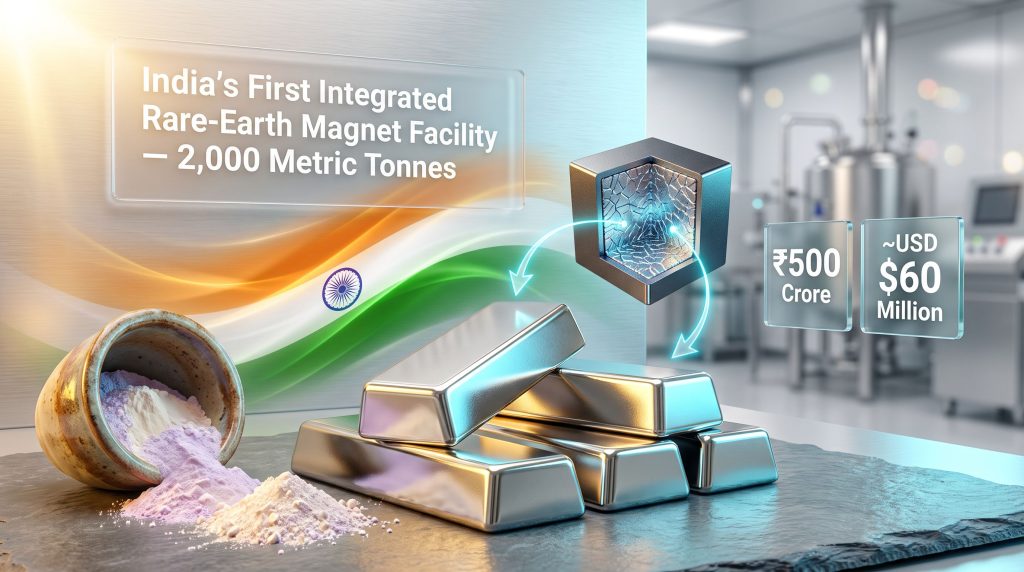
The LOHUM CSIR-IMMT rare-earth magnet manufacturing technology partnership does not exist in a vacuum. It is embedded within LOHUM's broader strategy to build what is described as India's first integrated rare-earth magnet facility, capable of processing rare-earth oxides through to finished sintered magnet output. The reported parameters of this facility are significant:
| Facility Parameter | Reported Figure |
|---|---|
| Annual Production Capacity | 2,000 metric tonnes |
| Capital Investment | approximately Rs 500 crore (approximately USD $60 million) |
| Integration Scope | Rare-earth oxide input through to finished magnet output |
| Metallisation Capability | Under development through CSIR-IMMT partnership |
The 2,000 metric tonne annual capacity figure deserves contextualisation. Global NdFeB magnet production is estimated at roughly 200,000 to 250,000 metric tonnes per year, with China accounting for the overwhelming majority. A 2,000 tonne facility represents a modest initial foothold in global terms, but it is scaled appropriately for an emerging domestic market anchor and for demonstrating the full integrated production model at commercially relevant scale.
Why NdPr Specifically, and What the End Markets Actually Require
Neodymium-praseodymium is not simply one rare-earth material among many. It is the primary magnetic constituent in NdFeB permanent magnets, which represent the highest energy density permanent magnet technology available commercially. The critical minerals demand surge across clean energy sectors has, furthermore, made NdPr one of the most strategically sensitive materials in the global supply landscape. The demand drivers for NdFeB magnets are structural and long-term:
- Electric vehicles: Each passenger EV requires approximately 1 to 2 kilograms of NdFeB magnets for traction motor applications, with premium performance motors at the higher end of that range
- Direct-drive offshore wind turbines: A single large-format offshore turbine can require in excess of 600 kilograms of NdFeB magnets, making wind energy one of the most material-intensive demand vectors in the rare-earth ecosystem
- Industrial automation and robotics: Servo motors and actuators in manufacturing automation rely on the high power density of NdFeB to achieve compact, high-torque designs
- Defence systems: Precision guidance systems, radar arrays, electric propulsion for naval vessels, and directed energy applications all incorporate NdFeB magnets in ways that create highly sensitive strategic dependencies
- Consumer electronics: Hard drive voice coil actuators, premium audio systems, miniature motors, and sensor arrays represent a high-volume, quality-sensitive application category
The combination of structural demand growth across all these categories with concentrated supply creates the supply chain risk environment that makes this collaboration strategically meaningful beyond its immediate domestic context.
The Intellectual Property Dimension: Often Ignored, Strategically Critical
One aspect of the LOHUM CSIR-IMMT partnership that deserves more analytical attention than it typically receives is the explicit focus on developing Indian intellectual property in rare-earth processing technology. India's critical minerals strategy has increasingly recognised that IP ownership, not merely production capacity, defines long-term strategic leverage in this sector.
The economic logic is compelling:
- A proprietary metallisation process that delivers safety, efficiency, or cost advantages over conventional molten salt electrolysis would have global licensing potential
- Nations across the Indo-Pacific, Europe, and North America are actively seeking to build domestic rare-earth processing capabilities and would represent willing licensees for validated alternative process technology
- IP ownership creates a revenue stream and strategic asset class that extends well beyond the direct production economics of the Indian facility itself
The partnership's stated objective of developing specialised engineering capabilities and skilled human capital in rare-earth materials science compounds this value. Technical expertise concentrated in a workforce represents a durable competitive advantage that cannot be replicated simply by replicating physical infrastructure.
India's long-term ambition in this sector extends beyond becoming a rare-earth magnet producer. The more transformative scenario involves India becoming a technology provider to allied nations pursuing their own supply chain diversification strategies, shifting its role from supply chain participant to technology licensor.
Readers should note that projections regarding technology licensing, commercial deployment timelines, and geopolitical strategic value involve inherent uncertainty and represent potential scenarios rather than confirmed outcomes. Technology development from MoU stage to commercial deployment typically involves multiple validation phases, each carrying execution risk.
How India's Approach Compares to Global Rare-Earth Technology Development Models
| Country or Region | Primary Development Model | Key Institutions | Technology Focus |
|---|---|---|---|
| China | State-directed vertically integrated industry | Multiple state enterprises | Full value chain dominance |
| Japan | Industry-led with government R&D support | NIMS, private sector | Magnet efficiency, recycling |
| USA | Government grants combined with private sector | DOE National Laboratories, MP Materials | Mining, separation, emerging metallisation |
| EU | Horizon-funded research consortia | Fraunhofer institutes, universities | Recycling, processing alternatives |
| India via LOHUM CSIR-IMMT | Public-private R&D partnership | CSIR-IMMT combined with LOHUM | Indigenous metallisation plus integrated magnet production |
India's model occupies a distinctive position. Unlike the USA's heavy reliance on direct government grant funding or the EU's multi-party consortium structure, the LOHUM CSIR-IMMT framework pairs a commercially driven private sector operator with established government research infrastructure. This structure, however, also differs meaningfully from China's rare earth strategy, which relies on state-directed vertical integration rather than public-private collaboration. The result is tighter alignment between research outcomes and commercial deployment objectives, reducing the gap between laboratory validation and industrial application.
Key Milestones That Will Define This Partnership's Success
For observers tracking the progress of this initiative, several specific development markers will indicate whether the collaboration is advancing toward its stated commercial objectives:
- Laboratory-scale technology validation confirming that the alternative metallisation approach produces NdPr metal meeting commercial magnetic quality specifications
- Pilot-scale demonstration at quantities sufficient to feed alloy production and magnet manufacturing process trials
- Intellectual property filing activity indicating that proprietary process claims are being formalised and protected
- Integration with LOHUM's existing magnet production infrastructure, demonstrating the full oxide-to-magnet pathway using domestically produced NdPr
- Commercial procurement or offtake agreements anchoring production economics at industrial scale
Each of these milestones represents a distinct risk-reduction event for the broader program. Furthermore, progress through this sequence will be the most reliable indicator of whether India is genuinely building a strategically independent rare-earth magnet manufacturing capability or simply adding another well-intentioned industrial policy announcement to a long list.
The LOHUM CSIR-IMMT rare-earth magnet manufacturing technology partnership represents one of the most technically substantive public-private initiatives to emerge in India's critical minerals space. Its significance lies not in what it announces, but in what it is attempting to solve: the hardest, most overlooked, and most strategically consequential step in the entire rare-earth permanent magnet supply chain.
This article is intended for informational purposes only and does not constitute investment advice. Statements regarding future technology development, commercial deployment, and strategic outcomes involve uncertainty and should not be relied upon as predictions of specific results.
Want to Track the Next Major Critical Minerals Discovery Before the Market Does?
Discovery Alert's proprietary Discovery IQ model scans ASX announcements in real time, instantly identifying significant rare-earth and critical mineral discoveries and translating complex data into actionable investment insights — explore historic discovery returns on the Discovery Alert discoveries page to understand what early positioning can mean, then begin your 14-day free trial at Discovery Alert to secure your market-leading edge.