
July 27, 2026
The Magnet Economy India Cannot Afford to Ignore
Every electric vehicle motor, every wind turbine generator, and every precision-guided defence system shares a common dependency: rare earth permanent magnets. These thumbnail-sized components, forged from neodymium-praseodymium oxide, represent one of the most concentrated material vulnerabilities in modern industrial supply chains. Approximately 80% of all rare earth consumption globally flows into magnet applications, yet the processing capacity to convert raw mineral sands into usable oxide intermediates remains overwhelmingly concentrated in a single geography. For India, a country racing to electrify its transport network and scale its renewable energy capacity, this dependency is not a theoretical risk. It is a structural constraint on sovereign industrial ambition.
The Tamil Nadu rare earth corridor, anchored by a joint venture between IREL (India) and TAMIN and formally elevated under India's Union Budget 2026-27, represents the country's most concrete response to this challenge. Understanding its significance requires looking beyond the project's financials and into the deeper mechanics of how rare earth supply chains actually work, and where India currently sits within that global hierarchy.
When big ASX news breaks, our subscribers know first
From Coastal Sand to Critical Oxide: Understanding the Mineral Geography
Tamil Nadu's coastline is not merely scenic real estate. Beneath its beaches lies one of India's most commercially significant concentrations of heavy mineral sands, a geological inheritance that positions the state as a cornerstone of any viable national rare earth strategy.
The mineralisation is concentrated across four coastal districts, each with distinct characteristics and strategic relevance:
| Coastal District | Key Mineral Resources | Strategic Relevance |
|---|---|---|
| Thoothukudi (Tuticorin) | Ilmenite, Rutile, Monazite | IREL-TAMIN JV site; NdPr oxide production target |
| Tirunelveli | Monazite-bearing sands | Light rare earth element feedstock |
| Kanniyakumari | Heavy mineral sands | Proximity to existing processing infrastructure |
| Ramanathapuram | Beach sand minerals | Coastal corridor expansion potential |
The Sattankulam and Kudhiraimozhi teri deposits in Thoothukudi district are the immediate focus of the IREL-TAMIN joint venture, formed in June 2023. The Atomic Minerals Directorate (AMD) has completed its exploration report and submitted it to the Tamil Nadu state government. Land demarcation by the state now constitutes the critical bottleneck before the Department of Atomic Energy can nominate a lessee and initiate the pre-project statutory clearance process, including Coastal Regulatory Zone approvals.
What makes Tamil Nadu's beach sand deposits structurally advantageous compared to hard rock rare earth deposits elsewhere is their mineralogical composition and extraction economics. The raw sand contains roughly 10% to 12% heavy mineral concentration, meaning extraction can proceed using excavators rather than blasting. The remaining 90% of processed sand is returned to the ground, with vegetation established over refilled areas. There is no permanent disruption to local topography, a characteristic that distinguishes beach sand operations from conventional mining and carries meaningful implications for both environmental approvals and community relations.
The Specific Minerals in Focus
Tamil Nadu's coastal sands contain a basket of commercially significant materials. The light rare earth elements embedded in monazite-bearing sands include neodymium, praseodymium, cerium, and samarium. Ilmenite and rutile emerge as co-products with their own substantial industrial pathways.
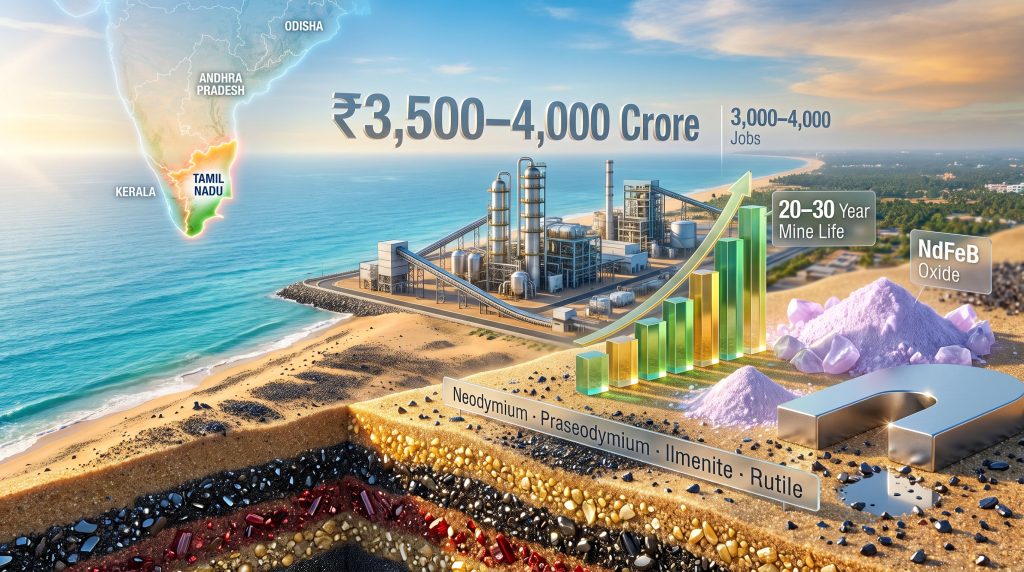
The highest-value commercial target from the IREL-TAMIN facility is NdPr oxide, the intermediate material produced by processing monazite concentrate. This oxide feeds directly into NdFeB permanent magnet manufacturing, making it the foundational input for India's entire downstream magnet ecosystem. Furthermore, rare earth exploration insights suggest that deposits of this quality are increasingly rare globally, reinforcing Tamil Nadu's strategic position.
NdFeB permanent magnets currently account for approximately 80% of total global rare earth consumption by application. India's inability to produce these magnets domestically forces manufacturers in the EV, wind energy, and defence sectors to rely on imported components, a vulnerability the Tamil Nadu rare earth corridor is explicitly designed to close.
The IREL-TAMIN Joint Venture: Architecture and Investment Scale
The proposed facility is designed as an end-to-end operation, covering mining, beneficiation, and refining of beach sand minerals through to intermediate oxide level. This is a critically important design choice. Processing only to oxide level, rather than attempting full downstream magnet manufacturing within the same facility, allows IREL to serve as a feedstock anchor for private sector manufacturers who are qualifying under Ministry of Heavy Industries incentive schemes to produce NdFeB magnets commercially.
The investment figures involved are substantial by any measure:
| Financial and Operational Metric | Estimated Figure |
|---|---|
| Primary processing plant investment | ₹3,500-4,000 crore |
| Projected direct and indirect employment | 3,000-4,000 jobs |
| Construction period (post-clearance) | 2-3 years |
| Operational mine life at current reserve estimates | 20-30 years |
The 20 to 30-year reserve longevity fundamentally changes the investment calculus for downstream manufacturers considering whether to co-locate near the facility. A single-decade operation creates limited incentive for permanent capital allocation. A multi-decade feedstock guarantee, by contrast, justifies the construction of magnet manufacturing plants, titanium processing facilities, and supporting industrial infrastructure in proximity.
This is the clustering logic that underpins the corridor's broader economic case. Once NdPr oxide becomes reliably available domestically, private and foreign manufacturers face a materially different cost and logistics calculation. Tamil Nadu's existing automotive sector, concentrated in and around Chennai, provides a natural anchor demand base for rare earth magnets used in EV motors, adding geographic coherence to the industrial ecosystem vision.
The Titanium Opportunity: India's Unaddressed Industrial Deficit
A dimension of the IREL-TAMIN project that receives less attention than its rare earth angle is the titanium supply chain opportunity embedded within the same mineral sands. Ilmenite and rutile, extracted as co-products alongside monazite, serve as the feedstock for synthetic rutile, titanium pigment, titanium slag, and titanium sponge.
India currently has a significant deficit in titanium products across multiple industries. Titanium dioxide pigment is a critical input for the paint, plastics, paper, and textile sectors. Titanium sponge, owing to its exceptional strength-to-weight ratio, is an essential material in aerospace and defence manufacturing. These are not niche applications. They represent large, structurally undersupplied industrial needs that the IREL-TAMIN facility could partially address through its co-product processing streams.
Why NdFeB Magnets Are the Commercial Linchpin
To understand why the Tamil Nadu rare earth corridor matters commercially, it is necessary to understand the magnet economy it is designed to serve. In addition, broader considerations around critical minerals and energy security make this corridor's success relevant well beyond India's borders.
NdFeB permanent magnets, composed primarily of neodymium, iron, and boron, are the most powerful permanent magnets commercially available. Their application profile spans:
- EV traction motors: The primary driver of rare earth magnet demand growth globally, with each EV requiring multiple kilograms of NdFeB magnets
- Wind turbine generators: Direct-drive turbines, increasingly favoured in offshore applications, use particularly large quantities of rare earth magnets per megawatt of capacity
- Defence systems: Precision guidance, radar, and communications systems all rely on rare earth magnet components
- Medical imaging: MRI machines depend on powerful permanent magnets for field generation
- Space and aerospace applications: Actuators, sensors, and propulsion systems in satellites and spacecraft
India's inability to manufacture these magnets domestically creates a cascading import dependency. Without domestic NdPr oxide supply, there is no viable feedstock for domestic magnet plants. Without domestic magnet plants, EV and wind turbine manufacturers must source finished magnet components internationally, primarily from China. The Tamil Nadu rare earth corridor is designed to break this dependency at the feedstock level, enabling private manufacturers operating under MHI incentive frameworks to establish viable domestic magnet production.
Inter-State Competition: Where Tamil Nadu Stands in the Regulatory Race
India's Union Budget 2026-27 formally proposed rare earth corridors across four coastal states, creating an implicit competition for investment flows, private sector interest, and first-mover advantage in establishing processing infrastructure.
| State | Corridor Status | Key Mineral Focus | Competitive Position |
|---|---|---|---|
| Tamil Nadu | JV formed; land demarcation pending | NdPr oxide, Ilmenite, Rutile | Established processing base; automotive demand cluster |
| Andhra Pradesh | Advanced regulatory progress reported | Beach sand minerals | Faster statutory clearance pace |
| Odisha | Active corridor development | Mixed rare earth minerals | Strong mining governance framework |
| Kerala | Corridor proposed under Budget 2026-27 | Coastal mineral sands | Proximity to existing refining infrastructure |
The competitive dynamic between these states is more consequential than it might initially appear. Private and foreign investors evaluating where to establish downstream magnet manufacturing facilities will not wait indefinitely for a preferred state to resolve its regulatory processes. Regulatory speed has become a genuine competitive differentiator.
States like Andhra Pradesh and Odisha are reportedly advancing their clearance processes at a faster pace, creating real competitive pressure for Tamil Nadu to accelerate land demarcation and CRZ approvals. For Tamil Nadu to fully capitalise on its geographic and industrial advantages, the state government must move decisively on plug-and-play infrastructure provision, including dedicated land allocation, electricity supply, and rare earth-specific industrial incentives.
Addressing the Radiation Debate: Science vs. Perception
Public opposition to beach sand mining in coastal Tamil Nadu has historically been shaped by concerns about radiation exposure from monazite, which contains radioactive thorium. This perception deserves direct examination because it materially affects project timelines and community relations.
Research conducted by the Bhabha Atomic Research Centre (BARC) presents a counterintuitive finding: the physical extraction of monazite from beach sand deposits results in a measurable reduction in background radiation at mining sites, not an increase. The mechanism is straightforward. Thorium, the radioactive element within monazite, is removed from the environment through the extraction process itself. Once extracted, the remaining 90% of processed sand, now stripped of its radioactive mineral fraction, is returned to the ground.
Key operational characteristics that distinguish beach sand mining from conventional mining include:
- No blasting or overburden removal required
- Excavator-based extraction with minimal surface disturbance
- Immediate sand refilling post-extraction to maintain topography
- Vegetation establishment over refilled areas
- No permanent alteration to coastal landscape or groundwater systems
Studies by BARC indicate that beach sand mining involving monazite extraction actually reduces localised background radiation by physically removing thorium-bearing minerals from the environment. The process does not involve blasting, and approximately 90% of processed sand is returned to the ground with vegetation planted over refilled areas. (Source: ET EnergyWorld, July 2026)
The next major ASX story will hit our subscribers first
The Inaiyam-Midalam Project: A Parallel Pathway
Operating separately from the IREL-TAMIN joint venture is the Inaiyam-Midalam project, a standalone IREL initiative that received its Letter of Intent from the government in 2021. This mining block covers 1,144 hectares and is designed to feed extracted minerals into IREL's existing Manavalakurichi (MK) processing unit, leveraging established infrastructure rather than requiring new facility construction from scratch.
The project is currently progressing through statutory clearance acquisition. Its significance lies in demonstrating that Tamil Nadu's rare earth development trajectory does not depend entirely on the IREL-TAMIN joint venture reaching financial close. Multiple concurrent pathways are being pursued, which consequently reduces single-project execution risk for the state's broader rare earth ambitions.
National Security Dimensions of Domestic Rare Earth Processing
The geopolitical argument for India developing sovereign rare earth processing capacity is not merely rhetorical. The concentration of global rare earth refining and magnet manufacturing capacity in a single country has been demonstrated to function as a supply chain pressure point during periods of geopolitical tension. Indeed, China's rare earth export restrictions have already demonstrated how swiftly this leverage can be applied, making India's domestic processing ambitions all the more urgent.
India's defence sector, aerospace programme, and energy transition infrastructure all carry implicit rare earth dependencies that, if unaddressed, represent strategic vulnerabilities. Framing the Tamil Nadu rare earth corridor purely as an industrial development initiative understates its policy significance. The explicit national security logic behind domestic rare earth processing, as articulated by IREL's leadership, connects mineral sand deposits on Tamil Nadu's coastline directly to India's ability to maintain autonomous capability in defence manufacturing, clean energy deployment, and advanced technology production.
Three Development Scenarios for the Tamil Nadu Rare Earth Corridor
Looking forward, the corridor's trajectory can be mapped across three broad scenarios:
Accelerated Scenario: Tamil Nadu completes land demarcation rapidly, CRZ clearances are processed efficiently, and construction commences by 2027. Under this pathway, first production could be achievable by 2029-2030, giving Tamil Nadu a meaningful head start over competing state corridors and positioning it as the primary destination for downstream magnet manufacturing investment.
Base Case Scenario: Standard regulatory timelines apply, with clearances finalised and construction beginning in 2027-2028. Phased clustering of downstream industries follows initial oxide production, with full operational ramp-up achievable by 2031-2032. This remains the most probable outcome based on current progress indicators.
Delayed Scenario: Bureaucratic bottlenecks, particularly around CRZ approvals and land demarcation, extend timelines into 2028-2029. Competing states that have moved faster attract the initial wave of private and foreign investment, disadvantaging Tamil Nadu's corridor relative to its potential.
The variable that most directly determines which scenario materialises is not geological or technical. The Tamil Nadu rare earth corridor's mineral endowment is well-characterised, its processing technology is established, and its downstream demand rationale is robust. However, the critical path runs through state government regulatory decision-making, specifically the speed and quality of land demarcation, CRZ processing, and industrial infrastructure provision. A broader critical minerals strategy at the national level will also play an important role in shaping the corridor's long-term trajectory. For further context on the geographical scope of India's coastal corridor plans, independent analysis provides useful background on how each state's mineral endowment compares.
Readers seeking additional context on India's rare earth policy landscape and the Tamil Nadu corridor's development can explore related reporting from ET EnergyWorld, which covers the evolving intersection of critical minerals, energy transition, and industrial policy in the Indian market.
This article contains forward-looking projections and scenario analysis. Investment timelines, production estimates, and development scenarios represent informed assessments based on currently available information and are subject to change. Readers should conduct independent research before making any investment or commercial decisions based on the information presented here.
Want to Identify the Next Major Critical Minerals Discovery Before the Broader Market?
Discovery Alert's proprietary Discovery IQ model delivers real-time alerts on significant ASX mineral discoveries — including critical minerals driving the global energy transition — instantly translating complex geological data into actionable investment insights for traders and long-term investors alike. Explore historic discoveries and their returns to understand the scale of opportunity, and begin your 14-day free trial today to position yourself ahead of the market.