July 27, 2026
The Midstream Bottleneck Nobody Talks About
The global conversation around rare earth supply chains tends to fixate on mining. Which country has the deposits? Who controls the ore? These are legitimate questions, but they obscure the more consequential problem sitting one level deeper in the industrial stack. Ore extraction is relatively straightforward compared to what comes next: separation, metallization, alloying, and magnet fabrication. Understanding the rare earth supply chain importance helps clarify why these midstream and downstream stages are where strategic leverage is actually concentrated, and where China's dominance is most difficult to replicate or replace.
Understanding this distinction is the starting point for understanding why China rare earth export restrictions and U.S. manufacturing revolution are not simply a trade dispute. They represent a deliberate, multi-decade strategy to concentrate industrial value within China's borders, and why the U.S. manufacturing response to those restrictions is more complex, more expensive, and more consequential than most coverage suggests.
When big ASX news breaks, our subscribers know first
Why China's Position Is Structurally Different From Any Other Commodity Monopoly
China controls approximately 70% of global rare earth mining output and commands roughly 90% of the world's refining and processing capacity. No other nation approaches this concentration in any critical industrial input. However, what makes this position uniquely difficult to challenge is not the raw numbers alone. It is the fact that China's dominance spans every meaningful stage of the value chain simultaneously.
Rare earth ore available in allied jurisdictions, including Australia, Canada, Greenland, Brazil, and the United States, does not solve the problem if there is no domestic capacity to process it. This is the trap Western nations walked into: encouraging mining exploration while allowing the processing infrastructure to atrophy or never develop in the first place.
The ore must pass through five distinct industrial stages before it becomes a functional component in a defence system or electric vehicle motor:
- Mining – Extraction of rare earth-bearing ore
- Separation – Chemical isolation of individual rare earth oxides
- Metallization – Conversion of oxides into high-purity rare earth metals
- Alloying – Combining metals into precise compositions for magnet production
- Magnet Manufacturing – Fabrication of finished permanent magnets for end-use applications
China's dominance is most acute and most entrenched at stages two through five. Western nations have made progress on stage one. The structural vulnerability, furthermore, sits in everything that follows.
The Metallization Gap: The Least Discussed Chokepoint
Of all the midstream processing stages, metallization receives the least public attention and represents one of the most severe capability gaps in the Western rare earth supply chain. Metallization is the industrial process of converting separated rare earth oxides into high-purity metals suitable for alloying and magnet production. The broader rare earth processing challenges at this stage are significant and frequently underestimated.
Without domestic metallization capacity, rare earth oxides extracted and separated in allied jurisdictions must still be shipped to China for conversion, recreating the strategic dependency at a later stage of the value chain. This is not a theoretical risk. It is the operational reality that has persisted in the Western supply chain for years, even as mining investment has increased.
A credible non-Chinese rare earth supply chain is not defined by where ore is mined. It is defined by whether every downstream conversion stage can be performed outside China's industrial system.
Heavy Rare Earths: The Elements That Actually Matter for Defence
Not all rare earth elements carry equal strategic weight. The category most critical for high-performance permanent magnets used in defence, aerospace, and advanced manufacturing applications is heavy rare earths, a subset of the broader rare earth family that China controls with particular thoroughness.
| Element | Primary Application | Defence Relevance |
|---|---|---|
| Dysprosium | High-temperature permanent magnets | Fighter aircraft, guided missiles |
| Terbium | Magnet performance enhancement | Submarines, radar systems |
| Yttrium | Phosphors, high-temperature alloys | Missile guidance, electronics |
| Samarium | Samarium-cobalt magnets | Military motors and sensors |
| Gadolinium | Metallization and specialty alloys | Defence-grade manufacturing |
Heavy rare earths cannot be easily substituted in the neodymium-iron-boron (NdFeB) and samarium-cobalt magnets used across these applications. Dysprosium in particular is added to NdFeB magnets to maintain their magnetic performance at elevated operating temperatures, a property essential in jet engines, missile guidance systems, and high-speed motors. Without dysprosium, magnet performance degrades at the temperatures these systems routinely operate at.
This is why China's rare earth export restrictions targeting dysprosium, terbium, and yttrium specifically are not commodity restrictions. They are precision instruments designed to degrade Western manufacturing capability at the component level.
How China's Export Restriction Campaign Escalated: A Four-Stage Progression
Beijing's approach to rare earth export controls has not been a single sweeping action. It has been a graduated campaign, with each stage tightening the restrictions in a qualitatively different way.
Stage one involved export licensing requirements on key rare earth materials, giving Beijing control over shipment timing, recipient approval, and processing volumes.
Stage two escalated to company-level targeting, with specific U.S. rare earth firms added to export control lists, blocking Chinese-origin dual-use materials from reaching named American entities. This transformed the controls from broad commodity management into precision economic targeting.
Stage three established a formal public reporting infrastructure for suspected violations, drawing freight companies, customs brokers, financial service providers, and industry employees into the enforcement network. Third-country rerouting strategies that Western buyers had previously considered viable workarounds became legally hazardous.
Stage four operated through chilling effects. Reported detentions of foreign nationals and enforcement actions against Chinese exporters created risk-aversion dynamics extending well beyond the formal scope of the regulations. Consequently, Chinese suppliers facing criminal liability and political exposure became structurally less willing to fulfil Western orders, even when technically permitted to do so.
According to analysis from CSIS, China's new rare earth and magnet restrictions pose a direct threat to U.S. defence supply chains, underscoring the severity of the four-stage escalation described above.
Featured Snippet: China's rare earth export restrictions are a multi-stage regulatory campaign combining licensing requirements, company-level blacklisting, distributed enforcement networks, and supply chain chilling effects. The cumulative result is a supply chain that becomes progressively less accessible to Western manufacturers by design, regardless of whether specific shipments are formally blocked.
The Pause Caveat: Why Temporary Relief Changes Nothing Structural
Some reporting has indicated that Beijing partially suspended elements of its tighter controls in certain periods, potentially as diplomatic leverage during U.S.-China trade negotiations. This does not eliminate the underlying strategic vulnerability. China retains the full institutional and regulatory infrastructure to re-tighten exports rapidly, and the demonstrated willingness to deploy these tools has permanently altered how Western manufacturers assess procurement risk.
The lesson for supply chain planners is that temporary access is strategically worthless for capital-intensive manufacturing operations that require multi-year procurement certainty.
Quantifying the Downstream Risk: The $6.5 Trillion Exposure
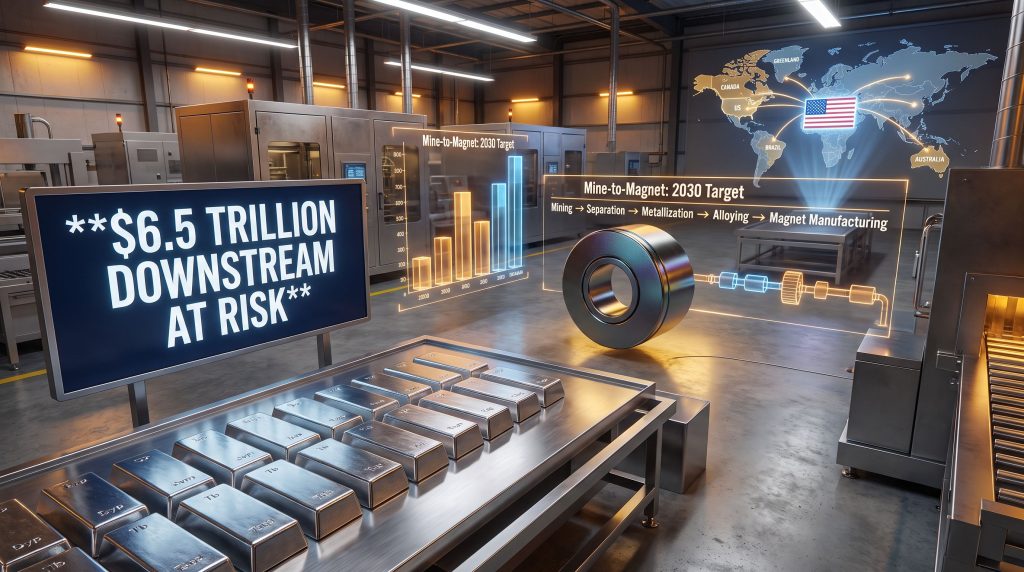
The International Energy Agency assessed in 2026 that full implementation of China's export controls could place approximately $6.5 trillion in downstream industrial production at risk across global automotive, high-technology, defence, and clean energy sectors. The United States and Europe account for close to half of that exposure.
| Sector | Rare Earth Dependency | Risk Category |
|---|---|---|
| Defence and Aerospace | Permanent magnets in weapons systems | Critical / National Security |
| Electric Vehicles | NdFeB magnets in drive motors | High / Supply Chain |
| Semiconductors | Processing chemicals and phosphors | High / Technology |
| Robotics and Automation | Precision motors and actuators | Medium-High / Industrial |
| Wind Energy | Direct-drive turbine generators | Medium / Energy Transition |
| Consumer Electronics | Speakers, displays, and sensors | Medium / Commercial |
The scale of this downstream exposure explains why China rare earth export restrictions and U.S. manufacturing revolution are treated as a national security issue rather than a trade dispute. A shortage of dysprosium does not merely inconvenience an automotive manufacturer. It directly impairs the ability to produce the motors in fighter aircraft, guided missile systems, and submarine propulsion equipment.
The Clean Energy Paradox
An underappreciated irony sits at the intersection of climate policy and rare earth strategy. The technologies central to the clean energy transition, particularly electric vehicle drive motors and direct-drive wind turbines, depend on rare earth permanent magnets sourced from a supply chain concentrated in a single geopolitical competitor. Decarbonisation and supply chain security are therefore pulling in competing directions unless a genuine non-Chinese rare earth manufacturing base is established.
Rebuilding the Mine-to-Magnet Chain: What It Actually Takes
A credible alternative supply chain requires feedstock secured across multiple geopolitically stable jurisdictions. Current industry efforts are drawing on deposits and processing partnerships across Canada, Greenland, Brazil, Montana, Wyoming, and Kazakhstan. This geographic diversification is designed to prevent any single jurisdiction from replicating China's supply concentration dynamic.
However, feedstock diversification alone is insufficient. The metallization and magnet manufacturing stages require:
- Production capacity of approximately 30 tonnes of dysprosium metal annually to support defence-grade magnet manufacturing at meaningful scale
- Production capacity of approximately 15 tonnes of terbium metal annually for high-performance magnet enhancement
- Modular facility designs that allow phased scaling and potential geographic flexibility as the supply chain matures
- Qualified technical workforces with expertise in the specialised electrochemical and thermochemical processes involved in rare earth metallization
The permanent magnet manufacturing market itself represents approximately $40 billion in addressable value, and it is the stage at which rare earth materials are converted into the functional components powering defence systems, electric vehicles, wind turbines, and advanced industrial machinery. Fully integrated mine-to-magnet platforms represent the structural end-state that coherent supply chain policy must work toward.
The next major ASX story will hit our subscribers first
The Pentagon's Role: From Customer to Industrial Partner
One of the most consequential shifts in U.S. industrial policy is the Pentagon's procurement ban on Chinese-origin rare earth magnets, scheduled to take effect in the near term. This regulation does not merely incentivise domestic supply chain development. It mandates it, creating captive demand for non-Chinese rare earth magnets that previously did not exist at anything approaching commercial scale.
Defence manufacturers across aerospace, weapons systems, and military electronics are now legally required to qualify entirely new sources of supply, transforming voluntary diversification into a compliance obligation. The implications for procurement timelines, supplier qualification processes, and capital allocation across the defence industrial base are substantial.
The Defence Logistics Agency has emerged as a key institutional actor in this rebuild, providing direct contract funding for metallization technology development and supporting the establishment of rare earth processing operations on U.S. military installations. This represents a meaningful departure from the traditional government-as-customer model toward active government participation in industrial capacity creation.
Investment Signal: Institutional capital commitments of approximately $100 million directed toward rare earth supply chain infrastructure signal that private markets are beginning to price rare earth supply chain security as a commercial opportunity. The transition from government-seeded concept to privately financed industrial project is the inflection point at which a supply chain rebuild becomes structurally durable rather than policy-contingent.
Three Scenarios for the U.S. Rare Earth Manufacturing Rebuild
Investors and industrial planners should resist treating the U.S. rare earth manufacturing rebuild as a binary outcome. The more analytically useful framework involves scenario modelling across a range of capital deployment, technical, and geopolitical variables.
Scenario A: Accelerated Rebuild. Pentagon procurement mandates, private capital at scale, and allied feedstock agreements combine to produce meaningful domestic magnet production capacity by 2028 to 2029, ahead of current consensus estimates. This outcome requires technical execution at metallization and magnet manufacturing stages to proceed without significant setbacks.
Scenario B: Managed Dependency (Base Case). The United States achieves meaningful but partial supply chain diversification by 2030, reducing but not eliminating rare earth dependency on China, while maintaining diplomatic channels to manage export control risk. This is the outcome most consistent with current capital deployment timelines and technical complexity assessments.
Scenario C: Prolonged Vulnerability. Capital deployment stalls, metallization bottlenecks prove more persistent than anticipated, and China's export controls succeed in concentrating more magnet manufacturing value within its domestic industrial base. This scenario would accelerate technology substitution research but is unlikely to produce near-term relief for defence procurement requirements.
Most credible industry projections point to approximately 2030 as the earliest timeline for meaningful U.S. self-sufficiency in rare earth magnet production. That timeline is not pessimistic. It reflects the genuine capital intensity, process chemistry complexity, and regulatory pathways involved in building entirely new industrial processing categories from minimal existing domestic infrastructure.
Sector Vulnerabilities: Who Bears the Most Risk
Defence and Aerospace
Military systems from fifth-generation fighter aircraft and precision-guided munitions to submarine propulsion and advanced radar arrays depend on heavy rare earth permanent magnets with no technically equivalent substitute. Supply disruption here is not a cost problem. It is a capability degradation problem with direct national security consequences.
Electric Vehicles and the Transition Technology Bind
EV drive motors using NdFeB magnets represent one of the fastest-growing demand categories for heavy rare earths. As global EV adoption accelerates, the structural tension between supply chain security and clean energy policy will intensify. Investment in alternative magnet technologies, including ferrite-based and rare-earth-reduced motor designs, is advancing but has not yet produced commercially viable substitutes for high-performance applications.
Robotics, AI Infrastructure, and Advanced Manufacturing
The expansion of AI-driven industrial automation and precision robotics is creating entirely new demand vectors for rare earth permanent magnets in motors, actuators, and cooling systems. In addition, the role of critical minerals for semiconductors is compounding the urgency further. As these sectors scale through the remainder of the decade, their rare earth dependency will compound rather than diminish, adding further urgency to the supply chain rebuild.
The Broader Industrial Repositioning Underway
The rare earth supply chain challenge is catalysing a structural transition across the North American industrial base, moving away from commodity extraction toward vertically integrated supply chains that capture value at every processing stage. America's rare earth supply chain is undergoing significant repositioning as major mining companies with significant critical minerals exposure, including Rio Tinto (NYSE: RIO), increase strategic positioning in rare earths and adjacent critical minerals as demand from defence, clean energy, and advanced manufacturing accelerates.
Companies such as Honeywell (NASDAQ: HON) and Caterpillar (NYSE: CAT) depend on secure rare earth access across aerospace, automation, defence, and increasingly electrified heavy equipment product lines. As China rare earth export restrictions and U.S. manufacturing revolution dynamics become more systematically restrictive, supply chain security is being repriced as a strategic asset across the industrial base, not merely an operational consideration.
The European Parliament's analysis of China's export restrictions similarly highlights how allied nations are now treating this as a shared industrial and geopolitical challenge, reinforcing the case for coordinated Western responses.
Rather than viewing rare earths as a conventional mining story, the more instructive frame is as foundational infrastructure for the next generation of American industrial manufacturing. The companies capable of securing reliable feedstock, processing capacity, and permanent magnet fabrication across a genuinely non-Chinese supply chain will be positioned to serve the compounding demand from defence, aerospace, electric mobility, robotics, and AI-driven infrastructure over the coming decade.
Disclaimer: This article contains forward-looking statements and scenario projections based on publicly available information and industry analysis. It does not constitute financial advice or a solicitation to buy or sell any securities. Investors should conduct independent due diligence and consult a qualified financial adviser before making investment decisions. Past performance does not guarantee future results. The rare earth industry carries significant technical, regulatory, and geopolitical risks that may cause actual outcomes to differ materially from projections described herein.
Want to Stay Ahead of the Next Major Critical Minerals Discovery?
Discovery Alert's proprietary Discovery IQ model delivers real-time alerts on significant ASX mineral discoveries — cutting through complexity across more than 30 commodities to surface actionable opportunities the moment they're announced. Explore historic examples of exceptional discovery returns and begin your 14-day free trial at Discovery Alert to position yourself ahead of the broader market.