July 25, 2026
The Hidden Rare Earth Treasure Buried in Aluminium Waste
The global race to secure rare earth supply chains rarely begins where the raw materials actually exist. More often, it begins where the refining infrastructure does not. For decades, nations rich in rare earth geology have watched refined materials flow in from overseas while their own resources sat dormant, caught between the complexity of extraction and the capital intensity of processing. India is a textbook example of this paradox, and it is precisely this gap that makes the Enervoxa India rare earths project one of the more strategically interesting proposals to emerge from the critical minerals landscape in recent years.
When big ASX news breaks, our subscribers know first
Understanding the Red Mud Opportunity
What Is Red Mud and Why Has It Been Ignored?
Red mud is not a niche industrial curiosity. It is one of the largest-volume solid waste streams generated by any manufacturing sector on Earth. Produced during the Bayer process used to refine bauxite ore into alumina, red mud is a caustic, iron-rich residue that accumulates at every alumina refinery in the world. For every tonne of alumina produced, approximately 1 to 1.5 tonnes of red mud is generated as a byproduct.
Globally, alumina production generates an estimated 150 to 180 million tonnes of red mud annually, with cumulative stockpiles now exceeding several billion tonnes stored in containment ponds across dozens of countries. These ponds represent both an environmental liability and, increasingly, an untapped mineral resource.
The reason red mud has historically been ignored as a rare earth source is largely one of concentration economics. Rare earth element concentrations in red mud typically range from around 500 to 2,000 parts per million total rare earth oxide (TREO), which is meaningfully lower than dedicated hard rock or ionic clay rare earth deposits. However, three factors change the calculus considerably:
- The feedstock is already mined, processed, and concentrated at existing industrial facilities, eliminating the need for primary mining costs
- The material is often delivered free or at negative cost, since aluminium producers pay for its disposal
- Revenue from co-products including iron oxide, titanium-bearing minerals, coagulants, and pigments can substantially offset or eliminate processing costs attributed to rare earth recovery alone
This last point is perhaps the most underappreciated aspect of the red mud opportunity. Rather than a single-commodity project, a well-structured red mud processing facility functions more like a polymetallic refinery, with multiple revenue streams sharing a common processing infrastructure.
Why India Is the Focal Point for This Technology
A Nation Sitting on Resources It Cannot Yet Use
India holds rare earth reserves estimated at approximately 6.9 million tonnes, ranking it among the more resource-endowed nations globally. Yet the country lacks the industrial infrastructure to convert those reserves, or the rare earths concentrated in its industrial waste streams, into commercially usable separated oxides. The result is a situation where India imports refined rare earth materials despite having substantial in-ground and residual resources available domestically.
This processing gap is not simply an economic inefficiency. It represents a structural vulnerability in India's ambitions to build competitive electric vehicle, wind energy, and defence manufacturing industries. Each of these sectors requires high-purity rare earth compounds, particularly neodymium and praseodymium for permanent magnets used in EV motors and direct-drive wind turbines.
Furthermore, India is also the world's second-largest aluminium producer and its third-largest consumer, meaning the feedstock base for a red mud rare earth recovery operation is both abundant and geographically concentrated. The majority of this production capacity is located in eastern India, specifically across the states of Odisha, Jharkhand, and Chhattisgarh, where bauxite production importance is well established and alumina refining infrastructure is firmly in place.
Does China's Processing Dominance Create the Strategic Imperative?
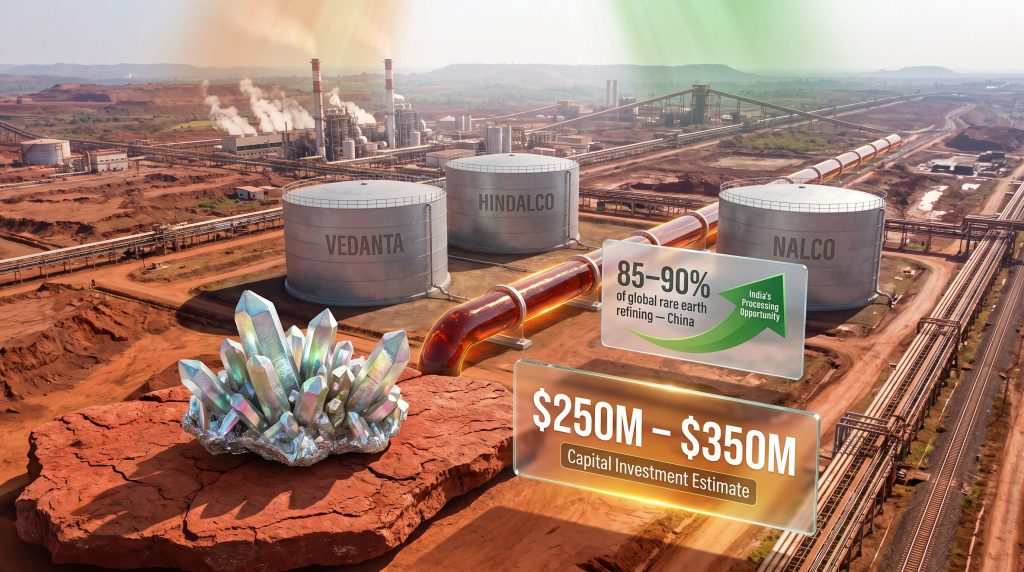
China controls an estimated 85 to 90 percent of global rare earth refining capacity, a position built over decades of deliberate industrial policy and subsidised domestic processing. This dominance gives China significant leverage over supply chains for technologies that are central to the energy transition and modern defence capability.
China's export restrictions on specific rare earth materials have accelerated demand from allied nations for alternative processing capacity in recent years. For India, the calculation is both economic and geopolitical: developing domestic rare earth processing capability reduces import dependency while strengthening the country's position in global supply chain negotiations.
The strategic case for rare earth processing in India sits at the intersection of energy transition ambition, national security planning, and the broader industrial aspiration to move up the value chain in critical minerals.
The Enervoxa Proposition: Eight Years in the Making
Technology Development and Commercial Positioning
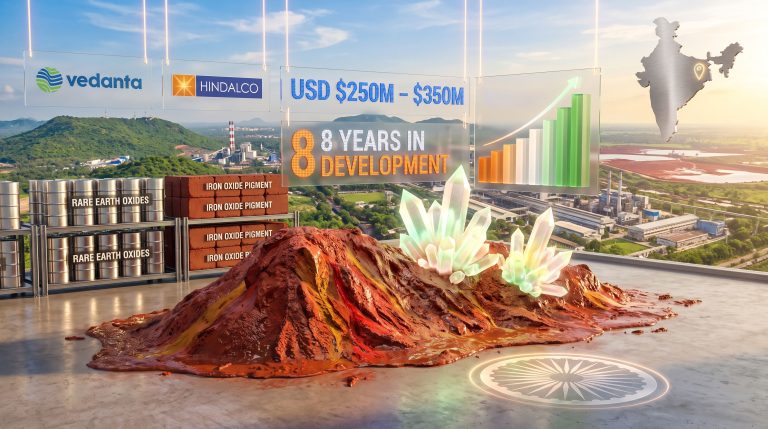
Canadian climate technology company Enervoxa has spent approximately eight years developing a proprietary process specifically designed to recover rare earth elements from bauxite residue. This development timeline is significant context for assessing the technology's maturity, as rare earth hydrometallurgical processes typically require extended development cycles to address the chemical complexity of separating individual rare earth elements from a highly heterogeneous feedstock like red mud.
The company's commercial focus extends beyond India, with active evaluation of opportunities across North America, Southeast Asia, and other alumina-producing regions. This multi-geography approach is strategically sensible given that red mud feedstock is available wherever alumina is refined, making the technology potentially deployable across a wide range of industrial host country contexts.
Enervoxa CEO Vandit Verma has confirmed the company's intent to evaluate commercial partnerships with Indian aluminium producers, citing India's combination of feedstock availability, industrial scale, and policy environment as factors driving the country's prioritisation, as reported by mining-technology.com.
The Two Processing Models Under Consideration
A critical decision in the project's development involves the degree of in-country processing to pursue. The two principal models each carry distinct risk and return profiles:
| Processing Model | Key Characteristics | Capital Intensity | Value Capture |
|---|---|---|---|
| Full Domestic Processing | Rare earth separation and oxide production within India | High ($250M-$350M+) | Maximum domestic value-add |
| Concentrate Production | Intermediate concentrate exported for offshore refining | Lower | Partial; dependent on refinery partner |
| Hybrid Phased Approach | Concentrate production in Phase 1, full processing in Phase 2 | Staged | Growing over time |
The concentrate model has advantages in terms of deployment speed and lower initial capital requirements, but it leaves India partially dependent on offshore refining infrastructure, which somewhat undermines the supply chain sovereignty argument. The full processing model is more strategically compelling but requires either a committed industrial partner willing to invest equity or access to project financing on terms that work at current rare earth price levels.
The Three Potential Partners and What Each Brings
Vedanta, Hindalco, and NALCO: Strategic Fit Analysis
Enervoxa has identified Vedanta, Hindalco Industries, and NALCO as the three most logical potential partners for the proposed facility. These companies are among the major aluminium producers in the region and collectively generate the majority of India's red mud output, making them simultaneously the natural feedstock suppliers and the most logical co-investors in a facility that converts their waste liability into revenue.
Vedanta operates as a diversified private sector metals and mining group with existing exposure to critical minerals and a demonstrated track record of accessing international project financing. Its private sector structure provides commercial agility and potentially faster decision-making timelines compared to state-owned entities.
Hindalco Industries, part of the Aditya Birla Group, is one of Asia's largest integrated aluminium producers with significant bauxite mining and alumina refining operations concentrated in Odisha. Its scale and geographic concentration in eastern India make it a particularly logical feedstock partner, and its downstream relationships in industrial manufacturing could support offtake for co-products like iron oxide and titanium materials.
NALCO (National Aluminium Company Limited) is a state-owned enterprise whose participation would bring a different dimension to the project. As a public sector entity, NALCO operates with alignment to government industrial policy objectives, and its involvement could facilitate access to concessional financing or policy support that a purely private sector structure might not attract.
Important Note: As of the reporting date, all discussions remain at the evaluation and engagement stage. No binding partnership agreements or final investment decisions have been confirmed by any of the parties named.
The Multi-Product Economics: Why Co-Recovery Changes Everything
Beyond Rare Earths: The Full Value Inventory of Red Mud
One of the most frequently underappreciated dimensions of red mud processing economics is the diversity of recoverable materials beyond rare earth elements. Understanding this multi-product structure is essential to evaluating whether the project economics are viable at different rare earth price points.
The commercially relevant products recoverable from red mud include:
- Iron oxide: Present at high concentrations in most red mud streams, iron oxide has established markets as a pigment in construction materials, paints, and coatings, as well as a feedstock for certain steelmaking applications
- Titanium-bearing minerals: Red mud derived from titanium-rich bauxite sources can contain meaningful concentrations of ilmenite or leucoxene, both of which have established markets as titanium dioxide feedstock
- Coagulants: Aluminium and iron-based coagulants recovered during processing have well-established markets in water treatment, a sector experiencing growing demand globally
- Specialty pigments: High-purity iron oxide fractions can command premium pricing in specialty pigment markets for ceramics, cosmetics, and industrial coatings
The economic implication of this multi-product structure is that a project generating revenue from four or five product streams can remain economically viable even when individual commodity prices, including rare earth prices, are under pressure. This built-in revenue diversification is a genuine structural advantage compared to single-commodity rare earth mining projects.
The next major ASX story will hit our subscribers first
India's Policy Landscape: Institutional Activity Without Project-Specific Commitments
Research Infrastructure and Policy Signals
India's government think tank NITI Aayog has been coordinating research into metal extraction and rare earth element enrichment from red mud through the Jawaharlal Nehru Aluminium Research Development and Design Centre (JNARDDC). This institutional activity signals that India's policy establishment is aware of the red mud rare earth opportunity and is investing in the scientific understanding required to evaluate it.
India's National Critical Mineral Mission and the broader policy architecture supporting domestic critical minerals demand create a regulatory environment that is, in principle, receptive to projects of the type the Enervoxa India rare earths project is proposing. However, it is important to note that general policy receptiveness is distinct from project-specific support, funding, or accelerated permitting, none of which have been confirmed for this particular proposal.
| Policy Objective | Connection to Red Mud Processing |
|---|---|
| Reduce rare earth import dependence | Domestic processing directly addresses import vulnerability |
| Develop critical mineral value chains | Multi-product red mud processing creates integrated upstream-downstream linkages |
| Monetise industrial waste streams | Environmental co-benefit from converting a waste liability into economic outputs |
| Attract foreign technology partnerships | Canadian technology transfer supports India's industrial capability development |
| Strengthen EV and defence supply chains | Rare earth outputs feed priority end-use manufacturing sectors |
Key Risks Investors and Analysts Should Monitor
Technical, Commercial, and Geopolitical Uncertainties
No analysis of this project would be complete without a clear-eyed assessment of the risks involved. Several categories of uncertainty deserve careful attention:
Technical Execution Risk
Enervoxa's process has been in development for eight years but demonstrating commercial viability at scale in an Indian industrial context introduces new variables. Red mud composition varies significantly depending on the bauxite source used by each alumina refinery, affecting both rare earth concentrations and the behaviour of the material during processing. Recovery rates and product purity targets achieved in controlled development settings may be more difficult to replicate consistently at commercial throughput volumes.
Partnership and Financing Risk
The project's capital cost estimate of $250 million to $350 million is substantial, and the financing structure combining strategic equity from industrial partners with project financing from debt markets is contingent on achieving binding commitments from parties who are currently only in early-stage discussions. Rare earth price cycles have historically been volatile, which can complicate debt serviceability assumptions in project finance models.
Regulatory Complexity
India's rare earth sector has historically been dominated by Indian Rare Earths Limited (IREL), a government-controlled entity with preferential access to rare earth resources under the Atomic Minerals framework. Foreign and private sector participation in rare earth processing involves navigating regulatory structures that were not originally designed with commercial joint ventures in mind. Furthermore, as analysed by Rare Earth Exchanges, export of rare earth concentrates also carries policy risk if regulatory settings change.
Geopolitical Response Risk
Historical precedent from other critical mineral sectors suggests that China has occasionally responded to the emergence of competing processing capacity through strategic pricing behaviour designed to make new entrants uneconomical. This risk is speculative and not unique to this project, but it is a dimension that longer-term project economics should account for. Consequently, any investment thesis built around the Enervoxa India rare earths project must weigh these external pressures carefully alongside the domestic opportunity.
Disclaimer: This article contains forward-looking statements, scenario projections, and financial estimates sourced from third-party reporting. These should not be interpreted as investment advice. All figures related to capital costs, feedstock volumes, and project timelines are subject to change and have not been independently verified. Readers should conduct their own due diligence before drawing investment conclusions.
Want to Stay Ahead of the Next Major Critical Minerals Discovery?
Discovery Alert's proprietary Discovery IQ model delivers real-time alerts on significant ASX mineral discoveries — including critical minerals driving the energy transition — instantly translating complex data into actionable investment insights for traders and investors at every experience level. Explore Discovery Alert's discoveries page to understand how historic ASX mineral discoveries have generated substantial returns, and begin a 14-day free trial to position yourself ahead of the broader market.