July 26, 2026
The Geopolitics of Permanent Magnets: Why the West's Most Critical Industrial Deal Is Caught Between Washington and Berlin
The global race to secure rare earth supply chains did not begin with a single policy announcement or corporate transaction. It evolved over decades of Western industrial complacency, during which China quietly consolidated control over every meaningful node in the rare-earth value chain: from mining and separation through to the production of the finished permanent magnets that power everything from electric vehicle motors to submarine propulsion systems. By the time Western governments recognised the depth of that dependency, the infrastructure gap had become structurally difficult to close in any short timeframe. The Germany conditions on Energy Fuels VAC magnet deal now unfolding in Berlin represents one of the most consequential tests of whether the Western world can actually build an alternative.
When big ASX news breaks, our subscribers know first
Understanding What Makes Permanent Magnets Irreplaceable
Not all magnets are created equal. The high-performance neodymium-iron-boron (NdFeB) permanent magnets at the centre of this transaction are fundamentally different from conventional magnetic materials. These sintered magnets are manufactured through a precise metallurgical process involving the alloying of rare-earth elements, milling to a fine powder, pressing under magnetic field alignment, and sintering at high temperatures. The resulting material holds its magnetic properties without any continuous power input, making it indispensable for applications where weight, efficiency, and reliability are paramount.
The defence sector's dependency on these components is particularly acute. High-performance NdFeB magnets, which sit at the heart of so many rare earth processing challenges, are embedded in:
- Precision-guided munitions and drone propulsion motors
- Submarine permanent magnet motors used in modern air-independent propulsion systems
- Radar and sonar signal processing equipment
- Military-grade communications hardware
- Electric drive systems for armoured vehicles
What makes China's position so commanding is not just its mining capacity. China controls an estimated 85–90% of global rare-earth processing capacity and accounts for the overwhelming majority of finished NdFeB magnet production. Furthermore, China's export restrictions introduced in the preceding period have made this leverage operational rather than theoretical, applying the most stringent controls specifically to defence-sector buyers.
Vacuumschmelze: A Singular Asset in a Fractured Supply Landscape
Vacuumschmelze, commonly known as VAC, occupies a position in the Western industrial ecosystem that has no true equivalent. The company's Hanau facility, situated in the Frankfurt metropolitan area, employs more than 1,000 workers and concentrates the core metallurgical know-how that underpins VAC's manufacturing capability. According to reporting by Bloomberg, VAC's CEO Erik Eschen has confirmed that the company's facilities in Germany, the United States, and Finland operate largely as independent production nodes, with the deepest technical expertise residing in Hanau.
This concentration of know-how in a single German location is precisely what gives Berlin meaningful regulatory leverage over the transaction. Unlike a deal involving a company whose operational capability is distributed across many jurisdictions, VAC's Hanau plant is not easily replicated or relocated. Any acquirer that disrupts operations there risks degrading the very asset it paid to acquire.
Why VAC's Singularity Matters
What is less commonly understood is the broader implication of VAC's singularity. The absence of a second or third Western-scale permanent magnet producer means that if this acquisition fails to close, or if the conditions imposed make integration commercially unworkable, there is no fallback option of comparable strategic value. The Western supply chain gap does not become marginally wider. It remains structurally unclosed.
Deal Structure and the Regulatory Landscape
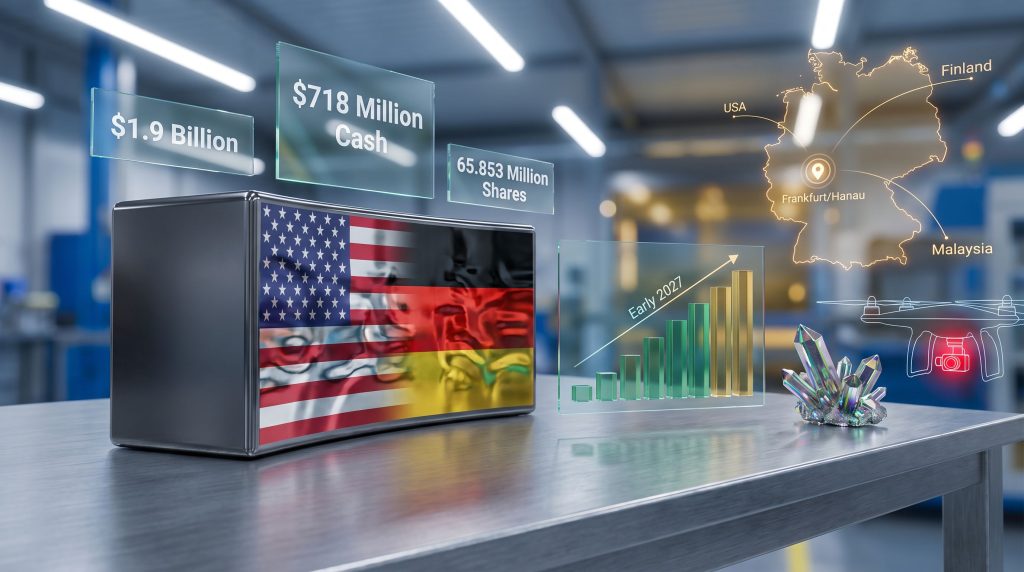
The Energy Fuels critical minerals strategy has been evolving steadily, and this transaction represents its most ambitious expression to date. The deal involves a total consideration of approximately $1.9 billion, structured as a combination of $718 million in cash and 65.853 million Energy Fuels shares. The deal is subject to regulatory approvals across multiple jurisdictions, with closing currently targeted for early 2027.
| Deal Component | Detail |
|---|---|
| Total Acquisition Value | ~$1.9 billion |
| Cash Component | $718 million |
| Equity Component | 65.853 million Energy Fuels shares |
| Expected Closing | Early 2027 |
| Key Regulatory Hurdle | German foreign investment review |
| VAC Global Footprint | Germany, USA, Finland, Malaysia, China |
Germany's foreign investment review framework operates in a manner conceptually analogous to the United States' CFIUS process. Both mechanisms grant authorities the power to impose conditions or block transactions outright when national security or strategic industrial interests are implicated. The German Economy Ministry has confirmed in writing, via a letter to a lawmaker reported by Bloomberg, that the formal investigation is underway.
| Feature | German Investment Review | US CFIUS Review |
|---|---|---|
| Authority to Block | Yes | Yes |
| Authority to Impose Conditions | Yes | Yes |
| Typical Resolution Timeline | Months to over a year | 45–90+ days |
| Transparency | Confidential | Confidential |
| Primary Trigger | Strategic/critical sectors | National security |
While German officials have characterised the probe as a routine procedural requirement applicable to any acquisition involving companies in strategically sensitive sectors, the conditions it is expected to generate are anything but routine.
What Germany Is Likely to Demand
Current indications, as reported by Bloomberg citing individuals familiar with the review process, suggest Berlin is expected to stop short of blocking the transaction entirely. However, the conditions attached to any approval could prove substantively constraining. The areas of likely focus include:
- Operational continuity protections for the Hanau facility, including employment thresholds and commitments to maintain the plant as a core operational hub rather than a rationalised satellite.
- Technology transfer restrictions limiting Energy Fuels' ability to migrate VAC's metallurgical know-how, intellectual property, or proprietary processes outside Germany.
- Supply allocation requirements ensuring that German and European defence and industrial customers receive priority or proportional access to VAC's magnet output, rather than being subordinated to US demand.
- Governance conditions requiring a degree of operational independence for VAC's German entity that limits the acquirer's ability to manage it as a fully integrated subsidiary.
The supply allocation question is arguably the most commercially sensitive. European defence manufacturers, who are prohibited from sourcing Chinese rare-earth magnets under Beijing's export licensing framework, have expressed concern that a US-controlled VAC would prioritise American defence primes. This concern has factual grounding: US Treasury Secretary Scott Bessent personally attended the opening of VAC's South Carolina facility, a level of senior political engagement that signals the depth of Washington's strategic interest in the company's output.
The Industrial Off-Take Gap and What It Reveals About European Policy
One of the most structurally revealing aspects of this situation is the contrast between US and European industrial commitments to VAC's output. General Motors has entered into an off-take agreement with VAC at a scale described by Frankfurt-based metals trader Jan Giese of Tradium GmbH as meaningfully covering GM's magnet demand. As Giese noted in reporting by Bloomberg, no comparable agreement exists on the European side relative to the volumes German industry actually consumes.
"The failure of European automakers to make binding off-take commitments to VAC has directly constrained the company's ability to justify expansion of German production capacity, creating the commercial conditions under which a US acquisition became the most viable strategic path."
VAC's CEO has indicated that commitments from one or two major European automakers would be the threshold required to support development of a second German production facility. Those commitments have not materialised. The defence sector, despite its acute supply vulnerability, does not generate sufficient volume to independently justify the capital expenditure.
A Deeper Policy Failure
This dynamic points to a deeper policy failure that extends beyond VAC. German defence ministry procurement tenders currently contain no requirements governing the origin of raw materials or components, according to a senior German defence company official cited by Bloomberg. That structural gap means European defence manufacturers remain exposed to supply disruption regardless of who ultimately controls VAC.
The next major ASX story will hit our subscribers first
The Co-Investment Proposal Berlin Never Followed Up On
Perhaps the most striking detail to emerge from the review process involves a proposal made at a roundtable with German Economy Ministry officials. VAC's vice president Alexander Barcza put forward a scenario in which a second German facility could be developed if the German government co-invested at a 50% equity level.
According to Bloomberg's reporting on individuals familiar with the meeting, German officials acknowledged the proposal and indicated it would be examined through a working group mechanism. No substantive follow-up from Berlin ever materialised.
This episode is analytically significant for several reasons:
- It demonstrates that VAC actively sought a German industrial partnership before pursuing a US acquisition structure.
- It reveals that Berlin had a concrete opportunity to anchor VAC's expansion within Germany and passed on it.
- It suggests the current regulatory scrutiny of the Energy Fuels-VAC deal involves a degree of retrospective concern that might have been avoided through earlier domestic engagement.
The regulatory and cost environment in Germany has made it progressively harder for manufacturers like VAC to compete globally, a reality acknowledged by Giese in Bloomberg's reporting. That competitive pressure compounds the incentive for a company in VAC's position to seek a well-capitalised US partner over a slow-moving domestic policy process.
Washington's Strategic Calculus and the $1.9 Billion Premium
The acquisition price of $1.9 billion has been widely characterised by industry observers as surprisingly elevated relative to conventional valuation benchmarks for a company of VAC's scale. This premium is not read as a commercial anomaly. It is read as a direct expression of strategic intent.
A US official attending a Berlin conference is reported by Bloomberg to have privately communicated an effectively unconstrained financial commitment to building out critical raw material supply chains outside China's sphere of influence. The $1.9 billion price tag is interpreted by market participants as a concrete expression of exactly that posture. Consequently, the critical minerals demand surge currently reshaping global industrial strategy has only heightened the urgency behind this transaction.
Energy Fuels brings a complementary capability set to the transaction. The company operates established uranium and rare-earth processing infrastructure that could, over time, supply VAC's Hanau and US facilities with feedstock independent of Chinese supply chains. The integration of upstream rare-earth processing with VAC's downstream magnet manufacturing capability would represent a vertically integrated Western supply chain with no current structural equivalent.
Risk Scenarios: What Happens If Conditions Are Too Onerous?
The most adverse scenario for the transaction's strategic value involves conditions that are individually defensible but collectively restrictive. Specifically:
- Supply allocation mandates that reserve a significant proportion of VAC's output for European customers could limit US defence industry access to precisely the volumes that justified Washington's support for the deal.
- Operational independence requirements for the Hanau entity could prevent the kind of integrated capital deployment and management coordination that would allow Energy Fuels to maximise the supply chain benefits of ownership.
- Protracted negotiation timelines extending into 2027 create prolonged uncertainty during a period of active geopolitical competition for rare-earth supply access.
The counterargument, advanced by outside observers cited in Bloomberg's reporting, is that the US is substantially more motivated than Germany to reach a workable outcome. That asymmetry of urgency may ultimately constrain the scope of conditions Berlin is able to impose without triggering a diplomatic reaction from Washington.
"If Germany imposes supply allocation conditions precedent in this transaction, it could establish a template that other European governments apply to future US acquisitions of critical mineral assets. The precedent-setting dimension of this deal extends well beyond the VAC transaction itself."
The Structural Argument for European Supply Chain Independence
A senior German defence company official cited by Bloomberg has argued that Europe's apparent binary choice between US and Chinese supply dependence is not structurally inevitable. It is, in this framing, a product of accumulated policy failures: the absence of raw material origin requirements in defence procurement tenders, the failure to advance co-investment mechanisms for domestic critical mineral infrastructure, and the lack of binding industrial off-take commitments from European manufacturers at volumes sufficient to justify capacity expansion.
This perspective reframes the Germany conditions on Energy Fuels VAC magnet deal not as protectionist obstruction, but as a belated recognition that European supply security requires active policy architecture rather than passive reliance on allied partners. Whether Berlin moves quickly enough to convert that recognition into durable industrial policy is a separate question, and the historical record on the co-investment proposal does not inspire confidence.
The Transatlantic Precedent Being Set in Real Time
The resolution of this review will carry implications well beyond the specific transaction. A heavily conditioned approval signals that European governments are willing to impose supply constraints on US-controlled critical mineral assets, complicating the broader architecture of transatlantic critical materials diplomacy. In addition, a lightly conditioned approval signals European willingness to integrate into US-led supply chain structures, with significant implications for how future cross-border deals involving Western critical mineral assets are priced, structured, and regulated.
What is not in dispute is the underlying strategic reality that has brought both governments to this inflection point. Beijing's export control regime has made the question of who controls Western permanent magnet capacity a matter of active national security concern rather than routine industrial policy. The Germany conditions on Energy Fuels VAC magnet deal are, in that sense, a direct consequence of a supply chain vulnerability that Western governments spent decades failing to address. As analysts have noted, the stakes of this transaction extend far beyond any single corporate balance sheet.
This article contains forward-looking statements and analysis based on currently available information. Regulatory outcomes, deal timelines, and geopolitical developments involve inherent uncertainty. Nothing in this article constitutes financial or investment advice. Readers should conduct independent research before making any investment decisions.
Want to Track the Next Major Critical Minerals Development Before the Market Does?
Discovery Alert's proprietary Discovery IQ model delivers real-time alerts on significant ASX mineral discoveries, instantly translating complex critical minerals data into actionable insights for investors at every level. Explore why historic discoveries have generated extraordinary returns on Discovery Alert's dedicated discoveries page, and begin your 14-day free trial today to position yourself ahead of the market.