
June 21, 2026
The global mining industry has entered an era where traditional risk assessment frameworks prove increasingly inadequate for navigating complex geopolitical environments. Major mining corporations now confront security challenges that transcend conventional operational hazards, requiring sophisticated scenario planning capabilities and dynamic risk management strategies. The intersection of high-value mineral deposits with volatile political landscapes creates unprecedented investment complexities that demand innovative approaches to capital allocation and project development, particularly as executive mining mandates reshape regulatory frameworks.
This shifting paradigm becomes particularly evident when examining mega-projects in frontier markets, where security considerations can fundamentally alter development timelines and financial projections. The mining sector's traditional emphasis on geological and technical risk factors has expanded to encompass comprehensive security intelligence, cross-border stability analysis, and adaptive operational protocols designed for rapidly changing threat environments.
How Security Risks Are Reshaping Major Mining Investment Strategies
The announcement that Barrick to slow development at Reko Diq represents a watershed moment in mining industry risk management, highlighting how security considerations now influence investment decisions at the highest corporate levels. Following preliminary security review findings and escalating incidents in Pakistan and surrounding regions, the company implemented comprehensive project reassessment protocols extending through mid-2027. This strategic pause reflects evolving corporate governance standards that prioritise personnel safety and asset protection over accelerated development timelines.
The New Risk Assessment Framework for Frontier Mining Projects
Contemporary mining corporations have developed sophisticated risk evaluation mechanisms that integrate real-time security intelligence with traditional geological and economic assessments. These frameworks incorporate dynamic monitoring systems capable of tracking security incidents across broad geographic regions, analysing threat patterns, and predicting potential escalation scenarios. The Reko Diq security review exemplifies this approach, encompassing comprehensive evaluation of the evolving security situation, capital requirements, project financing options, and timeline optimisation strategies.
The implementation of these enhanced risk frameworks requires substantial investment in specialised personnel, intelligence gathering capabilities, and scenario modelling systems. Mining companies now employ security analysts, regional political experts, and cross-border intelligence specialists as core members of project development teams. Furthermore, this expanded expertise base enables more nuanced understanding of how local conflicts, regional instability, and international tensions can impact mining operations across extended development periods.
Modern security risk assessment also incorporates predictive modelling techniques that evaluate multiple potential scenarios for regional stability over project lifespans extending 20-30 years. These models consider demographic trends, economic development patterns, governance stability indicators, and historical conflict cycles to establish probability ranges for various security outcomes. Consequently, the complexity of these assessments reflects recognition that mining investments represent long-term commitments in environments where security conditions can fluctuate dramatically.
Capital Reallocation Patterns in Response to Regional Instability
Mining corporations have developed sophisticated capital reallocation mechanisms designed to optimise investment returns while minimising exposure to unacceptable security risks. When projects face extended security reviews, companies implement carefully calibrated spending reduction protocols that preserve project viability without excessive capital exposure. For instance, Barrick's decision to maintain active project management while reducing capital expenditure demonstrates this balanced approach, continuing essential operations while limiting financial risk.
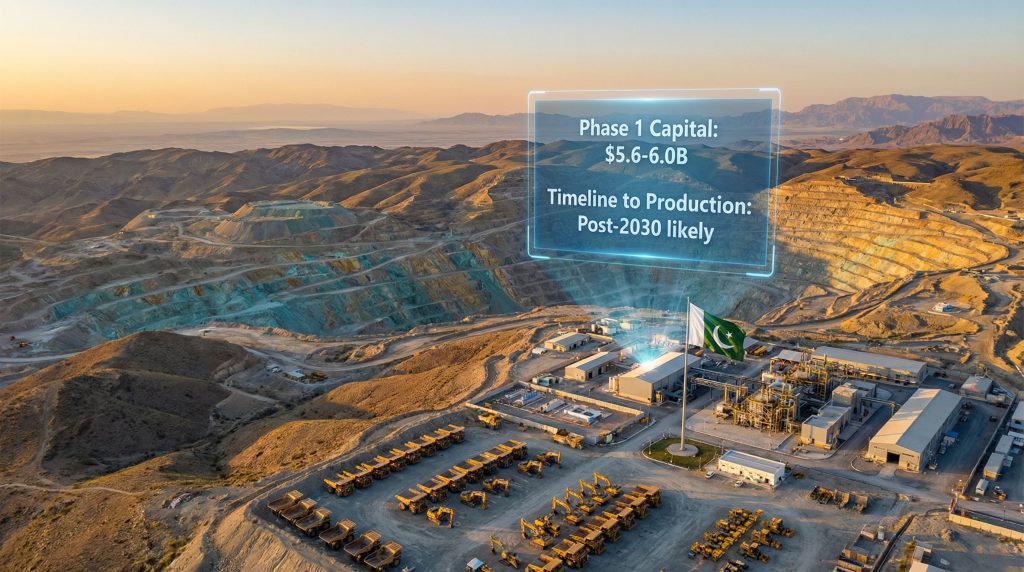
The financial implications of security-driven delays prove substantial across multiple dimensions. Original Phase 1 capital estimates of $5.6-6.0 billion face potential increases of 15-25 percent, while Phase 2 projections of $3.3-3.6 billion remain under comprehensive review. These escalations reflect not only construction cost inflation during delay periods but also enhanced security infrastructure requirements, modified operational protocols, and increased insurance costs reflecting elevated risk assessments.
Capital Impact Analysis During Security Reviews
| Impact Category | Original Estimate | Revised Projection | Variance |
|---|---|---|---|
| Phase 1 Capital | $5.6-6.0B | TBD (Significant increase expected) | +15-25% estimated |
| Phase 2 Capital | $3.3-3.6B | Under review | TBD |
| Timeline to Production | End 2028 | Post-2030 likely | 2+ year delay |
| Annual Carrying Costs | $200-300M | $150-200M (reduced activity) | Variable |
Companies experiencing security-related delays must also consider opportunity costs associated with capital tied up in suspended projects. Alternative investment scenarios for allocated capital become increasingly attractive when security reviews extend beyond 18-24 months. However, portfolio optimisation strategies during these periods often involve accelerating development at projects in more stable jurisdictions while maintaining minimal viable presence at suspended operations.
When big ASX news breaks, our subscribers know first
Why Balochistan's Strategic Location Creates Unique Investment Challenges
The Reko Diq project's location in Chagai district of Balochistan, with proximity to Afghanistan and Iran borders, creates exceptional security complexities that distinguish it from mining operations in more politically stable regions. This tri-border positioning exposes the project to overlapping jurisdictional challenges, cross-border security threats, and regional instability dynamics that can rapidly affect operational safety and supply chain integrity.
Geographic Risk Concentration in Critical Mineral Supply Chains
Balochistan's position at the intersection of three national jurisdictions creates what security specialists term geographic risk concentration, where multiple threat vectors converge in a single operational area. The province's extensive border with Afghanistan and Iran exposes mining operations to spillover effects from regional conflicts, cross-border militant activities, and trafficking networks that exploit porous international boundaries. Moreover, these challenges directly impact critical minerals energy security considerations for global supply chains.
The region's sparse population density and limited government presence compound security challenges by reducing civilian oversight and emergency response capabilities. Chagai district encompasses approximately 44,427 square kilometres with predominantly pastoral and trading communities, creating vast areas with minimal official security infrastructure. This geographic reality requires mining operations to develop comprehensive self-reliant security systems capable of operating independently of local law enforcement capabilities.
Border proximity effects on mining operations include supply chain vulnerabilities where essential equipment and materials must transit potentially unstable crossing points, personnel movement complications requiring coordination with multiple national border agencies, and communication challenges in remote areas with limited infrastructure redundancy. These factors collectively increase operational costs and timeline uncertainty compared to projects in more developed regions.
Historical analysis of the Afghanistan-Iran-Pakistan corridor reveals recurring patterns of cross-border instability, tribal conflicts, and militant activities that create persistent security challenges. The region's complex ethnic and political dynamics, combined with economic factors including smuggling networks and informal taxation systems, establish baseline security conditions that require specialised management approaches.
Joint Venture Governance Under Security Pressure
Complex joint venture structures involving international corporations and state entities face particular governance challenges when security conditions deteriorate rapidly. Decision-making protocols must accommodate different risk tolerances, legal frameworks, and political considerations among partners with varying exposure levels to regional security threats. Barrick's consultation with joint venture partners during the security review process illustrates these collaborative decision-making requirements.
Partnership dynamics during security crises often reveal fundamental differences in risk assessment methodologies between international mining corporations and local governmental or quasi-governmental entities. International companies typically employ conservative security standards reflecting global corporate governance requirements and shareholder protection obligations, whilst local partners may have different perspectives on acceptable risk levels based on regional experience and political considerations.
Stakeholder alignment strategies in high-risk environments require continuous communication protocols, shared intelligence gathering capabilities, and coordinated response planning for various security scenarios. These collaborative frameworks must balance the need for rapid decision-making during crisis situations with the requirement for consensus among partners with potentially conflicting interests and priorities. In addition, understanding the broader geopolitical mining landscape becomes crucial for effective partnership management.
What Are the Financial Implications of Extended Project Reviews?
Extended security reviews generate complex financial implications that extend far beyond simple delay costs, encompassing capital escalation, opportunity costs, financing complications, and market valuation effects. The comprehensive nature of these financial impacts requires sophisticated modelling techniques that account for multiple interacting variables over extended time periods.
Capital Budget Escalation Modelling for Delayed Mega-Projects
Mining project delays in frontier markets typically result in significant capital cost escalation due to multiple reinforcing factors. Construction material and equipment costs continue increasing during delay periods, often at rates exceeding general inflation due to supply chain constraints and specialised mining industry demand patterns. Furthermore, labour costs similarly escalate, particularly for skilled technical personnel required for complex copper-gold development projects.
Security-driven design modifications represent a major source of capital escalation for projects experiencing extended reviews. Enhanced perimeter security systems, upgraded personnel protection facilities, expanded emergency response capabilities, and fortified operational infrastructure all require substantial additional investment beyond original project specifications. These security enhancements often prove non-negotiable requirements for resuming development in deteriorated security environments.
The time value of money calculations for mega-projects experiencing 24+ month delays create substantial financial impacts independent of direct cost escalations. When applied to combined Phase 1 and Phase 2 capital budgets totalling $8.9-9.6 billion, even modest discount rate applications generate hundreds of millions in additional financing costs. Construction cost inflation averaging 3-4 percent annually compounds these effects, potentially adding $534-768 million in escalated costs over a two-year delay period.
Insurance cost escalation represents another significant factor in capital budget increases following security incidents. Political risk insurance, project completion insurance, and personnel coverage all experience premium increases when underwriters reassess regional risk profiles. However, these insurance cost increases often prove permanent rather than temporary, affecting project economics throughout operational lifespans rather than only during development phases.
Opportunity Cost Analysis for Shareholders
Shareholders of companies experiencing extended project delays face substantial opportunity costs as capital remains committed to suspended developments rather than generating returns through alternative investments. Comparative analysis of other copper-gold development projects reveals that investors could potentially achieve superior returns by redirecting capital to operations in more stable jurisdictions with clearer development timelines.
Portfolio optimisation strategies during delay periods require careful balancing of maintaining strategic positions in high-potential projects against pursuing more immediate returns from alternative investments. Mining companies must communicate effectively with shareholders regarding the long-term value preservation rationale for maintaining suspended project positions rather than liquidating assets during uncertainty periods.
The market valuation effects of extended security reviews typically prove more severe than simple delay cost calculations might suggest. Equity markets often apply significant risk premiums to companies with substantial exposure to frontier market projects experiencing security challenges. Consequently, these valuation discounts can persist well beyond resolution of immediate security concerns, reflecting ongoing market scepticism regarding management's ability to successfully navigate complex geopolitical environments.
How Do Security Incidents Impact Mining Project Valuations?
Security incidents create immediate and lasting effects on mining project valuations through multiple transmission mechanisms including market sentiment shifts, credit rating implications, insurance cost increases, and institutional investor behaviour changes. These valuation effects often prove disproportionate to direct operational impacts, reflecting market risk aversion and uncertainty regarding future security conditions.
Market Response Mechanisms to Operational Uncertainty
Equity markets typically respond to mining security incidents with immediate share price volatility followed by sustained risk premium applications that can persist for extended periods. The magnitude of these market responses often exceeds reasonable estimates of direct financial impacts, reflecting investor uncertainty regarding management's ability to effectively navigate complex security environments and resume normal operations.
Institutional investor behaviour during security crises reveals systematic risk aversion patterns that affect mining company access to capital markets. Many institutional investment mandates specifically limit exposure to companies with significant operations in regions experiencing active security incidents, creating potential liquidity constraints and financing complications for affected mining corporations. This trend aligns with broader US uranium policy measures that reflect increasing political risk considerations in resource investment decisions.
Credit rating agencies apply sophisticated risk assessment frameworks that incorporate security incident frequency, regional stability trends, and management response effectiveness when evaluating mining company creditworthiness. Extended security reviews often trigger credit rating reviews that can result in downgrades affecting borrowing costs and debt covenant compliance requirements across entire corporate structures.
Market volatility patterns during security incidents typically follow predictable sequences beginning with sharp initial sell-offs, followed by partial recovery phases, and concluding with sustained risk premium applications until security conditions demonstrate clear improvement. Understanding these patterns enables more effective investor communication strategies and market timing considerations for capital raising activities.
Insurance and Risk Transfer Strategies
Political risk insurance markets have evolved sophisticated products designed to protect mining investments against security-related losses, but coverage limitations and exclusions often prove more restrictive than companies initially anticipate. Insurance underwriters employ increasingly sophisticated risk assessment techniques that result in higher premiums and more restrictive coverage terms for projects in unstable regions.
Consortium-based risk sharing models enable mining companies to distribute security risks among multiple stakeholders, reducing individual exposure levels while maintaining project development capabilities. These collaborative structures require careful legal framework development and ongoing coordination mechanisms to ensure effective risk allocation and decision-making processes.
Government guarantee structures in joint venture arrangements can provide partial protection against political risks, but these instruments often prove limited in scope and may not cover security incident-related losses. The effectiveness of government guarantees depends heavily on the financial capacity and political stability of guarantor governments, factors that may correlate with the security risks they are intended to mitigate.
What Alternative Development Scenarios Could Emerge?
Mining companies facing extended security reviews have developed innovative approaches to maintaining project momentum whilst minimising risk exposure. These alternative development scenarios encompass phased construction strategies, enhanced technology integration, and modified operational protocols designed to reduce vulnerability whilst preserving long-term project value.
Phased Development Optimisation Under Constraint
Modular construction approaches enable mining operations to minimise on-site exposure during unstable security periods whilst maintaining development progress through off-site fabrication and preparation activities. These strategies involve constructing major project components in secure locations for later transportation and assembly, reducing both personnel exposure and asset vulnerability during high-risk periods.
Remote operation capabilities have advanced significantly in recent years, enabling mining operations to maintain productive capacity with substantially reduced on-site personnel requirements. Advanced automation systems, remote monitoring technologies, and drone-based surveillance capabilities allow companies to continue essential operations whilst minimising human exposure to security threats. These developments reflect broader mining industry innovation trends transforming operational approaches.
Technology integration for enhanced security monitoring encompasses sophisticated sensor networks, satellite surveillance systems, and predictive analytics platforms capable of identifying potential security threats before they materialise into incidents. These technological solutions provide early warning capabilities that enable proactive response measures rather than reactive crisis management.
Phased development strategies also involve careful sequencing of capital deployment to minimise sunk costs during security reviews whilst maintaining project development momentum. Companies can focus initial investments on secure infrastructure development, off-site preparation activities, and technology system implementation that provide value regardless of security condition changes.
Strategic Partnership Restructuring Options
Enhanced local stakeholder integration represents a critical strategy for improving project security through community alignment and regional support development. Mining companies increasingly recognise that robust community partnerships provide more effective long-term security than purely defensive security measures, creating shared interests in project success and stability.
Military-civilian cooperation frameworks in some jurisdictions provide structured approaches to security management that leverage official security capabilities whilst maintaining appropriate civilian operational control. These arrangements require careful legal and political navigation to ensure compliance with international standards and corporate governance requirements.
Community investment amplification strategies during security review periods can strengthen local support networks whilst maintaining project visibility and stakeholder engagement. Companies like Barrick continue investing in existing community programmes despite reduced development activity, recognising that sustained community relations prove essential for long-term project viability.
Which Global Copper Projects Benefit from Reko Diq's Delay?
Extended delays at major copper development projects create competitive advantages for alternative copper sources through accelerated investment flows, enhanced market positioning, and supply chain rebalancing opportunities. Mining companies with projects in more stable jurisdictions often experience increased investor interest and accelerated development timelines when competing projects face security-related delays.
Competitive Positioning Analysis
When major copper projects face delays, competing developments often experience accelerated investment and development timelines as capital and market attention shift to more stable jurisdictions.
Alternative copper development projects in politically stable regions benefit from increased investor attention and potentially accelerated financing as capital markets seek exposure to copper price appreciation without accepting elevated political risks. This dynamic creates competitive advantages for projects that previously struggled to attract investment due to relative disadvantages in resource quality or development costs. For instance, Barrick's recent Reko Diq update has highlighted these competitive dynamics in the copper sector.
Established copper producers in stable jurisdictions may experience enhanced market positioning as supply concerns increase due to delayed new production from projects like Reko Diq. These positioning improvements can translate into improved long-term supply agreements, enhanced pricing power, and increased market valuations reflecting scarcity premiums.
Regional supply chain advantages emerge for copper projects located in areas with established infrastructure, reliable logistics networks, and stable regulatory environments. These advantages become more pronounced when competing projects face supply chain vulnerabilities due to security concerns or geographic isolation in unstable regions.
Supply Chain Rebalancing Opportunities
Consuming nations increasingly prioritise supply security alongside cost considerations when establishing long-term copper sourcing strategies. Delays at major projects in unstable regions accelerate this rebalancing toward suppliers in more reliable jurisdictions, even when this involves accepting higher costs or lower quality resources.
Strategic reserve building by major copper-consuming countries reflects growing recognition that supply security considerations warrant premium pricing for reliable sources. This trend benefits established suppliers and projects in stable regions whilst creating additional challenges for developments in frontier markets experiencing security concerns.
Alternative supply source development receives accelerated investment and policy support as governments and corporations seek to reduce dependence on potentially unreliable suppliers. These acceleration efforts often involve enhanced financing terms, expedited permitting processes, and strategic partnership arrangements designed to encourage rapid development in preferred jurisdictions. However, security concerns affecting mining projects continue to influence global supply chain strategies.
The next major ASX story will hit our subscribers first
How Are Community Relations Being Maintained During the Slowdown?
Maintaining positive community relationships during operational slowdowns proves critical for preserving long-term social licence and ensuring successful project resumption when security conditions improve. Mining companies must balance reduced operational activity with continued community engagement and investment to prevent relationship deterioration during extended delay periods.
Social Investment Continuity Strategies
Barrick to slow development at Reko Diq whilst maintaining community commitments demonstrates recognition that community relationship maintenance requires sustained investment regardless of operational status. These programmes often provide essential services and economic opportunities for local communities that become dependent on mining company support for healthcare, education, and infrastructure development.
Local employment preservation during reduced operations involves creative workforce management strategies that maintain essential personnel whilst reducing overall staffing levels. Companies often prioritise retaining local employees over expatriate staff during slowdown periods, recognising that local workforce relationships prove essential for successful operational resumption.
Community programme sustainability frameworks require careful financial planning to ensure continued funding availability throughout extended delay periods. These frameworks must account for reduced project cash flows whilst maintaining programme effectiveness and community impact levels that preserve stakeholder relationships.
Transparent communication regarding project status and future intentions helps maintain community confidence despite operational uncertainty. Regular stakeholder meetings, progress updates, and clear communication regarding security concerns and resumption conditions help prevent speculation and maintain constructive dialogue with community leaders.
Long-term Social Licence Preservation
Trust-building mechanisms during operational pauses require sustained engagement and demonstration of long-term commitment despite current operational limitations. Mining companies must continuously reinforce their intention to resume operations whilst acknowledging legitimate security concerns and timeline uncertainties.
Cultural sensitivity maintenance in reduced-activity scenarios involves continued participation in local customs, religious observances, and community events that demonstrate respect for local traditions and sustained commitment to community integration. These activities often prove more important during difficult periods than during normal operations.
Social licence preservation strategies must account for potential competition from other economic development initiatives that may emerge during mining project delays. Communities may explore alternative economic opportunities during extended mining delays, requiring companies to maintain competitive community investment levels to preserve future operational viability.
What Does This Mean for Pakistan's Mining Sector Development?
The Barrick to slow development at Reko Diq situation carries implications extending beyond the immediate project to Pakistan's broader mining sector development prospects, international investment attractiveness, and resource development strategy implementation. These broader implications affect government policy responses, regional economic planning, and future investment promotion strategies.
National Resource Development Strategy Implications
Pakistan's mineral sector investment attractiveness faces potential negative impacts from high-profile project delays, particularly when these delays relate to security concerns that may affect multiple regions or project types. International investors often apply broad risk assessments to entire countries rather than evaluating projects individually, creating spillover effects from specific project challenges.
Government response mechanisms to maintain investor confidence become critical during high-profile project delays. These responses may include enhanced security provision commitments, revised regulatory frameworks designed to address investor concerns, and promotional activities highlighting successful projects in other regions or sectors.
Infrastructure development continuity despite project delays requires careful government planning to ensure that transportation, power, and communication infrastructure developments continue even when anchor mining projects experience delays. These infrastructure investments often prove essential for future mining development regardless of specific project timelines.
Regional economic diversification strategies may receive increased emphasis during mining project delays as governments and communities seek alternative economic development pathways that reduce dependence on single large-scale projects. These diversification efforts can provide economic resilience whilst maintaining readiness for mining development resumption.
Regional Economic Development Considerations
Balochistan provincial economic planning must accommodate potential extended delays at Reko Diq whilst maintaining development momentum in other sectors and regions. This planning requires careful resource allocation balancing immediate economic needs against long-term mining development preparation requirements.
Alternative economic development pathway exploration becomes more urgent during mining project delays as communities and governments seek immediate economic opportunities that can provide employment and development benefits whilst mining projects remain suspended. These alternatives may include agriculture development, small-scale manufacturing, or service sector initiatives.
Cross-border cooperation implications for regional stability encompass both challenges and opportunities as security concerns affect international investment whilst potentially creating incentives for enhanced regional security cooperation. Improved tri-border security coordination could benefit multiple economic development initiatives beyond mining projects.
When Might Development Resume and Under What Conditions?
Predicting mining project resumption timelines requires analysis of multiple interacting factors including security condition improvement, market dynamics, regulatory developments, and corporate strategic priorities. The Barrick to slow development at Reko Diq situation illustrates the complexity of these resumption decisions and the multiple variables that influence timing considerations.
Security Threshold Establishment for Project Restart
Measurable security improvement benchmarks provide objective criteria for evaluating conditions suitable for development resumption. These benchmarks typically include incident frequency reduction targets, regional stability indicators, and law enforcement capability assessments that demonstrate sustainable security improvements rather than temporary fluctuations.
Stakeholder confidence restoration requirements encompass multiple constituencies including shareholders, joint venture partners, local communities, and government entities. Restoration strategies must address each stakeholder group's specific concerns and demonstrate sustainable risk mitigation measures that provide reasonable assurance of continued operational viability.
Government stability indicators for investment resumption extend beyond immediate security concerns to encompass broader political stability, policy continuity, and regulatory predictability factors that affect long-term investment viability. These indicators help distinguish between temporary security fluctuations and more fundamental political instability that may require extended delay periods.
International security assessment validation through third-party risk evaluation services provides objective verification of security condition improvements and helps establish credible benchmarks for resumption decisions. These assessments often prove essential for satisfying insurance requirements and board governance standards for major capital deployments.
Market Timing Considerations for Project Reactivation
Copper price environment optimisation for restart decisions involves sophisticated market analysis considering global supply-demand balances, economic growth projections, and competing project development timelines. Higher copper prices can justify enhanced security investments and risk acceptance levels that enable earlier project resumption.
Global supply-demand balance influence on timing reflects the reality that tight copper markets create stronger incentives for overcoming security challenges and accepting elevated risk levels compared to periods of oversupply when delay costs prove more acceptable. Market fundamentals thus directly influence risk tolerance and resumption timeline decisions.
Competitive landscape evolution during delay periods affects project value propositions and market positioning when development eventually resumes. Companies must monitor competing project progress, technological developments, and market structure changes that may alter project competitiveness during extended delay periods.
Disclaimer: This analysis is based on publicly available information and involves forward-looking statements regarding security conditions, market developments, and project timelines that are inherently uncertain. Readers should conduct independent research and consult qualified advisors before making investment decisions. Mining investments in frontier markets involve substantial risks including political instability, security threats, regulatory changes, and market volatility that can result in significant losses.
Looking to Position Yourself Ahead of Market-Moving Mining Developments?
Discovery Alert's proprietary Discovery IQ model delivers instant notifications on significant ASX mineral discoveries, empowering investors to identify actionable opportunities before the broader market responds. Don't miss the next major breakthrough that could reshape commodity markets—explore Discovery Alert's historic discovery examples and begin your 14-day free trial today to secure your competitive advantage in mining investments.