July 24, 2026
The Brownfield Paradox: Why Built Infrastructure Is Both the Prize and the Trap
Copper mining has a counterintuitive problem. The assets most investors assume carry the lowest risk, past-producing mines with existing infrastructure, often carry a different and underappreciated set of risks compared to greenfield projects. The inherited physical plant is real. The inherited planning assumptions, capital structures, and permit shortcuts of the previous operator are equally real, and they do not disappear with a change of ownership.
This distinction sits at the core of the Selkirk Copper Minto mine restart thesis. The Minto operation in central Yukon is not a discovery story. It is a fully built copper-gold-silver mine that has already produced, already failed under one owner, and is now being rebuilt around an entirely different operating logic by a second.
Understanding why the first attempt failed, and what conditions must hold for the second to succeed, is the only framework that matters for evaluating this project.
When big ASX news breaks, our subscribers know first
What the Previous Operator Got Wrong at Minto
The prior operator restarted production at Minto in the second half of 2019. By May 2023, the company was in bankruptcy. The collapse was not geological. The orebody delivered; the planning and capital structure around it did not.
Three compounding failures defined the outcome:
-
Short mine plans optimised for early high-grade throughput. The operating model ran 5 to 7-year plans on the highest-grade material available, deferring mine-life extension decisions until after production had commenced. This compressed the window during which the operation had to recover its capital, exposing it to a single phase of the metal price cycle rather than a full cycle.
-
Permit assumptions carried into production rather than resolved beforehand. The previous operator made regulatory assumptions that were tested in operations rather than being confirmed before capital was committed. When those assumptions proved incorrect or incomplete, they created operational constraints mid-stream, the worst possible moment.
-
A leveraged balance sheet that claimed the cash flow before it arrived. A gold and silver stream held by Wheaton Precious Metals drew more than US$250 million over the mine's operating life. A concentrate offtake held by Sumitomo added a fixed structural obligation on top of that. Together, these claims subordinated shareholders to a debt-like structure that left no margin for error when prices moved or production stumbled.
The Minto orebody did not fail. The capital structure and planning sequence around it did. That distinction is what makes the restart thesis structurally coherent rather than speculative.
How Selkirk Copper Is Rebuilding the Minto Mine Around a Different Logic
The 12 to 15-Year Integrated Mine Plan: A Fundamental Inversion
Selkirk Copper (TSXV: SCMI | OTCQB: SKRKF | FRA: IO20) controls the Minto Project through an ownership structure that is itself unusual. The Selkirk First Nation acquired 100% of the Minto Project and vended it into Selkirk Copper through a reverse takeover, retaining an 18.2% shareholding with a controlling equity stake held through a wholly owned subsidiary. This alignment between the company and the First Nation on whose Category A settlement lands the mine sits is not incidental. It carries a concrete financial consequence: the only royalty on the project is a 1.5% net smelter return (NSR) payable to the Selkirk First Nation.
The physical asset that Selkirk inherited is substantial. The Minto site carries:
- A 4,100 tpd processing plant with an established flotation circuit
- A 400-person full-rotation camp
- Water treatment infrastructure
- Grid power connection
- Road and barge access
- Open-pit and underground workings across 26,850 hectares of claims in the Minto-Carmacks copper belt, approximately 250 km north of Whitehorse
The strategic question is not whether Minto can produce. It is whether a different planning approach can sustain production across a full metal price cycle.
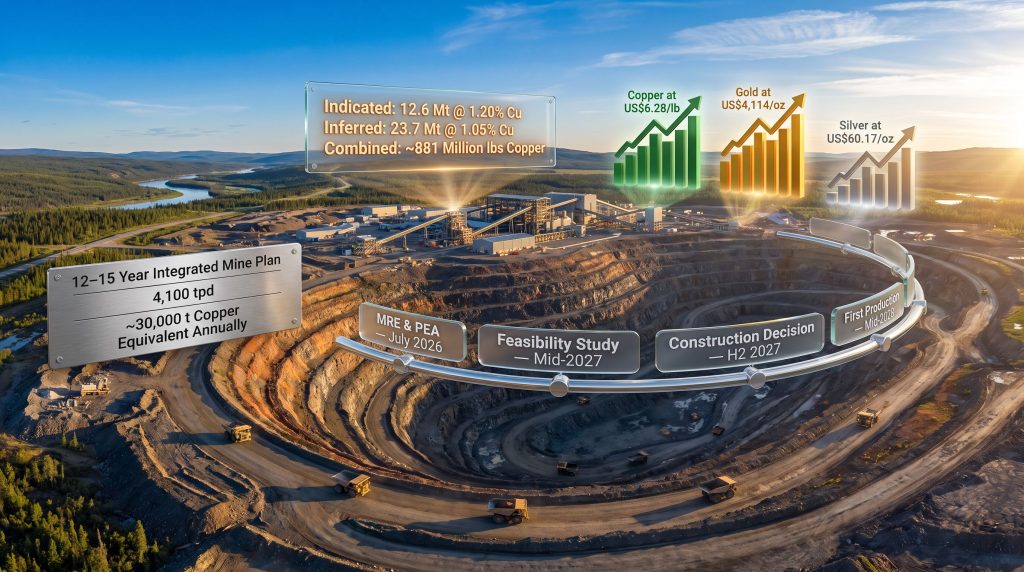
Selkirk's answer is a complete 12 to 15-year integrated open-pit and underground mine plan designed before a restart decision is committed to, rather than optimised after capital has been deployed. The plan draws roughly equal feed volumes from the Ridgetop open pit and underground workings for the first 7 to 8 years before transitioning toward predominantly underground feed. At 4,100 tpd (~1.5 million tonnes per annum), the operation targets approximately 30,000 tonnes of copper equivalent annually in concentrate, averaging:
- 18,000 to 22,000 tonnes of copper per year
- 25,000 ounces of gold per year
- ~250,000 ounces of silver per year
An ore-blending strategy is central to sustaining these throughput rates. By keeping mining consistently ahead of milling at steady blended grades, the operation maintains nameplate capacity without depending on consistently high-grade faces being available. Furthermore, a 12 to 15-year plan is not simply a longer version of a 5 to 7-year plan. It demands a fundamentally different approach to capital allocation, feed sequencing, and financial structure at every stage.
The Resource Foundation: What the Ground Actually Contains
The mineral resource underpinning the long-life plan carries a technical report with an April 2025 effective date. Consequently, the numbers are material when interpreting drill results from this project:
| Resource Category | Tonnes (Mt) | Copper Grade (%) | Gold Grade (g/t) | Silver Grade (g/t) |
|---|---|---|---|---|
| Indicated | 12.6 | 1.20 | 0.46 | 4.27 |
| Inferred | 23.7 | 1.05 | – | – |
| Combined Contained Copper | ~881 million lbs | – | – | – |
A detail that carries significant weight for the long-term upside case: only 3 km of a 7 km mineralised trend has been drilled. Near-mine ground that the Selkirk First Nation had not previously opened to operators is now accessible through the current ownership structure, representing genuine exploration upside that sits entirely outside the base case mine plan.
Permitting-First: The Regulatory Sequence That Defines Whether the Thesis Holds
Resolving Licences Before Capital, Not During Production
Selkirk is reviewing and amending every existing licence, covering quartz mining, exploration, and water authorisations, against the complete 12 to 15-year mine life before committing to a restart. Understanding grade, king, permitting dynamics is critical here — this is a direct reversal of the approach the prior operator took, and it is the most operationally unglamorous and strategically important work the company is doing.
The company has hired a dedicated director of permitting and awarded consultant contracts in early 2026 to execute this work. Water management sits inside the permitting workstream as a distinct sub-task: engineers are planning the removal and treatment of water that the Yukon Government stored underground during the closure period.
The territorial political environment has shifted toward a pro-mining posture following the Yukon Party's majority win of 14 of 21 seats in the November 2025 territorial election. A supportive regulatory environment reduces timing uncertainty at the margin. However, it does not substitute for the permit amendment process itself, and investors should treat the distinction carefully.
Risk Flag: Permitting timing is the single most binary constraint in the entire restart sequence. A delay beyond the October 2026 target for amended permit submission would cascade directly through the feasibility study timeline and into the construction decision window.
The amended permit file is targeted for submission to the Yukon Government and the Selkirk First Nation in October 2026, fixing the regulatory milestone rather than leaving it as a rolling variable.
What a Brownfield Base Actually Changes About Study Quality
One of the less appreciated advantages of a past-producing mine is what it removes from the study process. At Minto, rock strength, ground conditions, mining method, metallurgy, and processing behaviour are all characterised by a large historical operational database. The engineering work required for the upcoming definitive feasibility study is incremental rather than foundational.
New engineering requirements include additions such as a three-stage crushing circuit for efficiency improvements. They do not include designing a mill, specifying a flotation circuit, building a camp, or connecting grid power. Those assets exist.
This has a direct consequence for cost estimate quality. The Trade-Off Study and PEA engineering, being led by Hatch Ltd. and SRK Consulting (both of which have prior Minto site experience), can draw on vendor quotes for real equipment and fully built-out owner staffing rosters rather than parametric assumptions. That produces a more reliable cost basis at this stage than a comparable greenfield study would deliver.
The drilling programme reinforces this picture:
- Phase 1: 52,288 metres across 175 holes; economic-grade mineralisation in 87% of holes; average advance rate of ~94 metres per day per drill through winter conditions
- Phase 2: 50,000 metre target; 27,300 metres across 104 holes completed by end of June 2026, running ahead of schedule across four rigs
Key intercepts confirming grade continuity in priority resource areas:
- 117 Lens: 1.35% copper equivalent over 22.7 metres from approximately 317 metres depth, immediately adjacent to existing underground infrastructure
- Minto North: 2.59% copper equivalent over 4.5 metres, open to the west
Feasibility-level field data is being collected concurrently this summer, including geotechnical drilling, test pitting around planned pits and underground development zones, waste and tailings facility assessments, and geometallurgical and structural work. Because the ground conditions are already documented, the study inherits characterised inputs rather than open questions.
The Clean Balance Sheet: Financing After the Legacy Claims Were Removed
What the Bankruptcy Erased and What It Left Behind
The bankruptcy proceedings achieved something that no negotiation could have: they stripped out both of the contracts that had been extracting value from Minto's cash flows before shareholders could access them.
The removal of the Wheaton Precious Metals gold and silver stream, which had drawn more than US$250 million over the mine's operating life, improves net cash flow directly on every tonne produced. The removal of the Sumitomo concentrate offtake converts from a fixed obligation into an open financing lever that management can now deploy strategically.
What remains on the project is a single 1.5% NSR royalty payable to the Selkirk First Nation. That is the entire encumbrance stack.
The Proposed Financing Stack: Sequencing Capital to Avoid Repeating the Failure
The financing approach is built around a specific sequencing logic designed to introduce each capital layer only after the preceding one is exhausted:
-
Offtake prepayment (first and cleanest source): The Minto concentrate carries a historic copper grade of approximately 39% with low deleterious elements and has historically shipped largely to Japan. A high-grade, clean concentrate commands strong market interest and allows an offtake prepayment to serve as the primary capital source without diluting shareholders or surrendering precious-metal credits.
-
Project finance: Conventional debt secured against the feasibility study and a formal construction decision.
-
Selective silver stream: Considered only because silver represents approximately 2% of revenue. A gold stream is not under consideration; gold is the primary precious-metal credit and preserving it is a stated financing discipline.
-
Convertibles as backstop: Held in reserve rather than deployed early, ensuring dilution is a last resort rather than a default mechanism.
A C$35 million equity raise completed in April 2026 funds the current drilling and study work through to the restart decision point without drawing prematurely on the offtake or stream instruments.
Metal Price Context as a Structural Margin of Safety
In addition, broader copper market trends provide important context when assessing the project's economic resilience:
| Metal | Price (January 2023) | Price (Mid-2026) | Change |
|---|---|---|---|
| Copper | ~US$3.76/lb | US$6.28/lb | +67% |
| Gold | ~US$1,840/oz | US$4,114/oz | +123% |
| Silver | ~US$24.30/oz | US$60.17/oz | +148% |
Every tonne scheduled in Minto's 12 to 15-year mine plan is worth materially more today than it was when the prior operator entered bankruptcy. Elevated prices improve the margin of safety across the life of mine. However, they do not substitute for the planning and permitting work. The distinction is important for investors evaluating whether the current economics represent genuine structural improvement or temporary price momentum.
The next major ASX story will hit our subscribers first
Mapping the Real Risks: Where Execution Risk Has Migrated
Because geology, metallurgy, and infrastructure are effectively settled variables, the binding risks of the Selkirk Copper Minto mine restart have migrated downstream to three specific areas:
1. Permitting timing
Whether amended licences are submitted by October 2026 and approved on a schedule consistent with the mid-2027 feasibility study completion and H2 2027 construction decision. A delay here cascades through every subsequent milestone.
2. Staffing
Whether the operation can be resourced on schedule given Yukon's remote location. Remote northern operations have faced labour availability constraints in prior cycles, and a staffing shortfall at commissioning affects ramp-up rates and operating costs per tonne during the critical early production phase.
3. Plan discipline
Whether management holds the 12 to 15-year integrated plan under price pressure rather than reverting to the high-grade mining option that remains technically available. Reverting to short, grade-led extraction would recreate precisely the conditions that caused the prior bankruptcy. Understanding cut-off grade economics is therefore essential for monitoring this risk.
Speculative note: If copper prices were to weaken materially before a construction decision is made, the temptation to mine out the highest-grade material first to accelerate payback is a real behavioural risk. Management has acknowledged this option exists as a price-defence mechanism while stating it is not the base case. Investors should monitor the consistency of the mine plan across changing price environments.
The Milestone Framework: From Study to First Production
| Milestone | Target Date |
|---|---|
| Updated Mineral Resource Estimate (MRE) | H2 July 2026 |
| Preliminary Economic Assessment (PEA) | H2 July 2026 |
| Feasibility Study commencement | Q3 2026 |
| Amended permit file submission | October 2026 |
| Feasibility Study completion | Mid-2027 |
| Construction decision | H2 2027 |
| Mill commissioning | Q1 2028 |
| First production | Mid-2028 |
The PEA and updated MRE represent the first economic assessment of the Minto project since 2021, establishing the baseline against which all subsequent study work will be measured. Management identifies three milestones as the primary investor tests before any construction capital is committed: the PEA and MRE release, the feasibility study commencement, and the October 2026 permit submission.
Frequently Asked Questions: Selkirk Copper Minto Mine Restart
What is the Minto mine and where is it located?
Minto is a past-producing copper-gold-silver operation in central Yukon, approximately 250 kilometres north of Whitehorse on the Klondike Highway. The site covers 26,850 hectares within the Minto-Carmacks copper belt and includes a 4,100 tpd processing plant, a 400-person camp, water treatment infrastructure, grid power, road and barge access, and both open-pit and underground workings. For further background, resourceworld.com has covered the project's broader context in detail.
Why did the previous Minto operator go bankrupt in 2023?
The prior operator restarted production in the second half of 2019 and entered bankruptcy in May 2023. The failure was not attributable to the orebody, which had produced consistently. It resulted from a combination of short, grade-led mine plans of 5 to 7 years, permit assumptions carried into production rather than resolved beforehand, and a heavily leveraged balance sheet that included a gold and silver stream and a concentrate offtake agreement with fixed obligations.
How is Selkirk Copper's mine plan different from the prior operator's?
Selkirk is designing a complete 12 to 15-year integrated open-pit and underground operation at 4,100 tpd before committing to a restart. Every existing licence is being amended against that full mine life before a restart decision is made. The financing structure is being sequenced to avoid the over-leverage that caused the prior failure, beginning with an offtake prepayment rather than streams or convertibles.
What infrastructure already exists at Minto?
The site retains a 4,100 tpd processing plant, a 400-person full-rotation camp, water treatment facilities, road and barge access, grid power, and existing open-pit and underground workings. New engineering requirements are incremental, such as a three-stage crushing circuit, rather than foundational.
What are the key catalysts investors should monitor?
The three milestones management identifies as primary investor tests before construction capital is committed are: the updated MRE and PEA targeted for H2 July 2026, the commencement of the feasibility study in Q3 2026, and the amended permit file submission in October 2026. Mining News North has outlined how these milestones will determine whether the mid-2027 feasibility study completion and mid-2028 first production targets remain on track.
The Investment Thesis: Orebody or Operator?
The Selkirk Copper Minto mine restart thesis does not rest on geological discovery or infrastructure construction. Both of those variables are settled. The thesis rests entirely on whether the current operator executes the disciplined, unglamorous work that the prior operator did not: full-life planning before capital commitment, permit amendment before production assumption, and a financing sequence designed to avoid the over-leverage that ended the first attempt.
The near-mine exploration potential on ground the Selkirk First Nation had not previously opened to operators represents genuine upside to the base case, not a dependency of it. The metal price environment since the prior bankruptcy materially improves the economics of every tonne in the plan. Neither of these factors substitutes for execution on the three binding risks that remain.
The October 2026 permit submission and the H2 July 2026 PEA release are the first hard tests of whether this approach holds. Both arrive before any construction capital is committed. That sequencing is deliberate, and it is the clearest signal available to investors about whether the Minto restart thesis is being built on a structurally different foundation than the one that failed in 2023.
Disclaimer: This article is for informational purposes only and does not constitute financial advice. The Selkirk Copper Minto mine restart involves forecasts, timelines, and production targets that are subject to material risks including permitting delays, metal price volatility, staffing constraints, and changes in operating conditions. Past production at the Minto mine does not guarantee future results. Investors should conduct independent due diligence before making investment decisions.
Want to Be Among the First to Know When the Next Major ASX Mineral Discovery Hits the Market?
Discovery Alert's proprietary Discovery IQ model scans ASX announcements in real time, instantly translating complex mineral data across more than 30 commodities into clear, actionable insights — so subscribers are positioned ahead of the broader market the moment a significant discovery is announced. Explore Discovery Alert's discoveries page to understand how historic finds have generated substantial returns, and begin your 14-day free trial at Discovery Alert to secure your market-leading edge today.