June 5, 2026
Strategic Development Framework for Senegal's Emerging Gold Sector
West African gold mining faces unprecedented transformation as jurisdictions compete to establish themselves as premier investment destinations. The region's geological endowments, combined with evolving regulatory frameworks, create opportunities for strategic project development that can reshape national mining sectors. Senegal's emergence within this competitive landscape demonstrates how targeted development models can accelerate a country's transition from exploration-focused to production-oriented mining economy, with the Diamba Sud gold project in Senegal serving as a cornerstone development.
Strategic Development Phases for Senegal's Gold Sector:
• Foundation Phase (2025-2026): Regulatory framework establishment and permitting acceleration
• Construction Phase (2027-2028): Infrastructure development and processing facility construction
• Production Ramp (2028-2030): Operational optimization and market positioning
• Mature Operations (2030+): Economic contribution maximization and regional hub development
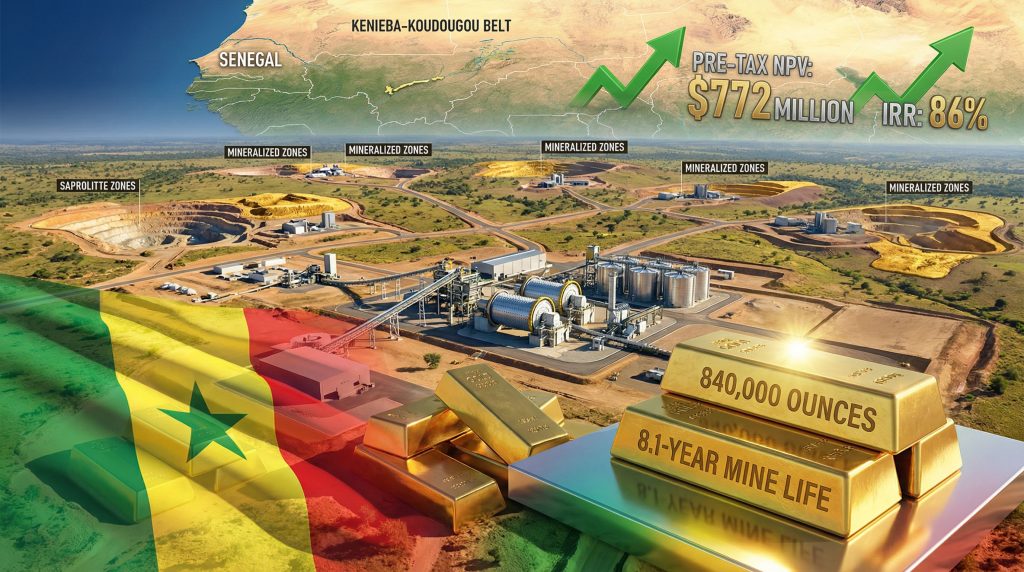
The Diamba Sud gold project in Senegal represents a critical milestone in the nation's strategic positioning, targeting first gold production in Q2 2028 with an 8.1-year mine life producing 840,000 ounces. Initial processing capacity of 2.5 million tonnes per annum during the first three years, scaling to 2 million tonnes from year four, positions this development as Senegal's entry into industrial-scale gold production.
Construction capital estimated at $283.2 million, combined with $17 million allocated for early works including accommodation camp construction, demonstrates capital efficiency through proven technology adoption and existing infrastructure utilisation. Furthermore, the rapid development timeline from definitive feasibility study completion by end of Q2 2026 to production start in Q2 2028 showcases Senegal's commitment to streamlined project execution.
When big ASX news breaks, our subscribers know first
What Makes the Diamba Sud Development Model Unique in West Africa?
The Diamba Sud project employs a multi-deposit consolidation strategy rarely implemented in West African gold development, integrating seven distinct mineralised zones under centralised processing infrastructure. This approach contrasts sharply with traditional single-deposit developments that characterise most regional operations, creating operational synergies while maintaining geological flexibility.
Seven Integrated Mineralised Zones:
• Area A – Primary oxide mineralisation
• Area D – High-grade saprolite zones (20-50 metre depth)
• Karakara – Structural-controlled mineralisation
• Western Splay – Extension mineralisation
• Kassassoko – Fresh rock reserves
• Moungoundi – Secondary oxide deposits
• Southern Arc – Recent high-grade discoveries
Recent drilling success at Southern Arc, intersecting 22.7 g/t gold over 21.6 metres, demonstrates continued resource growth potential with deposits remaining open along strike and at depth. Moreover, the 53% increase in indicated resources during 2024 supports resource confidence and mine life extension possibilities.
The oxide-focused early production strategy leverages supergene enrichment zones at Area D, ranging 20-50 metres in depth, to optimise initial cash flow generation. This geological advantage enables rapid capital recovery during early operational years while maintaining processing flexibility through both oxide and fresh rock ore types.
Standard openpit mining methodology utilising drilling and blasting for oxide and fresh ore, followed by truck-and-shovel operations, minimises technical risk while ensuring operational predictability. Consequently, the structural controls on ore body geometries provide mine planning certainty, reducing reserve estimation uncertainty that often affects early-stage mining operations.
How Do Regulatory Frameworks Shape Project Economics in Senegal?
Senegal's mining investment framework demonstrates strategic positioning to attract foreign capital while maintaining sovereign resource participation. The government participation structure includes 10% free-carried interest with option to increase to 25% on a contributory basis, creating alignment between state interests and project economics without excessive upfront burden on developers.
Key Regulatory Framework Elements:
• Permitting Timeline: Environmental and Social Impact Assessment submission targeting mining permit by mid-2026
• Government Participation: Two-tier structure balancing investment attraction with resource sovereignty
• Fiscal Competitiveness: Framework described as competitive with regional West African jurisdictions
• Democratic Stability: Senegal's institutional framework supporting long-term investment security
The ESIA-to-mining permit timeline targeting mid-2026 demonstrates regulatory efficiency compared to historical permitting durations in comparable West African jurisdictions. However, this expedited pathway reflects Senegal's strategic commitment to becoming a preferred mining investment destination within the region's competitive landscape.
The structured government participation model creates natural alignment between state revenue objectives and project success, while the contributory option for additional participation ensures government financial commitment aligns with increased ownership stakes. In addition, this framework addresses common investor concerns regarding arbitrary government intervention while preserving national resource sovereignty.
What Economic Scenarios Drive Project Viability?
Project economics demonstrate exceptional resilience across commodity price scenarios, with base case assumptions utilising $2,750 per ounce gold price as of December 2025. The financial metrics indicate substantial returns well above typical mining industry hurdle rates, creating significant margin for economic downturns or commodity volatility, particularly as record high gold prices continue to support the investment case.
Base Case Financial Performance:
| Metric | Pre-tax | After-tax |
|---|---|---|
| NPV (5% discount) | $772 million | $563 million |
| Internal Rate of Return | 86% | 72% |
| Capital Payback Period | 0.8 years | 0.8 years |
All-in sustaining costs estimated at approximately $1,238 per ounce position the project within competitive cost profiles for regional gold producers. Furthermore, the sub-one-year payback period provides exceptional downside protection, enabling project viability even during significant gold price declines or operational challenges.
The 86% pre-tax IRR substantially exceeds typical gold industry investment hurdles, which generally range between 15-25%, indicating exceptional economic robustness. The after-tax IRR of 72% maintains strong investor returns while incorporating Senegal's fiscal framework, demonstrating the jurisdiction's competitive positioning for mining investment attraction.
"The 0.8-year capital payback period creates unprecedented downside protection for a development-stage gold project, enabling investor confidence even during volatile commodity cycles."
How Does Geological Complexity Create Operational Advantages?
The orogenic lode gold system within the Kenieba-Koudougou inlier presents multiple geological advantages supporting operational predictability and resource confidence. Structural controls on mineralisation provide natural ore body geometries that enhance mine planning certainty while reducing exploration risk for resource extension opportunities.
Geological Advantages Framework:
• Supergene Enrichment: 20-50 metre saprolite zones creating high-grade oxide reserves
• Ore Type Diversity: Both oxide and fresh rock mineralisation enabling processing flexibility
• Structural Predictability: Consistent ore body controls supporting reserve conversion confidence
• Resource Growth Potential: Open-ended deposits along strike and depth extensions
The 53% increase in indicated resources during 2024 reflects ongoing geological confidence as exploration programmes continue to define mineralisation extent. Recent drilling intersections, including 22.7 g/t over 21.6 metres at Southern Arc, demonstrate continued discovery potential within the established orogenic system.
Supergene enrichment processes have concentrated gold values within shallow saprolite zones, creating natural geological advantages for early mine life cash flow optimisation. For instance, these weathering-enhanced zones require minimal processing complexity while delivering high-grade feed material during critical early operational periods.
The structural geological framework provides predictable ore shoot orientations and continuity, enabling confident mine design and scheduling. This geological certainty reduces typical early-stage mining risks associated with ore grade variability or structural complexity that can impact production forecasting, supporting the overall deposits analysis insights.
What Infrastructure Development Strategies Optimise Capital Efficiency?
The project employs a capital-light development philosophy emphasising proven technology and existing infrastructure utilisation to minimise upfront investment while ensuring operational reliability. The $283.2 million construction capital estimate reflects efficient design through standardised processing methodology and strategic infrastructure planning.
Processing Technology Selection:
• SAG Mill: Industry-standard semi-autogenous grinding for ore size reduction
• Gravity Recovery: Enhanced gold recovery through conventional gravity concentration
• Carbon-in-Leach (CIL): Proven gold extraction and recovery methodology
• Doré Production: Standard precious metal output for established marketing channels
The conventional processing flowsheet eliminates metallurgical risk through proven technology application across similar oxide-fresh rock ore combinations. This technology selection prioritises operational certainty over potential efficiency gains from experimental processing methods, ensuring predictable capital costs and operational performance.
Road transport infrastructure leverages existing regional connectivity to processing facilities, avoiding substantial infrastructure capital requirements for rail or port development. However, the $17 million early works allocation for accommodation camp construction and site access demonstrates efficient site preparation focused on construction enablement rather than comprehensive infrastructure development.
Scalable processing design accommodates future expansion scenarios through modular infrastructure planning, enabling capacity growth without major facility reconstruction. This forward-looking approach positions the project for potential mine life extensions or throughput optimisation as resource definition progresses.
The next major ASX story will hit our subscribers first
How Do Market Dynamics Influence Development Timing?
The 2028 production target strategically positions project commissioning within anticipated continued gold market strength driven by macroeconomic uncertainty and geopolitical risk premiums. Global monetary policy divergence and persistent inflation pressures support sustained investment demand for gold as portfolio hedging mechanisms, reflected in the historic price surge witnessed recently.
Market Timing Considerations:
• Monetary Policy Uncertainty: Central bank policy divergence supporting gold demand
• Geopolitical Risk Premiums: Regional conflicts maintaining safe-haven asset premiums
• Central Bank Accumulation: Continued official sector gold purchasing programmes
• Supply Constraint Pressures: Limited new mine development constraining global supply growth
Senegal's positioning as the region's fourth industrial-scale gold producer creates competitive advantages through early market entry before potential oversupply scenarios emerge. Consequently, the timing allows market share capture while regional supply remains constrained by limited new project development.
Regional Gold Production Context:
| Country | Status | Competitive Positioning |
|---|---|---|
| Mali | Established producer | Mature operations, political risk |
| Burkina Faso | Major producer | Security challenges impacting growth |
| Guinea | Growing sector | Infrastructure limitations |
| Senegal | Emerging producer | Stable jurisdiction, growth potential |
The 2028 production commencement aligns with anticipated gold market performance fundamentals supporting price stability above $2,500 per ounce through continued investment demand and constrained supply additions. This timing optimisation maximises project value capture during favourable market conditions.
What Risk Mitigation Strategies Address Development Challenges?
Comprehensive risk management emphasises proven technology adoption, regulatory engagement, and operational simplicity to minimise typical development-stage project uncertainties. The strategic approach prioritises risk elimination over potential optimisation, ensuring project execution predictability.
Technical Risk Mitigation Framework:
• Conventional Processing: Eliminates metallurgical uncertainty through proven technology
• Standard Mining Methods: Open-pit truck-and-shovel operations reducing complexity
• Resource Confidence: Substantial drilling supporting reserve conversion certainty
• Geological Predictability: Structural ore controls enabling confident mine planning
Political and regulatory risk management leverages Senegal's democratic institutional framework and structured government participation creating natural alignment of interests. The 10% free-carried government stake ensures state involvement while the contributory option for increased participation aligns government financial commitment with ownership expansion.
Operational Risk Management:
• Phased Development: Gradual capacity ramp reducing operational complexity
• Oxide Focus: Early high-grade production minimising processing challenges
• Infrastructure Leverage: Existing road networks reducing capital dependency
• Proven Team: Experienced development management reducing execution risk
The ESIA submission and regulatory engagement demonstrate proactive permitting management, reducing approval timeline uncertainty that often affects project scheduling. Furthermore, early environmental and social assessment completion enables construction mobilisation immediately following permit receipt.
How Does This Project Influence Regional Mining Investment Flows?
The Diamba Sud gold project in Senegal development model establishes a replicable framework for efficient gold project development across West Africa's underexplored geological terrains. The combination of rapid development timelines, strong economics, and proven technology creates an attractive template for future investment attraction.
Investment Attraction Factors:
• Rapid Development: 3-year construction-to-production cycle
• Strong Returns: Sub-one-year payback attracting development capital
• Proven Geology: Reducing exploration risk for adjacent properties
• Infrastructure Development: Creating shared-cost opportunities for future projects
The project's success could catalyse increased exploration investment across Senegal's Kenieba-Koudougou belt, where similar orogenic gold systems may exist within the underexplored geological terrain. Successful development often creates regional exploration momentum through demonstrated geological potential and infrastructure availability.
Regional Investment Implications:
| Impact Category | Short-term Effect | Long-term Influence |
|---|---|---|
| Exploration Investment | Increased regional activity | Systematic belt exploration |
| Infrastructure Development | Shared logistics costs | Regional mining corridor |
| Technical Services | Local capacity building | Regional expertise hub |
| Regulatory Framework | Proven permitting pathway | Standardised approval processes |
The demonstration of efficient project development from feasibility through production provides regional investors with confidence in Senegal's mining sector capabilities. This track record often influences subsequent investment decisions across similar geological settings within the broader West African region.
What Long-Term Strategic Implications Emerge for West African Gold?
Senegal's entry into industrial-scale gold production represents broader sectoral evolution trends toward multi-deposit consolidation, technology standardisation, and infrastructure sharing across West African mining corridors. These developments potentially reshape regional competitive dynamics and investment allocation strategies, supported by comprehensive market outlook insights.
Sector Evolution Indicators:
• Consolidation Opportunities: Multi-deposit models becoming more economically attractive
• Technology Standardisation: Proven processing routes reducing development capital costs
• Infrastructure Sharing: Regional development corridors emerging for cost optimisation
• Regulatory Harmonisation: Cross-border investment facilitation improving capital mobility
The project's positioning within established gold export corridors supports Senegal's broader strategy of becoming a regional mining services hub, potentially attracting downstream processing and refining capabilities. This value chain integration could enhance national economic benefits beyond primary mining operations.
Strategic Positioning Advantages:
• Democratic Stability: Institutional framework supporting long-term investment confidence
• Regulatory Efficiency: Streamlined permitting processes competitive with regional alternatives
• Infrastructure Access: Atlantic coast positioning for efficient export logistics
• Technical Capacity: Growing local expertise supporting sector development
Long-term implications include potential regional mining sector rebalancing as political stability and regulatory efficiency influence investment flows away from traditional but politically challenged jurisdictions toward more stable alternatives like Senegal. However, this trend could accelerate as security concerns affect operations in Mali and Burkina Faso.
The success of efficient development models like the Diamba Sud gold project in Senegal may influence industry standards across West Africa, promoting similar multi-deposit approaches and proven technology adoption. Consequently, this standardisation could reduce regional development costs while improving project success rates throughout the broader West African gold sector.
Disclaimer: This analysis involves forward-looking statements based on current market conditions and project development plans. Actual results may vary due to commodity price fluctuations, regulatory changes, operational challenges, or other factors beyond current forecasting capabilities. Investment decisions should consider comprehensive due diligence and professional financial advice.
Looking to Capitalise on West African Gold Opportunities?
Discovery Alert's proprietary Discovery IQ model delivers real-time notifications on significant ASX mineral discoveries, instantly empowering subscribers to identify actionable opportunities ahead of the broader market. Understand why major mineral discoveries can lead to substantial market returns by exploring Discovery Alert's dedicated discoveries page, showcasing historic examples of exceptional outcomes, and begin your 30-day free trial today to position yourself ahead of the market.