August 6, 2026
The Fragility Embedded in Conflict-Zone Upstream Operations
When geopolitical risk transitions from theoretical to kinetic, the upstream oil sector reveals a structural vulnerability that commodity price models rarely capture adequately. The Shamaran Iraqi Kurdistan production offline situation exemplifies how independent producers operating in semi-autonomous regions lack the sovereign security apparatus that national oil companies can draw upon. When active hostilities reach their doorstep, the only rational response is to shut the wellhead and wait.
This is not a temporary setback in the conventional sense. It is a binary outcome: production either runs near capacity or it stops entirely. There is no middle ground when missiles are landing near field infrastructure.
Iraqi Kurdistan illustrates this dynamic with uncomfortable precision. The Kurdistan Region of Iraq (KRI) occupies a structurally distinct position within the broader Iraqi oil architecture. Operating under its own governance framework through the Kurdistan Regional Government (KRG), the region functions semi-independently from Baghdad on oil policy, production licensing, and export arrangements.
Yet it remains deeply exposed to the geopolitical forces that shape federal Iraq and the wider Middle East, with no insulating mechanism capable of absorbing the shock when those forces turn violent. The geopolitical risk landscape for resource producers in contested regions has rarely been more complex.
When big ASX news breaks, our subscribers know first
Why the Iraq-Turkey Pipeline Is the Single Most Important Variable for KRI Producers
For Shamaran Petroleum and every other upstream operator in Iraqi Kurdistan, the Iraq-Turkey Pipeline (ITP) is not simply an export route. It is the only export route. Landlocked by geography and political complexity, KRI crude has no meaningful alternative pathway to international markets.
The ITP carries production from Kurdistan fields northward through Turkey to the Mediterranean terminal at Ceyhan, where it is loaded onto tankers and enters global trade as the Kirkuk crude grade, a medium sour blend with a well-established buyer base among European and Asian refiners.
This concentration of export infrastructure into a single corridor creates a systemic amplification effect. Any production disruption at the field level is immediately transmitted to the ITP's throughput, which then affects Ceyhan terminal volumes, which then ripples into the availability of Kirkuk-grade crude for downstream buyers.
When multiple KRI fields suspend operations simultaneously, the cumulative impact on the pipeline's utilisation rate is substantial. Higher federal Iraqi crude flows through the ITP have partially compensated for lost KRI volumes. However, federal flows cannot serve as a permanent or unlimited substitute for sustained KRI production losses, particularly if the shutdown period extends into multiple quarters.
How US-Iran Hostilities Created a Cascading Production Crisis in Iraqi Kurdistan
The Causal Chain From Conflict Outbreak to Field Shutdown
The escalation of US-Iran hostilities introduced a security threat environment across northern Iraq that fundamentally altered the operational calculus for independent upstream producers. Iraqi Kurdistan, while not a direct party to the conflict, sits within the operational range of the missile and drone strikes that have repeatedly targeted infrastructure across the region since hostilities commenced.
The Sarsang field sustained two confirmed direct strikes during the early phase of the conflict, establishing a critical precedent: KRI oil infrastructure is not peripheral to the conflict's targeting geography. It is within range, and it has been hit. This transforms the risk calculus for operators from probabilistic to demonstrated.
When a field has already been struck twice, the insurance and board-level threshold for resumed operations shifts dramatically upward. Furthermore, the broader global market trade tensions shaping international oil demand add another layer of commercial uncertainty for KRI producers already navigating security disruptions.
The Shutdown Timeline: A Pattern That Speaks for Itself
The sequence of operational interruptions across KRI fields from early 2026 onward reveals a pattern of fragility that goes beyond individual incidents.
| Period | Operational Status | Primary Driver |
|---|---|---|
| Pre-March 2026 | Online at normal rates | Stable security conditions |
| March to June 2026 | Shut in | Deteriorating regional security environment |
| June 2026 | Brief restart attempted | Temporary improvement in security conditions |
| 20 July 2026 | Shut in again | Renewed insecurity linked to US-Iran conflict |
| August 2026 | Offline, no restart date confirmed | Precautionary suspension, unresolved threat environment |
The restart attempted in June 2026 lasted only weeks before the security environment deteriorated again, forcing a second shutdown on 20 July. This cycle of shutdown, brief restart, and re-shutdown is arguably more damaging to investor confidence than a sustained single shutdown would be, because it signals that operators cannot reliably maintain production continuity even during temporary improvements in conditions.
Quantifying the Production Collapse: What the Numbers Reveal About Conflict-Zone Risk
From 63,800 b/d to 1,900 b/d: Understanding the Scale of Disruption
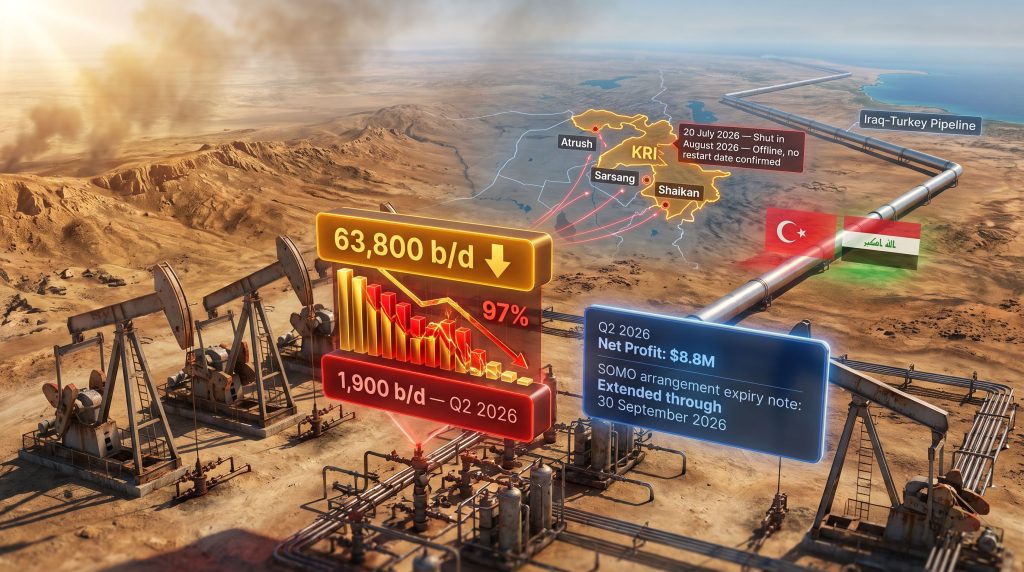
The raw production data for Shamaran's Atrush and Sarsang blocks in the second quarter of 2026 tells a story that no commentary can fully convey. Gross field production across the two blocks fell to approximately 1,900 barrels per day (b/d) during Q2 2026, compared with approximately 63,800 b/d in the same quarter one year prior. Shamaran's attributable share during the disrupted quarter dropped to approximately 700 b/d.
The near-total collapse in output, from over 63,000 b/d to under 2,000 b/d gross, is not a gradual operational decline. It reflects the structural inability of independent operators to maintain production continuity in an active conflict zone without sovereign security guarantees.
This 97% year-on-year decline in gross production is not the result of reservoir depletion, mechanical failure, or market-driven curtailment. It is the direct consequence of a security environment that makes continued field operations untenable. Understanding this distinction is essential for investors assessing the recovery potential of KRI-exposed upstream equities. The reservoirs remain intact. The question is exclusively about when conditions allow safe re-entry.
How Different Operators Have Responded to the Same Security Environment
Not all KRI producers have responded identically to the security deterioration, which introduces an important analytical dimension. Consequently, the relationship between commodity prices and company performance has become secondary to operational continuity as the primary determinant of near-term equity value for KRI-exposed producers.
| Operator | Asset | Shutdown Date | Current Status |
|---|---|---|---|
| Shamaran Petroleum / HKN Energy | Atrush and Sarsang blocks | 20 July 2026 | Offline, no restart date confirmed |
| Gulf Keystone Petroleum | Shaikan field | 20 July 2026 | Offline following June restart |
| DNO (Norway-listed) | KRI assets | Not shut in | Maintaining production continuity |
The divergence between DNO's continued operations and the shutdowns at Atrush, Sarsang, and Shaikan raises important questions that the market has not fully resolved. Differences in field location relative to strike-affected zones, infrastructure exposure, operator-specific risk frameworks, and insurance covenant structures all likely play a role.
The Financial Picture: Why Shamaran Posted a Profit Despite Near-Zero Production
Understanding the Timing Decoupling Between Revenue and Operations
One of the more counterintuitive aspects of Shamaran's recent financial disclosure is the company's reported net profit of $8.8 million for Q2 2026, up from $3.5 million in Q2 2025, despite the near-total collapse in production volume. This result is not paradoxical when the underlying accounting mechanics are understood.
The profitability improvement was driven by a timing effect: revenues generated from Q1 2026 crude sales arrived as cash receipts during the April-June quarter, while the cost base associated with those sales was substantially lower than the equivalent period one year earlier. In short, the financial statements for Q2 2026 reflect the commercial performance of Q1 production, not the operational reality of the April-June period itself.
Investors should distinguish carefully between cash receipts from prior-period sales and current operational performance. During extended shutdown periods, these two measures become temporarily decoupled, and reported profitability can substantially overstate the true underlying revenue-generating capacity of the business.
The SOMO Interim Arrangement: A Critical Commercial Bridge With an Expiry Date
A crucial but under-discussed element of Shamaran's commercial position is the interim sales arrangement operated through SOMO, the Iraqi state oil marketing company. This arrangement was originally established to allow Kurdish crude exports to resume in September 2025 following a two-and-a-half-year halt caused by the extended dispute between the KRG, Baghdad, and Turkey over pipeline revenue sharing and export terms.
The interim arrangement has been extended through 30 September 2026, and Shamaran has confirmed that no payment delays have occurred under the structure. This is a meaningful positive signal in an environment where commercial continuity for KRI producers has historically been unreliable. However, the rolling short-term extension structure introduces its own uncertainty, and the resource export vulnerabilities apparent in single-corridor dependent producers mirror broader challenges facing commodity exporters globally.
Scenario Modelling: Financial Outcomes Under Extended Shutdown
| Scenario | Assumed Duration | Revenue Outlook | Primary Risk Factor |
|---|---|---|---|
| Short-term suspension (under 60 days) | Resolves by late September 2026 | Manageable with SOMO arrangement intact | Interim deal expiry on 30 September 2026 |
| Medium-term shutdown (60 to 180 days) | Extends into Q4 2026 | Revenue gap widens as prior-period receipts are exhausted | Liquidity pressure without new crude sales |
| Prolonged shutdown (beyond 180 days) | Extends into 2027 | Significant cash flow deterioration | Covenant risk and potential asset impairment exposure |
Disclaimer: The scenarios above represent analytical projections based on publicly available information and are not financial advice. Investors should conduct independent due diligence and consult professional advisers before making investment decisions.
The Multi-Layer Risk Framework Preventing a Near-Term Restart
Four Structural Barriers Operators Must Navigate Simultaneously
The absence of a confirmed restart date for Shamaran Iraqi Kurdistan production offline is not simply a matter of waiting for hostilities to subside. It reflects the convergence of four distinct risk layers, each of which must be resolved before operations can safely and sustainably resume.
- Active conflict proximity: The ongoing US-Iran hostilities, with no confirmed ceasefire or de-escalation framework in place as of early August 2026, create an indeterminate security horizon that prevents forward operational planning.
- Infrastructure targeting precedent: The Sarsang field's dual-strike history establishes that KRI oil infrastructure sits within the targeting calculus of conflict parties, not merely within a general threat zone.
- Operator liability constraints: Listed independent producers face insurance covenant requirements and board-level fiduciary obligations that impose formal thresholds for resumed operations in active threat environments, independent of commercial pressure to restart.
- Multi-sovereign security guarantee complexity: The KRG's semi-autonomous status means that meaningful security assurances must be negotiated across both sub-sovereign Kurdish authorities and the federal Iraqi government, a process with no established fast-track mechanism.
In addition, government intervention in resources sectors frequently adds procedural complexity to restart timelines that operators in stable jurisdictions rarely encounter.
The Five-Condition Restart Equation
For Atrush and Sarsang to return to sustainable production, the following conditions would need to converge:
- A credible and durable reduction in active US-Iran hostilities across the northern Iraq theatre.
- Formal security assurances from both the KRG and federal Baghdad authorities covering field operations specifically.
- Engineering assessment and clearance of any residual infrastructure damage from prior strike incidents at Sarsang.
- Renewal or replacement of the SOMO interim commercial arrangement beyond 30 September 2026.
- Insurer and board-level operational clearance under revised risk assessments reflecting the post-strike environment.
Each of these conditions depends partly on factors entirely outside the operator's control, reinforcing why no restart timeline has been communicated.
The next major ASX story will hit our subscribers first
Iraqi Kurdistan Within the Broader Middle East Supply Disruption Picture
Compounding Pressure on Medium Sour Crude Availability
The simultaneous suspension of Shamaran Iraqi Kurdistan production alongside shutdowns at Gulf Keystone's Shaikan field is occurring against a backdrop of broader regional supply stress. The Strait of Hormuz, which historically facilitated the transit of more than 100 vessels daily before the outbreak of US-Iran hostilities, was handling approximately 30 vessel transits over a 2 to 3 day period by early August 2026 according to US military figures, a dramatic reduction that constrains Mideast Gulf crude availability for global buyers.
Diplomatic efforts centred on an Iran-Oman framework are reportedly close to defining agreed transit coordinates for Hormuz navigation, though significant obstacles remain, including disagreements over Iranian oversight of shipping routes and broader US demands related to sanctions and frozen assets. The interaction between Hormuz transit constraints and KRI export disruption creates a compounding supply pressure specifically on medium sour crude grades.
Regional Production Disruption Snapshot (August 2026)
| Region or Asset | Current Status | Estimated Volume Impact | Primary Driver |
|---|---|---|---|
| KRI Atrush and Sarsang | Offline | Approximately 63,000 b/d gross YoY decline | US-Iran conflict and security threat |
| KRI Shaikan (Gulf Keystone) | Offline | Material; operator-specific volumes pending confirmation | Security environment |
| KRI DNO assets | Producing | Minimal disruption reported | Operator-specific risk posture |
| Strait of Hormuz | Severely constrained | Down from over 100 vessels/day to approximately 30 over 2-3 days | US-Iran naval standoff |
Is Iraqi Kurdistan Still a Viable Upstream Investment Environment?
The Long-Term Investability Question
The recurring shutdown-restart-shutdown cycle now documented across multiple KRI operators raises questions that extend well beyond the immediate security situation. Capital allocation decisions in the upstream sector require multi-year revenue visibility. The combination of an unresolved security environment, a single-corridor export infrastructure, and a rolling short-term commercial arrangement creates a three-dimensional uncertainty that is difficult to price into conventional upstream equity valuation frameworks.
The longer the current disruption persists, the more difficult it becomes for the KRI to attract fresh capital commitments from independent producers. Operating in conflict-affected zones is not categorically disqualifying for upstream investment, but it does require that at least one of the three uncertainty dimensions — security, infrastructure, or commercial arrangement — resolves favourably to provide a credible foundation for capital planning.
Iraqi Kurdistan's upstream sector faces a compounding risk environment in which geopolitical instability, export infrastructure concentration, and commercial arrangement uncertainty are simultaneously elevated. The path to sustainable production recovery requires resolution across all three dimensions, not merely a security improvement alone.
The KRI's long-term upstream potential remains substantial on geological grounds. The region's Cretaceous and Jurassic carbonate reservoirs have demonstrated significant recoverable volumes across multiple fields, and the Kirkuk crude grade commands an established buyer base. The structural challenge is not resource availability. It is the governance, security, and export infrastructure framework required to translate subsurface potential into consistent, bankable production volumes — and that framework has proven repeatedly fragile under geopolitical stress.
Frequently Asked Questions: Shamaran and Iraqi Kurdistan Production
Why is Shamaran's Iraqi Kurdistan production offline?
Production at the Atrush and Sarsang blocks was suspended on 20 July 2026 as a precautionary measure in response to deteriorating security conditions linked to the ongoing US-Iran conflict. The Sarsang field had previously sustained two direct strike impacts during the early phase of hostilities, making continued operations untenable under current insurance and board-level risk frameworks.
When will Shamaran's Kurdistan fields restart?
As of the most recent company disclosures in early August 2026, no firm restart date has been provided. Operations are expected to resume only when safe and secure conditions can be confirmed, a threshold that remains unmet given the active conflict environment across northern Iraq.
How much production has Shamaran lost in Iraqi Kurdistan?
Gross production at the Atrush and Sarsang fields fell to approximately 1,900 b/d in Q2 2026, compared to approximately 63,800 b/d in the same quarter of 2025, a year-on-year decline of approximately 97%. Shamaran's attributable share during the disrupted quarter was approximately 700 b/d.
Is Shamaran still receiving payments for its oil?
Shamaran has confirmed that no payment delays have occurred under the SOMO interim commercial arrangement, which was recently extended through 30 September 2026. The arrangement was originally established to enable Kurdish crude exports to resume following a two-and-a-half-year suspension.
How are other Kurdistan oil producers responding to the security situation?
Gulf Keystone Petroleum suspended operations at its Shaikan field on the same date, 20 July 2026, following a June restart that proved short-lived. Norway-listed DNO has maintained production continuity, representing a divergent operational outcome attributable to a combination of field location, infrastructure exposure, and operator-specific risk management frameworks.
Want to Know When the Next Major Resource Discovery Hits the ASX?
While geopolitical disruptions continue to reshape upstream production landscapes, Discovery Alert's proprietary Discovery IQ model delivers real-time alerts on significant ASX mineral discoveries, instantly translating complex data across more than 30 commodities into clear, actionable insights — explore Discovery Alert's discoveries page to understand how historic finds have generated substantial returns, and begin your 14-day free trial today to position yourself ahead of the broader market.