
May 19, 2026
India's nuclear energy sector stands at a pivotal juncture where regulatory modernization intersects with ambitious decarbonization targets. The intersection of climate commitments, energy security imperatives, and technological advancement has created unprecedented momentum for nuclear capacity expansion. Within this complex policy landscape, institutional frameworks developed decades ago face mounting pressure to accommodate modern financing mechanisms, international partnerships, and advanced reactor technologies.
Understanding how regulatory transformation enables commercial participation requires examining both historical constraints and forward-looking policy architecture. The evolution from restrictive government monopolization toward selective private sector engagement reflects broader shifts in global nuclear governance, where established nuclear nations increasingly recognise the limitations of purely state-controlled development models. Furthermore, recent uranium market volatility has highlighted the importance of stable regulatory frameworks for long-term sector development.
How Does the SHANTI Bill Reshape India's Nuclear Regulatory Framework?
The SHANTI Bill 2025 fundamentally restructures India's nuclear governance architecture through comprehensive legislative consolidation. This transformation replaces fragmented regulatory approaches with unified oversight mechanisms designed for contemporary nuclear sector requirements.
Statutory Recognition for Nuclear Oversight Bodies
The legislation grants statutory recognition to the Atomic Energy Regulatory Board (AERB) for the first time under consolidated nuclear law, establishing parliamentary accountability frameworks previously absent from India's regulatory structure. This recognition transforms AERB from an administrative entity into a statutorily empowered regulator with enhanced independence from promotional government functions.
The five-day legislative passage from initial Lok Sabha tabling on December 15, 2025, to presidential assent on December 20, 2025, demonstrates unprecedented political consensus around nuclear sector modernization. This rapid approval process, spanning both parliamentary houses within 72 hours, reflects the strategic priority assigned to nuclear energy expansion within India's broader decarbonization framework.
Modernised Licensing and Compliance Architecture
The SHANTI Bill establishes differentiated regulatory pathways that accommodate varying levels of nuclear activity complexity and security sensitivity. Private sector participants gain access to equipment manufacturing without restrictions, while more sensitive activities like uranium enrichment remain subject to government-determined threshold limitations.
Digital transformation components within the new regulatory framework enable streamlined permitting processes through electronic submission systems and real-time monitoring capabilities. This modernization addresses previous bureaucratic bottlenecks that deterred private investment while maintaining rigorous safety oversight standards.
When big ASX news breaks, our subscribers know first
What Private Sector Opportunities Does the SHANTI Bill Create?
Commercial participation pathways under the SHANTI Bill represent a calibrated approach to nuclear sector liberalisation, balancing economic opportunity with national security imperatives. The legislation enables private companies to participate in plant operations, power generation, equipment manufacturing, and selected fuel fabrication activities.
Permitted Commercial Activities Under New Framework
| Activity Category | Private Participation Level | Government Oversight |
|---|---|---|
| Power Plant Operations | Full ownership permitted | Safety regulation only |
| Equipment Manufacturing | Unrestricted participation | Quality standards compliance |
| Fuel Fabrication | Threshold-limited enrichment | Strategic material controls |
| Uranium Enrichment | Government exclusive above threshold | National security priority |
The threshold-based approach to uranium enrichment activities allows private sector involvement in conversion, refining and enrichment of uranium-235 up to government-specified limits, creating commercial opportunities while preserving strategic control over weapons-relevant enrichment capabilities. Additionally, developments in US uranium production technology provide valuable insights for potential technology transfer arrangements.
Joint Venture and Foreign Investment Pathways
International technology partnerships gain regulatory clarity through the SHANTI Bill's provisions for foreign participation in reactor construction and technology transfer agreements. The Nuclear Power Corporation of India Ltd (NPCIL) request for proposals from Indian industries to finance and build 220 MW Bharat Small Reactors, with an extended deadline to March 31, 2026, exemplifies the practical implementation of private sector engagement mechanisms.
Foreign direct investment parameters remain subject to detailed implementation rules, but the legislative framework creates pathways for international equipment suppliers and technology partners to participate in India's nuclear expansion without the previous liability constraints that deterred global industry participation.
How Does the SHANTI Bill Address Nuclear Liability Concerns?
Nuclear liability restructuring represents one of the most significant commercial impact areas within the SHANTI Bill, directly addressing problematic provisions that previously gave nuclear operators extensive legal recourse to equipment suppliers in the event of nuclear incidents.
Operator-Focused Liability Structure
The legislation replaces the single statutory liability cap established under the 2010 Civil Liability for Nuclear Damage Act with a graded liability framework that differentiates operator responsibilities based on facility characteristics and operational parameters. This restructuring eliminates the broad supplier liability provisions that previously created disincentives for international equipment manufacturers.
The no-fault liability regime established under previous legislation is maintained while removing the extensive legal recourse mechanisms that allowed operators to pursue suppliers for incident costs. This change addresses a primary barrier to international nuclear industry engagement with Indian projects.
Enhanced Dispute Resolution Mechanisms
Critical Policy Innovation: The graded liability framework establishes differentiated responsibility levels while maintaining operator accountability for nuclear incidents, creating predictable risk allocation for commercial participants.
Specialised dispute resolution procedures provide technical expertise integration within judicial processes, enabling faster resolution of nuclear sector conflicts through dedicated tribunals with industry-specific knowledge and streamlined procedural frameworks.
What Are the Strategic Implications for India's Energy Security?
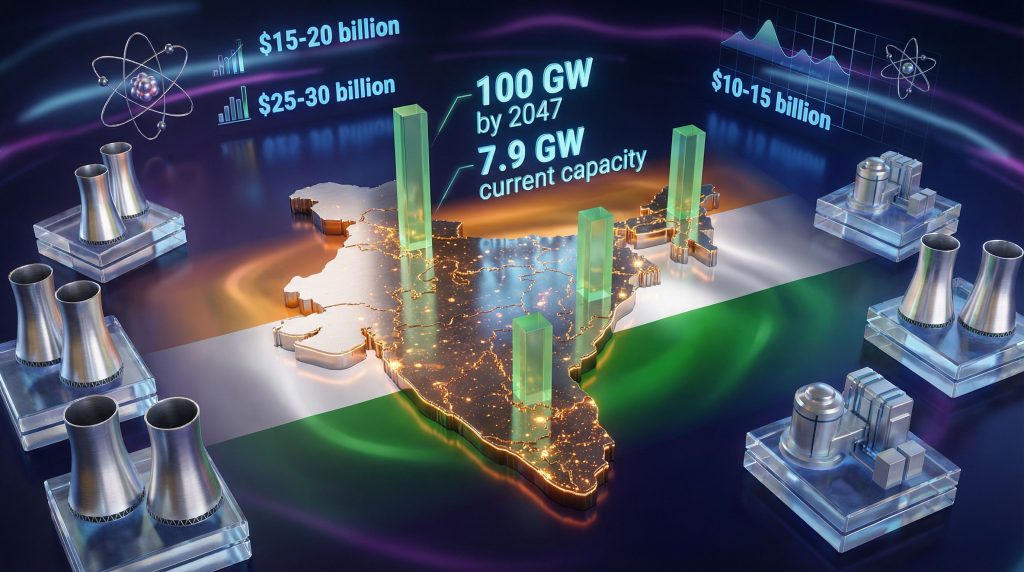
India's nuclear energy strategy operates within the context of achieving 100 GW of nuclear capacity by 2047, representing a 12-fold increase from the current 7.943 GW installed base across 24 operational reactors. This expansion target requires unprecedented coordination between government planning and private sector execution capabilities.
Decarbonisation Pathway Acceleration
The two-pronged Nuclear Energy Mission encompasses both large capacity reactor development and small modular reactor deployment to address diverse grid integration requirements across India's regional electricity markets. Current pipeline capacity includes 4.768 GW under construction and approximately 7 GW in pre-project stages, totaling nearly 20 GW of committed nuclear capacity.
Prime Minister Modi's characterisation of nuclear power as enabling safe powering of artificial intelligence infrastructure reflects strategic recognition that data centre and AI computing facilities require reliable baseload power that intermittent renewable sources cannot consistently provide. Moreover, this development aligns with broader energy transition security considerations globally.
Grid Stability and Industrial Applications
Nuclear baseload generation provides essential grid stability services that enable higher renewable energy penetration by compensating for solar and wind variability. The strategic deployment of nuclear capacity across regional electricity markets creates anchor loads that support grid modernisation and distributed renewable integration.
Industrial applications extend beyond electricity generation to include green manufacturing processes through process heat applications, hydrogen production for industrial decarbonisation, and specialised power supply for semiconductor and advanced manufacturing facilities.
Which Advanced Nuclear Technologies Does the SHANTI Bill Enable?
Advanced nuclear technology deployment gains regulatory clarity through the SHANTI Bill's modernised framework, particularly for small modular reactor development and innovative fuel cycle technologies.
Small Modular Reactor Development Framework
The Bharat Small Reactor program represents India's indigenous SMR development initiative, targeting 220 MW capacity units for distributed deployment across diverse geographical locations. The extended RFP deadline to March 31, 2026, provides additional time for private sector consortium formation and financing arrangement development.
SMR deployment addresses geographical constraints where large 1000+ MW plants prove unsuitable, while enabling standardised manufacturing approaches that reduce construction risk and improve economic predictability for private investors. However, considerations around the new nuclear law's provisions ensure these developments maintain safety standards.
Advanced Fuel Cycle Innovation
The modernised regulatory framework accommodates fuel cycle optimisation research and development activities, supporting India's three-stage nuclear program advancement through thorium utilisation and fast breeder reactor technology enhancement.
Regulatory pathways for advanced reactor technologies enable innovation in reactor design, fuel fabrication techniques, and waste management approaches while maintaining rigorous safety oversight appropriate to emerging nuclear technologies.
What Economic and Investment Implications Emerge?
Economic transformation through nuclear sector liberalisation creates investment opportunities across multiple industrial segments, from reactor construction and equipment manufacturing to specialised services and technology development.
Capital Market Access and Financing
Private nuclear companies gain access to diverse financing mechanisms previously unavailable under restrictive government monopolisation, including equity market participation, project finance structures, and international investment partnerships. In addition, the evolving landscape of US-China trade strategies creates new opportunities for strategic partnerships.
The SHANTI Bill creates regulatory certainty that enables long-term capital commitment from institutional investors, sovereign wealth funds, and development finance institutions seeking stable returns from infrastructure investments with predictable regulatory frameworks.
Industrial Applications Beyond Power Generation
Nuclear energy applications extend into hydrogen production for industrial decarbonisation, process heat for manufacturing applications, and specialised power supply for emerging technologies requiring reliable, clean electricity supply.
Modi's emphasis that this is the ideal time to invest, innovate and build in India reflects official government positioning of nuclear sector liberalisation as a wealth creation opportunity that extends beyond electricity generation into broader industrial transformation.
The next major ASX story will hit our subscribers first
How Do Environmental and Safety Considerations Factor In?
Environmental oversight mechanisms within the SHANTI Bill maintain rigorous safety standards while streamlining approval processes for nuclear facility development and operation.
Regulatory Oversight Mechanisms
Enhanced environmental impact assessment procedures accommodate both large-scale reactor projects and distributed SMR deployment, ensuring appropriate environmental review while avoiding bureaucratic delays that previously hindered nuclear project development.
Waste management responsibility frameworks establish clear operator accountability for radioactive waste handling, storage, and disposal throughout facility lifecycles, creating predictable compliance requirements for private sector participants.
Public Safety and Community Engagement
Transparent reporting requirements enable public access to safety information while protecting commercially sensitive technical details, balancing democratic oversight with competitive business requirements in the liberalised nuclear sector. Furthermore, comprehensive information about nuclear liability reform ensures stakeholder understanding of the new framework.
Emergency preparedness coordination mechanisms ensure seamless integration between private operators and government emergency response systems, maintaining public safety standards regardless of ownership structure.
What Challenges and Criticisms Does the Bill Face?
Implementation challenges span technical capacity development, regulatory infrastructure expansion, and international safeguards compliance under the transformed legal framework.
Environmental and Security Concerns
Environmental advocacy groups express concerns about potential bypassing of existing environmental protection frameworks through streamlined approval processes, particularly regarding long-term waste storage and disposal funding mechanisms.
Proliferation risk management requires careful balance between commercial opportunity and security oversight, ensuring private sector participation does not compromise India's nuclear security obligations or international safeguards compliance.
Implementation and Transition Challenges
AERB capacity expansion requirements include staff augmentation, technical expertise development, and regulatory infrastructure modernisation to accommodate increased oversight responsibilities across an expanded nuclear sector.
Industry readiness for private sector participation varies significantly across different nuclear activity categories, requiring coordinated development of technical capabilities, financial resources, and regulatory compliance systems.
How Does This Compare to Global Nuclear Policy Trends?
International nuclear policy evolution toward greater private sector participation provides context for India's regulatory modernisation, with lessons from established nuclear nations informing optimal implementation approaches.
International Best Practices Integration
The SHANTI Bill incorporates proven regulatory frameworks from nuclear-advanced nations while accommodating India's specific institutional context, security requirements, and development objectives.
IAEA safety standards and guidelines provide international benchmarks for regulatory oversight mechanisms, ensuring global compatibility while maintaining national sovereignty over nuclear sector governance.
Competitive Positioning in Global Nuclear Market
Technology export potential under the liberalised framework positions India to participate in global nuclear supply chains while developing indigenous capabilities for domestic nuclear expansion requirements.
Regional nuclear cooperation opportunities include technology sharing agreements, joint research initiatives, and coordinated regulatory harmonisation with other developing nuclear nations pursuing similar liberalisation objectives.
What Are the Next Steps in Implementation?
Regulatory infrastructure development requires systematic capacity building, detailed rule-making, and industry consultation processes to translate legislative framework into operational reality.
Regulatory Infrastructure Development
AERB expansion encompasses staff augmentation, technical training programs, and regulatory system modernisation to accommodate oversight responsibilities across an expanded nuclear sector with diverse private sector participants.
Implementation regulation development requires detailed consultation with industry stakeholders, international regulatory authorities, and domestic government agencies to ensure comprehensive coverage of nuclear activities under the new framework.
Timeline and Milestones for Nuclear Expansion
Short-term implementation targets (2025-2027) focus on regulatory infrastructure development and initial private sector entry pathways, while medium-term objectives (2028-2035) emphasise capacity addition acceleration and technology deployment scaling.
The 2047 target of 100 GW nuclear capacity requires sustained implementation momentum across multiple government administrations, necessitating institutional continuity and political commitment beyond current leadership tenures.
Disclaimer: This analysis involves forecasts and projections based on current legislative developments. Nuclear sector investments carry inherent technical, regulatory, and market risks. Investment decisions should incorporate comprehensive due diligence and professional financial advice. Implementation timelines and capacity targets remain subject to government policy changes, regulatory developments, and market conditions.
Want to Capitalise on India's Nuclear Energy Revolution?
India's nuclear sector transformation creates unprecedented investment opportunities across uranium mining, nuclear technology companies, and supporting infrastructure providers. Discovery Alert's proprietary Discovery IQ model delivers real-time alerts on significant ASX mineral discoveries, helping subscribers identify actionable opportunities in uranium and nuclear-related stocks before broader market recognition. Begin your 30-day free trial today to position yourself ahead of the evolving nuclear energy investment landscape.