
June 23, 2026
The Hidden Fault Line Running Through U.S. Precious Metals Markets
For decades, commodity exchanges have operated as self-governing institutions, setting the rules for how metals move, where they are stored, and who can participate in physical delivery. Most market participants accept these arrangements without question. But beneath the daily price fluctuations in silver, a structural problem has quietly persisted since the mid-twentieth century, one that concentrates the entire U.S. precious metals delivery infrastructure within a single geographic corridor and leaves the rest of the country without a single approved storage node.
That problem is now drawing attention from legislators, regulators, and market practitioners alike. The debate around the Silver Act COMEX depositories outside New York is no longer confined to industry insiders. It has entered the U.S. House of Representatives in the form of H.R. 8007, known as the SILVER Act, and the conversation it has sparked reveals just how outdated the current system truly is.
When big ASX news breaks, our subscribers know first
Why the Geography of Silver Vaulting Has Never Been Updated
The East Coast Lock on Precious Metals Delivery Infrastructure
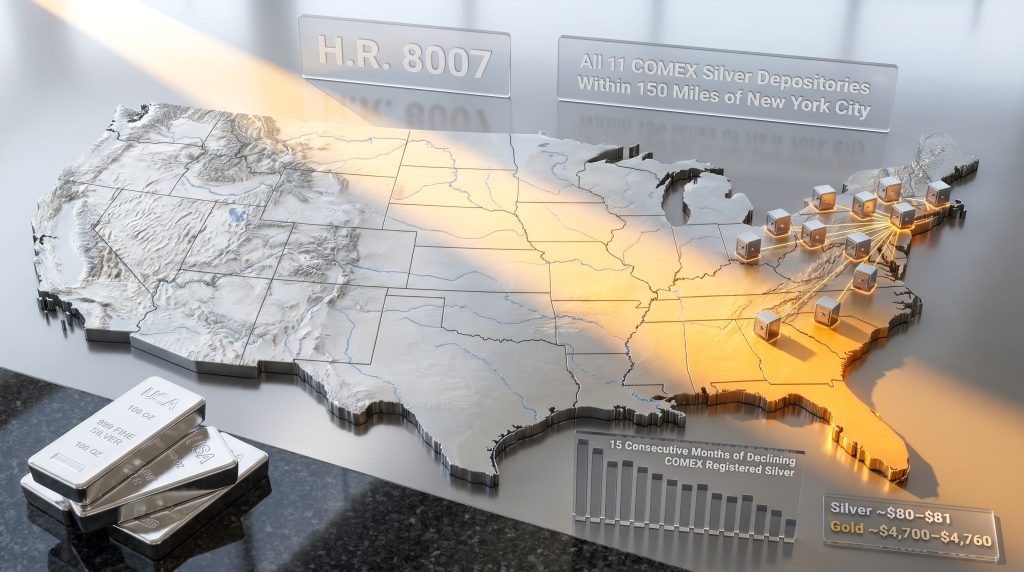
All 11 currently approved COMEX silver depositories operate within roughly 150 miles of New York City. This cluster spans New York, New Jersey, Delaware, and eastern Massachusetts. No approved delivery facility exists in the Central, Mountain, or Pacific time zones. Zero.
This was not always considered a problem. When the depository system was originally constructed, heavy manufacturing and fabrication activity genuinely was concentrated in the northeastern United States. Transportation logistics were slower, communications infrastructure was limited, and proximity to the financial centre of New York made operational sense for vault operators.
The system was not static. Through the 1980s and into the 1990s, a number of original COMEX-registered depositories closed as companies exited the precious metals storage business. To maintain adequate liquidity, the exchanges progressively extended the allowable distance from New York City where a depository could qualify for COMEX approval. This expansion gradually absorbed facilities in Delaware and eastern Massachusetts, reflecting the commercial realities of the era rather than any deliberate long-term infrastructure strategy.
The problem is that economic geography kept moving while the depository network did not.
Manufacturing's Westward and Southern Shift
Over the past three decades, precious metals fabrication demand has migrated dramatically. Electronics and aerospace manufacturing, which consume significant quantities of silver and other precious metals, have expanded across California, Texas, the Southeast, and the Mountain West. Companies that once sourced silver-bearing components from fabricators in Massachusetts and Rhode Island now procure those components from suppliers in Texas, Louisiana, Arkansas, and other states well outside the COMEX approval corridor.
This shift has created a structural mismatch. The physical users of industrial silver are increasingly located in regions with no access to COMEX-approved storage, meaning metal must be physically transported across enormous distances to meet delivery obligations on futures contracts. The logistical cost and time involved in moving silver between New Jersey vaults and end-users in California or Texas adds friction to a market that should, in theory, function efficiently.
Active and reputable vault infrastructure already exists in Nevada, Utah, California, and Idaho. Two particularly large-scale depository operations are established in Utah. Nevada hosts well-regarded facilities serving both mining and financial services clients. California supports multiple vault operations across technology, aerospace, military, and jewellery-related industries. These facilities are not peripheral or informal. They are simply outside the COMEX approval boundary, which is a regulatory and institutional boundary rather than a reflection of operational capability.
What the SILVER Act Actually Proposes
Legislative Mechanics of H.R. 8007
The SILVER Act, whose full name is the System Integrity through Licensed Vault Expansion and Resilience Act, was introduced to the U.S. House of Representatives on March 19, 2026. Representative Russ Fulcher of Idaho serves as the primary sponsor, with Representative Mark Harris listed as co-sponsor. The bill targets CME Group, the parent organisation of COMEX, and would legally require the exchange to approve a minimum of two precious metals delivery depositories in each U.S. time zone.
SILVER Act Legislative Summary
| Detail | Information |
|---|---|
| Full Name | System Integrity through Licensed Vault Expansion and Resilience Act |
| Bill Number | H.R. 8007 |
| Date Introduced | March 19, 2026 |
| Primary Sponsor | Rep. Russ Fulcher (R-ID) |
| Co-Sponsor | Rep. Mark Harris |
| Target Entity | CME Group / COMEX |
| Core Requirement | Minimum two approved depositories per U.S. time zone |
| Current Legislative Status | Early stage, no vote recorded |
The bill represents the first formal legislative attempt to mandate geographic diversification of precious metals delivery infrastructure through federal statute. Advocacy for this type of reform has existed within the industry for considerably longer. CPM Group, the commodities research firm, has publicly supported the concept of opening COMEX depository eligibility beyond the New York corridor since the 1980s, arguing that both domestic and international expansion of approved vault locations would strengthen market function.
What the Bill Gets Right
The core principle behind the SILVER Act is well-founded. Distributing precious metals storage across multiple time zones and regions reduces logistical bottlenecks, lowers the risk of regional disruptions affecting the entire delivery system, and better reflects where physical demand actually exists in the modern U.S. economy.
The case for decentralisation is further strengthened by COMEX registered silver inventory data. Registered silver, meaning metal held in approved vaults and cleared for futures delivery, has declined for 15 consecutive months. Furthermore, this sustained drawdown reflects physical delivery pressure on a system that routes metal through a single geographic corridor regardless of where it is ultimately needed. The silver market backwardation that has periodically emerged in recent years adds further urgency to these structural concerns.
"The geographic concentration of approved depositories means that physical delivery pressure translates directly into transportation bottlenecks. When tariff events or significant ETF redemption activity occur simultaneously, the demand on East Coast vault logistics can create delays and cost escalations that distort pricing and reduce effective liquidity."
Agricultural futures markets offer a relevant precedent. Grain elevators for corn, wheat, and soybeans are distributed across the Midwest, with price differentials applied depending on delivery location. This multi-node model has functioned effectively for decades and provides a domestic template for how commodity delivery infrastructure can accommodate geographic diversity without undermining contract integrity.
The LBMA and COMEX markets offer a useful international comparison. The LME operates approximately 450 approved warehouses across three continents, spanning Asia, North America, and Europe. Base metals traders can take or make delivery at nodes distributed globally, a model that both reduces systemic concentration risk and reflects the globalised nature of modern industrial supply chains.
Global Depository Infrastructure: A Structural Comparison
| Exchange | Commodity Focus | Approved Locations | Geographic Distribution |
|---|---|---|---|
| London Metal Exchange | Base metals | ~450 warehouses | Asia, North America, Europe |
| COMEX (CME Group) | Precious metals | 11 (silver) | U.S. East Coast only |
| NYMEX (WTI Crude) | Energy | Single delivery point | Cushing, Oklahoma |
| CME Group (Agricultural) | Grains | Multiple nodes | U.S. Midwest |
Where the Legislation Falls Short
Critical Omissions in the Current Draft
Despite its valid underlying premise, the SILVER Act as currently drafted contains several significant weaknesses that practitioners and market analysts have identified.
First, the legislation appears to lack explicit requirements for insurance standards, vault certification criteria, or minimum operational assurance thresholds that newly approved depositories would need to meet. This omission is not trivial. The precious metals storage industry includes operators of highly variable quality. While many facilities outside the COMEX approval corridor are professionally run with rigorous standards, others are not. An expansion mandate that does not specify qualifying criteria could, in theory, open approved status to operators who would introduce counterparty and custody risk into a market that depends on confidence in physical delivery.
"A comparable situation exists in the United Kingdom, where investors have moved metal just outside the LBMA-approved storage zone into facilities that are not subject to the same reporting and operational oversight standards. The precedent illustrates what can happen when the boundary of approval expands without corresponding quality controls."
Second, the bill's framing contains factual inaccuracies. Specifically, it implies that expanding the depository network would enhance silver market liquidity or add new supply to the market. Neither claim holds up to scrutiny. Redistributing approved storage locations does not create additional silver. It reduces logistical friction and improves access across regions, which are genuine benefits, but these are materially different from supply enhancement claims. What a congressman knows about commodity market mechanics and what the mechanics actually are can diverge substantially.
Third, the legislation conspicuously ignores the already-existing high-quality vault infrastructure in Utah, Nevada, and California, appearing instead to be oriented primarily around Idaho, the home state of the bill's primary sponsor. Two of the largest precious metals depositories in the western United States operate in Utah. Multiple credible facilities operate in Nevada and California. A reform bill whose geographic framing appears to reflect campaign finance relationships more than market geography raises legitimate governance questions.
Existing Western U.S. Vault Infrastructure Relevant to COMEX Reform
| State | Vault Activity | Industries Served |
|---|---|---|
| Nevada | Active facilities | Mining, financial services |
| Utah | Two large-scale operations | Commodities, investment |
| California | Multiple facilities | Technology, aerospace, jewellery, military |
| Idaho | Active | Regional commodities |
The Governance Question
There is a broader philosophical tension at the heart of the SILVER Act debate. Commodity exchanges possess deep institutional knowledge about contract design, delivery logistics, and counterparty risk that legislators generally do not. The argument for allowing CME Group to set its own depository standards, rather than having Congress mandate specific geographic outcomes, rests on this informational asymmetry.
The most structurally durable path to depository reform may not be legislative prescription but rather a combination of CFTC regulatory encouragement and voluntary CME Group adoption. This approach would allow the exchange to apply its own operational expertise to the selection and certification of new depositories while responding to clear regulatory and market signals that geographic concentration poses systemic risk. Concerns around concentration risk in precious metals depositories have been building for some time.
The Regulatory Escalation That Changed the Conversation
CFTC Testimony and Its Market Implications
On April 16, 2026, the CFTC Chairman appointed by the current administration delivered congressional testimony that marked a significant escalation in the policy debate. For the first time, a sitting U.S. commodities regulator publicly characterised the geographic concentration of COMEX silver depositories as both a national security vulnerability and a persistent source of price dislocation in the silver market.
This is not a routine regulatory statement. A sitting regulator endorsing structural decentralisation adds institutional weight to reform discussions that have previously been confined to industry advocacy and academic commentary. Crucially, this represents regulatory encouragement rather than project-specific support for any particular reform proposal. The CFTC's position is that the current structure is problematic, not that H.R. 8007 is the correct solution.
Whether the SILVER Act advances through Congress or not, this testimony has materially shifted the conversation between CME Group and its regulators. The practical implication is that voluntary depository expansion may now face greater institutional pressure than at any point in the past several decades. In addition, the broader debate around tariffs and silver markets has amplified scrutiny of single-zone delivery infrastructure.
Hypothetical Reformed COMEX Depository Network Under the SILVER Act
| U.S. Time Zone | Minimum Vaults Required | Existing Qualified Infrastructure |
|---|---|---|
| Eastern | Already satisfied | New York, New Jersey, Delaware, Massachusetts |
| Central | 2 minimum | Texas, Louisiana, Arkansas (emerging capacity) |
| Mountain | 2 minimum | Utah (2 large), Idaho, Nevada |
| Pacific | 2 minimum | California (multiple), Nevada |
Silver Market Fundamentals and the Consolidation Thesis
Where Silver Prices Stand Amid the Legislative Debate
The Silver Act COMEX depositories outside New York debate is unfolding against a precious metals backdrop that is notable for both its elevated price levels and its increasingly cautious near-term momentum. Silver reached approximately $82 per ounce in early 2026 before pulling back to a range of roughly $80 to $81. Gold, for context, set a record of approximately $5,500 per ounce at the end of January 2026 before retreating to a trading range near $4,700 to $4,760 by early May.
Precious Metals Price Landscape, May 2026
| Metal | 2026 High | Current Range | Key Support Levels |
|---|---|---|---|
| Gold | ~$5,500 (late January) | ~$4,700 to $4,760 | $4,100 / $3,800 / $3,500 |
| Silver | ~$82 | ~$80 to $81 | $65 to $70 / $60 / $50 |
| Platinum | Record spike, early 2026 | Elevated, pulling back | Monitoring Platinum Week (London) |
| Palladium | Recovering | Above 2024 to H1 2025 lows | Expected higher by late 2026 |
The pattern across gold, silver, platinum, and palladium reflects a shared dynamic: progressively lower highs since late January, suggesting a transition from the sharp rally phase into a consolidation regime. For silver specifically, support in the $65 to $70 range has proven meaningful, though tests of $60 or even $50 cannot be dismissed given the overall risk environment.
Fabrication demand and investment demand for silver are currently running at broadly normal levels. Financial market participants appear to have absorbed a significant portion of the macroeconomic and geopolitical uncertainty that drove precious metals to record levels earlier in the year. The prevailing thesis from market practitioners is that a consolidation phase extending through the end of August 2026 is the most probable near-term scenario, with a potential catalyst for renewed upward movement emerging around September.
That said, the nature of the current environment is that unexpected disruptions can alter market dynamics with very little warning. The political and economic landscape remains highly fluid, and investor psychology in precious metals has historically responded sharply to sudden shifts in perceived systemic risk. The gold and silver tariff impact from recent trade policy changes has reinforced this dynamic considerably.
Why Vault Geography Matters More During Price Stress
Physical delivery pressure on futures markets intensifies during periods of price volatility, ETF redemption activity, or macroeconomic shocks. When large numbers of futures contract holders simultaneously seek physical delivery, the logistical capacity of approved vaults becomes a binding constraint. With all 11 COMEX silver depositories concentrated in a single coastal corridor, a regional disruption could simultaneously impair the entire delivery mechanism.
This is the systemic risk argument for geographic diversification, and it is distinct from the economic efficiency argument. Even if East Coast vaults function perfectly under normal conditions, a single-zone system has structural fragility that a distributed network would not. Furthermore, ongoing silver supply deficits have made the resilience of delivery infrastructure an even more pressing concern for market participants. Analysts reviewing silver market structure behaviour have noted how these structural inefficiencies increasingly distort price signals.
The next major ASX story will hit our subscribers first
Frequently Asked Questions on the SILVER Act and COMEX Reform
What is the SILVER Act in plain terms?
H.R. 8007 is a U.S. federal bill introduced in March 2026 that would require CME Group's COMEX to approve precious metals delivery depositories in every U.S. time zone, with a minimum of two per zone. Currently, zero approved depositories exist outside the Eastern time zone.
Why has the COMEX depository network never expanded beyond the East Coast?
The original concentration reflected mid-twentieth century manufacturing geography and communications limitations. As fabrication demand shifted nationally and internationally, the depository approval framework was not systematically updated. Incremental extensions of the allowable radius addressed short-term liquidity problems without addressing the underlying geographic imbalance.
Would the SILVER Act increase silver supply or liquidity?
No. Expanding approved vault locations redistributes storage access and reduces logistical friction. It does not create additional silver or directly expand market liquidity in the classical sense. Claims to the contrary reflect a misunderstanding of commodity market mechanics.
What happens if the bill fails to pass?
CME Group retains the authority to voluntarily expand its approved depository network without legislative direction. The exchange has not done so despite decades of industry advocacy. The CFTC's April 2026 regulatory endorsement of decentralisation may create new pressure for voluntary reform independent of legislative outcomes.
Are high-quality depositories already operating outside the COMEX approval zone?
Yes. Established and well-regarded vault facilities operate in Nevada, Utah, California, and Idaho. The absence of COMEX approval status reflects a regulatory boundary condition, not a judgment about the operational quality of those facilities.
What standards should any expanded approval framework require?
Any reform, whether legislated or voluntary, should establish explicit minimum requirements covering insurance thresholds, security protocols, financial assurance standards, operational audit procedures, and management qualification criteria. The current bill's silence on these requirements is a material deficiency.
What the SILVER Act Debate Reveals About Commodity Infrastructure Governance
The SILVER Act is unlikely to become law in its current form. Its drafting reflects geographic parochialism, contains inaccurate supply claims, and omits critical quality standards. However, the legislative attempt has accomplished something valuable regardless of its ultimate fate: it has forced a public conversation about COMEX depository reform that has been overdue since at least the 1990s.
Key structural conclusions emerging from this debate include:
-
The concentration of all COMEX silver depositories within 150 miles of New York City is a legacy artefact that no longer reflects the geographic distribution of U.S. precious metals demand
-
High-quality vault infrastructure in Utah, Nevada, California, and Idaho demonstrates that operationally capable alternatives to East Coast storage already exist
-
The LME's approximately 450-warehouse global network provides a proven model for distributed commodity delivery infrastructure at a far greater scale than what COMEX reform would require
-
CFTC regulatory endorsement of decentralisation signals that the current structure faces institutional scrutiny at the highest regulatory level
-
Any expansion of approved depositories must be accompanied by rigorous certification standards to prevent low-quality or ethically questionable operators from entering the approved network
-
Voluntary exchange-driven reform, potentially guided by CFTC regulatory expectations, may ultimately prove more structurally sound than legislative prescription that reflects political geography as much as market logic
The globalisation of manufacturing supply chains, the shift of U.S. industrial activity toward the South and West, and the demonstrated fragility of single-zone delivery infrastructure all point in the same direction. The Silver Act COMEX depositories outside New York debate is no longer whether reform makes sense. The question is who will drive the reform, and whether the quality standards accompanying any expansion will be sufficient to protect the integrity of the market that depends on them.
This article reflects publicly available information and market analysis current to May 2026. It does not constitute financial or investment advice. Forecasts, price projections, and legislative assessments involve inherent uncertainty and should not be relied upon as predictions of future outcomes. Readers should conduct independent research before making investment decisions.
Want to Stay Ahead of Significant Mineral Discoveries on the ASX?
While the structural debates around silver delivery infrastructure continue to reshape precious metals markets, Discovery Alert's proprietary Discovery IQ model cuts through the complexity by delivering real-time alerts on significant ASX mineral discoveries — explore historic discovery returns that demonstrate just how transformative early positioning can be, and start your 14-day free trial at Discovery Alert to secure your market-leading edge today.