
June 20, 2026
When Infrastructure Fails to Keep Pace With Markets
Financial markets evolve at a pace that legislation rarely matches. Electronic trading replaced open-outcry floors decades ago, yet the physical infrastructure underpinning the world's most actively traded commodity futures contracts has barely changed since the Nixon administration. This is not a metaphor. It is a literal description of where exchange-approved precious metals depositories currently sit: clustered in a single metropolitan corridor that made operational sense in 1974 and has remained structurally frozen ever since.
The SILVER Act precious metals reform now moving through Congress represents something unusual in Washington: a targeted, technically specific fix to a regulatory artifact that has persisted long past its useful life. Understanding why this matters requires stepping back from the price charts and examining how the physical delivery system actually works.
When big ASX news breaks, our subscribers know first
How Exchange-Approved Depositories Actually Function
Most investors who hold gold or silver through futures-linked programs, IRAs, or vault storage products never interact directly with the exchange delivery system. That invisibility is part of the problem.
An exchange-approved depository is not simply a secure storage facility. It is a facility formally authorised by the exchange to hold physical metal against which regulated futures contracts can be settled upon expiry. When a futures contract reaches its delivery date and a counterparty demands physical settlement, the metal transferred must come from one of these designated facilities. No other vault qualifies, regardless of its security standards, auditing practices, insurance coverage, or proximity to production regions.
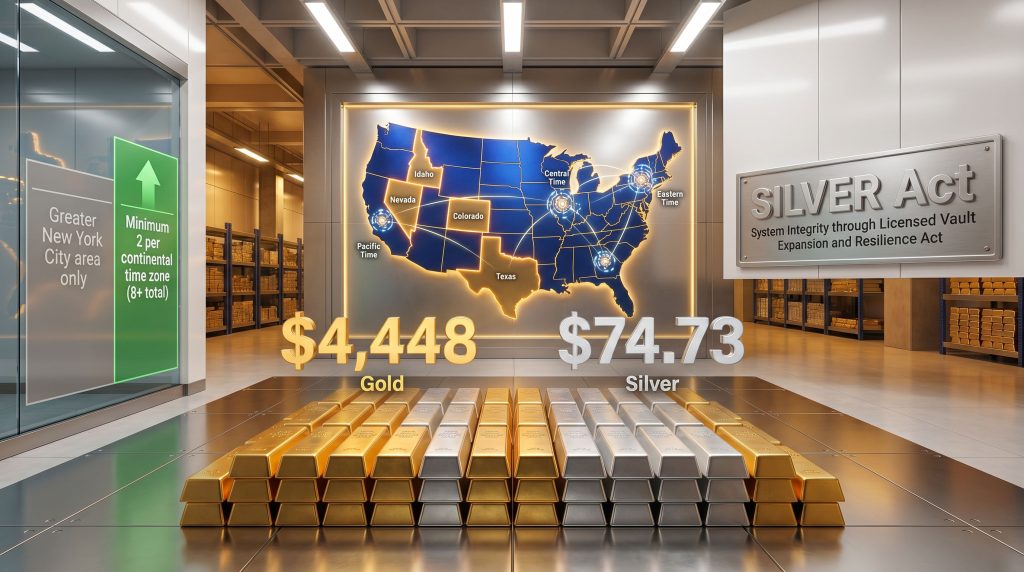
Under the rules that have governed US futures markets since the 1970s, that exchange-approved designation is effectively limited to vaults in the Greater New York City area. The practical consequence is straightforward: every troy ounce of gold, silver, platinum, and palladium that changes hands through regulated US futures delivery must pass through one geographic corridor, irrespective of where that metal was mined, refined, or currently stored.
The Operational Logic That No Longer Applies
The original rationale for geographic concentration was entirely reasonable. In an era of open-outcry trading, vaults needed physical proximity to exchange floors because traders, brokers, and clearing members could not efficiently coordinate metal transfers across thousands of miles without the logistical infrastructure that simply did not exist. Approved depositories clustering around New York City was not arbitrary; it was operationally necessary.
Electronic trading dismantled that necessity entirely. Settlement coordination, inventory tracking, and delivery logistics no longer require physical proximity to a trading floor. The operational justification for geographic concentration evaporated sometime in the 1980s and 1990s as electronic systems replaced floor trading. The approval rules, however, were never revisited. What began as a practical solution became a regulatory artifact, and that artifact has persisted for more than five decades without structural review.
The SILVER Act: Mechanism and Scope
The System Integrity through Licensed Vault Expansion and Resilience Act is federal legislation that amends the Commodity Exchange Act to require geographic diversification across the exchange-approved precious metals depository network. The bill's core mandate directs the Commodity Futures Trading Commission (CFTC) to ensure a minimum of two approved depositories in each of the four continental US time zones: Eastern, Central, Mountain, and Pacific.
Legislative Timeline
| Date | Development |
|---|---|
| March 19, 2026 | House bill H.R. 8007 introduced by Reps. Russ Fulcher (R-ID) and Mark Harris (R-NC) |
| April 16, 2026 | CFTC Chairman Michael Selig publicly endorses the bill's goals at House Agriculture Committee hearing |
| May 21, 2026 | Senate companion bill introduced by Senators Jim Risch (R-ID) and Catherine Cortez Masto (D-NV) |
The 60-day sequencing from House introduction through regulatory endorsement to Senate companion bill reflects coordinated momentum across legislative and regulatory institutions. That pace is characteristic of reform with genuine cross-institutional support rather than aspirational policy discussion. Lawmakers introducing the Silver Act to increase precious metals storage sites have framed this as both a market efficiency and national security measure.
Precision on What the Bill Does and Does Not Do
The SILVER Act does:
- Mandate geographic distribution of CFTC-regulated depository approvals across all four continental time zones
- Create a more open and competitive eligibility framework for qualifying vault facilities
- Direct regulatory action on geographic concentration risk independent of market conditions
- Amend the foundational federal statute governing US derivatives and futures markets
The SILVER Act does not:
- Mandate approval of any specific vault operator or named facility
- Directly alter gold or silver spot prices or futures pricing mechanisms
- Change the fundamental structure of futures contract settlement
- Transfer regulatory authority away from the CFTC
The CFTC retains full discretion over which specific facilities qualify. The bill creates the geographic diversification framework; it does not prescribe a list of approved operators.
Three Structural Vulnerabilities the Current Framework Creates
1. Single-Region Concentration Risk
Every piece of critical delivery infrastructure for regulated US precious metals futures sits within one metropolitan corridor. A regional disruption affecting the New York area, whether from infrastructure failure, severe weather, cyberattack, or geopolitical event, could impair settlement across the entire regulated market simultaneously. This is textbook single-point-of-failure risk applied to a market that now operates at gold prices of approximately $4,448 per troy ounce and silver prices of approximately $74.73 per troy ounce as of late May 2026.
At the April 2026 House Agriculture Committee hearing, Representative Mark Harris characterised the geographic concentration as troubling from the perspectives of national security, market efficiency, and operational resiliency, citing the exclusive clustering of approved gold and silver delivery depositories around New York City as the core structural concern. (CFTC House Agriculture Committee Hearing, April 16, 2026)
2. Absent Competition and Elevated Storage Costs
When a small number of exchange-approved facilities face no competitive pressure from qualified alternatives, the incentive to offer competitive pricing disappears. Testimony at the April 2026 CFTC hearing indicated that existing approved depositories charge maximum allowable storage rates, while comparable facilities in other US regions could offer equivalent services at materially lower cost. (CFTC House Agriculture Committee Hearing, April 16, 2026) That fee differential is ultimately absorbed throughout the supply chain, including by retail investors holding allocated metal through IRA programs or vault storage products.
3. Production-to-Delivery Geographic Mismatch
The Western United States accounts for the overwhelming majority of domestic gold and silver mining and refining activity. Nevada is the largest gold-producing state in the country. Idaho is a significant silver producer, contributing meaningfully to global silver production alongside major international mining operations. Colorado hosts major refining operations. Yet the entire regulated delivery network sits in the Northeast, meaning refined metal produced in these states must route through New York before it can be legally delivered against exchange contracts.
The transportation cost, transit time, and logistical friction this creates falls disproportionately on Western producers, refiners, and investors.
Concentration vs. Distribution: A Direct Comparison
| Dimension | Current Framework | Proposed Post-SILVER Act Model |
|---|---|---|
| Approved depository locations | Greater New York City area only | Minimum 2 per continental time zone (8+ total) |
| Competitive fee environment | Absent — maximum rates prevail | Present — multi-region competition |
| Systemic disruption vulnerability | High — single geographic chokepoint | Significantly reduced |
| Alignment with production geography | Misaligned | Aligned — Western vaults eligible |
| Regulatory framework | Commodity Exchange Act (unchanged since 1970s) | Amended Commodity Exchange Act |
The Coalition Behind the Reform
Reading the Bipartisan Geography
The Senate sponsorship pairing carries deliberate geographic logic. Senator Jim Risch is a conservative Idaho Republican representing a significant silver-producing state. Senator Catherine Cortez Masto is a Nevada Democrat whose state produces more gold than any other in the country. Both senators cited the direct competitive disadvantage their states face under the current New York-centric framework.
That a conservative mining-state Republican and a progressive mining-state Democrat arrived at identical conclusions about the same structural problem illustrates how clearly the geographic mismatch disadvantages the Western US. (Senator Risch and Senator Cortez Masto press releases, May 21, 2026)
Industry Supporters Across the Supply Chain
The bill has attracted backing from a notably broad cross-section of the precious metals industry:
- Silver Institute — international trade body representing silver producers and fabricators
- Texas Precious Metals Depository — state-administered facility currently ineligible for exchange approval
- First Majestic Silver Corp — primary silver producer with significant North American operations
- A-Mark Precious Metals — major wholesale distributor and logistics operator
- Zions Bancorp / Nevada State Bank — regional banking institutions with precious metals custody exposure
- Columbia Bank, Frontier Mint, Kilo Capital, Highland Mint — financial and minting sector participants
The breadth of this coalition, spanning miners, refiners, mints, distributors, and regional banks, reflects consensus that the current framework is structurally inadequate rather than merely inconvenient for specific operators.
The CFTC's Position: A Meaningful Signal
CFTC Chairman Michael Selig's public endorsement of the bill's structural goals at the April 2026 House Agriculture Committee hearing is a substantively important development. Early regulatory alignment at the chairman level improves legislative viability materially. Selig further committed to examining the concentration risk question independently of the legislative timeline, meaning regulatory guidance or rulemaking could emerge on a parallel track regardless of when or whether the bill is formally enacted. Both tracks carry real consequences for how the approved depository network ultimately evolves.
Furthermore, understanding how precious metals depositories operate at a practical level is increasingly relevant for investors evaluating the custody arrangements underpinning their holdings.
The physical metals market has expanded significantly in scale and institutional participation since the current depository framework was established. Central banks have purchased more than 1,000 tonnes of gold annually for three consecutive years, according to the World Gold Council's 2024 Central Bank Gold Reserves Survey. A market operating at these participation levels arguably requires delivery infrastructure commensurate with its systemic importance.
In addition, central bank gold reserves have become a defining feature of the modern precious metals landscape, reinforcing the case for more resilient and geographically distributed delivery infrastructure.
What Changes for Different Categories of Market Participant
Retail Investors
- Potential access to exchange-linked storage facilities outside the New York corridor
- Downward pressure on storage fees as multi-region competition enters the market
- Broader choice of approved custodian locations, potentially including facilities closer to Western US buyers
- Improved structural resilience for the physical market underpinning their holdings
For retail investors weighing their options, the choice between physical gold vs ETFs remains relevant, however the structural improvements proposed under the SILVER Act precious metals depositories reform could meaningfully affect the cost and accessibility of physical custody arrangements.
Institutional Participants and Futures Operators
- Reduced single-region exposure in physical delivery operations
- More efficient logistics for participants delivering against futures contracts from Western production regions
- Improved market depth and delivery resilience during periods of supply or price dislocation
Producers, Refiners, and Mining Companies
- Ability to deliver refined metal into exchange-approved facilities without mandatory routing through New York
- Reduced transportation costs and transit time from Western production centres
- Improved access to regulated futures settlement for operators in Idaho, Nevada, Colorado, and Texas
The next major ASX story will hit our subscribers first
What the Existing Depository Landscape Looks Like Outside New York
A lesser-known dimension of this debate is how much qualified infrastructure already exists outside the approved network. Several substantial facilities currently operate in non-approved status despite meeting or exceeding the physical security and operational standards that would qualify them for exchange approval under a reformed framework:
- Texas Bullion Depository: A state-administered facility specifically designed for precious metals custody, currently structurally excluded from exchange approval under existing rules despite its purpose-built design
- Private IRA custodian vaults: Operate across multiple US states serving retirement account holders; entirely disconnected from the regulated futures delivery network
- Refinery-adjacent storage: Western US refiners maintain substantial storage capacity near production centres; currently ineligible for exchange-approved status regardless of operational quality
The SILVER Act would not automatically approve these facilities. It would, however, create the regulatory framework under which qualified Western facilities could apply and be evaluated for the first time.
Tracking the SILVER Act: Key Milestones and Monitoring Framework
Legislative Pathway
- Senate committee referral — Commodity futures legislation typically falls under the Senate Agriculture, Nutrition, and Forestry Committee; referral is the first procedural gate
- Committee markup — Formal committee vote; advancement out of committee is the clearest signal of genuine legislative momentum
- Floor scheduling — Senate leadership calendar decisions determine whether the bill reaches a full chamber vote
- House-Senate reconciliation — H.R. 8007 and the Senate bill must be aligned before final passage
Monitoring Framework
| Signal | What It Indicates |
|---|---|
| Senate Agriculture Committee markup | Bill is on a real legislative path |
| CFTC notice of proposed rulemaking on depository eligibility | Regulatory track moving independently of legislation |
| Western state vault applications for approved status | Industry preparing for anticipated rule change |
| Fee structure adjustments at existing approved vaults | Competitive pressure beginning to materialise pre-enactment |
The Broader Signal Worth Recognising
The SILVER Act is an infrastructure reform. Its effects are structural, not speculative. It does not alter gold's monetary properties, silver's industrial demand profile driven by solar, EV, and electronics sectors, or the supply-and-demand dynamics that shape long-term price trajectories.
What it does change is the market's operational capacity to deliver on those fundamentals. A bipartisan Senate coalition, the federal commodity regulator, and a supply-chain-spanning industry coalition are now collectively treating precious metals delivery infrastructure as a matter of national security and market integrity. That institutional framing represents a meaningful shift in how Washington characterises these markets, independent of any specific investment thesis.
Consequently, monitoring how this legislation interacts with broader shifts across gold and silver markets in 2025 and beyond will be important for investors seeking to understand the structural forces shaping physical metal valuations.
For investors holding physical metal or evaluating entry, the structural improvement represented by the SILVER Act precious metals depositories reform is worth monitoring precisely because it is not about price prediction. It is about the health, resilience, and geographic equity of the market infrastructure that underpins every physical gold and silver position in the country.
Fifty years is a long time for critical market infrastructure to go unchanged. The legislative and regulatory momentum now building around the SILVER Act suggests that window is closing.
Disclaimer: This article is provided for informational and educational purposes only and does not constitute investment, legal, or financial advice. Legislative outcomes are inherently uncertain. All price references and market data cited reflect conditions as of late May 2026. Readers should consult qualified financial and legal advisers before making investment decisions.
Want to Stay Ahead of Significant ASX Precious Metals Discoveries?
As structural reforms reshape how physical gold and silver markets operate, Discovery Alert's proprietary Discovery IQ model delivers real-time alerts on significant ASX mineral discoveries — instantly translating complex data across 30+ commodities into clear, actionable insights for investors at every level. Explore Discovery Alert's dedicated discoveries page to see how historic ASX mineral discoveries have generated substantial returns, and begin your 14-day free trial today to position yourself ahead of the broader market.