June 17, 2026
The Architecture of Sound Money: Why Silver's Constitutional Role Is Being Reassessed
Few financial concepts generate as much misunderstanding as the relationship between the United States Constitution and precious metals. For most people, the phrase silver as constitutional money in the United States conjures images of nineteenth-century coinage debates or fringe economic theory. Yet the legal architecture underpinning this idea has never actually been dismantled. It sits quietly within the original text, largely ignored by mainstream commentary, waiting for the economic conditions that would make it relevant again.
Those conditions, many analysts argue, are now materialising faster than at any point in the past century.
When big ASX news breaks, our subscribers know first
What the Constitution Actually Says About Silver and Money
Article I, Section 10: The Forgotten Prohibition on States
The constitutional text most relevant to silver's monetary status is not found in the federal powers framework. It appears in Article I, Section 10, which explicitly prohibits individual states from making anything other than gold and silver coin a legal tender in payment of debts. This clause has never been repealed. It has not been amended. It exists today precisely as the framers wrote it, and it creates a legal distinction that most modern monetary discussions overlook entirely.
The practical implication is significant: while Congress has exercised its broad power under Article I, Section 8 to create and regulate a fiat currency system, states retain a constitutional constraint that aligns them with commodity money. Several states have already begun exploring sound money legislation that acknowledges this framework, though the dominant legal interpretation continues to favour federal currency authority.
Article I, Section 8 and Congress's Currency Authority
Congress holds the power to coin money and regulate its value under Article I, Section 8. Courts have consistently interpreted this as broad enough to encompass the transition from silver-backed coinage to Federal Reserve notes and ultimately to the fully fiat system that emerged after 1971. The prevailing legal position is that federal currency authority supersedes the original commodity-money framework.
However, this interpretation reflects legal evolution rather than constitutional amendment. The originalist argument, while not the dominant legal standard today, maintains that the constitutional dollar was defined by the Coinage Act of 1792 as 371.25 grains of pure silver, a definition that Congress never formally repealed through constitutional means.
Key Milestones in U.S. Silver Monetary History
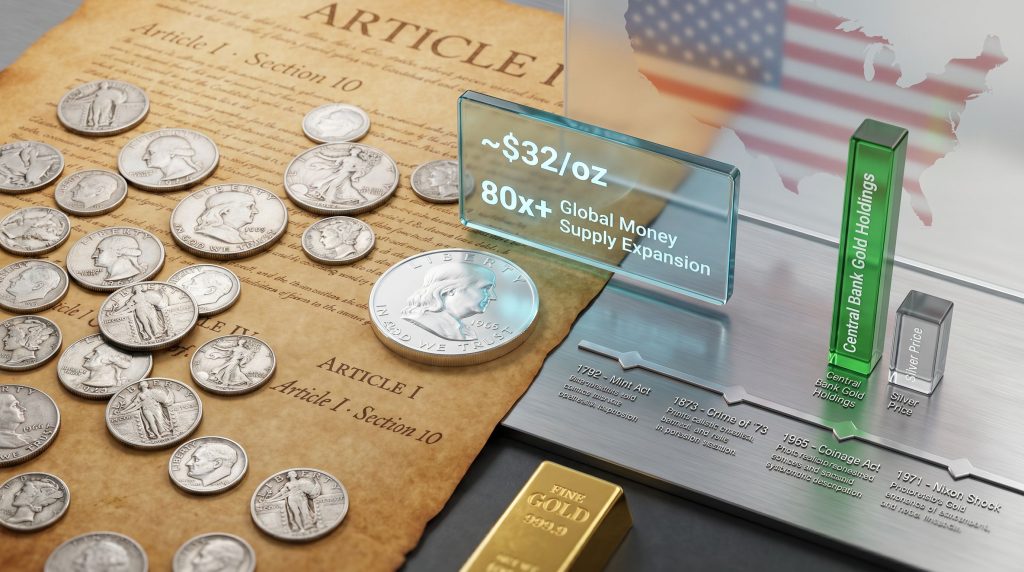
| Year | Event | Monetary Significance |
|---|---|---|
| 1792 | Coinage Act defines the dollar by silver weight | Constitutional silver standard established |
| 1873 | Silver demonetisation ("Crime of 1873") | Silver removed from the monetary base |
| 1933 | Executive Order 6102 | Gold recall from citizens |
| 1965 | Silver removed from circulating coinage | Final break with everyday commodity money |
| 1971 | Nixon closes the gold window | Full fiat era begins |
The Coin Market and Constitutional Silver
In the numismatic and bullion markets, the term constitutional silver refers specifically to pre-1965 U.S. coins, dimes, quarters, half dollars, and silver dollars minted when the coins contained 90% silver. This usage is descriptive and historical rather than a legal prescription. Understanding this distinction matters: the coin market's use of the term acknowledges a monetary heritage without asserting that modern law mandates silver as currency.
| Perspective | Core Argument | Legal Standing Today |
|---|---|---|
| Originalist View | The constitutional dollar was defined by silver weight | Not the prevailing legal standard |
| Mainstream Legal View | Congress holds broad currency power; courts uphold fiat | Dominant interpretation |
| Coin Market Usage | Constitutional silver = pre-1965 90% silver U.S. coins | Descriptive, not prescriptive |
| State-Level Constraint | States cannot make non-gold/silver coin legal tender | Constitutionally active, never repealed |
The Fiat System's Structural Weakness: Debasement, Velocity, and the Cantillon Effect
How Monetary Inflation Actually Works
The classic economic definition of monetary inflation is the abnormal expansion of the money supply beyond what genuine growth in wealth and population would justify. Most people experience it simply as rising prices, but that framing misses the mechanism entirely. The prices are a symptom. The cause is the creation of currency units that represent no corresponding increase in real productive output.
Since the 1980s, the global monetary system has expanded at a rate that has no historical precedent. One informed estimate suggests the number of global currency units has grown by a factor of at least 80 times since 1980. Notably, when this figure was raised in conversation with Jeffrey Christian, a well-connected precious metals analyst who advises central banks, his response was not to dispute it but to suggest the real figure may be considerably higher. Whether this constitutes a deliberate admission or an accidental disclosure is impossible to verify, but it points toward a debasement scale that has not yet fully transmitted into tangible asset prices.
The Cantillon Effect and Structural Wealth Inequality
The Cantillon Effect describes how newly created currency benefits those who receive it first, before price increases spread through the broader economy. Governments, large financial institutions, and well-connected borrowers capture real purchasing power during the window between money creation and general price adjustment.
A contemporary illustration: government programmes that offer 30-year loans to selected industries, with no repayments and zero interest for the first decade, followed by a 3% rate for the remaining 20 years. Recipients of such financing, operating with effectively free capital for a decade, face almost no barrier to building significant wealth. By contrast, wage earners face the compounding erosion of purchasing power in real time.
Globalisation as an Inflation Suppressor: The China Effect and Its Unwinding
China's entry into the World Trade Organisation created enormous deflationary pressure that masked the inflationary consequences of monetary expansion for roughly two decades. The availability of cheaply manufactured goods suppressed consumer price indices even as money supplies grew exponentially. A television that would have cost hundreds of thousands of dollars to manufacture in 1970 can now be purchased for a few hundred dollars, an example that illustrates how globalisation deflated price signals in specific categories.
That deflationary cushion is now compressing. Deglobalisation, geopolitical fragmentation, and mineral resource competition are reversing the supply chain dynamics that suppressed inflation. The latent inflationary pressure accumulated during decades of monetary expansion has not disappeared; it has been deferred. When velocity picks up and people begin treating currency as a hot potato, the deferred effects could transmit rapidly.
Global Money Supply Expansion: What the Numbers Suggest
| Metric | 1980 Baseline | 2025 Estimated Position | Implication |
|---|---|---|---|
| Global currency units | Baseline index | Potentially 80x+ expansion | Severe debasement risk |
| Silver price (1980 avg) | ~$20/oz | ~$32–70/oz (2025 range) | Monetary premium already embedded |
| Gold as reserve asset | Secondary tier | Surpassing U.S. Treasuries | Institutional confidence shift |
| Central bank gold holdings | Modest | Record levels globally | Structural hedge positioning |
Gold Surpassing U.S. Treasuries: What Central Banks Are Signalling
The BIS and Gold's Reclassification as a Tier One Asset
More than a decade ago, the Bank for International Settlements in Basel, Switzerland began reclassifying gold as a Tier One reserve asset. This change was embedded in the regulatory rulebook governing global central banks, written in private and largely ignored by mainstream financial commentary. Individual central banks were permitted to classify gold holdings at full value without needing cash reserves to backstop volatility.
The significance of this reclassification is structural, not incidental. It was not designed to complement the existing fiat system. The analytical case is that it was designed to eventually replace the dollar as the international monetary anchor. Central bank gold reserves accumulating at record pace, with gold replacing Treasuries as the primary reserve asset globally, is consistent with this long-term institutional repositioning.
Could Official Gold Holdings Be Understated?
A credible speculative dimension to this story is the possibility that central banks hold more gold than their official disclosures indicate. By routing holdings through counterparties and intermediary structures, the true reserve position could be kept opaque. The eventual revelation of a figure substantially higher than reported would reshape the entire framework for precious metal valuation.
The Digital Monetary Transition: Stablecoins, Tokenisation, and Financial Surveillance
Why Stablecoins Are Not Simply a New Investment Vehicle
Much of the public discussion around stablecoins frames them as a crypto-adjacent investment option or a faster payment mechanism. This framing understates what they represent at a structural level. Every financial asset that exists outside of privately held physical form is, in functional terms, already tokenised. It is a recorded claim, a representation of ownership that exists in a ledger system accessible to administrators.
Tokenisation refers to the conversion of ownership rights in a real-world asset into a digital record on a controlled ledger. The critical difference between this and historical bank ledger systems is not the concept itself but the speed, granularity, and permanence of surveillance it enables.
When a government promotes a digital monetary infrastructure, historical precedent suggests the primary beneficiary is not the individual account holder. The trajectory of absolute financial control, where every transaction can be monitored, approved, delayed, or blocked based on behavioural or regulatory criteria, is not a speculative scenario. It is the logical endpoint of combining existing financial infrastructure with AI-driven data processing.
The Data Center Build-Out: Infrastructure for Economic Surveillance
The enormous investment in data centre capacity currently underway may serve purposes beyond the widely cited AI productivity narrative. The computing power required to store, process, and cross-reference every financial transaction across an entire economy is substantial. The infrastructure being built is technically consistent with a comprehensive financial surveillance architecture, a point that deserves more serious analysis than it currently receives in mainstream commentary.
The Three Mechanisms That Could Delay System Collapse
A fully digital system provides three specific levers for delaying the transmission of inflationary pressure:
-
Offshore dollar exclusion – Dollars held outside the U.S. system can be prevented from re-entering, dumping latent inflation onto foreign holders.
-
Sanctions-based transfer control – The volume of currency permitted to move into the new system can be managed, limiting the velocity of monetary circulation.
-
Direct velocity management – By controlling the rate at which digital currency changes hands, authorities can slow the feedback loop between money creation and price increases.
Each of these mechanisms buys time. However, each one simultaneously destroys economic incentives, suppresses investment, and accelerates the conditions for stagflation. An economy that captures privately created wealth, restricts its redeployment, and substitutes transfers for productive activity will stagnate. The historical parallel with state-controlled economies, where asset confiscation ultimately destroys the incentive to build wealth at all, is not reassuring.
Silver as the People's Money: Transactional Logic in a Post-Fiat Scenario
Why Gold Struggles as Everyday Currency
During the 1933 gold recall in the United States, most of the gold that was surrendered came from bank reserves, not from ordinary citizens. The reason is straightforward: most households never conducted daily commerce in gold coins. A gold double eagle at the time held roughly 0.97 troy ounces of gold and had a face value of $20, a sum that represented significant purchasing power beyond typical daily transactions. Most people transacted in silver half-dollars and quarters.
This historical pattern has direct implications for any post-fiat monetary scenario. A single gold coin at current valuations approaching $4,300 to $4,400 with premium represents a large unit of value, more suited to acquiring a vehicle or a significant asset than to everyday exchange. Silver's lower unit value makes it fundamentally more practical as a transactional medium in a community-level barter or exchange economy.
Silver's Transactional Advantages
- Divisibility: silver coins and rounds exist across a wide range of denominations and weights, enabling granular transactions.
- Recognisability: pre-1965 constitutional silver coins are universally recognised by participants in the physical metals community.
- Privacy: peer-to-peer silver transactions can occur outside digital monitoring systems.
- Wide availability: unlike rhenium or platinum, silver is accessible at accessible price points for ordinary savers and wage earners.
Silver's Supply Dynamics: The Byproduct Problem
Furthermore, silver supply deficits are compounded by the fact that approximately 75% of global silver production comes as a byproduct of mining other metals, primarily copper, lead, and zinc. This structural characteristic means silver supply does not respond to silver price signals in the same way a primary metal would. When silver prices rise, the primary copper or zinc miner does not dramatically increase production simply to capture silver byproduct revenue. The silver just comes out at whatever rate the base metal operation dictates.
This supply inelasticity creates a fundamentally different price dynamic compared to gold, where primary miners can and do respond directly to price incentives. Silver's dual role as both a monetary asset and an industrial input, combined with growing consumption in solar panels, electronics, and medical applications, means the supply picture is structurally tighter than the headline production numbers suggest.
| Cost Category | Estimated Range (2025) | Implication |
|---|---|---|
| All-in sustaining cost (silver-primary miners) | ~$14 to $25/oz | Silver trading well above production cost |
| Silver price (approximate, 2025) | ~$32 to $70/oz range | Monetary and industrial premium embedded |
| Byproduct silver production cost | Near zero marginal | Majority of supply indifferent to price signals |
The next major ASX story will hit our subscribers first
Rhenium: The Ultra-Scarce Strategic Metal Silver Investors Are Starting to Watch
What Makes Rhenium Irreplaceable
Rhenium occupies a unique position in the periodic table and in industrial applications. It was the last naturally occurring element to be isolated, identified in Germany in 1925, meaning its commercial applications are relatively young and still developing. Its physical properties, including an exceptionally high melting point second only to tungsten and superior resistance to mechanical stress (measured by Young's modulus), make it the only material that can perform in jet turbine blade superalloys at the temperatures and pressures modern aircraft engines demand.
No commercially viable substitute has been found. This is not a temporary gap waiting to be filled by materials science. It reflects a fundamental combination of physical properties that no other element replicates.
The Supply-Demand Imbalance: A Structural Crisis in Formation
Rhenium is a byproduct of a byproduct, extracted primarily from molybdenite concentrates during copper smelting. It is not mined as a primary target anywhere in the world. Annual production stands at approximately 50 tonnes, with recycling adding roughly 25 tonnes, for a total available supply of around 75 tonnes per year.
Against this, civilian aviation demand alone, based on confirmed airframe orders currently in production, is estimated at 200 tonnes per year. Military and space applications require even higher concentrations of rhenium in superalloys, potentially up to four times the amount used in civilian turbines per engine. Rhenium also functions as a critical reforming catalyst in petroleum refining, blended with platinum, where approximately 10% is consumed each processing cycle.
At ten times its current price, one dollar of rhenium still enables the production of over one thousand dollars of product that cannot be manufactured without it. This degree of price inelasticity is virtually unique among industrial materials.
Rhenium vs. Silver: Different Profiles, Complementary Roles
| Asset Class | Role in Portfolio | Liquidity Profile | Price Driver |
|---|---|---|---|
| Physical silver | Transactional money, monetary hedge | High | Monetary + industrial demand |
| Physical gold | Large-value store of wealth | Medium | Institutional reserve demand |
| Rhenium | Strategic scarcity, industrial necessity | Lower, specialist market | Structural supply deficit |
| Platinum | Industrial + monetary hybrid | Medium | Auto/industrial demand |
Building Purchasing Power Resilience Outside a Digitally Controlled System
Tangible Assets as the Historical Anchor
Across every recorded monetary transition, from the collapse of the Roman denarius to the hyperinflationary episodes of the twentieth century, tangible assets have consistently preserved purchasing power better than paper or digital claims. Land, productive equipment, tools, and physical commodities retain utility regardless of what currency system surrounds them.
The current environment adds a new dimension: privacy. In a world trending toward comprehensive financial surveillance, the characteristic that may ultimately matter most about physical silver is not its price in dollars but its capacity to function as a private, peer-to-peer medium of exchange that operates outside monitored digital infrastructure.
A Diversified Tangible Asset Framework
| Asset Class | Portfolio Role | Privacy Characteristics | Liquidity |
|---|---|---|---|
| Physical silver (varied forms) | Transactional money, monetary hedge | High, peer-to-peer capable | High |
| Physical gold | Large-value wealth store | Medium | Medium |
| Rhenium | Strategic scarcity exposure | High, niche and private | Lower, specialist market |
| Platinum | Industrial and monetary hedge | Medium | Medium |
| Real estate and land | Long-term purchasing power anchor | Low, publicly recorded | Low |
| Tools, spare parts, consumables | Community barter utility | High | Variable |
Frequently Asked Questions: Silver as Constitutional Money in the United States
Is Silver Still Constitutionally Required to Be U.S. Money?
No. Modern courts have upheld Congress's broad authority to operate a fiat currency system. However, Article I, Section 10 still prohibits states from designating anything other than gold and silver coin as legal tender in payment of debts, a constraint that has never been removed from the constitutional text.
What Does Constitutional Silver Mean in the Coin Market?
It refers to pre-1965 U.S. circulating coins that contained 90% silver. The term is historical and descriptive, acknowledging the period when everyday U.S. currency was commodity money by design. Investopedia's overview of lawful money provides additional context on how these distinctions evolved within the broader legal framework.
Can U.S. States Legally Mandate Gold and Silver as Legal Tender?
The constitutional architecture of Article I, Section 10 provides the basis for state-level sound money legislation. Several states have explored this pathway in recent years, though federal supremacy creates ongoing legal complexity.
What Would Trigger a Return to Silver-Backed Currency?
The most probable trigger would be a collapse in confidence in the digital fiat system, particularly if financial surveillance infrastructure were seen as having failed or produced severe economic stagnation. Community-level silver exchange could emerge organically in such an environment, driven by practical necessity rather than top-down mandate.
How Does Silver Differ From Gold as a Monetary Asset in a Post-Fiat Scenario?
Gold's high unit value makes it better suited to large transactions and institutional reserves. Silver's lower unit value, divisibility, and widespread recognisability position it more naturally as everyday transactional money in a community exchange context.
What Is the Difference Between a Stablecoin and a CBDC?
A Central Bank Digital Currency is issued directly by a central bank and represents a direct liability of that institution. A stablecoin is typically issued by a private entity and backed by reserve assets. The mechanisms differ, but both create digital transaction records accessible to system administrators, producing similar surveillance characteristics in practice.
How Does the Cantillon Effect Explain Wealth Inequality During Inflationary Periods?
First-order recipients of newly created money, governments, large financial institutions, and favoured borrowers, capture real purchasing power before prices adjust. By the time the monetary expansion filters through to wage earners and retail savers, prices have already risen, effectively transferring wealth from the latter to the former.
Silver's Constitutional Legacy and the Case for Monetary Realism
The legal, historical, and economic threads connecting silver as constitutional money in the United States are not the product of ideological nostalgia. They reflect a specific and documentable architecture: a constitutional text that has never been amended, a monetary history that was dismantled by policy rather than by law, and economic conditions that are increasingly consistent with the scenarios that made commodity money valuable in the first place.
The institutional shift toward gold as a Tier One reserve asset, coordinated quietly through the Bank for International Settlements, signals that the world's most sophisticated monetary actors are repositioning for a transition. Consequently, if gold becomes the anchor of the institutional monetary system, silver's historical role as the transactional complement to gold becomes structurally relevant in a way it has not been since the end of the gold standard.
The trajectory from here runs through a digital intermediary phase, a period of tokenised surveillance and controlled monetary velocity that may delay the final reckoning but, based on the economic logic of incentive destruction and stagflation, is unlikely to resolve it. When that phase exhausts itself, the assets that will carry purchasing power forward are those that exist outside the system entirely: privately held, physically real, and recognisable without reference to any digital ledger.
Silver, in that context, is not a relic. It is infrastructure for the economy that comes next. For those seeking a broader perspective on the current landscape, a detailed examination of gold and silver legal tender developments in 2025 offers valuable additional context on where policy directions may be heading.
This article is intended for educational and informational purposes only and does not constitute financial advice. Forecasts, price targets, and economic projections referenced throughout are speculative in nature and involve significant uncertainty. Readers should conduct their own research and consult a qualified financial adviser before making investment decisions. Past monetary history does not guarantee future monetary outcomes.
Want to Know Which ASX Miners Are Discovering the Silver and Gold of Tomorrow?
Discovery Alert's proprietary Discovery IQ model delivers real-time alerts on significant ASX mineral discoveries, instantly cutting through complex data to surface actionable opportunities in precious metals and beyond — explore historic discoveries and their exceptional returns, then begin your 14-day free trial to position yourself ahead of the broader market.