July 23, 2026
The Mechanics Behind Silver Futures: What They Are, How They Work, and Who They're Really For
Most commodity markets evolved not from speculation, but from necessity. Farmers, miners, and manufacturers needed a reliable way to lock in prices months before production cycles completed. From those practical origins, futures markets grew into sophisticated instruments that now attract everyone from institutional hedgers to individual traders seeking leveraged exposure to commodity price movements. Silver futures sit at the intersection of monetary history and industrial reality, making them one of the more complex but potentially rewarding instruments in the broader precious metals space.
This silver futures guide breaks down the mechanics, contract types, pricing dynamics, and strategic considerations that every investor should understand before approaching these markets.
When big ASX news breaks, our subscribers know first
What Is a Silver Futures Contract, and How Does It Actually Work?
A silver futures contract is a legally binding, standardised agreement to buy or sell a specified quantity of silver at a predetermined price on a defined future date. The critical distinction from physical ownership is that no silver changes hands at the time the contract is opened. The agreement governs a future transaction, and most participants close their positions before expiration without ever interacting with physical metal.
Three variables define every contract:
- The quantity of silver measured in troy ounces (one troy ounce equals 31.1 grams, the universal standard across precious metals markets)
- The agreed price per troy ounce established at the time the contract is opened
- The settlement date, which corresponds to the contract's expiration month
These contracts are exchange-traded, meaning the exchange itself acts as a central counterparty, reducing the risk that either side of the trade defaults on its obligations.
Where Silver Futures Trade Globally
The primary global benchmark for silver futures pricing is the COMEX division of CME Group in the United States. However, the silver futures market is genuinely international in scope.
| Exchange | Location | Notes |
|---|---|---|
| COMEX (CME Group) | United States | Primary global benchmark and highest liquidity |
| Multi Commodity Exchange (MCX) | India | Significant retail trader participation |
| National Commodity & Derivatives Exchange (NCDEX) | India | Broad commodity and agricultural focus |
| Dubai Gold & Commodities Exchange (DGCX) | UAE | Regional hub for Middle Eastern traders |
| Tokyo Commodity Exchange (TOCOM) | Japan | Asia-Pacific exposure and pricing reference |
Who Trades Silver Futures and Why
Three distinct participant categories shape silver futures market dynamics:
- Speculators open long (buy) or short (sell) positions to profit from anticipated price movements, with no intention of receiving or delivering physical silver
- Hedgers such as silver miners, solar panel manufacturers, and electronics producers use futures to lock in prices and manage exposure to input cost fluctuations
- Arbitrageurs exploit brief price discrepancies between contract months or across exchanges, capturing small gains before market efficiency closes the gap
Understanding which participant category dominates trading activity at any given time provides useful context for interpreting price behaviour in silver futures markets.
How Leverage Works in Silver Futures
Leverage is the mechanism that makes silver futures fundamentally different from buying silver outright. Rather than paying the full value of a silver position, traders deposit a margin — a performance bond that represents a fraction of the contract's notional value.
Margin is not a fee or a down payment in the traditional sense. It is a good-faith deposit held by the exchange to cover potential adverse price moves against an open position.
A Practical Leverage Example
Consider a scenario where silver is trading at $80 per troy ounce:
- A 100-ounce silver futures contract carries a notional value of $8,000
- The initial margin required to open this position is approximately $1,400
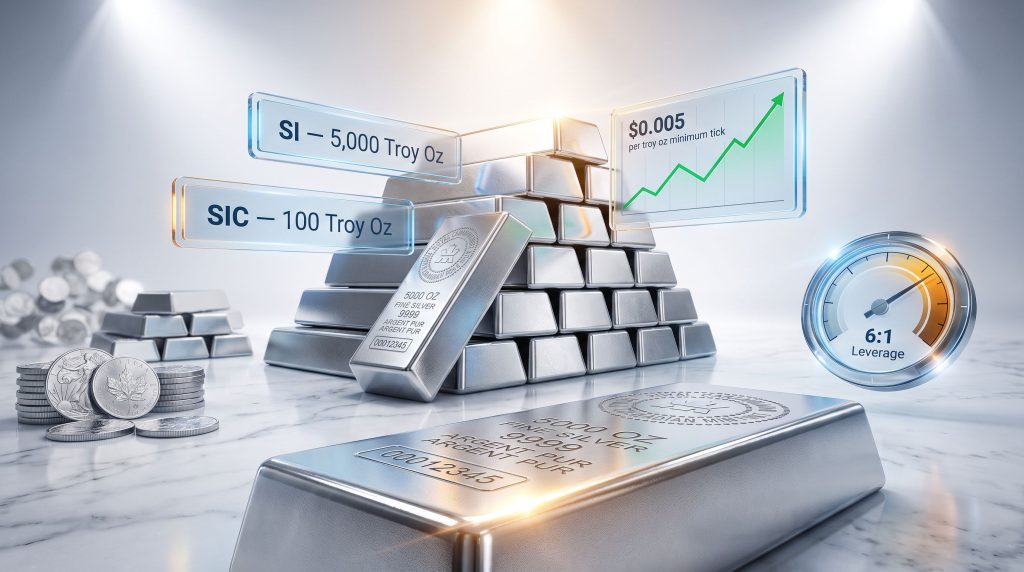
- This creates an effective leverage ratio of roughly 6:1
- A 10% price increase in silver would generate approximately a 60% return on the margin deposited
- The same 10% price decline would produce a 60% loss on the margin
This asymmetry means margin requirements are not static. Exchanges adjust them in response to volatility, and traders who experience adverse price moves may face margin calls requiring additional capital deposits or forced liquidation of the position.
Understanding Silver Futures Contract Sizes
One of the most practically important aspects of any silver futures guide is understanding the different contract sizes available and what they mean for capital requirements and risk exposure.
| Contract Type | Contract Size | Typical Use Case | Capital Requirement |
|---|---|---|---|
| Standard CME Silver (SI) | 5,000 troy ounces | Institutional traders and commercial hedgers | Highest |
| Mini Silver | 2,500 troy ounces | Mid-tier traders seeking reduced exposure | Moderate |
| Micro Silver | 1,000 troy ounces | Retail traders and strategy testing | Lower |
| 100-Oz Silver (SIC) | 100 troy ounces | Entry-level access and low-capital participation | Lowest |
CME Group Standard Silver Futures (Ticker: SI)
The benchmark silver futures contract has been trading for decades. Key specifications include:
- Contract unit: 5,000 troy ounces
- Minimum price tick: $0.005 per troy ounce
- Tick value: $25.00 per tick movement
- Settlement method: Physical delivery of silver metal
- Trading access: Nearly 24 hours per day, Monday through Friday
At $80 per troy ounce, a single standard SI contract represents $400,000 in notional exposure — a figure that places this instrument firmly in institutional territory for most purposes.
CME Group 100-Oz Silver Futures (Ticker: SIC)
Launched on January 13, 2026, the SIC contract was specifically engineered to lower the capital threshold for futures participation. Key specifications include:
- Contract unit: 100 troy ounces
- Minimum price tick: $0.01 per troy ounce
- Settlement method: Cash-settled against the 5,000-oz SI contract
- Listed contract months: March, May, July, September, and December within a rolling 24-month window
- Trading access: Nearly 24 hours per day, five days per week
At $80 per troy ounce silver, the full notional value of one SIC contract is $8,000 compared to $400,000 for the standard SI contract. This difference in scale makes the SIC contract relevant for a substantially broader pool of participants, including those testing strategies before scaling to larger contract sizes.
What Drives Silver Futures Prices: The Dual Nature of Silver Demand
Silver occupies an unusual position among commodities because price formation is influenced by two fundamentally different demand categories simultaneously. Understanding silver's dual role as both a monetary asset and an industrial input is essential for informed participation in silver futures markets.
Industrial Demand: Silver's Invisible Price Driver
Roughly 70-80% of annual silver supply is produced as a byproduct of mining other base metals including copper, zinc, and lead. This supply structure means primary silver mine output cannot rapidly respond to demand surges, creating periodic supply tightness. Furthermore, the silver supply deficits emerging in recent years have added further complexity to price dynamics.
On the demand side, silver's industrial consumption base is expanding rather than contracting:
- Solar photovoltaics consume meaningful quantities of silver paste per panel, with global solar capacity additions accelerating
- Electronics and semiconductors rely on silver's unmatched electrical conductivity for contacts, switches, and printed circuits
- Electric vehicles and charging infrastructure create demand through battery systems and high-current electrical components
- Medical devices and antimicrobial applications utilise silver's bacteriostatic properties across a range of healthcare products
- Aerospace and defence manufacturing depends on silver alloys for high-reliability electrical connections
The inelastic nature of silver byproduct supply combined with structurally growing industrial demand creates a supply-demand dynamic that differs substantially from gold, which has minimal industrial consumption.
Monetary and Macro Factors
Beyond industrial dynamics, silver futures prices respond to monetary conditions. In addition, broader precious metals market trends exert a strong influence on silver's pricing behaviour:
- Inflation expectations historically support silver prices as investors seek tangible stores of value during periods of currency purchasing-power erosion
- Real interest rates influence the opportunity cost of holding non-yielding assets; lower real rates typically support silver
- U.S. dollar strength inversely correlates with silver prices because silver is globally priced in USD
- The gold-silver ratio provides a relative value signal; historically the ratio has ranged from below 20:1 to above 100:1, with extremes often interpreted as mean-reversion opportunities
The gold-silver ratio above 80:1 is frequently cited by precious metals analysts as a signal that silver is historically undervalued relative to gold, though this interpretation requires caution since ratio extremes can persist for extended periods.
Consequently, reviewing gold-silver ratio analysis can help traders contextualise entry and exit timing within a longer-term framework.
A Step-by-Step Framework for Trading Silver Futures
Step 1: Open a Futures-Approved Brokerage Account
Not all investment accounts support futures trading. Brokers require separate approval based on trading experience, financial profile, and risk acknowledgment. Importantly, some major retail platforms, including certain well-known brokerages, restrict settlement to cash only and do not permit physical delivery of the underlying commodity.
Step 2: Fund With Adequate Capital
Deposit enough to cover the initial margin requirement plus a meaningful buffer. Underfunding relative to position size remains one of the most common errors among new futures participants.
Step 3: Select Contract Month and Size
Choose the expiration month that corresponds to your intended holding period. Shorter-dated contracts carry higher near-term price sensitivity, while further-dated contracts may reflect different supply-demand expectations embedded in the futures curve.
Step 4: Conduct Thorough Market Analysis
Effective analysis in silver futures typically integrates multiple frameworks:
- Technical analysis: Trend direction, volume patterns, moving averages, and key support-resistance levels
- Fundamental analysis: Inflation data, Federal Reserve policy signals, industrial demand trends, and mine supply reports
- Macro context: Dollar index movements, geopolitical risk events, and cross-commodity correlations
Step 5: Place Orders With Defined Exit Parameters
Set stop-loss levels before entering. Define profit targets and position size relative to total account equity. Never enter a leveraged position without knowing the maximum capital loss you are prepared to accept.
Step 6: Monitor Margin and Manage Position Lifecycle
Track daily mark-to-market settlements against your margin balance. If you wish to maintain exposure beyond the front-month expiration, roll the position to a later contract. Close all positions before expiration unless you have made explicit arrangements for physical delivery or cash settlement.
The next major ASX story will hit our subscribers first
Common Silver Futures Trading Strategies
Trend-Following
Best suited to sustained directional moves driven by macro catalysts such as Federal Reserve policy shifts or major industrial demand announcements. Traders align with the prevailing trend and manage positions with trailing stops.
Range Trading
Applicable when silver consolidates between identifiable support and resistance bands. However, the strategy requires disciplined risk management given silver's capacity for sharp breakouts from range-bound conditions.
Breakout Trading
Positioned around significant macro events including central bank decisions, major economic data releases, or geopolitical disruptions. Fast execution and pre-defined risk parameters are essential given the velocity of post-breakout price moves.
Commercial Hedging Applications
- Solar manufacturers and electronics producers sell futures to lock in known input costs
- Silver miners sell futures to guarantee revenue at defined price levels, providing cash-flow certainty for project financing
- Portfolio holders of physical silver may sell futures as a partial hedge during periods of anticipated price weakness
Silver Futures vs. Physical Silver: Choosing the Right Instrument
| Dimension | Silver Futures | Physical Silver |
|---|---|---|
| Capital Required | Low (margin-based) | Full purchase price |
| Leverage | High (amplifies gains and losses) | None |
| Storage Required | No | Yes |
| Trading Hours | ~24 hrs/day, Mon-Fri | Dealer-dependent market hours |
| Counterparty Risk | Exchange-cleared (lower) | Minimal (direct ownership) |
| Inflation Hedge Quality | Indirect price exposure | Direct tangible asset ownership |
| Delivery Option | Possible but logistically complex | Immediate physical possession |
| Best Suited For | Experienced active traders | Long-term holders and wealth preservation |
Physical silver remains the more appropriate choice for investors prioritising long-term wealth preservation, seeking direct ownership without margin complexity, or building diversified precious metals portfolios using high-ounce silver bars or sealed mint boxes.
Silver futures are more appropriate for traders with relevant experience, hedgers with genuine silver price exposure in business operations, or investors seeking short-term tactical positioning without storage logistics. For a broader perspective on pricing and market conditions, reviewing the silver market overview can provide valuable context before committing capital.
Frequently Asked Questions About Silver Futures
What is the minimum capital needed to trade silver futures?
Capital requirements depend on the contract size and current exchange-set margin levels. For the 100-oz SIC contract at approximately $80 per troy ounce silver, the initial margin has been approximately $1,400, though this figure adjusts with market volatility.
Can I take physical delivery through a silver futures contract?
Standard COMEX silver futures (SI) are physically deliverable at expiration. However, many retail brokerages, including some major platforms, restrict delivery and settle in cash only. Confirm your broker's delivery policy explicitly before trading.
How are silver futures taxed in the United States?
Under Section 1256 of the Internal Revenue Code, futures contracts are generally subject to a 60/40 rule where 60% of gains are treated as long-term and 40% as short-term, regardless of actual holding period. Physical silver is typically classified as a collectible and taxed differently. Tax treatment varies by jurisdiction; professional tax advice is essential.
What happens if I hold a silver futures position through expiration?
Physically deliverable contracts (SI) require the holder to either deliver or receive silver according to exchange specifications. Cash-settled contracts (SIC) settle financially against the reference price. Most retail traders close or roll positions before expiration to avoid delivery obligations.
How do silver futures differ from silver ETFs?
Silver ETFs trade like stocks on standard exchanges, hold silver or silver-linked instruments, and require no futures-approved account or margin management. Silver futures involve direct exchange-traded contracts with expiration dates, leverage, and potential delivery obligations. The two instruments serve meaningfully different investor profiles.
Key Takeaways for Silver Futures Participants
- Silver futures are standardised exchange-traded contracts, not direct ownership of physical metal
- Contract sizes range from 100 troy ounces (SIC) to 5,000 troy ounces (SI), allowing precise calibration of exposure
- Leverage ratios of 6:1 or higher mean small silver price movements produce disproportionately large portfolio impacts
- Silver's price is shaped by both monetary demand and growing industrial consumption, a dual dynamic not present in gold
- 70-80% of silver supply comes as a byproduct of other metal mining, creating structural supply inelasticity
- Trading hours spanning nearly 24 hours per day, five days per week mean material price moves can occur outside standard market sessions
- Most traders never take physical delivery — positions are closed or rolled before expiration
- Physical silver and silver futures serve genuinely different investor profiles and should not be treated as interchangeable strategies
This article is intended for educational purposes only and does not constitute financial or investment advice. Silver futures involve significant risk of loss and are not appropriate for all investors. Leveraged products can result in losses that exceed the initial margin deposit. Individuals considering silver futures trading should seek guidance from a licensed financial adviser and fully understand the mechanics and risks involved before committing capital.
Further Exploration: Readers seeking to deepen their understanding of silver markets and precious metals investing can explore additional educational resources through the APMEX silver investing guide, which offers a comprehensive range of guides covering silver investing fundamentals, bullion mechanics, and market dynamics.
Want to Catch the Next Major ASX Silver Discovery Before the Market Does?
Discovery Alert's proprietary Discovery IQ model scans ASX announcements in real time, instantly converting complex mineral data across 30+ commodities into clear, actionable insights — so subscribers are positioned ahead of the broader market the moment a significant silver or precious metals discovery is announced. Explore historic discoveries and their extraordinary returns, then begin your 14-day free trial to secure your market-leading edge.