August 9, 2026
When Safe Havens Stop Working: Understanding the 2026 Precious Metals Anomaly
There are moments in financial history when the rules appear to break down entirely. Investors trained on decades of market behaviour expect certain assets to perform predictable roles during crises. Gold rises when wars begin. Silver follows. Capital floods into tangible stores of value when geopolitical certainty evaporates. Yet in 2026, the silver and gold market outlook amid the Iran war has confounded expectations, with both metals moving in the opposite direction despite active military conflict disrupting one of the world's most critical maritime chokepoints. Understanding why requires a framework that goes well beyond conventional safe-haven logic.
When big ASX news breaks, our subscribers know first
The Mechanics of a Safe-Haven Inversion
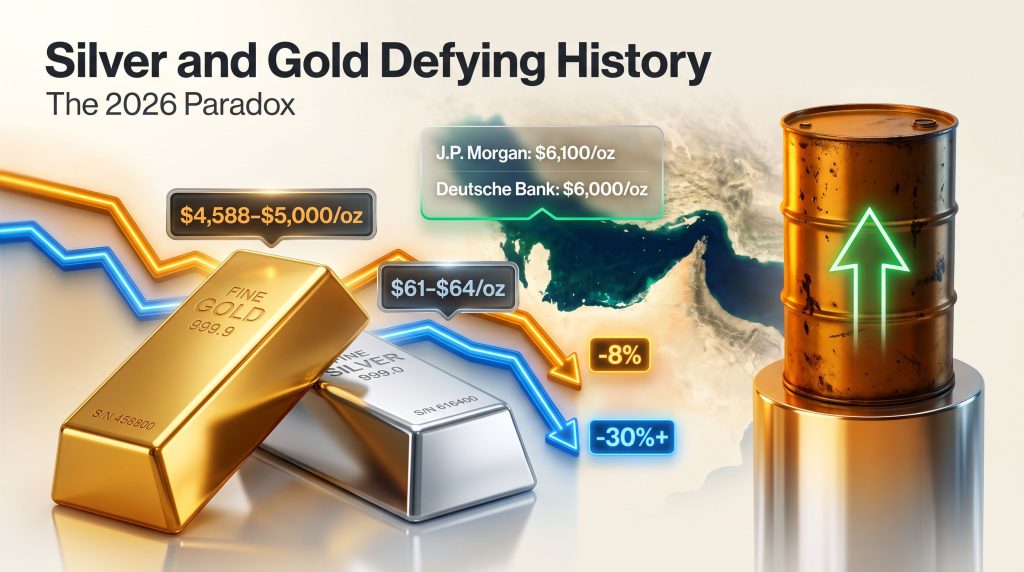
The core anomaly is this: gold has declined more than 8% from its January 2026 peak near $5,645 per ounce, with prices settling in the $4,588 to $5,000 range. Silver's correction has been even more severe, falling over 30% from its January highs to approximately $61 to $64 per ounce. These are not minor fluctuations. These are significant drawdowns occurring during an active military conflict, a scenario that historically generates the opposite outcome.
The key to understanding this inversion lies in identifying what kind of war is being fought, economically speaking. Not all geopolitical conflicts create the same macro environment. The Iran conflict is not primarily functioning as an uncertainty shock that drives capital into defensive assets. Instead, it is functioning as an energy supply shock that accelerates inflation, which in turn triggers monetary policy responses that are structurally hostile to non-yielding assets like precious metals.
This is a crucial distinction that many retail investors overlook when they apply historical templates to current conditions. Furthermore, the gold safe-haven dynamics that proved reliable in previous conflicts are being fundamentally disrupted by this unique economic transmission chain.
The Oil-Inflation-Rate Hike Transmission Chain
The Strait of Hormuz disruption has been the critical transmission mechanism. At the onset of the conflict, roughly 20% of global oil supply transited that strait. While Middle Eastern producers have been actively developing alternative shipping routes, full logistical rerouting takes years, meaning the supply disruption risk remains a structural pressure on energy markets throughout the conflict's duration.
The direct consequence has been elevated oil prices, with Brent crude reaching peaks above $120 per barrel and West Texas Intermediate touching approximately $110 per barrel. These elevated energy costs feed directly into headline consumer price inflation. When CPI prints rise, central banks respond with tighter monetary policy. Tighter monetary policy strengthens the US dollar and raises bond yields, which are historically the two most reliable suppressors of gold and silver valuations.
The following table illustrates how this chain reaction moves from a single geopolitical trigger to broad precious metals pressure:
| Macro Factor | Trigger | Impact on Gold and Silver |
|---|---|---|
| Strait of Hormuz disruption | Oil supply constraints | Brent crude above $120/barrel |
| Rising energy costs | Headline CPI acceleration | Stagflation fears intensify |
| Fed rate hike expectations | Inflation persistence | Non-yielding assets lose appeal |
| Stronger US dollar | Rate differential widening | Downward pressure on USD-priced metals |
| Capital rotation to oil | War-driven commodity trade | Liquidity exits precious metals |
It is worth noting that when recent CPI and PPI data showed cooler inflation figures, this was largely a function of oil prices retreating from their peaks rather than any structural improvement in the inflation outlook. The underlying dynamic remains intact, and headline risk from ongoing geopolitical developments continues to create volatility that markets cannot simply absorb and move past. Precious metals market analysis from prior cycles reinforces how unusual this environment truly is.
Capital Rotation: Why Oil Is Winning the War Trade
In conventional conflict cycles, gold absorbs the bulk of safe-haven capital flows. The current situation is different because the war's primary economic effect is to dramatically increase the value of energy assets. Investors who positioned long on crude oil have significantly outperformed precious metals holders since the conflict escalated.
The United States, as the world's largest oil producer, holds a structurally advantaged position in this environment, as elevated global energy prices benefit domestic production economics while only partially affecting domestic supply chains. According to recent reporting on precious metals price movements, safe-haven demand has faded considerably as energy-driven inflation concerns take centre stage.
This creates an uncomfortable reality for precious metals investors: in an energy-supply-shock war, oil functions as the primary war-premium asset, drawing capital that would historically flow into gold. The rotation is rational given the macro environment, even if it defies the intuitive safe-haven narrative.
The current conflict is functioning as an inflation accelerant rather than a pure uncertainty event. This structural difference is why the traditional safe-haven playbook is producing the wrong predictions for precious metals in 2026.
The Federal Reserve Factor: New Leadership, New Posture
Compounding the oil-driven inflation pressure is a significant shift in monetary policy communication. Kevin Warsh assumed the role of Federal Reserve Chair and has adopted a markedly different stance compared to his predecessor Jerome Powell. His approach involves considerably less forward guidance and a more pronounced commitment to combating inflation.
Following his first FOMC meeting, market pricing shifted to reflect at least one additional rate hike expected in Q4 2026. Higher rates create two compounding headwinds for precious metals:
- Dollar strengthening: Rate differentials widen, making the US dollar more attractive relative to other currencies, which applies downward pressure on commodities priced in USD.
- Rising opportunity cost: When bond yields climb, income-oriented investors can earn meaningful returns from fixed income without accepting the price volatility inherent in holding gold or silver. This raises the cost of holding non-yielding assets.
The combination of an inflation-accelerating conflict and a newly hawkish Fed creates what can be described as a double suppression environment for precious metals, something that historical models built around single-variable analysis struggle to anticipate.
Silver's Structural Disconnect: The Industrial Demand Floor
Is Silver's Decline Justified by the Fundamentals?
Silver's situation deserves specific attention because its more than 30% year-to-date decline represents a particularly complex analytical problem. Unlike gold, which functions almost exclusively as a monetary and financial asset, silver occupies a dual role as both a monetary metal and a critical industrial input. The market appears to be pricing silver almost entirely through a financial asset lens while ignoring the structural industrial demand story underneath.
Silver's non-substitutable industrial applications include:
- Solar photovoltaic manufacturing: Silver paste is a core component in photovoltaic cell production and cannot be easily replaced by cheaper alternatives without significant efficiency losses.
- Electric vehicle systems: Silver is embedded in EV charging infrastructure, battery management electronics, and power control systems.
- Semiconductor and 5G fabrication: High-conductivity silver compounds are used in next-generation chip architectures and advanced electronics manufacturing.
- Medical and antimicrobial applications: Expanding use cases across healthcare technology continue to generate incremental demand growth.
The global electrification megatrend, driven by energy transition policies and accelerating EV adoption, underpins a structural demand floor that the current market pricing appears to be largely discounting. The International Energy Agency has projected exponential growth in solar and EV deployment through 2030, with silver as a critical input material throughout that expansion.
Silver's current decline appears technically overdone when evaluated against its industrial demand fundamentals. The market is applying financial asset logic to a commodity with genuine manufacturing demand drivers that do not disappear because interest rates are rising.
From a technical standpoint, silver's 20-day exponential moving average sits near $73.95, a significant distance above current trading levels, indicating deeply oversold conditions by conventional technical analysis standards. Gold's 50-day EMA sits at approximately $4,901, providing a near-term reference point for recovery scenarios. Furthermore, the gold-silver ratio analysis available from recent research highlights how extreme the current divergence between the two metals has become.
The next major ASX story will hit our subscribers first
Scenario Modelling: What Prolonged Conflict Means for Precious Metals
The Russia-Ukraine war offers a cautionary parallel. Initially expected by many analysts to resolve within months, that conflict has now extended beyond three years, demonstrating that markets consistently underestimate the duration of modern geopolitical conflicts. Applying this lesson to the Iran situation is essential for constructing realistic investment scenarios.
| Scenario | Oil Price Range | Fed Response | Gold Outlook | Silver Outlook |
|---|---|---|---|---|
| Ceasefire within 12 months | Returns to $75-$85/barrel | Rate cuts resume | Strong rebound toward $6,000+ | Industrial demand recovery accelerates |
| Conflict sustained 2-3 years | Remains elevated $90-$110 | Rates held high or increased | Continued suppression with volatility | Structural industrial floor limits downside |
| Escalation or Strait closure | Spikes above $130/barrel | Emergency policy response | Extreme volatility; potential flight to gold | Supply chain disruption boosts industrial premium |
The longer the conflict continues, the more entrenched oil price elevation becomes. Sustained energy inflation delays the Fed's pivot toward rate reductions, which in turn extends the suppression period for precious metals. However, the structural demand drivers for both metals do not deteriorate during this period; they simply remain overshadowed by the dominant macro narrative.
The Long-Term Bull Case: Why the Structural Thesis Remains Intact
What Macro Forces Support a Long-Term Recovery?
Despite near-term suppression, the multi-year structural case for gold and silver has not been undermined. Several macro forces continue to build beneath the surface:
- Central bank accumulation: Global central banks, particularly in emerging markets, continue increasing gold reserves as a hedge against dollar-denominated debt exposure. Central bank gold demand of this nature is largely price-insensitive and represents a persistent structural bid.
- Sovereign debt levels: Escalating government debt-to-GDP ratios across major economies have historically correlated with long-term gold appreciation as fiscal sustainability concerns erode confidence in fiat currencies.
- Dollar diversification: Geopolitical fragmentation is accelerating efforts by non-Western economies to reduce reliance on the US dollar in trade settlement, a dynamic that structurally supports gold over multi-year horizons.
Major institutional price targets for gold reflect this longer-term optimism:
| Institution | Gold Price Target (End-2026) |
|---|---|
| J.P. Morgan | $6,100/oz |
| Deutsche Bank | $6,000/oz |
| Current Spot (War-Suppressed) | ~$4,588-$5,000/oz |
The gap between current war-suppressed pricing and institutional targets represents meaningful potential upside, contingent on de-escalation, rate normalisation, or dollar weakening. A ceasefire scenario would likely trigger falling oil prices, reduced inflation expectations, potential Fed rate adjustments, and dollar softening.
Historically, this combination produces strong gold and silver rallies. For silver specifically, any monetary metal recovery would be compounded by industrial demand normalisation. In addition, the broader gold and silver markets context shows that central bank behaviour remains a key long-term anchor for valuations.
The AI Equity Anomaly and What It Reveals About 2026 Markets
One of the more striking features of the current environment is that equity markets are performing relatively well despite the convergence of war, inflation, and elevated interest rates. The explanation lies in the AI infrastructure investment cycle. Technology sector capital expenditure on AI data centres, chips, and cloud infrastructure is sustaining corporate earnings expectations in ways that override conventional war-period equity risk pricing.
This creates an unusual market environment where geopolitical risk, inflation, and equity strength coexist simultaneously. However, there is a lagging headwind that many investors have not yet fully priced in. Many companies refinanced debt at historically low interest rates during 2020 to 2022. As those facilities mature and require refinancing at current elevated rates, margin compression and earnings pressure will become increasingly visible.
Interest rates drive every equity valuation model in use. Higher rates mean higher discount rates applied to future earnings, which mathematically reduces present valuations. The AI growth narrative has been powerful enough to override this effect temporarily, but the repricing risk remains significant.
Portfolio Strategy: Navigating the Precious Metals Paradox
For investors assessing how to position precious metals exposure in the current environment, the key framework shift is moving away from viewing gold and silver as short-term momentum trades and toward treating them as long-term portfolio diversifiers and inflation hedges.
Attempting to time entry based on conflict developments introduces excessive headline risk. A more systematic, staged allocation approach allows investors to manage timing uncertainty while capturing potential upside from eventual de-escalation or monetary policy normalisation. Analysts at Investing.com note that stagflation fears are adding further complexity to positioning decisions for precious metals investors.
The following asset class comparison helps contextualise where precious metals fit within the broader opportunity set:
| Asset Class | 2026 Performance Driver | Risk Profile |
|---|---|---|
| Crude Oil | Strait of Hormuz supply disruption | High volatility, geopolitical dependency |
| US Equities | AI infrastructure investment cycle | Elevated but rate-sensitive |
| Bonds and Fixed Income | Rising yields create income opportunity | Moderate; duration risk remains |
| Gold | Inflation hedge; currently rate-suppressed | Medium-term recovery potential |
| Silver | Industrial demand plus monetary dual role | High volatility; structural upside |
The core investment principle that applies here is staying diversified and staying invested. Volatility in both equity and commodity markets is expected to remain elevated for as long as the macro environment combines geopolitical uncertainty, inflation pressure, and an active tightening bias from the Fed. Within that context, gold and silver serve a specific diversification function rather than a directional momentum function.
Frequently Asked Questions: Silver and Gold Market Outlook Amid the Iran War
Why is gold falling during the Iran war?
Gold is being suppressed by the indirect economic consequences of the conflict rather than the conflict itself. Elevated oil prices from the Strait of Hormuz disruption have accelerated inflation, which has driven expectations of further Federal Reserve rate increases. Higher rates strengthen the US dollar and raise the opportunity cost of holding non-yielding assets, creating a net negative environment for gold despite the surface-level geopolitical uncertainty.
Is silver's 30% decline an overreaction?
Based on the underlying industrial demand fundamentals, the decline appears technically excessive. Silver's use in solar manufacturing, EV systems, semiconductors, and medical applications creates a structural demand floor that the current market pricing is largely ignoring. The electrification megatrend represents a multi-year demand driver that does not disappear because of short-term monetary policy headwinds.
What would trigger a gold and silver recovery?
The most likely recovery catalyst is a combination of conflict de-escalation, falling oil prices, reduced inflation expectations, and a subsequent shift in Fed policy toward rate normalisation. A weaker dollar combined with declining real yields has historically produced strong precious metals rallies. Silver's recovery would likely be amplified by simultaneous industrial demand normalisation.
How does the Strait of Hormuz disruption affect gold prices?
The effect is indirect but powerful. Reduced oil flow through the strait elevates global energy prices, which feeds into broader consumer inflation, which prompts central banks to tighten monetary policy. This sequence strengthens the dollar and suppresses gold and silver, making the Strait of Hormuz situation a negative factor for precious metals despite being a classic geopolitical risk event.
The 2026 Precious Metals Market in Context
The silver and gold market outlook amid the Iran war presents one of the more analytically complex environments for precious metals investors in recent memory. The conflict is producing effects that run counter to historical templates, not because the safe-haven properties of gold and silver have changed, but because the specific economic mechanism through which this war operates happens to activate the primary suppressors of precious metals valuations.
The oil-inflation-rate hike chain is functioning as a more powerful force than the safe-haven demand that would normally accompany military conflict. Silver's industrial demand story remains structurally compelling but is being overwhelmed by financial market dynamics in the short term. Institutional price targets of $6,000 to $6,100 per ounce for gold by end-2026 suggest the long-term recovery thesis is intact; the timeline simply depends on when macro conditions allow that thesis to reassert itself.
For investors, the silver and gold market outlook amid the Iran war is not a broken market. It is a market responding rationally to an unusual and compounding set of pressures. The structural case for both metals as long-term stores of value and industrial inputs remains as strong as it has been at any point in the current cycle. The more productive question is not whether a recovery will occur, but what combination of macro shifts will allow the underlying fundamentals to reassert pricing control.
This article is intended for informational and educational purposes only. It does not constitute financial advice. Precious metals markets involve significant volatility and risk. Past performance is not indicative of future results. Readers should consult a qualified financial professional before making investment decisions. Institutional price targets referenced are forward-looking projections subject to revision and do not represent guaranteed outcomes.
Want to Stay Ahead of the Next Major ASX Mineral Discovery?
While precious metals markets navigate complex macro headwinds, significant discovery opportunities continue to emerge on the ASX — and Discovery Alert's proprietary Discovery IQ model delivers real-time alerts the moment they are announced, turning complex data across 30+ commodities into clear, actionable insights for both short-term traders and long-term investors. Explore how historic discoveries have generated substantial returns on Discovery Alert's dedicated discoveries page, and begin your 14-day free trial today to position yourself ahead of the broader market.