June 8, 2026
Why Silver's Investment Thesis Is More Complex Than Most Investors Realise
Commodity markets rarely move on a single variable, yet investors persistently search for the one dominant narrative to anchor a trade. For silver, that anchor has been solar photovoltaic demand for much of the past decade. The problem with single-driver narratives is that they collapse spectacularly when the dominant variable shifts, leaving investors unprepared for what comes next.
Understanding the silver market AI bubble and solar demand dynamic in 2025 requires stepping back from headline-level analysis and examining the structural forces pulling silver in multiple directions simultaneously. This is not a simple bull-or-bear story. It is a market defined by competing pressures, eroding paper market credibility, and a physical supply situation that makes the downside far less straightforward than most technical traders assume.
When big ASX news breaks, our subscribers know first
The Solar Demand Pillar and Why It Is Starting to Crack
From 11% to 29%: The Decade-Long Transformation
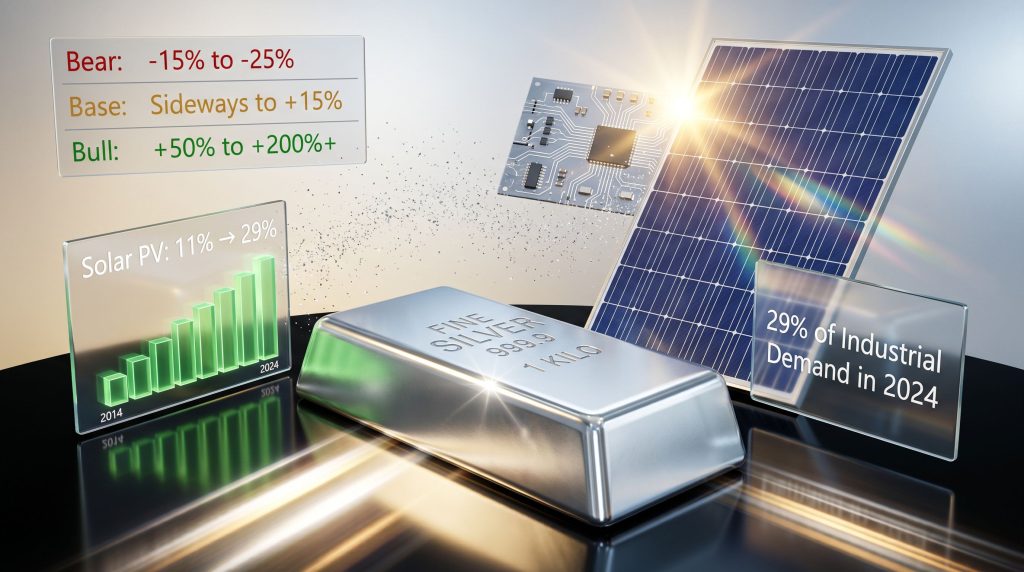
The rise of solar photovoltaics as the dominant industrial consumer of silver has been one of the most significant structural shifts in the metal's demand profile in modern history. According to the Silver Institute, solar PV manufacturing accounted for approximately 11% of total silver industrial demand in 2014. By 2024, that figure had grown to roughly 29%, making it the single largest industrial consumption category, surpassing traditional electronics and every other industrial application.
This transformation underpinned much of the bullish silver investment thesis entering 2025. The logic was compelling: accelerating global solar deployment, rising cell efficiency targets, and the resistance of high-efficiency cell architectures to silver substitution created what appeared to be a durable demand floor. Furthermore, silver's dual role as both a precious metal and an industrial commodity amplified this structural appeal.
The Fraunhofer Institute Breakthrough That Flew Under the Radar
That assumption was significantly challenged in April 2025 when researchers at Germany's Fraunhofer Institute published findings demonstrating a method to reduce silver content in high-efficiency solar cells by approximately 90%. The technology focuses on Tunnel Oxide Passivated Contact (TopCon) cell architecture, which currently represents roughly 70 to 80% of the solar cells in active production and had previously resisted silver substitution more successfully than older cell designs.
The new approach replaces most of the silver with copper, nickel, and silicon, retaining silver only as a thin anti-oxidation coating layer. If commercialised at scale, the demand implications are significant. A full-scale transition using this method could theoretically remove between 100 and 150 million ounces of annual silver demand from the market, a reduction that cannot be dismissed as immaterial.
The inventors themselves have indicated a commercialisation timeline of two to three years. However, historical precedent in photovoltaic technology transitions suggests this estimate is optimistic. Similar cell architecture innovations have typically taken five to ten years to move from laboratory demonstration to widespread manufacturing adoption, constrained by:
- Supply chain reconfiguration and capital expenditure requirements
- Certification and standards processes for grid-connected solar installations
- Manufacturing inertia at scale among established cell producers
- Customer qualification timelines for utility-scale project procurement
A conservative five-year adoption window materially preserves near-term silver demand. However, investors would be unwise to ignore the directional signal entirely.
What the Supply Side Cannot Change Regardless of Demand
Even as solar demand faces a structural headwind, the supply constraints underpinning silver's long-term price case remain fully intact. These are not policy-dependent or demand-driven variables. They are geological and structural realities. In addition, silver supply deficits continue to compound these constraints year on year:
- Peak silver production is widely considered to have already occurred, with output unlikely to recover meaningfully
- Declining ore grades mean that deeper, more costly extraction delivers progressively lower yields per tonne mined
- Byproduct dependency means that approximately 70% of silver is produced as a secondary output of lead, zinc, and copper mining, making supply unable to respond independently to silver price signals
- Mine development timelines averaging over 15 years from discovery to first production prevent any rapid supply-side response
- Depleted surface inventories built up over prior decades cannot be rebuilt on short notice, regardless of what happens to demand
The demand architecture may be shifting. The supply architecture is not.
The AI Bubble Risk and Its Double-Edged Impact on Silver
Why AI Infrastructure Is Currently Bullish for Silver
Artificial intelligence infrastructure expansion creates genuine, measurable silver demand through two distinct channels. First, data centres and the semiconductors, memory systems, and connectivity hardware that fill them consume silver directly. Second, AI's enormous and growing electricity appetite drives up power costs across all industries, including mining. Higher electricity costs make silver extraction progressively more expensive, acting as a supply-side constraint that supports prices.
The net effect during an AI investment expansion cycle is therefore directionally positive: rising industrial demand from hardware manufacturing, combined with rising production costs in mining, creates a structurally supportive environment for silver prices. AI and solar-driven demand growth is increasingly recognised as a defining theme for silver well into 2026.
The Valuation Problem That Threatens to Unwind This Thesis
The difficulty is that the investment cycle sustaining this demand is built on valuations that increasingly diverge from provable economic outcomes. An MIT study analysed corporate AI adoption outcomes and found that 95% of implementing companies reported no measurable improvement in profitability, with meaningful gains concentrated in just 5% of adopters. The market, however, continues to price outcomes as though the entire adopting population will achieve transformative returns.
The structural parallels to the dot-com era are instructive:
| Characteristic | Dot-Com Era (1999-2001) | AI Era (2023-2025) |
|---|---|---|
| Technology genuinely revolutionary? | Yes | Yes |
| Revenue generation present? | Minimal | Moderate |
| Valuations vs. earnings | Extreme | Elevated |
| Profitability at scale proven? | No | Largely unproven |
| Cross-sector contagion risk | Telecom, media | Crypto, EVs, cloud, labour markets |
The critical distinction is that a bursting AI bubble in 2025 carries broader cross-sector contagion risk than the dot-com collapse did, given AI's deep integration with cryptocurrency valuations, electric vehicle investment theses, and cloud computing equity multiples. A disorderly unwind could consequently affect more interconnected markets simultaneously.
Three Mechanisms Through Which an AI Collapse Hits Silver
If a significant equity market correction unfolds as AI valuations compress, silver faces three sequential pressure mechanisms in the near term:
-
Forced liquidation: Institutional investors receiving margin calls are compelled to sell liquid assets, including silver, regardless of their fundamental view on the metal. This was clearly observable in the 2008 crisis.
-
Forward-looking demand contraction: Equity markets price expected future conditions, not current ones. Even if actual industrial silver demand remains stable, markets will discount expected demand destruction before it materialises, producing a preemptive price decline.
-
Wealth effect rebalancing: Investors whose portfolio values decline substantially are forced to reduce position sizes across asset classes to maintain target allocation percentages, creating selling pressure in silver that has nothing to do with silver's fundamentals.
None of these mechanisms represent a permanent shift in silver's long-term value. They represent the temporary dislocation that historically precedes silver's most powerful recoveries.
How Silver Has Behaved in Previous Crisis Cycles
The 2008 and 2020 Playbooks
The 2008 financial crisis saw silver decline sharply alongside equities, with prices cut roughly in half at the trough. Critically, however, silver's recovery was faster than the broader equity market's recovery. What followed over the subsequent three years was a rally from below $10 per ounce to approximately $50, a move of over 400% that massively outperformed every other major asset class over the same period.
The 2020 COVID-19 selloff produced a near-identical pattern. Silver fell sharply in the initial liquidity crisis, recovered faster than equities, and subsequently delivered significant outperformance as monetary policy shifted toward aggressive rate cuts and liquidity expansion.
The common denominator in both episodes was the policy response. Aggressive rate cutting by central banks created the conditions for precious metals outperformance. With debt levels and monetary system stresses substantially higher in 2025 than in either prior episode, the slingshot dynamic, if it repeats, could be proportionally larger. The gold and silver price impact from macroeconomic stress adds yet another layer to this already complex picture.
The Paper Market Problem: COMEX and the Fracturing Price Discovery Mechanism
Open Interest Collapse and What It Reveals
COMEX silver futures open interest has contracted dramatically. Comparable gold futures figures illustrate the magnitude: open interest peaked at around 800,000 contracts in May 2020 and has since declined to approximately 320,000 contracts, reflecting a substantial and sustained exodus of institutional and sovereign market participants from the futures complex.
The reason is straightforward. Sophisticated market participants require certainty of physical delivery. COMEX's structure, which allows positions to be established and settled without physical ownership of the underlying metal, creates counterparty and delivery risk that large industrial and sovereign buyers are no longer willing to accept.
Where Real Money Has Gone Instead
Institutional and sovereign participants have redirected liquidity toward venues that require physical metal ownership before a position can be established, including free-trade zone corridors and Shanghai Gold Exchange markets. The Shanghai spot price has increasingly become the reference point for physical silver pricing, often diverging from COMEX futures in ways that expose the futures market's weakening relevance as a price discovery mechanism.
This structural migration has a critical implication for remaining COMEX participants. With large, sophisticated players absent, the market's residual participants are disproportionately momentum traders and leveraged speculators. A reported instance of approximately 800 contracts changing positions producing a $26 intraday price move in silver illustrates precisely how thin current COMEX liquidity has become and how asymmetric the risk is for leveraged traders operating in this environment.
Silver's futures market is no longer behaving as an efficient price discovery mechanism. It is behaving as a venue where small position changes produce outsized price dislocations, and where technical analysis rules derived from more liquid markets frequently produce false signals and expensive traps for inexperienced traders.
The Physical Squeeze Scenario: Silver's Most Explosive Potential Pathway
Musical Chairs in a Depleted Market
The most asymmetric upside scenario for silver is not driven by solar demand, AI hardware consumption, or geopolitical safe-haven flows. It is driven by a potential collision between large industrial buyers with non-negotiable supply requirements and a physical inventory situation that is already critically depleted. Indeed, a silver squeeze scenario of this nature represents one of the most discussed structural risks currently circulating among sophisticated market observers.
Unlike gold, where mined metal accumulates above ground in various forms across centuries of production, silver is consumed industrially and does not recirculate into investable inventory in the same way. Once depleted, physical silver inventories cannot be rapidly rebuilt regardless of price.
The palladium market in the late 1990s provides a historical analogue. When a major automotive manufacturer concluded it could not secure adequate palladium supply for catalytic converters and began purchasing aggressively at any price, palladium experienced a price explosion of approximately 1,000% over a multi-year period. The physical requirement was non-negotiable: cars could not be manufactured without it.
Silver's position in defence technology, advanced electronics, and critical manufacturing creates equivalent non-negotiable demand vectors. A scenario where one or more large industrial buyers or sovereign entities begin competing for scarce physical inventory simultaneously could trigger a price dislocation that bypasses futures market constraints entirely.
The next major ASX story will hit our subscribers first
Scenario Modelling: Three Pathways for Silver Through 2026
| Scenario | Primary Trigger | Near-Term Price Impact | Long-Term Implication |
|---|---|---|---|
| Bear Case | AI bubble bursts, solar substitution accelerates | -15% to -25% | Significant buying opportunity |
| Base Case | AI spending continues, solar demand stable near-term | Sideways to +15% | Steady structural appreciation |
| Bull Case | Physical market squeeze, delivery crisis | +50% to +200%+ | Structural market repricing |
Bear Case Context
A 15 to 25% price decline driven by AI bubble unwinding and accelerated solar substitution fears would be painful for short-term holders but historically consistent with prior crisis entry points that preceded silver's largest bull moves. The key variable is duration: a decline measured in months rather than years preserves the slingshot dynamic.
Bull Case Context
The physical squeeze scenario requires no single dominant catalyst. It requires only that the gap between available physical supply and aggregate industrial demand narrows past a critical threshold at a moment when one or more large buyers recognise the risk simultaneously. At that point, price becomes secondary to security of supply.
How Investors Should Think About Positioning Right Now
Physical vs. Paper: A Structural Decision, Not Just a Preference
Given the deterioration of COMEX as a reliable price discovery mechanism, the case for holding physical silver rather than futures or ETF positions has strengthened considerably. Physical silver eliminates counterparty risk, is unaffected by the intraday volatility dynamics of a thinly traded futures market, and participates in the potential upside of a physical squeeze scenario that paper positions may not fully capture.
For investors who wish to manage short-term downside exposure while preserving physical holdings, hedging strategies offer a middle path, using futures or options to offset near-term price risk without liquidating the core physical position that provides leverage to the longer-term structural thesis. Furthermore, monitoring the gold-silver ratio remains a useful tool for gauging relative value between the two metals during periods of elevated uncertainty.
Mining Stocks vs. Physical: Different Tools for Different Objectives
- Mining equities tend to behave more predictably from a technical analysis standpoint on shorter timeframes, making them more suitable for active traders seeking defined entry and exit signals
- Physical silver remains the superior long-term store of value, least susceptible to paper market dynamics and most directly exposed to the physical squeeze scenario
- Tokenized silver represents an emerging middle option, combining physical metal backing with the liquidity flexibility of digital settlement
Dollar-cost averaging into physical silver over time has historically produced favourable outcomes for investors who maintained discipline through volatility cycles, with those who accumulated consistently over the past several years sitting on meaningful unrealised gains despite periods of significant drawdown. Analysis of silver's market positioning further supports this long-term accumulation approach.
The Long-Term Bull Case Remains Structurally Intact
Removing solar demand growth as the primary price engine does not dismantle the silver bull case. It redirects it. Geopolitical instability, erosion of central bank credibility, monetary system stress, and the structural dynamics of a market where investment demand can move prices dramatically given silver's relatively small total market size — these factors remain fully active and arguably more relevant in 2025 than at any prior point in the current cycle.
The silver market AI bubble and solar demand narrative is not a reason to abandon silver exposure. It is a reason to understand silver more thoroughly, position more thoughtfully, and distinguish between near-term tactical vulnerability and long-term structural opportunity. Those two things can, and currently do, coexist.
Disclaimer: This article is for informational and educational purposes only and does not constitute financial or investment advice. All forecasts, scenarios, and projections discussed represent analytical frameworks and possibilities, not predictions or guarantees. Investors should conduct their own research and consult a qualified financial adviser before making any investment decisions. Silver markets involve significant risk, including the potential loss of capital.
Want to Stay Ahead of the Next Major Mineral Discovery on the ASX?
Discovery Alert's proprietary Discovery IQ model delivers real-time alerts on significant ASX mineral discoveries across silver, gold, and more than 30 other commodities — turning complex market data into clear, actionable insights for investors at every level. Explore why major mineral discoveries have historically generated extraordinary returns on Discovery Alert's dedicated discoveries page, and begin your 14-day free trial today to position yourself ahead of the broader market.