August 6, 2026
When Supply Rewrites the Rules: The Simandou Iron Ore Supply Surge Reshaping Global Markets
Commodity markets operate on long cycles, and the iron ore industry is no exception. For roughly two decades, the mechanics of seaborne iron ore trade were remarkably predictable: a small cluster of Australian and Brazilian producers controlled global volumes, and price movements were almost entirely dictated by fluctuations in Chinese steel demand. That model is now being structurally disrupted by the Simandou iron ore supply surge, and the consequences for ASX-listed miners, global price benchmarks, and downstream steel economics are only beginning to unfold.
When big ASX news breaks, our subscribers know first
Guinea's Simandou Project: From Decades of Delay to Active Market Participant
The Simandou iron ore deposit in Guinea's Fouta Djallon highlands has occupied a unique space in commodity market discussions for over twenty years. Repeatedly cited as one of the largest undeveloped high-grade iron ore bodies ever identified, it simultaneously represented both an enormous opportunity and an almost impossibly complex logistics challenge. The ore body's remoteness, the absence of supporting infrastructure, and a series of ownership disputes, legal complications, and financing hurdles kept it locked in development limbo long past the point where many analysts expected it to produce.
What makes Simandou geologically distinctive is not just its scale but its iron content grade. Pilbara ore from Western Australia, which has served as the global benchmark for decades, typically grades in the range of 57% to 62% iron. Simandou's ore is widely reported to carry iron grades in the vicinity of 65% to 66%, placing it firmly in the high-grade category that Chinese steel mills actively compete to secure.
The commercial logic is straightforward: higher-grade ore requires less coking coal per tonne of steel produced, directly reducing both input costs and carbon emissions per unit of output. In an environment where Chinese mills are under increasing pressure to improve energy efficiency and reduce emissions intensity, this quality differential carries genuine economic value. Furthermore, China steel and iron ore dynamics make this grade advantage particularly significant heading into the latter half of the decade.
The Infrastructure Equation: A 650-Kilometre Railway That Changed Everything
The single most daunting barrier to Simandou's development was never geological. It was logistical. The deposit sits approximately 650 kilometres from the Guinean coastline, in mountainous terrain with no existing heavy-haul rail infrastructure. Constructing a dedicated trans-Guinean railway of that scale, along with a purpose-built deep-water export terminal at Morebaya capable of accommodating capesize bulk carriers, represented one of the most ambitious and capital-intensive mining infrastructure undertakings in Africa's modern history.
The railway and port infrastructure are now operational. Rio Tinto iron ore operations confirmed the departure of the first commercial shipment from Guinea in December 2025, formally marking the project's transition from development asset to producing operation. What has surprised market observers is not that exports commenced, but the pace at which volumes have escalated. According to recent export data, monthly throughput has near-quadrupled over a compressed timeframe:
- First quarter 2025: below 0.6 million tonnes per month
- April 2026: 1.3 million tonnes
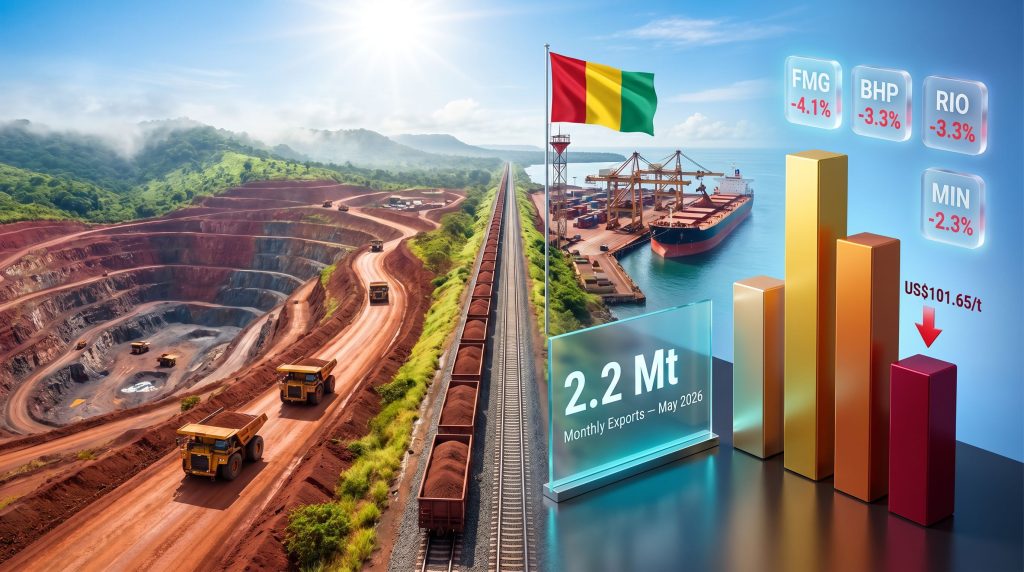
- May 2026: 2.2 million tonnes (the highest monthly figure recorded)
This near-quadrupling of monthly throughput suggests that rail-to-port coordination, which analysts had consistently identified as the key operational bottleneck, is resolving faster than the consensus timeline anticipated. That acceleration is precisely what triggered the sharp repricing of iron ore futures.
Simandou's Production Targets: What Full Capacity Actually Means
| Phase | Estimated Output | Approximate Target Timeframe |
|---|---|---|
| Current ramp-up | 2025-2026 | |
| SimFer operation (full capacity) | 60 Mtpa | ~30 months post-commissioning |
| Combined project capacity | 120 Mtpa | ~2028 |
To contextualise these numbers: global seaborne iron ore trade currently runs at approximately 1.5 to 1.6 billion tonnes per year. A fully ramped Simandou project at 120 Mtpa would represent roughly 7 to 8% of total traded volumes. That is not a marginal addition. It is equivalent to inserting a mid-sized producing nation into the supply base, without any corresponding reduction from existing suppliers. Consequently, iron ore surplus concerns have intensified considerably among market analysts.
The Market Reaction: ASX Iron Ore Stocks Under Pressure
When May 2026 export data from Morebaya port became available, iron ore futures fell 1.9% to US$101.65 per tonne, registering a two-month low. The reaction across ASX-listed iron ore producers was immediate and sharp:
| ASX-Listed Producer | Share Price Move | Primary Exposure |
|---|---|---|
| Fortescue (ASX: FMG) | -4.1% | Pure-play iron ore |
| BHP (ASX: BHP) | -3.3% | Diversified; iron ore dominant |
| Rio Tinto (ASX: RIO) | -3.3% | Diversified; Simandou stakeholder |
| Mineral Resources (ASX: MIN) | -2.3% | Iron ore + lithium + mining services |
| S&P/ASX 200 Materials Sector | -3.2% | Broad materials index |
| S&P/ASX 200 Index | -1.13% (to 8,686) | Benchmark index |
Why Fortescue's Exposure Is Uniquely Concentrated
Fortescue's steeper decline relative to BHP and Rio Tinto reflects a fundamental structural difference in earnings composition. As a near-pure-play iron ore producer, Fortescue has no meaningful revenue offset from copper, aluminium, potash, or energy assets. Every dollar of sustained downward movement in the iron ore price benchmark flows directly and proportionally into its earnings per share and dividend capacity. There is no diversification buffer to absorb the shock.
By contrast, BHP generates material earnings contributions from copper operations in Chile, and Rio Tinto produces significant aluminium and copper revenue alongside its iron ore division. Both companies experience iron ore price weakness as a meaningful headwind, but not an unmitigated one. The BHP iron ore strategy reflects this broader diversification approach in its longer-term planning.
Rio Tinto's Paradox: Beneficiary and Victim Simultaneously
Rio Tinto's position is the most analytically complex of the three majors. As a significant stakeholder in the Simandou SimFer joint venture, Rio stands to benefit over the long term from production growth and incremental volume revenue as the project scales toward 60 Mtpa. However, in the near and medium term, every additional tonne that Simandou exports into the seaborne market contributes to the price compression that is eroding the earnings from Rio's existing Pilbara operations.
This creates an internal tension between the company's two largest iron ore assets that will take years to resolve. Both BHP and Rio Tinto had also traded near multi-month share price highs in the period before the Simandou export data release. That elevated positioning made profit-taking behaviour more likely at the first credible catalyst for concern, amplifying the magnitude of the single-day selloff beyond what pure fundamental repricing would suggest.
The Displacement Debate: Does New Supply Add or Replace?
The most consequential analytical question in the iron ore market right now is whether Simandou's exports will displace existing tonnes from Chinese import schedules, or simply add to an already well-supplied market and push benchmark prices lower across the board.
The displacement argument rests on the ore quality premium. Because Simandou's high-grade material delivers genuine efficiency advantages in blast furnace operations, Chinese mills may preferentially substitute it for lower-grade Pilbara feedstock rather than consuming it as an additive volume. Under this scenario, Australian mid-grade producers face selective volume displacement rather than universal price compression. However, China demand prospects remain deeply uncertain, complicating any straightforward analysis.
The additive supply argument, by contrast, points to the scale of the volumes involved and the current state of Chinese demand:
- Chinese steel output has been under structural pressure due to a contracting property development sector and slowing infrastructure investment growth.
- Chinese port iron ore inventories were already elevated at the time Simandou began its export ramp-up, reducing the immediate absorption capacity for additional seaborne tonnes.
- At 120 Mtpa, the volume exceeds what grade-based substitution alone can accommodate within existing mill operating patterns.
The most probable real-world outcome involves elements of both mechanisms operating simultaneously, with the balance between them shifting as market conditions evolve. Indeed, industry analysts tracking the project note that the timeline for full market absorption remains highly contested.
Profitability Thresholds and Dividend Considerations
A critical point for investors to anchor their risk assessment is the cost structure reality. BHP, Rio Tinto, and Fortescue all operate with all-in sustaining costs sufficiently low that iron ore prices around US$100 per tonne remain comfortably profitable. The current environment does not raise questions about operational viability or financial distress.
The risk framework is more nuanced:
- At US$100/tonne (current): All three majors remain profitable; earnings compression is modest but manageable.
- At US$90/tonne: Margin pressure becomes more visible; consensus earnings forecasts require downward revision.
- At US$85/tonne and below: Higher-cost operations begin to experience meaningful margin deterioration; dividend sustainability for pure-play producers comes under scrutiny.
Both BHP and Rio Tinto operate dividend frameworks that are explicitly tied to earnings and cash flow generation. A sustained shift in the iron ore price deck toward the US$85 to US$90 range would likely produce downward revisions to distribution forecasts, which matters considerably for the income-focused investor base that holds significant positions in both companies.
Capesize Shipping: An Often-Overlooked Secondary Effect
One market dynamic that receives insufficient attention in mainstream coverage of the Simandou iron ore supply surge is its effect on capesize bulk carrier freight rates. Guinea to China represents a substantially longer voyage than Australia to China. The trans-oceanic distance from Morebaya to Chinese ports is roughly twice that of the comparable Pilbara-to-China route.
This means each tonne of Simandou iron ore consumes significantly more vessel-days to deliver than an equivalent Australian tonne. The net effect is that increased Simandou volumes support capesize tonne-mile demand even as they create headwinds for iron ore prices. Shipping market participants who track vessel utilisation independently of commodity prices may therefore find Simandou's ramp-up a net positive for their sector.
The next major ASX story will hit our subscribers first
Three Scenarios for the Iron Ore Market Through 2028
Scenario 1: Managed Absorption (Base Case)
Simandou's ramp-up continues at a measured pace while Chinese steel demand stabilises modestly as fiscal support measures take hold. Iron ore prices consolidate in the US$90 to US$105 per tonne range. ASX producers experience moderate earnings compression but maintain dividends at reduced but sustainable levels. The market gradually reprices the new supply reality without a disorderly correction.
Scenario 2: Accelerated Oversupply (Bear Case)
Simandou exports exceed forward projections as infrastructure performance continues to improve, while Chinese demand remains subdued. Iron ore prices test the US$80 to US$90 range on a sustained basis. Earnings forecasts for FMG, BHP, and RIO are revised materially lower. Dividend reductions become a realistic scenario for pure-play producers, and valuation multiples compress across the sector.
Scenario 3: Demand Recovery Offsets Supply Growth (Bull Case)
Chinese fiscal stimulus drives a meaningful recovery in steel production and property construction activity. Simandou's additional tonnes are progressively absorbed without significant price deterioration. ASX iron ore producers recover lost ground, and furthermore, Rio Tinto's long-term position as both a Pilbara producer and Simandou stakeholder becomes a recognised competitive advantage.
Practical Investor Considerations for Navigating the Simandou Supply Surge
For investors holding or evaluating positions in ASX iron ore producers, several monitoring priorities stand out:
- Track monthly Morebaya port export data as the most direct and timely indicator of supply trajectory. Each new monthly figure provides an updated read on ramp-up velocity.
- Monitor Chinese steel production statistics and port inventory levels as the demand-side counterweight. Rising inventories alongside rising Simandou exports would be a bearish combination.
- Differentiate producers by earnings diversification. The investment risk profile of a pure-play iron ore operator is fundamentally different from a diversified major during a period of sustained price pressure.
- Stress-test dividend assumptions at multiple price scenarios before committing to income-focused iron ore positions.
- Recognise that Rio Tinto's dual exposure creates a unique long-term optionality profile that is absent from BHP and entirely absent from Fortescue.
Disclaimer: This article is intended for informational purposes only and does not constitute financial advice. All forecasts, price scenarios, and production timelines discussed involve significant uncertainty. Past performance is not indicative of future results. Investors should conduct their own research and consult a licensed financial adviser before making investment decisions.
Want to Stay Ahead of the Next Major Mineral Discovery Before the Market Moves?
While the Simandou iron ore supply surge reshapes ASX valuations and commodity price dynamics, Discovery Alert's proprietary Discovery IQ model scans ASX announcements in real time, instantly notifying subscribers of significant mineral discoveries across more than 30 commodities — explore historic examples of transformative discoveries and their market returns, then begin your 14-day free trial at Discovery Alert to position yourself ahead of the broader market.