June 9, 2026
Silver's Moment: Understanding the Capital Dynamics Behind the Sinda US IPO Filing
Precious metals exploration has always operated on a different clock to the rest of the capital markets. The time between discovery and production can span decades, yet the windows when exploration capital flows freely are surprisingly narrow. When silver trades at multi-decade highs, when institutional appetite for hard assets intensifies, and when a buoyant IPO market creates receptive conditions for pre-revenue listings, those windows open. In 2026, all three forces have converged simultaneously, creating the conditions that make the Sinda US IPO filing one of the more strategically calculated capital markets events in recent silver sector history.
When big ASX news breaks, our subscribers know first
The Macro Backdrop Driving Silver Exploration Into Public Markets
Silver's push above $80 per troy ounce in 2026 is not simply a speculative price move. It represents a structural realignment of the metal's role in the global economy, driven by surging industrial consumption from photovoltaic solar manufacturing, advanced electronics, and electric vehicle components. Furthermore, silver's dual demand characteristics mean that when industrial consumption accelerates in parallel with monetary demand, the supply-demand dynamic can tighten rapidly.
This price environment fundamentally changes the economics of greenfield silver projects. Assets that were previously sub-economic at $20 to $30 per ounce become compelling at $80 per ounce, particularly when the project sits within a high-grade geological belt with a documented production history stretching back centuries.
At the same time, the broader US IPO market has experienced a pronounced resurgence in 2026. Multiple sectors, including artificial intelligence, aerospace, and biotechnology, have rushed to capture investor enthusiasm for fresh listings. High-profile anticipated listings, such as SpaceX's expected record-breaking debut on the New York Stock Exchange, have reinvigorated both institutional and retail participation in new offerings. Mining companies, historically underrepresented in US IPO cohorts, are now positioning themselves within this window, leveraging elevated commodity prices and a demonstrably receptive capital markets environment.
What the Sinda US IPO Filing Actually Reveals
The Guanajuato Silver Belt: Historical Significance and Geological Context
Sinda's core asset sits within Mexico's Guanajuato silver belt, a region whose mining history extends back to the Spanish colonial period. The Guanajuato district has historically been one of the most productive silver-producing areas in the world, with output spanning multiple centuries. This geological pedigree matters in exploration finance: established silver belts typically offer predictable structural frameworks, known mineralisation styles, and a body of historical data that helps exploration teams model resource potential with greater confidence than truly virgin terrain.
The company holds exploration and exploitation rights to five contiguous mining concessions within this belt. The contiguous nature of the tenement package is significant from a geological standpoint. Fragmented concession holdings create operational complexity and can limit the ability to pursue mineralisation across structural boundaries. A consolidated block of five adjoining concessions allows exploration programs to follow ore trends without jurisdictional interruption.
The project is characterised as a high-grade, large-scale silver-gold greenfield discovery. The greenfield designation is a critical qualifier. It signals that while the geological setting is well-understood and historically productive, the specific deposit being targeted by Sinda has not previously been subject to systematic modern exploration or development. This creates an asymmetric risk-reward profile: the upside from a first-pass resource definition at a high-grade greenfield discovery in a world-class belt can be substantial, but the geological uncertainty before drilling is complete remains meaningful.
Filing Mechanics and Capital Structure
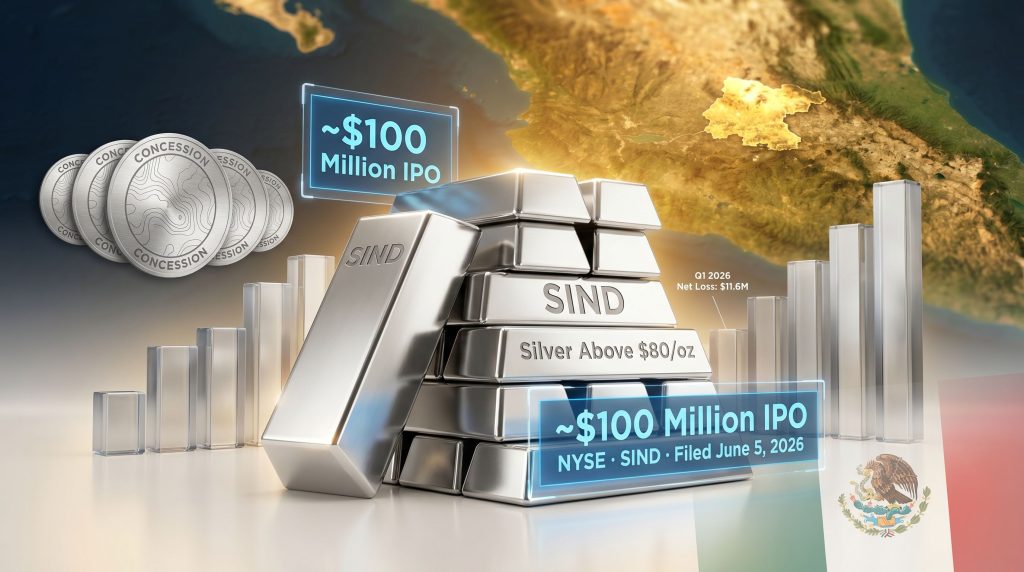
The S-1 registration statement was filed with the US Securities and Exchange Commission on June 5, 2026. The estimated deal size is approximately $100 million, though no share count or indicative price range had been disclosed at the time of filing, which is standard practice for early-stage S-1 submissions.
| Detail | Information |
|---|---|
| Filing Type | Form S-1 (SEC Registration) |
| Filing Date | June 5, 2026 |
| Estimated Deal Size | ~$100 million |
| Proposed Exchange | NYSE |
| Proposed Ticker | SIND |
| Share Count / Price Range | Not yet determined |
| Offering Status | Subject to SEC effectiveness and market conditions |
The underwriting syndicate assembled for this offering deserves particular attention. The panel combines tier-1 global investment banks with specialist mining capital markets franchises, a structure that reflects a deliberate strategy to attract both generalist institutional allocators and sector-focused natural resources funds.
Joint Lead Book-Running Managers:
- Morgan Stanley
- Scotiabank
- BMO Capital Markets
Joint Bookrunners:
- Canaccord Genuity
- Citigroup
- RBC Capital Markets
The presence of Morgan Stanley and Citigroup alongside dedicated mining banks such as BMO, Scotiabank, RBC, and Canaccord Genuity is not accidental. This dual-audience syndicate architecture is typically employed when an issuer needs to maximise order book breadth across investor categories that do not naturally overlap. Generalist institutional investors, who may be drawn to the silver macro thesis or the Electrum Group's track record, require coverage from the bulge-bracket names. Meanwhile, specialist mining funds and precious metals-focused family offices are more naturally covered by sector-dedicated banks with deep commodity equity relationships.
The Electrum Group Connection: Strategic Capital Architecture
Sinda is a portfolio company of The Electrum Group, a natural resources-focused private investment firm founded and led by Thomas Kaplan. Kaplan has built a well-documented track record in precious metals investment, with previous vehicles including significant stakes in gold and silver exploration companies that were subsequently acquired by major producers.
What makes the current moment particularly notable is the timing. The Sinda US IPO filing came just one day after Sunshine Silver Mining, another Electrum Group portfolio company, completed its listing on the NYSE. The near-simultaneous entry of two Electrum Group silver vehicles into US public markets within a 48-hour window is not a coincidence of scheduling. It reflects a deliberate capital strategy designed to capture peak silver market sentiment, establish a publicly traded precious metals portfolio under the Electrum brand, and maximise investor attention during a single concentrated market moment.
This dual-listing approach effectively creates a publicly accessible silver investment platform, allowing investors to gain exposure to different stages and styles of silver asset development through listed equities rather than private placement structures.
For sophisticated investors, this structure raises an interesting question about portfolio construction. Sunshine Silver Mining, having listed a day earlier, likely represents a more advanced development-stage asset, while Sinda's greenfield status positions it as the higher-risk, higher-potential leg of a complementary silver equity pair.
Financial Profile: Reading the Loss Trajectory Correctly
Pre-revenue mining companies require a fundamentally different analytical framework than operating businesses. Applying standard profitability metrics to an exploration-stage company produces misleading conclusions. The relevant question is not whether the company is profitable, but whether its capital deployment is generating geological progress.
| Period | Net Loss |
|---|---|
| Q1 2025 (Jan-Mar) | $2.6 million |
| Q1 2026 (Jan-Mar) | $11.6 million |
| Year-over-Year Increase | $9.0 million (+346%) |
A 346% increase in quarterly net losses sounds alarming in isolation. In the context of an exploration company accelerating underground development activity ahead of an IPO, it reads differently. The increase is driven by exploration expenditure, not by revenue shortfalls or cost structure deterioration. Underground exploration is capital-intensive by nature: drill rig mobilisation, underground access development, geological sampling, assay programs, and technical consulting all consume cash at rates that bear no resemblance to the early-stage surface reconnaissance costs that characterise initial exploration phases.
Investor note: The critical post-IPO metric to monitor will not be quarterly net losses, but the rate of resource conversion. Specifically, how efficiently each dollar of exploration spend translates into defined mineral resources under internationally recognised reporting standards such as NI 43-101 or JORC. A discovery cost per ounce of silver equivalent, tracked across successive drill programs, will provide the most meaningful signal of whether the Guanajuato concessions are delivering on their geological potential.
Risk Factors That Demand Serious Evaluation
Geological and Operational Risk
Greenfield exploration carries inherent resource uncertainty that no amount of historical district data fully eliminates. At the time of filing, no publicly disclosed mineral resource estimate exists for the Sinda concessions. This means investors are underwriting geological potential rather than a defined resource base, a materially different risk proposition than a company with established reserves entering a production finance transaction.
Underground exploration in Mexico's Guanajuato region introduces specific technical challenges:
- Historical mine workings in the district create ground stability considerations for modern underground programs
- Hydrothermal silver-gold systems in the region can exhibit significant grade variability over short distances, requiring dense drill spacing to achieve reliable resource estimation
- Metallurgical characteristics of the ore body must be established through systematic testwork before processing assumptions can be validated
In addition, silver supply deficits globally are sharpening the urgency for new discoveries, which simultaneously increases the strategic value of Sinda's concessions and raises the stakes for delivering geological results.
Jurisdictional Considerations
Mexico's mining regulatory environment has undergone meaningful policy evolution in recent years. Legislative changes affecting concession rights, environmental permitting processes, and the relationship between mining companies and local communities have increased the complexity of operating in Mexican mining jurisdictions. Investors should conduct independent analysis of the current regulatory framework applicable to the Guanajuato concessions rather than relying on historical assumptions about Mexican mining policy.
Currency dynamics, specifically the Mexican peso to US dollar exchange rate, introduce an additional operational variable. Exploration costs are incurred predominantly in pesos, while the company raises capital and reports financials in US dollars, creating a natural currency mismatch that can affect cost outcomes.
Market and Financing Risk
A $100 million offering entering a market simultaneously processing multiple competing mining IPOs, including Sunshine Silver Mining and CopperTech Metals, faces order book competition for a finite pool of mining-focused institutional capital. The tier-1 underwriting syndicate mitigates this risk by accessing generalist capital pools, however the concentration of mining listings within a single week creates a real supply-demand dynamic in terms of investor attention and allocation capacity.
Important disclaimer: Nothing in this article constitutes investment advice. The Sinda US IPO filing involves a pre-revenue, greenfield exploration company, and investments of this nature carry substantial risk of capital loss. Prospective investors should review the full S-1 registration statement and seek independent financial advice before making any investment decision.
The next major ASX story will hit our subscribers first
How the Sinda Filing Fits the Broader 2026 Mining IPO Cohort
| Company | Exchange | Date | Focus | Stage |
|---|---|---|---|---|
| CopperTech Metals | NYSE | Filed June 3, 2026 | Copper | Development |
| Sunshine Silver Mining | NYSE | Listed June 4, 2026 | Silver | Development |
| Sinda | NYSE (SIND) | Filed June 5, 2026 | Silver-Gold | Exploration |
The clustering of three mining-focused listings within a single week reflects sophisticated market timing by multiple issuer groups arriving at the same conclusion simultaneously: the 2026 IPO window, combined with elevated commodity prices and institutional appetite for hard asset exposure, represents an unusually favourable environment for mining equity capital raises.
Silver's disproportionate representation in this cohort, with two of the three listings being silver-focused, is consistent with the metal's structural price strength. Unlike copper, which benefits primarily from electrification and infrastructure demand, gold-silver supply constraints are amplifying the investment case for silver in 2026, creating a broader addressable investor audience that combines industrial demand growth with monetary safe-haven characteristics.
What Successful Execution Could Mean for Junior Silver Miners
If Sinda and Sunshine Silver Mining both achieve successful listings and sustain post-IPO trading performance, the implications extend well beyond the Electrum Group's portfolio. A demonstrably functional US public equity pathway for silver exploration companies would likely encourage additional junior miners and metal prices to align more favourably, prompting junior companies holding high-grade silver assets in established districts to pursue American listings.
The involvement of Morgan Stanley and Citigroup as lead managers represents a particularly meaningful signal. The willingness of bulge-bracket banks to commit their institutional distribution capacity to a pre-revenue silver explorer suggests that generalist capital allocators are prepared to engage with the silver exploration equity category at a scale not commonly seen in previous market cycles.
Consequently, this potential broadening of the investor base, beyond the traditionally retail-dominated junior mining audience, could structurally improve valuations and liquidity for the sector as a whole. Furthermore, junior exploration investment at the US exchange level could establish a new benchmark for how greenfield silver assets are valued in public markets.
The Sinda US IPO filing is, at its core, a bet on two things converging: the geological potential of one of the world's most historically significant silver belts, and a capital markets window that may not stay open indefinitely. Whether those two forces align in time for Sinda to execute on its exploration ambitions is the question that will define this story over the years ahead.
Want to Know When the Next Major Silver Discovery Hits the ASX?
Discovery Alert's proprietary Discovery IQ model delivers real-time alerts the moment significant mineral discoveries — including silver and precious metals — are announced on the ASX, transforming complex geological data into clear, actionable investment insights for traders and long-term investors alike. Explore historic discoveries and the exceptional returns they generated, then begin your 14-day free trial at Discovery Alert to position yourself ahead of the market before the next major find is announced.