June 6, 2026
The Capital Market Window That Silver Miners Have Been Waiting For
Commodity cycles have a long memory. When metal prices sustain elevated levels long enough to shift institutional sentiment from scepticism to conviction, a predictable sequence unfolds: producers accelerate timelines, operators restart idle assets, and management teams that spent years cultivating relationships with investment banks finally pull the trigger on public listings they had quietly prepared for. June 2026 represents precisely such a moment for the silver sector, and the Sinda US IPO is among the clearest expressions of that shift.
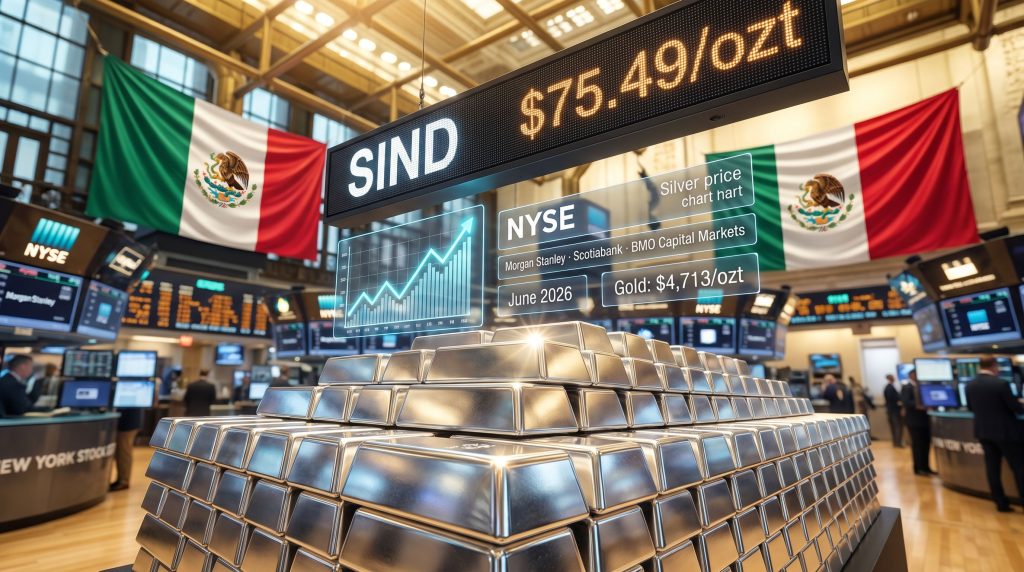
The confluence of forces driving this moment is unusually well-aligned. Silver futures reached $75.495 per troy ounce at the time of filing, reflecting a gain of 7.47% on the day alone, while micro silver futures moved in lockstep at $75.48 per ounce with a 7.54% advance. Gold futures simultaneously rose to $4,713.3 per ounce, up 3.84%, reinforcing a broader precious metals momentum that has proved durable enough to attract fresh institutional capital into the sector.
Against this backdrop, a Mexican silver mining company filing for a New York Stock Exchange listing under the ticker symbol SIND is not a coincidence of timing but rather a calculated entry into a market window that may not remain open indefinitely.
When big ASX news breaks, our subscribers know first
Why Are Silver Mining Companies Targeting US Public Markets in 2026?
The Structural Shift in IPO Sentiment Driving Mining Listings
The US IPO market has experienced a pronounced recovery in 2026, with renewed appetite for fresh listings spanning technology, healthcare, consumer goods, and increasingly, resource extraction companies. Mining firms, which have historically been late arrivals to IPO waves due to the longer lead times required to prepare reserve estimates, environmental disclosures, and operational documentation, are now actively participating in this resurgence.
What makes the 2026 environment particularly receptive to resource sector listings is the combination of elevated commodity prices and a shift in institutional portfolio strategy. After several years in which growth equities dominated capital allocation, many large fund managers have rotated toward inflation-linked assets, real assets, and commodity exposure as a hedge against persistent price pressures. This structural rotation has expanded the investor universe willing to evaluate a primary silver producer at IPO.
The commodity price context is critical to understanding why this window exists. At $75.49 per troy ounce, silver is trading at levels that substantially improve the economic profile of virtually every producing mine in Mexico. For companies with well-established cost curves, the margin expansion at current prices is significant and provides a compelling investment thesis that requires relatively little persuasion with institutional buyers already predisposed toward commodity exposure.
Furthermore, precious metals market analysis continues to underscore how supply and demand dynamics are reinforcing the case for silver-focused listings at precisely this juncture.
How Precious Metals Producers Are Responding to Capital Market Windows
The clustering of resource sector IPO filings in a single week is not accidental. Investment banks tracking commodity price momentum and investor flow data actively advise mining clients on optimal timing, creating periods where multiple companies converge on the same window simultaneously. The following companies demonstrate this dynamic clearly:
| Company | Exchange | Timing | Commodity Focus |
|---|---|---|---|
| Sinda | NYSE (Ticker: SIND) | June 2026 | Silver (Mexico) |
| CopperTech Metals | New York | June 2026 | Copper |
| Sunshine Silver Mining | NYSE | June 2026 | Silver |
Sunshine Silver Mining's completed offering, which raised $270 million on the NYSE just days before Sinda's filing, serves as a particularly meaningful data point. A successful comparable transaction in the same commodity, on the same exchange, in the same week provides underwriters and investors with immediate pricing context and reduces execution risk. This sequencing is rarely coincidental.
"The parallel between the current 2026 environment and the 2010–2012 silver boom is instructive. During that earlier cycle, when silver briefly surpassed $49 per ounce before correcting sharply, a wave of silver-focused listings followed on major exchanges globally. The lesson learned from that period is that timing the IPO to the sustained middle of a price cycle, rather than at its speculative peak, tends to produce better long-term outcomes for both issuers and investors."
What Is Sinda and What Does Its NYSE Filing Reveal?
Company Profile: Mexico's Silver Sector and Sinda's Operational Context
Mexico has held a dominant position in global silver production for centuries, a geological reality rooted in the country's position along the Trans-Mexican Volcanic Belt and the Sierra Madre Occidental range. Both host extensive epithermal and polymetallic vein systems that are among the world's most productive silver-bearing geological environments. Mexico consistently ranks as the world's largest silver-producing nation by volume, accounting for roughly 23% of global mine supply in recent years according to the Silver Institute's World Silver Survey data.
This geological endowment gives Mexican silver miners an inherent advantage in resource quality and extraction economics. The country's primary silver-producing states — including Sonora, Chihuahua, Zacatecas, Durango, and Oaxaca — host deposits ranging from high-grade narrow veins historically worked by artisanal miners to large low-grade bulk tonnage operations capable of supporting significant industrial scale.
For a Mexican silver company pursuing a US listing, the decision to target the NYSE rather than the Toronto Stock Exchange or Mexican Bolsa reflects a deliberate strategic calculus. The NYSE provides access to the world's deepest pool of institutional capital, commands premium valuation multiples for resource companies compared to regional exchanges, and delivers analyst coverage that can significantly enhance follow-on capital-raising ability.
Breaking Down the S-1 Filing: What We Know and What Remains Undisclosed
The information available from Sinda's initial filing establishes the structural framework of the offering while deliberately withholding commercial terms that will only be disclosed as the roadshow process advances:
- Filing date: June 2026 with US securities regulators
- Intended listing venue: New York Stock Exchange
- Proposed ticker symbol: SIND
- Offering terms disclosed: None at initial filing stage
- Share price range: Not yet disclosed
- Total capital raise target: Not yet disclosed
The absence of offering terms in an initial S-1 filing is entirely standard procedure and should not be interpreted as a negative signal. The SEC's registration process involves an initial filing that undergoes regulatory review, followed by amendments that progressively add detail including pricing ranges, lock-up periods, and allocation structures.
Featured Snippet: What exchange is the Sinda US IPO listing on? Sinda has filed to list its shares on the New York Stock Exchange under the proposed ticker symbol SIND. The company submitted its IPO registration in June 2026, with full offering terms — including share price range and total capital raise — expected to be disclosed in subsequent amendments to the initial filing.
The Underwriting Syndicate: Reading the Signal in the Bank Lineup
The selection of joint book-running managers is among the most informative signals available to investors evaluating an early-stage IPO filing. For the Sinda US IPO, three institutions have been appointed to lead the offering:
-
Morgan Stanley brings access to the deepest pools of US institutional capital, including major asset managers, sovereign wealth funds, and hedge funds with dedicated natural resources mandates. Its presence as a lead manager signals that the company is targeting top-tier institutional participation rather than retail-heavy distribution.
-
Scotiabank contributes specific relevance through its long-established Latin American mining finance practice. Scotia has been a consistent participant in Mexican and broader Latin American resource transactions for decades, with sector expertise and investor relationships directly applicable to a Mexican silver producer's story.
-
BMO Capital Markets rounds out the syndicate with Canadian mining capital markets depth. Canada remains the world's preeminent centre for mining finance, and BMO's extensive relationships with mining-focused institutional investors in Toronto, London, and New York provide access to sophisticated sector-specific capital that understands reserve methodology, jurisdictional risk, and commodity price sensitivity.
This combination targets three distinct investor constituencies simultaneously: US generalist institutions through Morgan Stanley, Latin American and resource-specialist accounts through Scotiabank, and mining-dedicated capital through BMO. The breadth of this syndicate is a deliberate strategy to maximise order book depth and reduce pricing risk.
How Does the 2026 Mining IPO Wave Compare to Historical Listing Cycles?
Cyclical Patterns in Resource Sector Public Listings
The relationship between commodity prices and mining IPO activity follows a well-documented cyclical pattern. When metal prices rise above the long-run incentive price required to justify new mine development, capital flows toward the sector, exploration activity increases, and companies at various stages of development seek public market access to fund their next phase of growth.
What distinguishes the current cycle from previous ones is the addition of industrial demand drivers that did not exist at the same scale during earlier silver booms. Silver's role in photovoltaic solar panel manufacturing has grown substantially, with the solar industry now consuming an estimated 14–15% of global silver supply annually. Each gigawatt of solar capacity installed requires approximately 20 tonnes of silver, creating a demand floor increasingly decoupled from the monetary and jewellery demand that historically dominated silver's consumption profile.
Furthermore, silver supply deficits have been widening in recent years, adding further structural support to the investment thesis that mining companies are now actively presenting to institutional investors.
What Drives Investor Enthusiasm for Fresh Mining Listings?
Several converging forces explain why investors are receptive to new silver mining listings in the current environment:
-
Industrial demand growth from solar, electronics, and electric vehicle components creates a structural demand narrative that complements the traditional store-of-value argument for silver.
-
Pure-play exposure through dedicated silver miners offers investors precise commodity positioning that diversified major miners cannot provide, appealing to portfolio managers who want silver exposure without dilution from other commodities.
-
Supply constraints resulting from years of underinvestment during the 2014–2019 low-price period have created tightness in the market that is increasingly visible in inventory drawdowns at major warehouses.
-
The gold-to-silver ratio, which measures how many ounces of silver are required to purchase one ounce of gold, remains elevated relative to historical averages despite silver's recent price appreciation. With gold futures at $4,713.3 per ounce and silver at $75.49, the ratio stands above 62, compared to the historical 20-year average of approximately 68, suggesting silver may still offer catch-up potential.
However, investors considering the Sinda US IPO should weigh these drivers against meaningful risk factors, including commodity price sensitivity, Mexico-specific operational considerations, and the inherent uncertainties of evaluating a company before full commercial disclosure is available.
What Are the Key Risk Factors Investors Should Evaluate in the Sinda IPO?
Jurisdiction and Regulatory Considerations for Mexican Mining Operations
Mexico's mining regulatory framework has undergone meaningful changes in recent years, including amendments to the Mining Law that affected concession renewal processes and introduced new community consultation requirements for projects operating in areas with significant indigenous populations. These changes have extended permitting timelines for some projects and introduced new categories of social risk that companies must manage proactively.
When comparing Latin American silver jurisdictions, investors typically construct a risk matrix that considers political stability, royalty and tax structures, environmental permitting predictability, and community relations complexity:
| Jurisdiction | Political Risk | Royalty Framework | Permitting Predictability | Community Complexity |
|---|---|---|---|---|
| Mexico | Moderate | Special Mining Duty applies | Moderate, improving | High in some regions |
| Peru | Elevated | Multiple royalty tiers | Variable | Very High |
| Chile | Low-Moderate | Stable, established | High | Moderate |
| Bolivia | High | State-heavy, unpredictable | Low | High |
Mexico's position in this comparison is nuanced. While it carries more regulatory complexity than Chile, it benefits from far greater infrastructure development, proximity to US markets, and a deep pool of experienced mining professionals and contractors that makes operational execution more reliable than in some competing jurisdictions.
Commodity Price Sensitivity: Silver's Dual Role as Industrial and Monetary Metal
Silver occupies a unique position among commodities in that it simultaneously functions as an industrial input and a monetary asset. This dual character means its price is driven by two largely independent demand sets that can move in different directions simultaneously, creating both upside potential and downside risk structurally different from either a purely industrial metal like copper or a purely monetary asset like gold.
The macroeconomic environment at the time of Sinda's filing illustrates this dual sensitivity precisely. On the same day that silver futures reached $75.49 per ounce with a 7.47% gain, gold spot prices declined approximately 3% to $4,330 per ounce as rising interest rate expectations created headwinds for monetary metals. This divergence demonstrates that silver can exhibit more complex price behaviour than simpler commodity narratives suggest.
Investors evaluating the Sinda US IPO must recognise that a 10% decline in silver prices from current levels would materially compress operating margins, even at a company with well-positioned cost structures. Commodity price forecasts remain inherently speculative, and any investment thesis built on sustained elevated silver prices carries meaningful downside risk if macro conditions shift toward rate-driven dollar strength.
Offering Structure Unknowns: What Undisclosed Terms Mean for Retail Investors
The standard IPO timeline between initial S-1 filing and final pricing typically spans four to eight weeks for mining companies, though this can vary based on regulatory review pace and market conditions. During this period, the underwriting team conducts a roadshow, presenting the company's investment thesis to institutional investors and building an order book that ultimately informs final pricing.
Retail investors face a structural disadvantage during this phase because institutional accounts receive priority allocation and access to management presentations that are not publicly available. This asymmetry is inherent to the IPO process and is particularly pronounced in mining offerings where technical data interpretation requires specialised expertise. Tracking IPO calendar updates can help retail investors stay informed as key disclosure milestones approach.
How Does Sinda's IPO Fit Within the Broader Mexican Silver Mining Landscape?
Mexico's Silver Sector: A Structural Overview
Mexico's position as the world's leading silver producer is supported by geology that is genuinely exceptional by global standards. The country's silver endowment is concentrated in three primary geological environments: the epithermal silver-gold systems of the Sierra Madre Occidental, the polymetallic carbonate replacement deposits of central Mexico, and the skarn systems associated with intrusive contacts throughout the northern mining states.
Epithermal deposits, which are formed by hydrothermal fluids circulating near the surface in volcanic environments, typically host high-grade silver in narrow but continuous vein structures. Grades can range from 200 grams per tonne silver equivalent at the lower end to several thousand grams per tonne in bonanza-style ore shoots. The high grades possible in these systems can make them economically viable even with relatively small throughput.
Peer Activity in the Mexican Mining Sector
The announcement, made on the same day as Sinda's filing, that Minera Frisco would restart two mines and plan a new silver unit provides meaningful context for understanding sector-wide sentiment. When an established operator with deep Mexican experience makes operational restart and expansion decisions simultaneously with a new entrant filing for public market access, it reinforces the view that current silver prices are sufficient to justify meaningful capital deployment across the sector.
This synchronised activity — spanning both capital markets transactions and operational decisions — suggests that the current price environment has crossed a threshold of durability that was absent during earlier, more volatile periods.
The next major ASX story will hit our subscribers first
What Does the Sinda IPO Mean for Silver Sector Investors?
Strategic Implications for Portfolio Positioning in Precious Metals
The Sinda US IPO, if successfully completed, expands the investable universe of NYSE-listed silver equities, providing portfolio managers with an additional instrument for expressing silver price views through equity exposure. This matters because the universe of pure-play primary silver producers listed on major US exchanges has historically been limited, with many silver miners either listed in Canada or classified as diversified metals companies.
A new primary silver listing provides index providers with an additional candidate for sector-specific benchmarks, potentially creating systematic buying demand as the company achieves sufficient market capitalisation and liquidity thresholds for index inclusion. In addition, investors seeking broader context around gold investment options will find that understanding silver equity listings complements a well-rounded precious metals allocation strategy.
Step-by-Step Framework for Evaluating a Mining IPO Like Sinda
Investors considering participation in the Sinda US IPO should approach the evaluation systematically:
-
Review the S-1 Filing in Detail — Examine disclosed reserve estimates, resource classifications, production history if available, management backgrounds, and any disclosed cost structure information. Pay particular attention to the distinction between proven and probable reserves versus inferred or indicated resources.
-
Assess Underwriter Credibility and Track Record — Research the recent mining IPO performance of Morgan Stanley, Scotiabank, and BMO Capital Markets, examining how comparable transactions they managed have performed in the 12 months following listing.
-
Analyse the Commodity Price Context Rigorously — Avoid assuming current silver prices at $75.49 per ounce represent a permanent new baseline. Model the investment thesis at silver prices of $60, $50, and $40 per ounce to understand the downside scenario and whether the company's disclosed cost structure remains viable through a commodity cycle trough.
-
Evaluate Mexican Jurisdictional Risk Specifically — Research recent developments in Mexico's mining regulatory environment, including any legislative proposals affecting concession rights, environmental standards, or community consultation requirements.
-
Compare Against Listed Peers — Benchmark Sinda's disclosed operational metrics against established silver producers already trading on major exchanges, examining price-to-net-asset-value multiples, enterprise value per ounce of silver equivalent production, and cash cost comparisons.
-
Monitor the Final Prospectus Before Committing Capital — The initial filing provides structural information but lacks the pricing data necessary for valuation assessment. Wait for the final prospectus before making any allocation decision.
Frequently Asked Questions: Sinda US IPO
What is Sinda?
Sinda is a Mexican silver mining company that filed to list its shares on the New York Stock Exchange in June 2026. The company filed its registration with US securities regulators and intends to trade under the proposed ticker symbol SIND.
Who are the underwriters for Sinda's IPO?
The joint book-running managers for the Sinda US IPO are Morgan Stanley, Scotiabank, and BMO Capital Markets. This syndicate covers US institutional capital markets, Latin American mining finance, and Canadian mining sector networks respectively.
What is the IPO price for Sinda?
As of the initial filing, Sinda has not disclosed offering terms including share price range or total capital raise. These details are expected in subsequent amendments to the registration statement and in the final prospectus filed prior to pricing.
Why is Sinda listing in the US rather than Mexico or Canada?
While Sinda's initial filing did not specify the strategic rationale for choosing the NYSE over regional alternatives, the NYSE provides access to a substantially larger institutional investor base than either the Mexican Bolsa or the Toronto Stock Exchange, and tends to support premium valuation multiples for well-positioned resource companies.
Is Sinda the only silver miner going public in 2026?
No. Sunshine Silver Mining completed a $270 million NYSE listing in the same week as Sinda's filing, and CopperTech Metals filed for a New York listing on the same Tuesday, reflecting a broader wave of resource sector IPO activity in 2026.
What are the primary risks of investing in the Sinda US IPO?
Key considerations include silver commodity price volatility, Mexico-specific regulatory and operational risk, currency exposure between the Mexican peso and US dollar, the limited financial disclosure available at the pre-pricing stage, and the inherent uncertainty of evaluating a company before full commercial terms are disclosed.
Positioning the Sinda US IPO Within the 2026 Resource Capital Markets Cycle
Summary of Key Analytical Takeaways
The Sinda US IPO filing represents the intersection of several independently powerful forces: a silver price environment at historically elevated levels, renewed institutional appetite for commodity exposure after years of growth equity dominance, a proven investment bank syndicate with complementary sector expertise, and a peer group of concurrent successful transactions that validate the sector narrative. These elements do not guarantee a successful offering, but they establish a foundation of favourable conditions stronger than most mining IPOs have enjoyed in the past decade.
The underwriting team's composition — spanning Morgan Stanley's US institutional reach, Scotiabank's Latin American mining expertise, and BMO's Canadian mining capital markets depth — reflects a sophisticated targeting of multiple investor constituencies simultaneously.
Forward-Looking Considerations
Several signposts are worth monitoring as the Sinda US IPO progresses from initial filing toward pricing:
-
The performance trajectory of Sunshine Silver Mining's NYSE listing in the weeks following its own IPO will provide near-term comparable data that the market will use to calibrate Sinda's valuation.
-
Silver price movements between now and Sinda's pricing date will materially influence investor appetite. A sustained move above $75 per ounce would strengthen the investment case, while a retreat toward $60 would require careful reassessment of the valuation framework.
-
Amendment filings to the initial S-1, which will progressively disclose more operational and financial detail, should be monitored closely as they will provide the information necessary for more precise valuation analysis.
-
Broader precious metals sentiment, including gold's response to interest rate expectations, will influence the macro environment within which institutional investors evaluate the Sinda story.
This article is intended for informational purposes only and does not constitute financial, investment, or legal advice. The Sinda US IPO involves material risks including commodity price volatility, jurisdictional factors, and the inherent uncertainties of evaluating a company prior to full commercial disclosure. Prospective investors should conduct independent due diligence and consult qualified financial advisors before making any investment decision. All commodity prices referenced reflect market data from the time of Sinda's initial filing in June 2026 and are subject to change.
Want To Be First When the Next Major Silver Discovery Hits the ASX?
Discovery Alert's proprietary Discovery IQ model delivers real-time alerts the moment significant mineral discoveries — including silver and precious metals — are announced on the ASX, transforming complex data across 30-plus commodities into a clear, actionable gold-equivalent metric so investors can move ahead of the broader market. Explore why historic mineral discoveries have generated extraordinary returns and start your 14-day free trial today to position yourself at the forefront of the next major find.