August 24, 2026
The convergence of renewable energy systems with advanced desalination processes has created unprecedented opportunities for sustainable freshwater production. A solar-powered desalination plant represents a technological synthesis where renewable energy generation directly powers water purification processes, eliminating dependency on fossil fuel electricity sources. This integration addresses two critical resource challenges simultaneously: energy security and freshwater availability. According to the United Nations World Water Development Report 2023, approximately 2 billion people currently experience high water stress, with projections indicating this figure could reach 3.9 billion people by 2050.
Understanding Solar Desalination Technology Fundamentals
Solar-powered desalination represents a technological synthesis where renewable energy generation directly powers water purification processes. Furthermore, these energy transition insights demonstrate how renewable integration transforms traditional industrial operations. This integration addresses two critical resource challenges simultaneously: energy security and freshwater availability.
The global desalination capacity has expanded to approximately 109 million cubic meters per day as of 2022. However, solar desalination remains a growing minority segment within this broader infrastructure. The solar desalination market achieved a valuation of approximately USD 1.2 billion in 2023, with projected growth at a compound annual growth rate of 7.8% through 2030.
Core Technology Distinctions
Solar-powered desalination plant systems operate through two fundamental pathways that distinguish them from conventional grid-powered installations:
• Photovoltaic conversion systems transform solar radiation into electricity that powers reverse osmosis membranes
• Direct thermal applications utilise solar heat for distillation processes including multi-stage flash systems
• Hybrid configurations combine both electrical and thermal energy capture for optimised efficiency
In addition, the operational independence of solar systems provides critical advantages over grid-dependent infrastructure. This decentralised approach creates climate-resilient water treatment capabilities that function independently of centralised power generation.
Environmental and Economic Impact Metrics
Solar desalination technology delivers measurable environmental benefits compared to conventional alternatives. For instance, research demonstrates 1,400% emission reduction potential when compared to fossil fuel-powered reverse osmosis systems. These innovations align with broader decarbonisation benefits being realised across industrial sectors.
| Environmental Metric | Solar Desalination | Conventional RO |
|---|---|---|
| Carbon Emissions | Near-zero operational | 3.5-5.2 kg CO2/m³ |
| Energy Source | Renewable solar | Grid electricity/fossil |
| Water Recovery Rate | 35-45% | 30-40% |
When big ASX news breaks, our subscribers know first
Photovoltaic-Powered Reverse Osmosis Technology
The integration of photovoltaic arrays with reverse osmosis systems represents the most commercially viable solar desalination technology currently available. Modern monocrystalline solar panels achieve 19-22% electrical conversion efficiency under standard test conditions. Consequently, they provide sufficient power generation capacity for sustained water treatment operations.
Solar Energy Conversion Mechanics
Photovoltaic generation functions through semiconductor photon absorption, creating charge separation across PN junctions within silicon crystalline structures. This fundamental process converts solar radiation into direct current electricity with predictable efficiency characteristics. These solar-powered desalination systems enable system sizing calculations with remarkable precision.
Maximum power point tracking controllers optimise real-time power extraction across varying irradiance conditions. These typically improve overall system efficiency by 20-30% compared to fixed voltage operation. These advanced control systems automatically adjust electrical load characteristics to match solar panel output optimisation curves.
Reverse Osmosis Membrane Technology
Commercial reverse osmosis membranes achieve 95-99% salt rejection rates for seawater applications. Furthermore, they produce freshwater with total dissolved solids typically under 500 mg/L. The membrane separation process requires sustained pressure between 60-80 bar (8,700-11,600 psi).
Membrane technology operates through pressure-driven separation where applied hydraulic pressure exceeds osmotic pressure. This thermodynamic principle enables consistent water quality regardless of feedwater salinity variations.
System Sizing and Configuration
A typical 1,000 L/day household PV-RO system requires approximately 2-3 kW peak solar capacity. This equates to 8-12 square metres of panel area in locations receiving average daily irradiance of 5 kWh/m²/day. These calculations provide baseline parameters for residential and small community applications.
Energy recovery devices integrated within RO systems capture pressure energy from concentrated brine discharge. However, these reduce net system energy consumption by 10-25% depending on salinity levels and recovery device efficiency.
Solar Thermal Desalination Methods
Solar thermal technologies harness incident solar radiation for direct heating applications in water treatment processes. These achieve different efficiency characteristics compared to photovoltaic systems. Flat-plate solar collectors demonstrate 60-80% net efficiency in converting solar radiation to usable heat for distillation applications.
Multi-Stage Flash Distillation Integration
Multi-stage flash distillation systems achieve 8-15% overall thermal efficiency, requiring approximately 70-80 kWh of thermal energy per cubic metre of freshwater produced. These systems employ cascading pressure and temperature reduction across sequential evaporator stages. This enables thermal energy recovery through vapour condensation processes.
Solar thermal storage systems extend operational capacity beyond daily solar generation periods. For instance, they utilise sensible heat storage in insulated water tanks or latent heat storage using phase-change materials. These storage technologies provide 12-18 hours of thermal energy availability.
Passive Solar Still Technology
Passive solar still systems represent the simplest solar desalination technology. They produce approximately 2-6 litres per square metre of evaporative surface daily under Mediterranean solar conditions. These systems operate through basic thermodynamic principles where solar radiation heats saline water on darkened surfaces.
Solar stills require minimal maintenance and demonstrate exceptional durability in harsh environmental conditions. Consequently, they are suitable for emergency applications and extremely remote locations where technical support availability remains limited.
Concentrated Solar Power Integration
Concentrated solar power systems achieve operating temperatures of 300-400°C through parabolic trough or tower configurations. This enables efficient thermal distillation and simultaneous electricity generation. This dual-output capability optimises land use efficiency while providing operational flexibility across varying water demand patterns.
Hybrid System Configurations and Grid Integration
Hybrid solar desalination systems combine multiple energy sources to optimise operational reliability and economic performance. These configurations typically integrate photovoltaic generation with thermal collection, battery storage, or grid backup systems. Furthermore, these advanced configurations reflect broader industry innovation trends transforming traditional infrastructure approaches.
Battery Storage Integration
A 1,000 m³/day PV-RO system operating with 24-hour capacity in regions with 4 peak sun hours requires approximately 600-800 kWh battery storage capacity. This storage requirement represents 35-45% of total system capital cost. However, it significantly influences project economics and financing structures.
Lithium-ion battery technology provides optimal energy density and cycle life characteristics for solar desalination applications. Nevertheless, alternative technologies including vanadium redox flow batteries demonstrate superior longevity for large-scale installations.
Grid-Tie Hybrid Economics
Grid-connected hybrid systems with net metering capability reduce desalination operating costs by 20-40% through electricity arbitrage strategies. These systems sell excess solar generation during peak rate periods. In addition, they purchase grid electricity during low-cost periods, optimising overall energy costs.
| System Configuration | Capital Cost Premium | Operating Cost Reduction |
|---|---|---|
| Battery Backup | 35-45% higher | 10-15% lower |
| Grid-Tie Hybrid | 15-25% higher | 20-40% lower |
| Pure Solar | Baseline | Variable |
Performance Efficiency and Innovation Breakthroughs
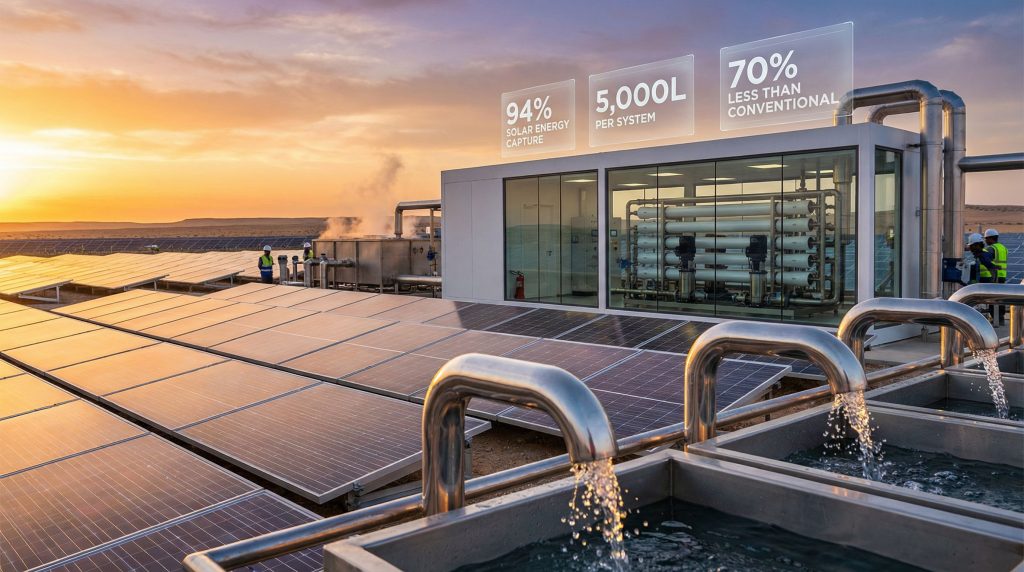
Recent technological advances demonstrate substantial improvements in solar desalination efficiency metrics. Research installations have achieved 94% solar energy utilisation rates through advanced system integration and control optimisation. This represents significant progress beyond earlier generation technologies.
Advanced Control Systems
Dynamic sunlight tracking systems automatically adjust solar collector orientation throughout daily solar cycles. These improve energy capture by 25-35% compared to fixed-orientation installations. These tracking mechanisms utilise GPS positioning and solar angle calculation algorithms to maintain optimal collector angles.
Furthermore, AI optimization systems monitor multiple operational parameters including solar irradiance, water demand, membrane performance, and storage capacity. These control systems adapt operational parameters in real-time to changing environmental conditions.
Membrane Technology Improvements
Advanced membrane materials demonstrate extended operational lifespans from typical 5-7 years to 7-10 years through improved polymer chemistry and surface modification techniques. These improvements reduce replacement costs whilst maintaining consistent rejection performance across extended service periods.
Feedwater pretreatment systems remove particles larger than 5 microns through multimedia filtration. This prevents membrane fouling and extends operational life. Proper pretreatment represents critical infrastructure that determines overall system reliability and maintenance requirements.
Cost Analysis and Economic Considerations
Solar-powered desalination plant economics vary significantly based on system scale, location, and configuration choices. Capital investment requirements encompass equipment costs, installation expenses, land acquisition, and regulatory compliance. However, there are substantial variations across different markets and applications.
Capital Investment Breakdown
Equipment costs typically represent 60-70% of total capital investment. This includes solar panels, desalination units, storage systems, and power conditioning equipment. Installation and commissioning expenses account for an additional 15-25% of total project costs.
Land acquisition and site preparation requirements vary dramatically between applications. These range from minimal costs for rooftop installations to substantial expenses for utility-scale ground-mounted systems. Permitting and regulatory compliance costs typically represent 5-10% of total capital investment.
Operating Cost Structure
| Cost Category | Small-Scale ($/m³) | Medium-Scale ($/m³) | Large-Scale ($/m³) |
|---|---|---|---|
| Maintenance | 0.50-1.00 | 0.30-0.70 | 0.20-0.50 |
| Replacement Parts | 0.20-0.40 | 0.15-0.30 | 0.10-0.25 |
| Monitoring | 0.10-0.20 | 0.05-0.15 | 0.03-0.10 |
| Total Operating | 0.80-1.60 | 0.50-1.15 | 0.33-0.85 |
Low-Cost Innovation Examples
Gravity-driven family systems demonstrate production costs as low as $4 per unit for basic household applications. These utilise passive solar heating and gravity-fed distribution systems. These simplified designs eliminate complex pumping and control systems whilst maintaining acceptable water quality for domestic use.
Community-built solutions leverage local labour and materials to reduce installation costs by 30-50% compared to turnkey commercial systems. These approaches require technical training and ongoing support. However, they create local employment opportunities whilst reducing project capital requirements.
The next major ASX story will hit our subscribers first
System Selection and Implementation Guidelines
Successful solar-powered desalination plant implementation requires systematic site assessment, technology selection, and system sizing. These must be based on specific application requirements and local conditions. Critical evaluation criteria include solar resource availability, water quality characteristics, demand patterns, and infrastructure constraints.
Site Assessment Methodology
Solar irradiation measurements provide fundamental data for system sizing calculations. Minimum thresholds of 4 kWh/m²/day are generally required for economic viability. Seasonal variation analysis identifies storage requirements and backup system needs for continuous operation.
Water source quality assessment determines pretreatment requirements and membrane selection criteria. Total dissolved solids, turbidity, and biological contamination levels influence system design parameters. Salinity levels above 35,000 mg/L typically require specialised high-pressure membrane systems.
Technology Selection Matrix
| Application Type | Recommended Technology | Capacity Range | Key Advantages |
|---|---|---|---|
| Remote Communities | PV-RO with battery backup | 50-500 m³/day | Reliability, low maintenance |
| Agricultural Irrigation | Solar thermal with storage | 200-2,000 m³/day | Low cost per m³, seasonal flexibility |
| Industrial Applications | Hybrid CSP-PV systems | 1,000-10,000 m³/day | Continuous operation capability |
| Emergency Response | Portable PV units | 5-50 m³/day | Rapid deployment, durability |
Implementation Planning Framework
Peak demand calculations establish baseline capacity requirements. These account for seasonal variations, population growth projections, and industrial development plans. Storage capacity optimisation balances capital costs against operational reliability requirements.
Redundancy planning incorporates backup system capacity to maintain critical water supply during equipment maintenance or failure conditions. These considerations typically require 10-20% excess capacity beyond calculated peak demand requirements.
What Are Future Technology Trends and Market Projections?
Emerging technologies in solar desalination focus on efficiency improvements, cost reductions, and system integration advances. Artificial intelligence optimisation represents a significant development area. Machine learning algorithms are improving operational efficiency through predictive maintenance and demand forecasting.
Innovation Pipeline Developments
Next-generation membrane materials utilise advanced polymer chemistry and nanostructure engineering to achieve higher rejection rates. These require lower pressure requirements. These materials demonstrate potential for 20-30% energy reduction compared to current commercial membranes.
Modular plug-and-play designs enable rapid deployment and scalable expansion. These reduce installation time from months to weeks for standardised configurations. These approaches utilise factory pre-assembly and standardised interfaces to minimise field construction requirements.
Market Growth Projections
Global solar desalination capacity installations demonstrate accelerating growth rates. This is particularly evident in water-stressed regions including the Middle East, North Africa, and southwestern United States. Investment trend analysis indicates increasing private sector participation and declining technology costs.
Regional deployment priorities focus on island communities, remote mining operations, and agricultural irrigation applications. These represent areas where conventional water infrastructure remains economically unfeasible. These markets provide testing grounds for technology refinement and cost optimisation.
Implementation Success Factors
Successful solar-powered desalination plant projects require comprehensive planning that addresses technical, financial, and operational considerations. Decision-making frameworks should evaluate cost-benefit relationships, risk mitigation strategies, and long-term sustainability requirements. These projects embody the broader sustainability transformation occurring across industrial sectors.
Critical Success Elements
Technical feasibility studies must evaluate local solar resources, water quality characteristics, and infrastructure availability. This ensures realistic performance expectations. These assessments prevent costly design errors and operational difficulties.
Financial planning encompasses capital funding sources, operating cost projections, and revenue models where applicable. Grant funding, development bank financing, and private investment options provide various pathways. MIT's solar-powered desalination research demonstrates how innovative approaches reduce system complexity and costs.
Risk Assessment Framework
Operational risks include equipment failure, membrane fouling, and seasonal performance variations that affect water production capacity. Mitigation strategies incorporate redundant systems, preventive maintenance programmes, and performance monitoring technologies.
Financial risks encompass technology cost evolution, regulatory changes, and market competition from alternative water sources. Long-term contracts and technology warranties provide protection against some risk categories. However, they maintain operational flexibility.
Disclaimer: The projections, cost estimates, and performance data presented in this article reflect current technology capabilities and market conditions. Actual project results may vary based on specific site conditions, technology selection, and implementation quality. Readers should conduct detailed feasibility studies and consult qualified professionals before making investment decisions in solar desalination technology.
Want to Capitalise on the Resource Revolution?
Discovery Alert's proprietary Discovery IQ model delivers instant notifications on significant ASX mineral discoveries, empowering investors to identify actionable opportunities in critical minerals essential for solar and renewable energy infrastructure. Discover why major mineral discoveries can lead to substantial returns by exploring historic examples, then begin your 14-day free trial to position yourself ahead of the market.